Quality / Choice of Drinks: 10/10 Décor & Style: 10/10 Character, Atmosphere & Local Life: 10/10 Amenities & Events: 8/10 Value For Money: 7/10 OVERALL: 9.5/10
Image Gallery
Address:Rue Soeurs-de-Hasque 9, 4000 Liège, Belgium NearestStation: Liège-Carré , 10 mins walk Opening Hours: 11am-4am Monday-Saturday, 2pm-2am Sunday (Due to Coronavirus restrictions this may change, so check with the bar directly for any latest info)
History Le Pot au Lait is located on Soeurs de Hasque in the heart of Liege. Number 9 is a magnificent house from the 19th century built over an ancient convent which held, from the end of the 15th century, sisters from another convent from Hasselt, a Flemish city, being often called “Haske” in Liege, “The Sisters from Haske” gave their name to the street. Here is how the bar was founded:
“In 1973 a group of students created a place that until then had never existed in Liège where they could organise films, concerts, debates, theme days, free of any official politics. They found what they were looking for at No 9 Soeurs de Hasque Street and it opened as “Trou Perrette”.
In 1979, it became obvious that a second bar was needed next to the “Trou Perrette”. So we needed a name and after a brain storming session came up with “Pot au Lait” in reference to a fable from a french poet, Jean de La Fontaine (1621-1695) called “The Dairywoman and the Pot of milk”.
In 1981, the Trou Perrette closed its doors for the last time. But now you know why the Pot-au-Lait became the Pot-au-Lait“ The Pub
These days, Le Pot Au Lait continues its historic function, being the beating heart of nightlife and social affairs in the city. It would be untrue to say that this is a student venue either, more a youthful rite of passage that stays with you afterwards, one of those rare things, a pub you keep returning to over and over long after the early years.
Set off the main street, you will enter through a narrow courtyard, already spying the decorations festooned left and right. Some people will be hanging out on the terrace. The place gives off good vibes straight away.
Then, enter through to what at first appears to be a greenhouse, with uneven flooring. The ethos is akin to Hundertwasserhaus in Vienna, with a commitment to uneven surfaces, and heterodox approach. To call it distinctive is underselling it. Cartoon gorillas, carnival scenes, macabre taxidermy, graffiti, tall plants and more that would take too long to describe. Le Pot Au Lait is the funfair that got lost one day and decided to lay down roots.
Like some of the best bars in Europe: Szimpla Kert, ‘t Brugse Beertje, Zlatna Ribica, to name but a few, the place has an immediate draw that comes from sensing that everyone is having a great time, the excitement of being in the place to be.
It’s pretty cool too that Le Pot Au Lait is located somewhere like Liége. No, not somewhere fashionable for the nightlife like Brussels or Hamberg or Copenhagen, but this down-at-heel working class city in Wallonia.
Anyway, it’s time for a drink, don’t you think? You’re very well served here with several tap options and a suite of bottles covering a reasonably broad range of Belgium’s better beers. Perhaps they could serve a few more specialist options for the sniffier customers, but there is something here for most beer drinkers. Being popular with a younger crowd, there is also a reasonable selection of alternatives. You’d think this might be one of the more expensive venues too, but some choices appear genuinely cheap, and will certainly come across that way after a few days in the much more expensive end of Belgium.
Once served, plonk yourself among the communal niches surrounding the bar, the atrium (good for people watching), the mezzanine level or any little hidey-hole that suits your needs. Go for a wander around, because this is an art gallery as well as a bar.
Le Pot Au Lait has maintained a commitment to culture and the arts, so while we’d be perfectly happy if they just served drinks, it deserves extra commendation for hosting live events and being a communal meeting spot. Long opening hours mean this is a versatile venue that suits a quiet afternoon hangout or raucous late night drinks, each enjoyable in their own right.
We give bars a 10/10 rating when they are reasons in and of themselves to visit a place, and Le Pot Au Lait certainly justifies that.
Quality / Choice of Drinks: 10/10 Décor & Style: 9/10 Character, Atmosphere & Local Life: 10/10 Amenities & Events: 8/10 Value For Money: 7/10 OVERALL: 9.1/10
Image Gallery
Address:85-87 Gwydir St, Cambridge, CB1 2LG NearestStation: Cambridge, 10 mins walk Opening Hours: Sun-Thurs Midday-10pm, Fri-Sat – Midday-11pm (Due to Coronavirus restrictions this may change, so check with the bar directly for any latest info)
History
The Cambridge Blue, began life as the Dewdrop Inn, and remained with the name for over a century. All things come to an end, however, so when ownership changed to an ex-rower (always likely to be a big deal around Cambridge) in the 1980s, the pub name changed to those of the University and city colours. The new pub sign was a rather macabre mix of Welsh Dragon and American Eagle, reflecting the nationalities over the Landlords until their departure in 2007. There is more information on its history here, underlining that this pub is a backstreet, locals’ venue, despite close proximity to the train station.
New owners did not dispense with the rebranded pub name, but you will notice on arrival The Cambridge Blue’s signage now has a bold crimson/reddish brown background, creating a typically English contradiction. The little firkin barrel hanging underneath is a reasonably distinctive touch top. The pub boasts out front about being a ‘Real Ale Paradise‘, which immediately put me in mind of ‘Landbierparadies‘, a Nuremberg business dedicated to preserving and exhibiting Franconian beer (which, if you’re interested will make you completely rethink lager as a drink).
The Pub
On entry you will find a large bar, and it must be so in order to house The Cambridge Blue’s strongest suit, a vast offering of real ales, craft cask + keg, real cider + perry, dozens of whiskies, and tall fridges stocked full of Belgian beers, hundreds to choose from as it happens. The pub has won so many awards over the years for this offering that it would be frankly boring to reel them all off, but it leaves a firm impression. Pricing is along the lines of what you can expect in the city, so it is unlikely you will feel ripped off by many choices.
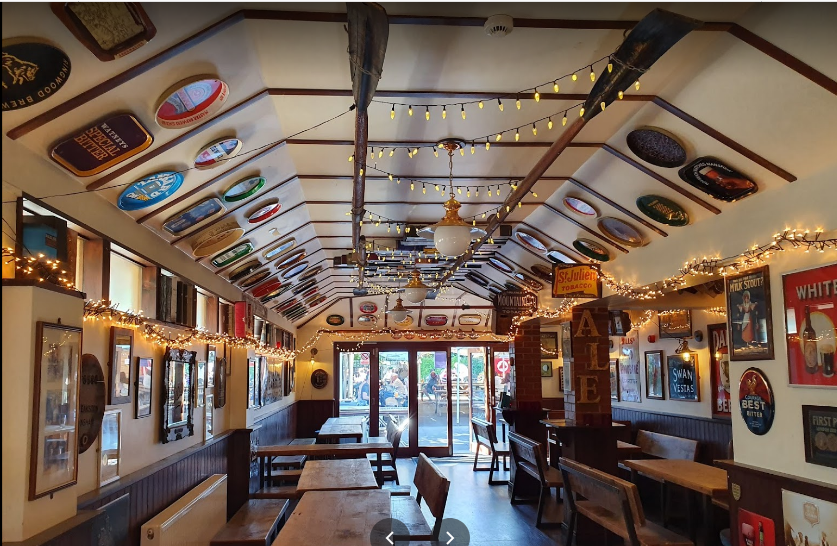
A wooden floor, chunky tables along with some recovered branding and signage from long gone businesses (including some which used to supply the pub with beer) helps bring the dominating bar area down to earth, lending a genteel element that contributes to that vital old nugget: genius locii.
Although there are normally (outside of Covid) a spread of tables around the bar area, including a nice snug set of a few tables around the corner, the main pub room is up to the left of the bar. With its slanted ceilings, fairy lights and yet more recovered pub ephemera, it’s like an oversized tube train carriage that’s crashed into a barn owned by a pub obsessive. In a good way.
Carrying on through, you will find that The Cambridge Blue boasts a large back garden, one that wouldn’t be immediately guessable while stood by the terraces facing directly onto the street front. The extra capacity is vital (even before distancing) given it’s such a popular venue and it backs on to the city cemetery. Without this a pretty small pub would remain.
Food is available, and although that isn’t really our area of interest, suffice to say, they cover a number of bases and dietary requirements.
Spending an evening in the main room as the natural light disappears, the glowing yellow of the lamps and dots of the fairylights takes over, or perhaps holding forth in the beer garden on a summer’s eve as the dusk sets in, you realise you are within – and part of – a quite special place. Other writers (who are very well travelled across the UK) have The Cambridge Blue as one of their Top 10 Pubs in the UK. When you pick the right moment and company here, it is tough to claim otherwise.
The concept of the Free House, (free that is, of the infamous brewery tie), a place free to stock its own choice of products to sell to the public is obviously one that attracts brave, bordering on foolhardy owners to make work. These are usually people with a vision. This far more often leads to better choice, a more distinctive venue and – in this case – the rewards of their labour: the custom of a great mix of locals and those from elsewhere who know that The Cambridge Blue is only a short walk away from the train station.
The pub at its best is all about a space to socialise, space where you know you can have a chat, play games, speak to different kinds of people, make friends, or sit in a cozy corner and ruminate. The Cambridge Blue offers that, so it would be valuable even without the compendium of Belgian beers. The fact it does go the extra mile is simply the cherry (or should that be Kriek?) on top. That is why we are delighted to add it on our guide.
Quality / Choice of Drinks: 9/10 Décor & Style: 10/10 Character, Atmosphere & Local Life: 10/10 Amenities & Events: 9/10 Value For Money: 7/10 OVERALL: 9.2/10
Image Gallery
Videos
Address:Yorckstraße 15, 10965 Berlin, Germany NearestU-Bahn stop: Mehringdamm Opening Hours: 6pm-11pm Sun-Tues, 6pm-Midnight Wed-Thu, 6pm-1am Fri-Sat (Due to Coronavirus restrictions this may change, so check with the bar directly for any latest info)
Yorckschlösschen, a name not easily tripping off an English tongue, references a district named after the van Wartenburgs, with ‘Schlösschen’ referring to a castle. However grandiose its name, disregard images of aristocrats and palaces from your mind. Here is situated a pub, and a quite brilliant one at that.
At the entrance you will be met by a huge curved sign above the door in the style of a theatre or ballroom, advertising Jazz and Blues performances. It is a flamboyant welcome that demands attention from any passer by. This is clever use of the corner of the building which juts back beyond 90 degrees in a wedge. For whatever reason, there a lot of good pubs in wedge shaped buildings.
Upon entering you will notice how this determines the layout. To your right, a small stage with a piano, to your left, a chunky table in front of some thick red curtains. This is the prized seat in the house if you are hear to enjoy a performance.
One can’t help notice the large chandelier which adds to its decadent, slightly sleazy bohemian feel. For Yorckschlösschen, above anything else, seeks to transport you to the peak of Berlin’s Jazz scene a hundred years earlier. While regular performances only begun around 30 years ago, you can quite easily believe they had been going on longer. Part of this is that the building has served as a pub under the very same name for 120 years, so there is an authentic and tangible history, which lays the platform for the more recent musical addition. To be fair, 30 years is reasonably good going, all by itself. Every Wednesday, Friday + Saturday from 9pm performances begin, with Thursday added during the winter months.
Moving forward now in the aim of getting a drink, you’ll notice its bar area is slightly occluded by a pillar and the comings and goings of the staff, but offers plenty to look at, indeed, as you swirl around you will be engulfed by historic posters, ephemera, styling and decorations that have come in and out of fashion more often than most of us have had hot dinners. As the band play, the waiter takes your order and you are ensconced at the heart of the pub, you cannot help but declare, silently or otherwise: This is it, this is where I want to be.
But what about the food and drink?!
For those souls who are more focused on Product, I am pleased to report good things about the local Kreuzberger Tag und Nacht beers available on tap alongside a reasonable stock of more common German offerings and a fairly comprehensive array of spirits, mixers and cocktails to choose from. Additionally, you’ll find reliable pub grub served from a small kitchen. Service is pretty efficient and friendly if you are being waited on, though there are a few spiciers characters around if you go nearer the bar.
The backroom is more of a hangout and socialising spot in the pub, where raised voices won’t upset those enjoying the music. This part itself we found cosy, distinctive and worth exploring. You could turn the place into your local very easily, play cards, board games, read a book – as long as you lived somewhere near it. Nowhere in the pub feels unloved, or cavernous. It’s all compact and cosy.
The final, and not insignificant string to its bow is a beer garden which regardless of the situation near a busy road feels nicely calm, verdant and – to a degree – private. It doesn’t feel like you’ve been stuck out far from the pub, you still feel part of its anatomy, which for me is crucial, as so many beer gardens are so anonymous that there is no special reason to comment on them.
This all builds a picture of a fabulous all-rounder, with no obvious weaknesses to report. Sure, everyone could think of one or two tweaks here and there which would add to the quality of the place even further, but on a 1st, 2nd, 3rd, 4th, etc, visit, such considerations will be far from your mind.
We travel far and wide in the hope of discovering pubs and bars like this one that don’t just settle for mediocrity but want to be a piece of living art, a cosy home for locals, an interesting place for visitors and a dazzling contribution to pub culture. Visit as soon as you can.
In Timișoara, a venue has appeared in the last 5 years which is entirely unlike anything you would expect to find in the West.
Strada Arhitect Laszlo Szekely 1 Timișoara Romania
Our Ratings:
Choice & Quality of Drinks: 7/10 Style & Décor: 10/10 Character, Atmosphere & Local Life: 9/10 Amenities & Events: 9/10 Value for Money: 8/10
Overall: 9.2/10
In Timișoara, a venue has appeared in the last 5 years which is entirely unlike anything you would expect to find in the West.
While Western Romania is hardly a hotbed of distinctive individual bars setting Europe alight, in a strange way, the cheaper rents, creative freedom and lack of corporate control make it much more likely that such a place may come into existence versus an expensive, tightly corporate trend-following city centre (eg. Leeds).
There is a twisted irony that Timișoara, birthplace of the Romanian revolution against communism would now host as one of its most popular attractions, Scârț, a bar and museum nostalgically smothered in its relics and ephemera and making money from them.
The name itself, “Scârț” translates to ‘Squeak’. Apparently there are extra layers of meaning to that (I haven’t managed to find out just what. Other suggestions seem to think it means Creaky door). Loc Lejer is more direct: ‘A chill place’. It was opened by a group of actors who were looking for a way to sustain themselves and their work.
The bar itself is located in a large old house in a quiet neighbourhood south of the city centre. It is not all that far away on foot, perhaps 15 minutes, also only a hundred metres away from a locally famous restaurant Casa Bunicii.
While the walk to Scârț may feel unsettling, entering the bar, even for the first time, feels almost like going to see an old friend.
Despite a Museum attraction on the premises, you won’t find too many huge signs nearby advertising its location. However, as long as you stick to the address and follow your nose, you’ll be OK.
Like a lot of cities in the region, backstreet Timișoara during the evenings is dark. I mean really, really dark. With little signage or street lights to guide you, the strongest indicator of the bar is the rumbling of conversation around the back of the building. Enter through the front gate and you will see a number of large artworks fixed to the fence in the driveway. Carry on through and you’ll find a small garden terrace, and a set of steps leading up to the bar itself.
On entering, you will find the bar directly to your right. You will have quickly noticed the place is very nicely decorated, with an array of communist-era nostalgia among one or two new artworks, with a few tables directly opposite the bar top to sit around.
There is a wide choice of drinks – alcohol certainly does not dominate, although there is plenty of that should you wish. The cheapest (though certainly not nicest) beer, Ciuc, will set you back 7 lei, reasonably good value in a city which generally fluctuates between 8-13 lei for a basic half litre bottle. If you are simply looking for tea, that can be served in pints and I read that they make their own elderberry drinks. We also read that you can buy certain old time snacks like Pufuleti, Eugenia and Danut, which is thoughtful.
Once served, you can explore two backrooms, where the décor hits you from all angles, with any number of interesting and varied pieces of communist kitsch to cast your eyes on. The furnishing is eclectic, but thoughtful, with some chunky tables to sit around, some bench seats and some soft furnishings to laze around on.
They have also provided board games, books and musical instruments, great touches from a bar which has dedicated itself to becoming a social hub.
We visited Scârț several times during our visit, at different times of day too, and there always seemed to be people milling about and treating the place as a second home (in a positive way). The garden in particular seems to be an area for convalescence, almost.
Remember we mentioned a museum? Well here is where the experience becomes even more colourful. If you have already been identified as a tourist the staff at the bar will likely invite you to go down and see the museum at a time of your choosing.
You will experience more intense version of what can be found in the bar. The name is “The Communist Consumers’ Museum”, effectively a collection of childhood items, relative luxuries and day-to-day objects which inspire nostalgia for the era set out in the style of a small apartment.
I must admit, its basement location makes it feel more nuclear bunker-like than was probably intended, but they have put a lot of care into arranging the items in a homely way. The exhibition is also interactive to a point. You are free to play with stamps, blackboards, musical instruments, old radios and really get hands on with the items in front of you (providing you show respect, of course!)
At the end point you will find some piggy banks – the museum is free but donations are welcome (and well deserved).
Once you have exhausted yourself in their historical air raid shelter of nik-naks and nostalgia, it’s back up to the bar to take a seat and socialise.
The crowd hanging out at Scârț are down-to-earth. This isn’t a pretentious see-and-be-seen destination. There are no bouncers, no under-dressed teenagers and no one is trying to be someone they aren’t. It’s a place to be yourself, at ease with others. Which is why we like it – a lot. This is also the recurring reason why thousands of people have rated it so highly on Google and TripAdvisor.
As if this wasn’t enough, the bar also has a theatrical connection, founded by members of the local Auăleu theatre group, who you can find more about during your visit.
Scârț does what nearly all the best bars in Europe achieve: it pits itself at the heart of a community, gives people multiple reasons to visit and exudes an identity that inspires loyalty.
What other bars find so difficult, this one seems to find easy. Where other venues have settled for less, this one has gone expressively explosive. As the website itself states – nothing has been left to chance. (Also, they haven’t removed the bath from the restroom, even more underlining that this really was someone’s house back in the day!)
Their sign-off is bold and confident: “you have got to be new, surprising, magical, young, warm, precise, inviting and everything else that Scârţ proves to be every single time.” We couldn’t agree more.
This mission statement is what all should have in mind when they create a bar. Sadly very few do, but at least we have places like this one to remind us what things could be like, and a website like ours to tell you where they exist! 🙂
On a cold or damp day (not uncommon in Durham), walking in from the main entrance of The Victoria will throw you straight into the heart of the action and the warmth of the room rushes to bid you welcome.
The Victoria hosts cheerful, very chatty locals who will seize any opportunity to engage in a bit of banter, ask you how you’re doing and what you’re up to, and altogether give the sense that they never really leave the pub, other than on some onerous errand or other. It’s a down-to-earth community greeting that may take aback those used to more a reserved, private experience. There is no forced jollity however, don’t worry about that. On a weekday evening or Saturday afternoon especially don’t be surprised to encounter a bar area thronged with people.
The longstanding publican Michael Webster will give you a straightforward and honest North East greeting and absolutely has your interests at heart. On a busy day you may be offered a seat in the back – unusually this can be accessed via the bar hatch, but also via a couple of sets of doors at the back of the bar.
Pubs of this sort were conceived with an understanding of the concept of genius loci, a harmonious use of space to create a genial special atmosphere. The local architect Joseph Oswald who designed the hotel prior to its construction in 1899 appears to have fundamentally grasped what layout would produce a special venue. Since then, what changes there have been to its appearance have been kept to a minimum. This is now protected by Grade II listed status.
The layout, fixtures and fittings have been well preserved, including some genuine curios such as their vintage coin till, and the service bells fixed in the frames of the bench seats. Some of you may have seen in traditional pubs and know they are nearly always found to be out of action. Well, they have rigged up a new call bell and it’ll be nae botha (within reason) if you use it to attract the attention of the bar staff. Victoriana at its finest, as WhatPub splendidly describes.
However distinctive the venue may be, a pub its nothing without the atmosphere created by its patrons. While the décor in the Victoria is rightly prized for its distinctive and well-preserved quality – almost a museum in fact – the customers, along with the enthusiasm and commitment of the staff (an impression which is imparted by everything they do) give the place a vibrancy that others pubs don’t match, for all the wax and varnish they may apply. In my opinion these folks are as integral a part of the pub’s character as the marble fireplace, quirky side rooms or any eccentric array of chintzy royal memorabilia.
So what’s to drink?
For many years The Victoria has offered as its permanent ale
‘Big Lamp Bitter’, a full-flavoured and now rather old fashioned brown bitter of
a sort which fits in with the experience of visiting The Victoria very well.
You will find other local ales on rotation, for prices which are a little
higher than most in the area, not that this deters the locals.
On the Saturday we visited, their kitchen had put on a spread of what can only be described as Durham tapas, traditional North Eastern grub mixed in with the kind of tuck you’d expect to fill the Famous Five’s hampers. You’ll be warmly invited to help yourself and get stuck in. They don’t much stand on ceremony around this area, and all the better for it in my view. Outside of tapas days, food may limited to toasties. Factoring in the hospitality here, their prices become far fairer.
The venue still operates as a hotel and you may see visitors
hustled through the back with their suitcases and up the stairs to the guest
rooms. In the morning they will enjoy a full English breakfast rustled up by
local legend Maureen, reportedly well worth a try.
We spent most of our time in the small lounge at the back of
the bar, a beautiful and cosy room with dark red detailed wallpaper, coal fires
and hosting domino games. In the warmth and intimacy, you can kiss goodbye to
the dreak and the damp of the outside and settle in for the evening. It’s the
kind of comfort and enjoyment that’s been regrettably overlooked when attempts
to modernise pubs have been made.
One of the great aspects of Victoriana (if we put aside some
of the horrendous inequalities and hardships for working people) was the real
concept of craft. That mass production was not incompatible with creating
something special. That a venue ordinary people could visit could be lavish and
a treat to visit rather than looking cookie-cutter and off-the-shelf, and on a
human level, as Dr Johnson famously put it:
“As soon as I enter the door of a tavern, I experience oblivion of care, and a freedom from solicitude. when I am seated, I find the master courteous, and the servants obsequious to my call; anxious to know and ready to supply my wants. The more good things you call for, the more welcome you are. Alcohol exhilarates my spirits, and prompts me to free conversation and an interchange of discourse with those whom I most love : I dogmatise and am contradicted, and in this conflict of opinion and sentiments I find delight. There is nothing which has yet been contrived by man, by which so much happiness is produced as by a capital tavern or inn.”
This is borne out by the fact so many of these historic venues
have endured any number of fashion trends, changes of property ownership and
economic disasters. Not nearly enough of them, to be sure, but there is
something intrinsically appealling that keeps people coming back. And these
people, as in all good pubs, belong to different walks of life.
A lot of pub owners and managers could learn a lot by
spending a day seated and observant in a place like this.
Quality & Choice of Drinks: 8/10 Style & Decor: 8/10 Character, Atmosphere & Local Life: 9/10 Amenities: 8/10 Value For Money: 7/10
OVERALL: 8/10
Summary: A triumph of survival and will power to keep something simple going, in the way Tilt has. It is interesting how that alone has steadily made the place feel more and more special as time goes on.
Serving Mechelen, Belgium since 1906, Den Tilt is a true survivor tucked away in a pleasant residential suburb, even then only 15 minutes walk from the train station or the old centre. It seemed only fair, given the proximity, to attempt a visit on our first trip to the city.
Google can only tell you so much, but the gathering impression from the comments was one of authenticity and local life, which appeals to us far more than 50 different beer taps or vintage-effect light bulbs. While many towns have their ‘local institution’, we had no idea just how famous the place was.
It was a pleasant day and a pleasant walk, crossing past the enormous stone medieval gate, over the grand canal (which dissects the rivers La Senne & Den Dijle, the second running through Mechelen centre) and a short zig-zag through quiet suburbs. We had previously stopped in at Café Hanekeef near the central square, itself an interesting venue, and thoroughly enjoyed both the pub and the sights of the town centre. Mechelen really is an excellent city that remains overlooked by tourists despite its beauty and historic interest.
Upon arrival, we spotted familiar Maes Pils signage (one of the most common Belgian lagers), Palm emblems (same) and a whitewashed shop front with an interesting old ‘Brigand’ sign attached to what was once a first floor window.
The sign for Café Tilt “Lokaal W.T.C” itself seems to our eyes a bit unfashionable, the kind of thing you expect from community pubs. This is a good sign actually, as it duly indicates what’s to be found inside.
The
wording ‘Lokaal’ is colloquial for pub, but not so often displayed outside in
that manner – perhaps a throwback in itself. The W.T.C is a reference to its
other purpose: a ‘cycling tourist club’!
As its homepage proudly boasts, “Storms, hurricanes, earthquakes, tsunamis, genocides, gulf wars, the fall of the wall, the word trade centre, bird flu: WTC-Tilt survives everything!”
While
we don’t want to spend this review talking about cycling, this club helps
sustain interest in the pub and keep it at the heart of the community, and a
lot of their events naturally drag back to a beer or three in the pub – that
deserves enormous credit.
Furthermore, football club KV Mechelen compete with the cycling club for wall space and seating space, with Tilt being a designated ‘club house’.
Sporting allegiance is a very common theme for Belgian cafes and all the more important when economic conditions and fashions make life tougher. There is a fabulous blog article here which was very helpful when writing this piece.
Tilt is special, but also run by a special human being. Owner Rozeke Raymaekers is now well into her 80s, having stood at the tap for 40 years. It should go without saying that she, cycling or no cycling, is the stuff of national legend, even featuring on a TV testimonial for the cleaning product Feem!
I arrived at Tilt as an outsider of course, and, as you would expect from any pub was treated with an assured and friendly welcome by Rozeke, someone who has seen it all before but become no poorer for the experience.
The rhythm of the pub, with its simple one roomed front of house layout, in the early afternoon suits her, they fit like hand in glove. Sedate, friendly, and calm with the occasional burst of laughter or exclamation. While of course it may be unusual to an outsider to see someone of her advanced years on her feet all day long, there is nothing upon inspection of the facts which would lead that to be inappropriate. If she feels strong and willing, all power to her!
The pub itself is defined by a lack of pretension, right down to the outside toilets. You will find real life of all kinds mixing together, a true democracy, while the decoration itself is more of a collection of memoirs and sporting achievements than a genuine attempt towards any sort of stylistic angle (though it would seem the café did previously resemble more of a brown café ). There are some nice touches such as the pot-stove which remains in use, and old-fashioned savings cupboard, common but nostalgic items.
Drinks are simple and affordable. It isn’t all about a cheap 25cl of lager either, you will find some stronger bottles, mostly from the classic Belgian range, reliable and high quality. However sometimes, in straightforward pubs like Tilt, it makes sense to order something simple from the taps, which, you will often hear claimed as being “the best poured in the city”, however much trust you place in such hyperbole.
While you may walk past, or poke your head through the door and see something ordinary, the people around you are the true indicators. The glint in everyone’s eye betrays they know they are lucky to have a place like Tilt in their lives.
Before we go, please enjoy this nostalgia trip into Mechelen’s cafés of the past.
I sincerely hope they have a continuity plan for when the inevitable happens. After all, “WTC Tilt survives everything.”
As for Rozeke’s take on the future?
“I will keep this way until the very end”. “Life is celebrated here, and nobody is looked at here by its colour, age or gender. Having fun, that’s what counts here. Yes, I mean it: I will fall dead here after my counter.“
Quality & Choice of Drinks: 8/10 Style & Décor: 9/10 Character & Atmosphere: 9/10 Amenities & Events: 7/10 Value For Money: 6/10 OVERALL: 8.7/10
Stylish, high quality and very atmospheric, here is the peak of Bari’s nightlife.
Where is Opus Pistorium?
The best bar in Bari is located in the tight twisty environs of Bari old town! Here you can enjoy an atmosphere which – at the time of writing – has survived the effects of major tourism that has so drastically affected the likes of Dubrovnik and Venice, destroying the local life in the centre of its city.
Such local life, in all unfettered glory can be found in the heart of Bari, what many other hollowed-out cities would simply call their ‘cultural centre’ (with the tacit acknowledgement that the city’s residents are surplus to requirements), but what in Bari constitutes a genuine living city.
The air is heavy with fresh laundry as residents drape their newly washed bed linens over the balcony to dry, families gather in dining room cum kitchens to dine and converse, their loud exclamations echoing along the alleys and passageways. Children play football and bar owners trundle the latest batch of beer on trolleys around the uneven flagstones with careworn expressions. Traffic noise appears distant, with only the occasional revving of a Piaggio piercing the background echoes of human life cleanly bouncing off the flat surfaces and crooked streets.
Don’t be fooled, Bari is no backwater, indeed the old town is simply 1 of several distinct constituent parts of what is a busy and vibrant place. The city simply features a little further down most travellers to-do lists. Yet, what Bari may lack in self-opportunities, quirky features and bucket-list icons, it compensates for through its authenticity. Outside of the summer in particular, the lack of tourism will feel like a breath of fresh air. This experience is now absent from the places which have welcomed cruises, AirBnB and backpackers all year round.
Bari old town’s nightlight is crowned by 2 very atmospheric brooding bars situated within 30 seconds of each other just off the old town square Piazza Mercantile, the first being Chat Noir (also featuring on our guide), and this one, Opus Pistorium.
The name, which sounds uncannily like a disgraced amputee, is actually a reference to a Henry Miller novel. OP (as we will refer to it from now on) is the best bar we have found in any district of Bari. What made the discovery even more fun was finding it on a whim, not after any studious research, and it being the last bar we visited in Bari on our stay!
What’s it like?
On arrival from the exterior, the contents within will not appear screamingly obvious, with a small discreet entrance, but venture in, and you will be greeted with a spectacularly stylish bar.
OP is based in a tall long room with a curved brick ceiling nearly 15 metres up. I would not be surprised if the room had a specific different use in the past (a water tank perhaps, like Azimutin Sibenik?) but the effect on the bar is endowing it with acres of wall space.
Most bars would not attempt to rise to the challenge, but instead OP carefully accepts it, with a tall long bar area decorated with plants, rather than simply bottles, and artwork of an exotic, occasionally oriental leaning. The colour scheme is crimson – combined with fairylights and candles, this creates a brooding effect that lends itself wonderfully to an intimate late night drink.
Casting your eyes around the room will also reveal a careful decoration of antique furnishings and ephemera, although this isn’t an out-and-out antique bar like the half dozen we have documented in our Days Out feature at Kazimierz, Krakow. The end effect at OP is somewhere in between. Modern artwork and lighting but with a strong nod to the past in other aspects. It is effective and impresses as being tasteful and distinctive – extremely important for becoming eligible for the European Bar Guide.
…come on, tell me about the drinks!
Of course be interested to know what drinks are on offer. Wine strongly features on any menu in a non-specialist Italian bar, and OP is no different, but the beer and cocktail choices are similarly very strong, the emphasis being on quality, not quantity in terms of options. The cocktails we tried were carefully but promptly made, beautifully mixed and presented at a fair price, certainly one which makes you raise an eyebrow in comparison to the cost of beer (which after all, takes rather less effort for bar staff to prepare and serve). Local ingredients make up a strong feature. Normally a sprig in a cocktail in any old bar would be largely presentational, but the rosemary was so fresh and full of scent it added to the flavour and sensation of drinking (what in my case was a Penicillin).
OP is a late bar, so don’t attempt to visit before 7pm,
indeed you may be advised to pop by later on if you are seeking a faster-pace.
While it was sedate on our visit, many other reviews reference how busy it can
get, so it may be advisable to reserve a table, which is possible between 7 and
9.30pm.
Combining a drink here with one in the longer standing and slightly more bohemian Chat Noir will delight anyone who enjoys drinking in those deep red boudoir aesthetics.
One of the risks of a bar of this kind is drowning in its own pretentiousness, risking a lack of openness and a stuffy feel, producing a crowd of customers that behave accordingly. Neither of these bars fall into that category, as while they may not be down to earth either, the decoration, atmosphere and staff will put you at ease.
Both are worth visiting, indeed both belong among the best bars in Europe but Opus Pistorium stands out even further, offering better drinks and value for money, with a style that is original in places. We highly recommend taking time to drink at this superb moody bar on your visit to Bari!
There is a certain delight in finding a diamond in the rough, not least when it’s a brown café. Liège’s careworn and ramshackle districts provide plenty of rough – this is not a city that has enjoyed the most tasteful town planning, nor preservation of its heritage. There are quirky features and surprising beauty spots if you are determined to find them. Impasses, a giant staircase, quiet side streets, timber framed buildings sprinkled across the city, and upon arrival a dramatically different (if annoyingly distant) ultra-modern railway station.
This city is certainly not one to write-off, but on a grey weekend, the place seems overburdened with regret about its numerous ill-maintained architectural mistakes, not to mention the inevitable results that come from relatively pauce economic circumstances.
Wallonia is not the well-to-do side of Belgium these days, and hasn’t been for a long time. While it is breathtakingly beautiful in its rural areas and some small towns, a visit to its cities (the likes of Charleroi or Liège) is more than a tad reminiscent of the atmosphere you’ll find visiting dour towns in Northern France, especially in comparison to the well-financed Flemish cities of Ghent and Antwerp.
However, a reliable general rule is: the more hard-nosed a city, the worse its climate, the more likely it will be crammed full of drinking holes. Liège proves this quite adequately, as a cursory search will reveal, you can barely turn a corner in the centre without bumping into some bar or other, while certain streets have a local notoriety.
Some bars, such as Taverne St. Paul, Café Lequet and Le Pot Au Lait are, for their own differing reasons, Liégeois institutions, the bright lights that draw everyone in (those with good taste, anyway). However, today we are going to focus on a more understated city centre venue, Au Delft.
This slideshow requires JavaScript.
Au Delft is a corner bar situated in an art deco influenced grey-brown brick city building with a quarter-circle frontage and circular windows running down each storey. The structure is non-committal and the materials used are unattractive in colour, so the impression lands in an uncanny valley between noticeably funky and downright ugly.
It doesn’t seem as though this would contain anything preserved except perhaps the embryonic ego of a reckless architect, but one look at the Jupiler signage, and the ground floor bar indicates that something interesting may be inside – or at the absolute very least, somewhere to buy a beer.
Step inside under a large dark green awning to discover a well-preserved bar blending stylish décor (appearing to span from the early ’50s to ’70s to my eye), with features and fittings that regularly appear in brown cafés, one of my absolute favourite styles of bar. Their name itself references a medieval town in Western Netherlands, a heartland of the brown café or bruine kroege.
That Au Delft now feels frozen in time is no accident – they knew they were onto a winner with this place and haven’t altered the format. Unlike the thousands of idiots who have vandalised amazing pubs and bars over the years, the owners have chosen to retain what made it special and ignored the nearly irrepressible human instinct to follow trends.
The bar area itself is magnificent. Faded with age but handsomely redeemed by its character. This scene is juxtaposed with a chess board tiled floor, which wouldn’t be my preferred choice usually, but works brilliantly for this place.
Some small details set this place apart, without adding clutter. The newspaper clips, the beautiful painted lettering on the mirrors which are installed in the partitions above crimson leather-backed seats. Indications of present tradition and ritual mixed with a melancholy legacy of days that are long gone, never to return.
Some of this reminded me of Au Daringman, in Brussels, another out-of-time venue, that exudes confidence and contentment in what it is.
If you are used to paying 4 euros 50 for a quarter litre of beer in Brussels bars then you will scarcely believe your eyes when you discover the prices. Yes, pleasingly these are pitched to attract the custom locals rather than fleece tourists, but when allowing for Au Delft’s city centre location it comfortably beats some of the local competition too.
Au Delft are not competing with those bars that are trying to start their own seed bank of beer for when the human race faces extinction, but they carefully tick off most of the main traditional Belgian beer styles and none of these could be said to be poor value: far from it.
There is actually something relieving about being spared the task of rifling through a Bible to choose between hundreds of beers and dozens of styles each time you desire a drink.
With my limited French I struggled a little to get my point across (there’s nothing more confidence-sapping than delivering a sentence which you are fairly confident is grammatically correct and well-pronounced only to receive a reaction of complete opacity and confusion) but thankfully the service was more than kind enough to offer patience in that regard. Any beer you select will be served to your table along with a small tray of nuts, which is a little token of mutual back-scratching I always like. After all, once the salt gets to work, further liquid is required.
The crowd in Au Delft is a mixture of loyal older regulars who have instant recognition and are well cared for by the staff. You will also find couples wanting a quiet drink and the occasional group of young friends.
Au Delft has a nice convivial atmosphere whether quiet or busy, partly down to the carefully preserved décor and sense of refuge. It is both an excellent place for quiet contemplation or jovial conversation.
I was on limited time and so could only stay for a couple of beers, but I could have easily remained in Au Delft all evening. The impossible prospect of turning a place into my local, to get to know the other staff and become part of the fixtures of the bar are often one of the melancholy aspects of travelling. Often I am happy just to have found the venue and spent a night there, but Au Delft is one of those places I suspect you can only truly ‘find’ when you have visited for many years.
While Au Delft may not be the first name on everyone’s lips when it comes to nightlife in Liège, their quietly confident style, preserved features, genuine local life, friendly service and great value mean that it can’t be missed out and it comfortably earns a place on our guide as being one of the best pubs in Europe.
Although it shouldn’t, it comes as a surprise to me, as much as a relief to have located a cosy, non-corporate pub slap-bang in the middle of a European city centre.
However, Belgium and Netherlands make a habit of it, and these nations just so happen to be Aachen’s closest neighbours.
This German border city and the Low Countries (either of which can be reached in an hour walk from Aachen centre) share a host of cultural cues, with the city itself having initial importance as a Roman spa town before the cult of Imperial Rome spawned Charlemagne and the crowning of 31 Holy Roman Emperors in the subsequent centuries. Aachen also enjoyed a position as a major trading point between nations, goods and wares shipped from the North Sea ports, which may help explain the cultural overlap.
Don’t be under the impression Aachen is any less German for it – believe me, Aachen is a firm fixture of Nord-Rhein Westphalia, and this mixture today results in interesting blends of buildings as you walk around town. Its town hall and surrounding Gothic buildings in the Altstadt could as easily appear as far away as Ghent or Nijmegen without raising any suspicion, but similarly, the remnants of the city wall and the post-war reconstruction are as German as it comes. The cultural centre of Aachen isn’t a large ensemble of buildings when compared to some places, but they are nonetheless impressive and occupy a bigger portion of the city than Cologne or Dusseldorf’s old towns, for example. Aachen is easy to get to from virtually anywhere nearby, and its attractions justify you spending a night here.
Domkeller is situated in the heart of town in an attractive brick townhouse on the small Hof square (you know you’re somewhere central when Hof appears). The scene is made all the more picturesque by a ruined arch halfway along and the distinctive houses that line the square, all fitted with huge grid windows of the kind you normally expect to see on Burgher houses.
This slideshow requires JavaScript.
The risk is that Domkeller could so easily be one of those common tourist traps and a let-down given its advantageous situation. Instead, you will find the opposite is true.
Domkeller is neither based at the cathedral, or in fact a cellar venue (that ceased to be true in the 1980s, apparently, due to safety regulations), however its proximity and age, dating back at least until the 1950s justifies a name of such significance.
This pub enjoys a handsome trade of local people both young and old who are happy to sit and socialise among the odd tourist (such as myself) or group of businessmen that are passing through.
It’s a place that invites interactions with other people; that magic chemistry where strangers who would otherwise be ignoring each other feel they can cross the divide. That alone would be a good reason to include Domkeller on our guide. Aside of that – the antifascist sign near the entrance is proof that many of these elements go hand-in-hand.
Be assured, the appeal doesn’t stop there. As you walk in through a corner door you will find a cosy room with bar area to your right and communal bench seating with fixed small tables. To your left is some chunkier furniture and further benches. Beyond the bar area is the second part of the room, which again is based around bench seating by the walls and has the effect that most of the time you are spent in an enclosed space where you are looking at and interacting with what’s inside rather than what’s outside.
Domkeller accepts orders at the bar but keeps table service operating and prefers that – it is quick, attentive and polite without being too formal. You’ll be needing a drink of course, and here is where Domkeller comes into its own.
The choices of beer are certainly quality over quantity, but even this selection is encyclopaedic when compared to most German venues. Here at Domkeller, several bases are covered. They have various styles of German beer on tap covering Kolsch, Altbier, Landbier, Pils and Hefeweissbier – most of which are from medium-sized, not corporate breweries – and a suite of Belgian bottles which are mostly the familiar Trappist and Abbey ales, but nonetheless hugely welcome in a nation that is not fond of selling beer brewed by anyone except themselves. Believe me, travel east from Domkeller, stop in each pub you find and it will be a long time before you see as many Belgium beers again.
The atmosphere is also quite fitting for drinking whisky, something which the management appear to have recognised a long time ago – take a look at the drinks menu for a few interesting options.
Prices are along the typical level for this part of the world – perhaps cheaper than Maastricht up the road, a little cheaper than Cologne too, though perhaps a little more expensive than Liege and the rest of Wallonia, which is after all a poorer region of Belgium than Flanders. For a city centre venue, it’s fair value.
Domkeller’s website claims their Weinstube (the upper floor, accessed via a central staircase by the end of the bar) is converted into a small concert hall every Monday night, which I can imagine drumming up even more atmosphere in this place. These start at 8PM, and the pub won’t accept new entrants after 7.30PM.
The upper floor is a lighter shade than the downstairs with a surprisingly high ceiling, though still decorated in a simple, traditional style. There is a gently sloping roof at one side of the room which adds a bit of character. I would rather be downstairs, but would certainly accept a seat upstairs if that was what remained.
Domkeller have a relaxed attitude towards bringing food into eat, which is a refreshing change and shows the sort of pragmatism that people who know pubs recognise but accountants do not. Clearly any food is going to make a person thirsty for more of their fine beers – who loses?
Have I mentioned the opening hours yet? Bloody brilliant! How many cities have I been to that practically shut up shop by midnight? A lot. Too many. Expect Domkeller to serve your needs well into the early hours of the morning, in fair weather or foul, throughout the week. This, along with the friendly company and Belgian ales explained why I found it very difficult to leave and go to bed!
Speaking of weather, the place throws itself open as the weather improves, with outside seating on the square. This is of course a pleasant place to sit back and enjoy the sun, but the true character of the place is indoors in my opinion, a wonderful refuge from the bitter winter weather – the core creation should be at the core of the appeal.
Across Europe, places like Domkeller, based so close to the centre of the city, have ceased to be cult venues long ago and sold out to middle aged tourists to become a generic café.
It’s great to see that the real character of Aachen endures and therefore we say, ‘long live Domkeller’ – and hopefully see you again very soon!
Being a cult venue, Marsella isn’t exactly a secret. Any basic search will reveal lurid tales from this bar’s often sordid 200-year history, but just because Barça residents know all about it doesn’t make the experience passé for a newcomer. Every first visit is by definition a novel one and besides, there are good reasons why it has become an institution, as I will now reveal:
You’ll need to walk to the Raval district just a short walk west of La Rambla. This has been a notoriously edgy red-light district in the past, but they seem to have cleaned it up a touch lately. From my experience it isn’t any more or less edgy than most major European city centre districts, including those on the Med. While there may be some drunkards around late in the evening, and destitute migrants trying to sell you ambient temperature beer from crates, all this stuff can be swerved without encountering any real trouble. Perhaps my tolerance comes through growing up in Northern cities in the UK, where you’re never far away from confrontation of some sort. The only thing I would watch out for is being corned by any groups down any narrow lanes – they will know the rat runs better than you (being rats and all).
After a short walk the faded and stained net curtains and geriatric frontage of Marsella comes into view, set directly off the street. You might need to do a double-take to confirm which of the various panels is the door – and don’t yank the door off its hinges! The fixtures look so delicate and aged that any mistreatment might cause the whole edifice to crumble.
This theme continues once you’re inside. You’ll find a single-room marble bar with a wide open space at the front doubling as old-time dance-floor and bar area. Though they do occasionally organise events, there probably won’t be any dancing going on and you’ll see most people gathered along the seating areas to the left as you enter.
Take a moment to inspect the cracked plaster everywhere, the decrepit wood panelling and former grandeur, which brings to mind a Havana cocktail bar. There are shelves and bookcases along the far wall with bottles that look untouched for several decades, if not longer.
Among many items of interest are Franco-era signs prohibiting singing, spitting, loitering and amassing in large groups (fun not being one of the hallmarks of living in Catalonia during his dictatorship). It was known at the time that the establishment was a hangout of dissidents and revolutionaries.
As with most Spanish bars, you can expect to find it open until the late hours. If Google is correct, opening at 6pm would make Marsella is somewhat of an early riser. 10pm is not uncommon time for some bars to open in Spain, and given I have read varying reports about its opening hours I would recommend you try this place later on in the evening to give you the best chance.
Marsella is well-known for its Absinthe, a rarity in the city until the last few decades. You may find some brave souls partaking in the rather studied ritual as you scan the room.
There is certainly a time and place for Absinthe – and where better than here? However, even with that factored in, a more astute decision in my view would be to order one of their enormous boozy cocktails that are made with panache but presented plainly and simply (contrast that with any cocktail bar in England where the added value is all about the artifice and presentation). While I love a beer, some bars just don’t feel quite right to drink it in, and this is one of them.
The current operation is a fascinating double team of Master and Apprentice. His teacher, a scholarly old soul who tends the bar, chips in here and there, and a young scholar who does the table service and most of the hard yards.
The atmosphere is powerful, particular once the booze gets to work. I’d recommend plonking yourself on a table where you can see the bar area on your left and the seating area on your right, as this gives you the full panorama. There is a hell of a lot to look at in the bar, but take a moment to ease back in your chair and appreciate the general scene itself, where at points you will feel as if you’re fading into the history of the place. Perhaps it’s the glow of the lights against the walnut-coloured wooden panels, or that undefinable ‘vibe’ that makes it an unforgettable destination, but the short of it is, they’ve created something simply by doing nothing. Since 1820 they’ve opened their doors and just let it gradually age (and in some senses rot) around them. Is the place ever cleaned? Glasses, seats, floor and table-tops, perhaps. The rest? Don’t bet on it.
You can read the anecdotes about Hemingway, Picasso, Dali if you like, but I preferred to sit there and considering the wider churn of people that must have frequented the place over time, mostly to enjoy the absinth and heady surroundings.
I read here that Marsella was previously threatened with closure due to the wishes of the building owner (something this 2013 website appears to mourn), until the city itself stepped into save it, purchasing the building itself to insure against it. This article (in Spanish) confirms it.
“The bar Marseille, whose future was uncertain during the last two years due to disagreements between Lamiel and the former owners of the premises, has just become the property of the City Council, which has bought the building on Sant Ramon Street, 1, Sant Pau corner. for 1,093,000 euros.”
Extraordinary. How many bars could you possibly say that about?
So many new bars try to be all things to all people, with the end result being a bland beige mush no-one will ever remember – let alone try and save from closure. By contrast, this bar knows itself, isn’t afraid to be loved or hated and is never going to change until the building itself collapses into rubble on top of it. Until that day comes, Viva el Marsella! – Places like this don’t come along every day.
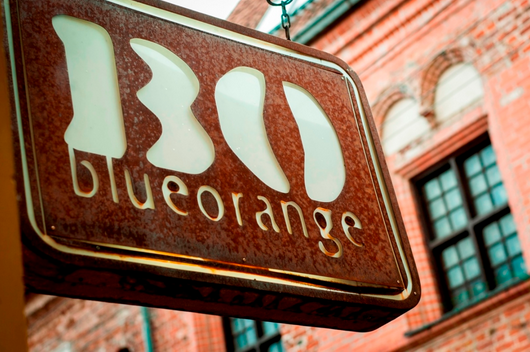
Blue Orange, or B.O for short (…lol!) is undoubtedly Kaunas’ foremost long-standing social drinking institution for students and young folk, taking on an unofficial Student Union bar feel, with a few bells and whistles that entice a post-Uni crowd as well.
The name was inspired by the poemThe World Is Blue As An Orange by the French Surrealist poet Paul Éluard, yet this little pretentious flourish couldn’t be further apart from the uncomplicated down-to-earth and friendly bar you’re about to visit.
Unusually for a student bar, Blue Orange is a family operation, opened by the current manager’s father and uncle, now run by mother and son. This is a nice fact in an increasingly corporate world.
Enter off a quiet side street in Kaunas’ pretty, though low-key old town and you’ll see a long room tunneling off to your left, and the bar straight in front of you. Décor is down to a earth, a little offbeat but generally plain, going on ramshackle, but in that cosy lived-in way that gives places like these some charm.
B.O (yep, this is still funny) offers a range of the usual pub amenities in addition to the beer: board games, beer pong, foosball, rudimentary pub food, events nights etc, and is without doubt focused on gathering and maintaining a community around it as best as it can. It succeeds. Football championships, “Guitar Hero” nights etc., you name it.
At the minute the second floor is being renovated so don’t count on any DJing or dancing up there for now. We shall keep a close watch on what they do with the space.
Everyone likes a late bar (What, you don’t? See me after class!) and Blue Orange provides a stalwart service in that regard, opening way past midnight into the early hours, all nights of the week. Be aware though that the place doesn’t actually open until 5pm, so don’t rely on it for an afternoon pint.
The furnishings and the bar concept may be growing a little dog-eared, but among a friendly crowd, that doesn’t seem to matter. And it’s an easy place to make friends, with space being at a premium you may find a group or individuals offer you a friendly – if drunken – introduction.
As far as the beers go, you can fill your glass for a very decent price, and there are 6-7 decent taps with Lithuanian beer on offer, along with a correspondingly well stocked fridge full of bottles. It is, after reflection, a pretty good range for the type of bar it is, and reasonable quality. Unfortunately you might find as with a lot of small time operations in mainland Europe that the beer comes out of the taps far too lively and it takes three pint glasses of foam before finally enough beer is produced to fill your glass. This can cause holdups but thankfully the drink at the end is worth it.
Staff are surly in the usual Baltic manner (perhaps they are fed up by the bar taps) but at least it’s service at the bar and not having to wait for table service – a dreaded custom across many venues in Eastern Europe.
BO has a central location near a number of good transport connections, but isn’t situated on a main thoroughfare that gets passing trade. This means it is visited by a loyal crowd of those in the know. It remains a really good option if you want to sample what the young but not so preening Kaunasii are up to with their free time or make it your local.
Going from some comments, Blue Orange isn’t quite as zeitgeisty as it’s heyday, though you can’t help wonder whether these critics are just resentful thirty somethings trying and failing to relive their glory days. It must have been some heyday if they’re correct, as during my visit the bar was rammed full of young people who all looked like they were having a great time, also with the feel that it was their regular hangout spot. I’ll be back next time I’m in Kaunas, that’s for sure.
If Blue Orange doesn’t suit your mature post-grad mentality, then check out their new bar B20 on Gedminas gatve 30, which is similarly well reviewed but has a more modern and generic décor to my eyes. All the same, it breaks up the long, long walk between the train station and the old town quite nicely.
Have you been to Blue Orange? Agree or disagree with this review? Join in the discussion on Facebook or leave a review below!
Galgenhuis, ‘The Gallows House’ is Ghent’s most central and historical pub, occupying a small but nevertheless fascinating and lurid position in the city’s heritage. Set on a corner by the Kleine Vismarkt bridge, and strapped onto the striking Groot Vleeshuis, the uneconomically modest size never gives the impression of being a likely pub venue.
It’s name stems from a medieval pillory based on the rear of the roof, used in those days to shame criminals. A former fish stall, tripe house, then schandstraffen, Galgenhuis has seen its fair share of fishy doings, both before and following its conversion into a pub during the 1700s. There is some terrific writing about the history of the building to be found here and here.
All the same, it’s 2019, so what’s the place like now? Well, you enter via steps down off the street, past a small patio area. Upon entering you’re greeted with a one room bar with arched ceiling, barely larger than a shed. They believe it is one of, if not the smallest pubs in Ghent.
OLYMPUS DIGITAL CAMERA
The bar room fits a row of bench seats on each side, and just enough space in the middle to congregate if they are full. There is also a very cosy little mezzanine area up steps behind the bar. The terrace area on the square is very probably bigger than the standing area in pub itself. You will enjoy a great view of the square, sure, but you’ll be getting that the moment you leave anyway – it isn’t really the same as being in a pub, is it?
Despite the limited space in the main room, Galgenhuis boasts ample space in the cellars by virtue of the tunnels built under the Groot Vleeshuis for fishermen and greengrocers back in t’ day. There were, by some accounts, historical problems with the moisture, restricting its usage, but these days they boast of a refurbishment and as you may notice, the cellar can now be rented out for parties and suchlike.
Galgenhuis counts in my book as a ‘brown café’ due to the traditional furnishings and genteel down-to-earth atmosphere in the main room; very much a Flemish pub, but the history of the venue means it has been bestowed with additional historical features that predate the style. Cast your eyes over the impressive painted tiled walls and beamed ceiling painted with some rather threatening gallows-appropriate slogans in gothic lettering. This in my view takes it to another level. Our level.
However, while I love all of that, unfortunately the whitewashed exterior and the splashing of an – in my view – rather bland logo across the wall of the building sticks out a mile in front of some grand stepped-gable houses by the water front. I’m afraid the signage is not really in keeping with the tradition or the interior making the place look far more bland than it actually is. That’s disappointing, as they previously had Gothic signage, but it’s a matter of personal opinion.
This isn’t a concern once you’re inside however, as it can’t be seen. Believe me, if you’re lucky enough to find a seat in here you’ll feel like remaining for the duration. Perhaps it’s the modest size that makes it feel like the centre of the action, being so close to the water nearby and the goings-on in the street, it really does feel like being inside a capsule, one that might even detach itself from the town and leave you up to your neck in the Leie.
Perhaps this is because the bar area is set a half-level down from the street, and so with plenty of windows facing at ground level, it gives the impression of a grotto. In actuality this was to assist bargemen unload their wares – today it is merely an attractive quirk.
If you strip back the numerous eccentricities that add to the charm of Galgenhuis, you will still find a fundamentally sound pub that does the simple stuff well. A cosy room, jovial atmosphere, and during the evening that classic golden glow that emerges from time spent in a well-decorated friendly pub room and careful application of beer.
Speaking of beer, there is a small but decent selection of Belgian ales on tap, from Tongerlo (an excellent though not always common option) down to Primus lager, while hardly Pilsner Urquell in lager stakes, nevertheless preferable to Jupiler and is an acceptable fallback option if the dubbels, tripels and quadrupels are getting on top of you. Prices are as you’d expect for a pub in the middle of an affluent city centre in Northern Europe (ie. belt up), but the manager reminds me that a glass of Primus costs €2.20, in itself a very reasonable price for the city centre.
The bar staff carry out their job with pride, clearly in the knowledge they are playing their small part in the continuation of Galgenhuis. I also felt they were among the more friendly Ghent servers, while considering the places I visited. By contrast, the forgivably wonderful Den Turk (follow the link for our full review) boasts about its ‘Ghent arrogance’: impressive in print, but reflected in fairly charmless service in person. Thankfully basic pleasantries are still deemed fashionable here at Galgenhuis.
The central location means you can shoot off from here to half a dozen other bars and pubs within minutes, making it suitable for a pub crawl, but the high demand for seating puts the experience itself at a premium. If you are lucky enough to grab a table, why not bed in for a full afternoon session and get drinking?
Have you been to Galgenhuis? Agree or disagree with our take on it? We’d love to find out what you think – please drop us a line in the comments below or join the discussion in our Facebook group!
Picture the scene: Amsterdam in winter, one of those dire evenings when gales blow in off the North Sea all the way up De Pijp, whipping sleet in your face. Meanwhile, the going underfoot lurches from ice rink to quagmire with each step. Checking to your right for the cyclist that probably isn’t there (but inevitably will break your arm the one time you don’t bother checking) – and then left to see if any motorists fancy testing how well their airbags work. Each movement of your leg invites a splash of freezing sludge and fresh test of your balance.
Across the roundabout we spot a window glowing like a beacon, heat from the room condensing on the glass, the silhouette of drinkers and the sound of good cheer – it’s a pub – rarely has there been a more fine or welcome sight.
Shuffling precariously across the ice I spot the sign above the bar confirming the establishment and nothing can stop us now. While there isn’t video evidence to prove otherwise, you may take my word for it, I’ve never homed in on an Amstel sign with such vigour and enthusiasm.
Amsterdam is well-used to this appallingly unpleasant weather and therefore well-prepared in its provision of shelter and booze. In late spring and summer Café Mulder flings open its doors and spreads out into the street front, but on a night like tonight this traditional brasserie turns into a refuge.
Being hugged, wrapped in a fresh towel and ushered inside would be the ideal welcome, but the blast of warmth and prospect of a stiff drink ably substitutes.
The pub was as busy as it looked from the outside, full of folk relieved indeed to be anywhere except outside. Now, ensconced among a mixture of regulars and tourists, a drink and a chat will do the trick very nicely.
Seeing an Amstel sign would normally be a bad omen, but their sickly dross is ubiquitous in the city and it’s genuinely more difficult to find such a place that doesn’t also serve other, better beer. So, here you can choose between a pint of that insipid liquid or a smaller portion of something far nicer for the same price.
Outside of craft beer enthusiasts perhaps, it’s difficult to think that beer drinkers could be too upset by the selections here, especially as the place isn’t wholly beer-focused. The likes of Brugse Zot and De Koninck on tap, and at least 7 or 8 genuinely good bottles provide a stock that, while it could be better in variation and sizes, covers several bases well and isn’t going to let too many people down.
It’s nice to see that the place provides a small selection of food rather than turning itself into a dining room, so if you fancy wolfing down some soup, toasties or bitterballen (I wouldn’t blame you in weather like this) get involved. You can even get a hot boiled egg – very old fashioned and it doesn’t take away from the pub feel.
There’s a bit of extra character too with a pub cat and you’ll note it claims to be “the most authentic pub in Amsterdam“. A bold claim (not one it backs up in any way) but this is really for you to explore and see for yourself.
Ronald Pattinson of European Beer Guide fame – a man worth listening to about Dutch brown cafés – commented:
“I’m still regularly pleasantly surprised by Amsterdam’s pub scene. While simple, unpretentious cafés like this survive in such numbers, I’ll pass on the razor blades.”
Mulder fits into the brown café aesthetic beloved of the Low Countries but has a hint of the French brasserie to my eyes, with enormous windows and a more classically corner bar layout. The pub-like elements come from an impressively ornate bar area and shelf unit, the stylish old décor, rustic furniture and the type of socialising going on within, which certainly on a bitter night swings towards the communal. The sense of history helps too, with a lot of features looking turn of the 20th century.
London is blessed to have a huge number of pubs in the same way Amsterdam does, of a variety as-good-as-duplicated many times over. However, with a few exceptions, many of these London pubs have been made more generic by unimaginative owners or pub-companies, the scourge of character and identity. In London, I suspect this place would have gone the way of Nicholsons or Taylor Walker in the last decade and had its soul expunged, but pleasingly, one of the nicest things to say about Café Mulder is that it is not unique, it is not an oasis surrounded by a desert, but it’s common, frequent to find and that’s what makes Amsterdam still so thoroughly enjoyable. We should celebrate the fact that a place this good is only a notch above the mean average for a brown café in Amsterdam. Is this the inverse of damning with faint praise? I hope so.
Anyway, to boil it down, Mulder is a great place to go for a drink, and you know what? I managed to write all that without a single X-Files joke. Cheers!
Insomnia in the Romanian city of Cluj-Napoca claims the title of the longest continuing pub in town.
22 years (23 in May this year) doesn’t seem to me a long time in the life of a pub, so perhaps this has something to do with the turbulence of the revolution at the turn of the ‘90s, and/or a change in cultural trends? I am from a country where so many pubs have remained open over a hundred years or more, so this strikes me as peculiar.
Cluj-Napoca is a university town and so the nightlife reflects the demands of young people. You’ll struggle to find anywhere (deserving of the label ‘pub’ at least) where young and old people mix as they would in England, or indeed many other countries in Mainland Europe. In fact it was difficult to find the sort of old-man’s drinking hole you’d expect to see everywhere. Another surprise.
Insomnia is very much geared towards a younger crowd – if not young then young at heart – with bright, psychedelic décor, paint thrown up the wall Jackson Pollock style and giant lampshades covered in stretched Insomnia-logo t-shirts. About that logo – a not particularly discreet drawing of two animals humping. That aside, the place is funky and seems to have survived 15 years without looking overly dated.
You will notice from their website a rather esoteric mission statement (some of which might be lost in translation) which is reflected in the bar itself. It is the perigee between taking themselves too seriously and not taking themselves seriously at all. This must come from its early days as an art gallery. While the venue is now predominantly a bar, they still host events of varying flavours – book launches, poetry readings, the odd festival here and there.
The bar, as with most you’ll find in Cluj, is set up for sitting rather than standing, which means dealing with table service – not my favourite thing in the world. In Romania I noticed some people become rather upset when they have to order at the bar. Not sure why – getting drinks that way is quicker, direct and you can settle the bill there and then, saving everyone time and effort.
Insomnia also has a slightly different format in that they expect you to settle the bill upon the drinks being served, which took a little getting used to when most table service involves you settling the bill at the end of the evening. I can only imagine they have had some trouble with people leaving without paying – which again could be solved by switching to bar service!
The other gripe is that, quite alike other central European countries, it is possible to reserve tables in advance. Is this a good thing? In practice this hardly ever works well in a pub, as it deters people who haven’t got a reservation sitting in that spot until the reservation starts, costing the bar money and making the arrangement feel off-putting. Also, when the bar is really busy, save for two or three empty tables, simply because of a couple of reservations that may last for only one round of drinks, where is the logic there?
In Cluj, all beers seem to have arrived on the same lorry, so you can expect the local brew Ursus and its variants (which are okay at best), and other SABMiller-owned brands including some English beers. The choice here is neither great nor terrible – they have covered several bases, but after a couple of days in the city, seeing the identical drinks everywhere becomes a little dull.
Draft beer is also served in 400ml glasses, a cynical way of gaining 20% on every drink, and quite pointless given the bottle sizes are 500ml and often cheaper. It’s difficult to criticise Insomnia over any other Cluj pub for this, as it is unfortunately commonplace. The upshot is that most people order bottles, not draft beer as they are better value for money – given the expense involved in setting up a bar, this seems hideously counter-productive.
Insomnia also offer what they call “long draft”, 2.5l of beer arriving in an enormous trophy-like stand with its own tap which I saw a few people taking ‘advantage’ of. You know you are in student land when gimmicks like this pop up.
Anyway, moving back to the positives, Insomnia’s atmosphere inside is lively and well-paced, while the surrounding décor certainly helps keep things upbeat.
Insomnia is also based on the first floor of a historic building, which I often like as bars of that sort always feel quite bohemian. Outside the bar you will step out onto the balcony walkway of an inner courtyard, the typical sort of atrium you get in ex-Hapsburg cities (especially those with Hungarian history). This situation is appealling and adds to the experience.
Insomnia can be found just a few seconds walk from the main square, which is also handy as the main squares of European cities are generally host to far more corporate venues than this. Insomnia, more than others, underlines the all-encompassing young feel of the city, not to mention a European city centre that yet hasn’t been ruined by corporatising everything.
Maybe Insomnia will continue for another 23 years to come – and onwards – or perhaps the economic tides will sweep it away. I certainly hope to find it is going strong when I return, and hope it doesn’t take me 23 years to do so!
I strongly recommend Insomnia for your visit to Cluj, primarily as a fun alternative venue, and a strong all-rounder that does a lot of what it takes to be a good bar well, or really well.
Lastly, be aware Insomnia closes at 1AM, so if you are having trouble sleeping, you’ll need to move elsewhere!
While ruin bars may be synonymous with Budapest, other cities in Hungary quickly taken inspiration from the design and ethos – it was inevitable they would create their own version. Gázfröccs in Sopron and Csillag EzPresszó in Győr both prove that the bar has been raised. Roncsbár in Hungary’s 2nd city Debrecen, is the most convincing example yet that it’s worth leaving Hungary’s megacity to explore the nightlife in the provinces.
While I love an old boozer, such as Wichmann’s in Budapest, it must be said the standards of décor, atmosphere and amenities in Hungarian pubs have shot up dramatically since Szimpla et al arrived on the scene. Roncsbár (Roncs, meaning Wreck) immediately showed that its up to the task.
Established 2013, Roncs is both a cosy pub, a concert hall, a garden terrace and a arty streetfood courtyard, delivering the alluring appeal we love about ruin bars – a combination of rooms to explore as well as cosy areas to congregate. Unlike unsuccessful attempts to export these to the West, it doesn’t feel the least bit corporate, even when you add bouncers and plastic cups (we’ll get to that in a minute).
There is no shortage of ways to spend your evening here, whether that be for a quiet drink, for food, for music and partying, or games. What’s better, the bar is designed in such a way that it never feels like those people are clashing with each other.
While not as enormous as the likes of the Fogas Ház ‘party complex’ or the ruined mansion of Szimpla, there is a fair expanse of space, and just like those it’s exciting to walk through it all for the first time.
Entering via the front door of the pub, you could be fooled for thinking that’s all there is. It is very pleasant – nothing negative to report – the area is focused on drinks and socialising rather than food – fine by me. You’ll find exposed brick and slightly ramshackle wooden tables. The ceiling appears to be studded with cymbals from drum kits (or was I wrong?). There’s a lively atmosphere and if that was it, then Roncsbár would probably warrant inclusion on our website as an 8/10 pub.
But after you’ve taken in the indoors, have a wander around and look for a side door – this will take you into the entrance way for the ruin-pub aspect proper. The design suddenly explodes into an eclectic whirlwind of bric-a-brac and, if you pay attention, some finely-crafted artwork. The cherry on top of the cake is, in this case, a wrecked (get it?!) aeroplane which looks like it has been hung, interior contents an all, to the inside of the roof.
What’s better, is this is heated in the icy winter and well-ventilated, keeping the place comfortable at all times.
Carry on past the stalls to find a courtyard seating area which will appeal to anyone wanting to watch some sport (big screen, of course) and a terrace garden area – closed on my visit due to the snowy weather – but definitely a further area to spread out in spring and summer. Barbecue? Yes please.
Drinks are about on standard with most Hungarian bars, however their website boasts they have their own-label beer from Rendelkezik (Reindeer?) which I must admit I didn’t see. It’s still possible to get a standard lager for a fair price and nothing here, be it beer, wine or spirits will offend most local or foreign wallets. If you’re outside you will be made to drink it in a plastic cup – on the upside no-one has to worry about broken glass.
Service can be a bit rushed and impersonal in that way all popular places end up being, but that isn’t a reason to mark this place down.
Unlike Budapest, there really is only one place like this in Debrecen, certainly making it stand out. There will always be one or two people of a contrary or conservative nature who take a dislike to these bars. You can’t please all of the people all of the time, but Roncsbár comes pretty damn close.
I love being able to dip in and out of events that are happening, be able to get some fresh air, or have a sit down, and still be in the same place, and still have something interesting to look at.
Please note that Debrecen has a very lively, albeit dispersed nightlife and there are several pubs of a very different style that are also worth visiting. Please see HERE.
There are only a few bars that have earned our 10/10 score, and so congratulations goes to Roncsbár. Long live the Wreck!
In clarty weather there’s nothing more enjoyable than diving into a warm cozy pub. Franconia is no stranger to such climatic conditions and the pub offerings are generally designed with that in mind.
It is January after all, so when we emerged from the U-Bahn station at Rathaus (from our weekend stay in Nuremberg) we were faced with a deluge arriving from above. Fürth old town is a pretty one, with a classic Bavarian/Franconian appearance, clock tower, steep tiled roofs and timber-houses, enough for an hour or two pleasant wandering, but it took us only ten minutes stroll around getting soaked through before resolving that we needed to get to a pub – and quick.
After researching in advance I had one pub in mind as an outstanding potential venue – Keimling.
It’s a short walk from the stop and a pleasant one, along one of the main streets and then down a steep lane. A charming and enticing little lane spurs up to your left but carry on down until you see a small beer garden – you have arrived.
Keimling (translated as Seedling) is so named after a seed-trade facility which formerly existed on the premises. Evidence of this remains apparent as you walk in, with the drawers and cupboards re-purposed into the new pub structure, most notably to the left of the bar as a corner-bar top. The bar’s logo and mascot is a seedling emerging from a wooden house, which can be seen in wood carving in the corner to the left of the bar.
This slideshow requires JavaScript.
I really like the use of space in Keimling. You’ll enter to find a small bar directly facing the entrance and inviting partitioned benches to your right. The alley leading to the toilets also manages to find space for a dartboard (N.B – careful not to leave the gents toilet without checking if a dart is headed towards your face!) There is a small standing area to the left of the bar with ledges and corner area with stools, which has been constructed from the cupboards and drawers I mentioned above.
Carrying on past behind the bar leads you to a subterranean cellar ‘snug’, a very characterful little quirk of the pub which I can imagine being handy for gambling and plotting – among other things. The rest of the pub space is a large, more communal back-room area akin to a quaint pub restaurant, with windows looking out over the street.
The style is rustic, a quintessential traditional pub of a kind you’d hope to see everywhere in Northern Europe, especially on a rainy day. Apparently the owner Wenzel has not altered this appearance since the 1980s; hopefully it will remain intact for another 40 years to come.
The rock soundtrack is a clever touch as it brings in a younger crowd and prevents the risk of the pub becoming too genteel and middle-aged. Staff also vary between young and middle aged so there is a nice communal mix, and it feels like the community are coming together, in that great way a pub should do. The music is also a throwback to the pubs long-standing connection with live acts.
It’s a typically Germanic thing to combine the quaint with the visceral – in this case the almost twee decoration that you’d expect to find in your Grandma’s living room with hard rock music.
Adding further to an impressive list of positives is the selection of beer. Not only do they offer the Franconian speciality Rotbier (red beer) on tap, but they offer their own label beer, Keimling Dunkel, a rich, thick and dark beer that was at once flavourful as it was easy to drink. You’ll note a host of other local ales, which are about quality over quantity.
Don’t sweat about the prices either. As with most places in Franconia a half-litre of beer rarely exceeds 3 euros 5 cents, considerably lower than in the West.
Service is assured and courteous, and despite being English ausländers they were kind to us – it’s a friendly place.
Keimling also offers food, a handy thing for any pub, though I cannot comment on that so much as my real interest is in the pub and the experience.
The optimum time to arrive in my opinion is between 7pm-9pm where you can watch the pub transform from sleepy (albeit with a rock soundtrack) to a bustling neighbourhood venue, with every bit of seating space occupied.
It’s always a great sign of a pub when it makes you feel like you wouldn’t want to be anywhere else.
If there was any room for improvement I would suggest keeping the volume of music down in quieter times. Many pubs believe loud music compensates when it is quiet, but I believe the opposite, it simply emphasises the absence of people while making it more difficult to speak. This is not a big problem with Keimling, but a little recommendation nonetheless.
Fortunately Keimling is very easy to reach, even if you are staying in Nuremberg, because the U-Bahn links to Fürth in a simple 10 minute journey, and Keimling is only 5 minutes up the road from there. There are pubs in the city I live in, sitting at work right now, that would take me longer to get to.
For my money it’s worth doing. Perhaps only WeissbierHex in Nuremberg old-town directly competes to a similar standard, so I’d say Keimling is the best pub in the Nuremberg/Fürth area.
As their website states, quoting Terry Pratchett:
“If you don’t turn your life into a story, you just become a part of someone else’s story.“
Now there’s a romantic philosophy to justify pubgoing, if ever there was one.
Have you visited Keimling? Any comments or suggestions? We’d love to hear from you!
Although you may read reviews referring to A Baiuca as a restaurant, the homely open-kitchen style, late-night drinking and the music-focused atmosphere make this place definitely worthy of the name pub – indeed the doors themselves present A Baiuca as a ‘Taberna’, which is near enough to meet my threshold.
That said, there is an entrance fee which covers the flow of wine and ginjinha and the musical main event, Fado, dramatically mournful Portuguese folk music which translates as ‘destiny or fate’, but symbolising a bohemian, or vagabond lifestyle, signposting what you might expect in the performance.
This may seem off-piste so far considering the beer halls and pubs covered on the blog, but be aware I have offered a degree of latitude to this venue on account of the authenticity and character, and I am seeking to provide a broad range of options.
Lisbon’s traditional working class neighbourhood the Alfama is the perfect setting for a place like this. Wandering up and down the maze of winding streets on the hillside is atmospheric at any time of year.
A Baiuca is not the easiest to spot at night – I remember we ended up locating it by peering through a metal garage door which seemed to correspond to the co-ordinates after wandering around in a circle. The front door itself was shut, but after a couple of knocks the owner met us at the door and arranged our seating, only after payment was made.
At the time of the visit our fee was 10 euros which at the time seemed very reasonable considering the wine and music were both very good.
We gathered on a communal table in a small room, most places taken already, and were made to feel welcome with a couple of glasses of red wine. There is no stage, and the musicians simply perform in the corner of the room. Each song is dramatic and passionate and the performers looked extremely well practiced at the style. An overkill of maudlin music doesn’t seem like the basis for a night out, but the songs are short, melodic, often intense and were received enthusiastically by the room.
There are a great many corporate joints in the city centre offering Fado performances in a large restaurant with a full sit-down meal, and while there is always a place for that, this is where to go for the real McCoy, stripped back, homely and raw, following an unbroken folk tradition.
After considering the experience overall, I think aside of the entrance fee, it occupied a very similar social space as going to a pub, both in terms of the homely working class surroundings and manner of drinking.
Our visit extended long into the early hours of the morning leading to a very uncomfortable wake-up call the following morning to the airport!
There are a few other traditional Fado venues in the Alfama, which I am sure warrant exploration, but I can strongly advocate visiting here if you prefer real and rustic above sheen and pretension. Finding this place on our final night in Lisbon more or less made our holiday.
P.S – I would recommend reserving tables if there are more than two of you, or if it’s the off-season with it being such a small space.
Anyone with a mild interest in the European bar scene or the city of Prague will no doubt have heard of U Zlatého Tygra (At The Golden Tiger), the historic Czech pub and city institution based slap-bang in the tourist hub of Prague’s old town.
Reading about the pub’s stories, its literary connections and seeing the photos of Bill Clinton and his ilk tucking into schnitzel and beer sat among locals may generate a degree of excitement alone, but I will be up front with you about the good – and not so good – aspects of U Zlatého Tygra.
Let’s begin with the good stuff first, of which there is plenty!
The pub signage with its bas-relief tiger and gold lettering is striking and one of Prague’s true icons. The sign indicates not only the business but also the historical identity of the building, which pre-dates its current use. The interior has hosted various previous operations such as a patriotic café and reading room before the second world war, and undergone rebrands such as U černého tygra (The Black Tiger), U kopáčů (The Dice), and U Kraftů (The Craft) in the past. Its literary leanings continued through the 20th Century, not least due to the patronage of writer Bohumil Hrabal, (now made permanent life President) who had a favourite area of the pub in which he would hold forth on the topics of the day, and just as often sit there quietly absorbing the atmosphere and consumed in his own thoughts. Hrabal passed away shortly before the turn of the century, but the pub keeps his memory alive in the best way possible, with tributes that are lovingly well-pitched but don’t turn the place into a shrine.
The entrance is based down an alleyway rather than on the street-front which I generally quite like as this increases a sense of cosiness and clandestine activity, vital for building the atmosphere in traditional venues like this. Heading inside, the design and layout is an archetypal Czech pub with communal tables, bench-seats installed along the walls, wooden panels, cream (going on yellow) walls and those curved arches so typical of the pivnice style. The stained glass windows (with tiger insignia) allow light in but effectively block out activity from the busy street, creating that cocoon-like feel that most of the best Czech pubs offer.
This slideshow requires JavaScript.
Look around and note many framed photographs which present the three key themes of the pub – tigers (of course), famous patrons from sport, art and politics and, as could be predicted: Pilsner Urquell. This lager, while brewed by Plzeňský Prazdroj in Pilsen, not in Prague, is nevertheless synonymous with Prague and Czechia due to its ubiquity. The Golden Tiger was only the second pub in the city of Prague to secure a contract to service it so there is a long-standing connection not likely to be severed or altered any time soon.
When you consider the old town mean average price for a half-litre of Pilsner Urquell, the prices here are fair-to-middling given the central location, and the first pint of it arrives without your say so (as does a second and a third unless you make a point of putting the mat over your drink). Beware, if you turn up thirsty you could easily find yourself processing several glasses in short order. This is one of those pubs where it’s virtually impossible to leave without at least two.
A slight quirk is an insistence on using 0.45l glasses meaning they gain 10% on each beer. Annoying and cynical, but not worth fussing over too much.
The place sells very little else to drink (see their menu here), and even has a policy of not serving spirits! Highly unusual as nearly every other pub in the country will offer you at least Slivovitz, Becherovka or Fernet Stock.
U Zlateho Tygra was for decades and up until the war a bit of an all-boy’s club, refusing women service and directing them to find the nearest cinema while the menfolk held forth in the pub. However, this culture was broken in fittingly macho fashion by a woman called Lady Helenka, as the tale goes:
“She came here with her fiance Vaclav Prymek, who was an officer and an army pilot. When Lady Helenka was stopped at the door, she promised to keep track. And when the waiter counted the lines on the bill, there were 44 of them. Lady Helenka managed 22 beers that evening, as did her future husband. The waiter laid a white napkin in front of Helenka on the floor, kneeled down and said: Madam, this seat by the counter will always be yours, even if the Egyptian king Faruk comes in.”
22 pints? Sounds crazy but you wouldn’t rule it out.
Now some bad stuff. A famous pub is, as you’d expect, a popular one, with the problem that it cannot accommodate locals and tourists at the same time without losing its appeal pretty quickly. Therefore they have struck some form of compromise.
You may or may not be aware that Czech pubs permit reservations even for the right to perch on a bar stool. This system, so unlike the first-come-first served approach in English pubs can result in disappointment. At U Zlatého Tygra you may as well forget even trying to turn up in the evening unless you have reserved your spot well in advance, though it may be worth enlisting a Czech friend to help secure that.
In the evenings, as there are reservations it feels almost like a private member’s club where you need to stay all evening to get full value for the exclusivity.
Here comes the compromise: there is a way in but it relies on your being prepared to begin drinking mid-afternoon, not always everyone’s favourite starting point. Turn up at 2.50pm, 10 minutes before opening time, join the queue (which at this point may be snaking around the front of the building), and if you’re in the front 30 or so you should be assured of a seat unless you’re in a large group. If you see people pushing in at the front then choose whatever retribution you see fit.
This may not be a concern of yours, but I feel a certain duty, given that I am waxing lyrical about the place, to point out that U Zlatého Tygra is not a museum, and the enduring appeal is because it is not spectacular but authentic and traditional. Even though there is some nice stained glass and a sturdy preserved atmosphere, it’s hardly La Sagrada Familia. Therefore, treat it as the pub it is meant to be – eat, drink and be merry. If you show the staff the respect you would show a host who invited you in, you will not be badly treated.
Inevitably, the authenticity can be occasionally vandalised by some tourists who believe it to be a fairground ride instead of a pub. Their behaviour is offset in amusingly curt fashion by the servers who adopt an uncompromisingly stony-faced approach to anyone who isn’t their mates and anything they regard as bullshit (quite a long list).
This is – depending on your point of view – chauvinistic, deeply cynical in order to maintain their asset, or their absolute right as publicans.
While this can be intimidating, consider it a pushback against the place being overrun with tourists and gentrified, as it surely would be without a little resistance.
While it is easy to have a pop at tourists, in one sense their custom helps keep the philosophy of the place alive – people from all walks of life sitting around together and enjoying themselves. The pub website explains further through this anecdote:
“There is the story, in which the pre-war French Prime Minister Herriot visited U Zlatého Tygra. He was accompanied by the section chief of the Ministry of Foreign Affairs, a permanent guest U Zlatého Tygra. They bought pork neck with bread and mustard and fitted incognito in the beer hall . While Herriot was drinking, showed to the opposite side and said : “There is sitting the chair of the Chamber of the Deputies of the Parliament Malypetr, but the gentleman sitting next to him I do not know . ” – The section chief said: ” There is sitting a master of painting from Melantriška. ” Herriot greeted again and then whispered : “But there is sitting the president of the Administrative Court , but the gentleman next to him I do not know. ” Also the guide did not know. Then their neighbour to the right said:” This is a manufacturer of funeral lamps from Karlovka. ” – Surprised Herriot turned to that neighbour and asked : ” And who are you ? “That gentleman raised up his glass and answered” I am a caretaker from Skořepka, please . ” – Then the Prime Minister declared : ” Gentlemen, fault! Democracy is not in France but here ! “
Once the crowds are seated, and after their first beers have been extinguished the atmosphere inside quickly gets going. Among them, comfortable and surrounded by the excitable friendly crowd, with dishes of hot food emerging from the kitchen, it really feels like the place to be.
Whilst seated you will note a stout tapster working flat out to replenish glasses, pausing the flow only to greet and converse with the stamgasty whose presence ensures this most Czech of pubs stays that way.
Due to the tourist trade it’s not somewhere I would choose to go every week – there are other places to go in Prague for an authentic traditional pub experience, without the hype and tourist hordes (Hostomicka Nalevarna, for example, which you can read about by following the link), but there’s no doubt the Golden Tiger has a certain sprinkling of magic borne from its history and ultimately its significance. Try it on different dates and times of day in order to work out when to absorb the most local flavour. As hackneyed as it is to say, you can’t really miss out on a pint in U Zlatého Tygra while in Prague. Which, as discussed above, means two. This really is a pub to be reckoned with.
Rue Des Flandres, in St. Catherine quarter is a great road for a bar crawl, host of several venues varying between good and great. In my view Au Daringman belongs to the great category, not only for the street but for Brussels more widely – I know, high praise in a city jam-packed with great bars.
The primary reason I reach this view is that despite the bar scene across Europe turning increasingly corporate, this brown café still feels like a personal venture. Despite being surrounded by crowds of people, passing trade of tourists and the daily grind, Au Daringman supplies an oasis of calm, moody contemplation during the day and an alternative-feeling cosy haunt at night.
Upon arrival you’ll note an attractive red exterior with old Stella hoarding, partly obscured by the greenery cascading down the front of the entrance, a look which is typical for a street with plenty of side-alleys and greenery.
This slideshow requires JavaScript.
In the afternoon the bar is managed by the charismatic Martine (the pub known locally as Martine’s or Chez Martine), the managing in the quiet hours extending no further than being propped up on a stool reading a newspaper or a book, filing her nails, peering over the rim of her specs and drinking coffee.
On first appearances there doesn’t appear to be all that much maintenance required of Au Daringman other than a morning clean, watering of the plants and the odd keg change/clean of the lines, but it is clear the enterprise is a labour of love.
This café is so named because the original owner was a boxer and member of the Daring Club de Bruxelles in the 1950s and 1960s, a Molenbeek-based football club whose players were referring to as the Daringmen. Read further here.
Au Daringman also proves what a solid basis the ‘brown café’ is as a concept to work outwards from. Let’s compare other Brussels venues: Le Coq is the archetypal Belgian boozer, Monk is an elegant historical recreation, and Au Daringman is the off-beat jazz era cousin, with artistic leanings. Yet all of these still belong to the same pub family.
There are lots of interesting touches to the decor, from the cubist textured wood paneling, to a board with what appear to be scores from a local table football league. Apparently the bar has been going since 1942 – it looks like most of the bar hasn’t been significantly altered since the 1970s.
The simplicity extends to the beer choices on tap – it’s very standard stuff. Stella, Leffe, or Hoegaarden. In Belgium at least, all three of these are a reasonable standard.
While it may not be apparent – at least not during my visits – they also boast a host of bottled drinks, some of the well-known Trappist, Abbey and lambic Belgian ales along with some lesser-seen ones such as Gageleer.
On my last visit I spent two hours here quietly, with no book and no telephone function (imagine that in this day an age). The beautiful simplicity of sitting among the wood paneling and minimalist jazz memorabilia, enjoying a beer and alone your thoughts sums up what Au Daringman is about during the day. Au Daringman wants to make you feel at home, but also quietly oozes cool.
While the bar becomes a lively place in the evening, almost transformed in doing so, some essence of the place goes missing when it is crowded. However, that goes with my impression, which may not be yours. As with Monk, I recommend visiting in the early evening when it begins calm then slowly starts to bubble up.
Despite Instagram cataloguing the world, you won’t find much online presence for Au Daringman, as presumably its location on Rue De Flandres makes advertising superfluous.
Yet another brilliant Brussels bar and an essential visit on the ‘brown café’ circuit in the city.
P.S – Sadly Martina does not own the building itself, so this is a bar that may be on borrowed time. All the more reason to visit while you still can!
Evenings in Olomouc are a tough time to get seated. Wherever you turn, each hostinec, hospoda, pajzl, minipivovar or výčep seems to be full. It is no exception when it comes to U Kuděje. Yet, frustrating though that is, there is all justification to persevere as you are searching for a drink in one of the best pubs in the city, if not in the whole country.
At first appearances Hospůdka U Kuděje may seem unremarkable. A Czech pub in a half-step basement of a very Czech city building? – seen plenty of those before. Wooden furniture from the Austria-Hungary era, with traditional ruralist décor? A well-trodden choice, too but the true quality of U Kuděje is the combination of a number of smaller things contributing to a greater whole, known as genius loci, or spirit of a place. Which we will now come to.
U Kuděje is not based slap bang in the centre (it could potentially lose a fraction of its charm if it were) but a short walk west on the fringes between Olomouc’s old town and a residential neighbourhood west of Čechovy sady.
U Kuděje is named after the writer Zdenek Kuděj, the closest and perhaps long-suffering friend of Jaroslav Hašek, who were both part of an anarchist/bohemian literary scene in the early 20th century, so is a fitting tribute to someone who spent huge amounts of time in pubs. You will find theirs and others’ works available to read (in Czech, of course) within the pub. Here is a short explanation of the pub and connection to the writer: http://www.memorialmatejekudeje.cz/?cat=14
Drop down a short set of stairs outside to the basement level and enter, where the bar area greets you immediately, with a list of beers attached above the bar. The place feels warm and bunker-like and you will almost certainly find people sat at stools around the bar, and a cast of regulars sat on tables to your right. To your left is a small lounge area with people deep in conversation and set into the ritual of the place itself.
This slideshow requires JavaScript.
The pub has the atmosphere you’d expect from a neighbourhood dive and you’ll quickly notice from the interactions there are folk sat around who know each other well. This in my opinion is the core of the pub’s appeal, the warmth and simplicity of a social scene that people invariably seek out when given the choice.
A busy pub full of locals can be intimidating at first, and if you can’t see anywhere to sit you may be forced to hang at the bar (also awkward if there is no leaning room). Take a full look into the pub and if there is a spare seat ask “je tu volny”, and hopefully someone will yield. If you arrive as a group in the evening without a reservation, then all I can say is: Good luck. Yep, unfortunately Czechia does not do first-come-first served in pubs and will reserve tables for loyal locals at the expense of fly-by-night tourists and turf you out of your seat when the time comes.
U Kuděje’s big thing – atmosphere aside – is a focus on regional Czech beer, which is very good news for any fans of unfiltered and/or unpasteurised lagers (me). Offering 5 or so on tap at any one time, this is a sensible number that helps ensure freshness, and a little rotation for new and recurring brands. The beers are also served on porcelain plates built with recesses to collect spillage – this is very old fashioned but seems to be making a comeback of late.
They may try to suggest that these beers are good for your health but quite frankly, who cares? If it makes you feel better then yes, yeast can in theory help repopulate your stomach with good bacteria. However if you need it repopulating because of an excess of beer the previous night then that rather negates the point, doesn’t it? Prices are reasonable, perhaps on the high side for Olomouc, which isn’t a problem given Olomouc is an extremely affordable city.
The pub snacks at U Kuděje are typical for Czech pubs – expect the usual cheese, ham, pickles but keep a look out for Moravian cheese if that’s your thing, as that’s quite the regional speciality.
Lastly, take a look at the opening hours – few places open later on a Saturday than they do during the week, but U Kuděje is one of them This place is does a short 5 hours service on weekends, and opens at 3 during the week. This makes it doubly difficult to try and get into.
Although U Kuděje may be a tough nut to crack as an outsider, I personally couldn’t think of too many pubs on my travels I’d prefer to make the effort to ingratiate myself in. You’ll find the true atmosphere and camaraderie of a mixed crowd partaking in a time-honoured tradition, rate authenticity, not to mention enjoying some of the freshest, well-kept and well-poured lager available.
Have you been? Any comments or suggestions? We’d love to hear from you. Please get in touch, particularly if any of the above requires amending.
Claiming to originate in 1602, the building itself containing The Seven Stars has survived The Great Fire of London, and – just as impressively in my view – the next 400 years of change unscathed, all the while serving as a public house. It’s a remarkable feat that places it as one of London’s core heritage pubs.
Many pubs trade on their history, (and that of The Seven Stars is an interesting read) , without backing that up by being an enjoyable place to drink in the here and now. Thankfully, The Seven Stars is not one of those places: it’s a little cracker.
Carey Street has a row of townhouses that are overshadowed by the enormous London County Court, Royal Courts of Justice and LSE library, so it is quite easy to wander halfway past The Seven Stars before realising. It’s a very quiet street and doesn’t seem the most likely place for a pub to be situated these days, though that makes it a perfect venue for those in-the-know. The frontage of The Seven Stars is squat and compact with the predictable (but entirely appropriate) gothic signage. It looks like a small place and it is – there’s no TARDIS effect once you walk inside.
This slideshow requires JavaScript.
Although micro-pubs may now be reversing the trend for enormous, open plan pubs, none of them are made quite like this old thing. You’ll walk through the entrance to find a low-beamed venerable establishment with a bar directly opposite the entrance, and a narrow space set over two rooms. There are stools to sit at the bar and drink, and tables decorated with checked tablecloths and candles (a little dressy for my tastes, but it did make me think fondly of Den Turk in Ghent, which is not dissimilar).
For the last decade or so, The Seven Stars has been the domain of a ruff-sporting and locally famous pub cat who sadly passed away not so long back. Nevertheless, I have been informed a new cat has entered the premises! If you venture into conversation at the bar with the owner Roxy, she may expand on the and possibly get into the tale of one punter who mistook the cat bowl for bar snacks. Don’t be shocked – anything can happen in London.
The décor and ‘lived-in’ nature of the pub is where most of its character comes from, a pleasingly ungentrified and carefully preserved sense of welcome that tends to strike an immediately positive impression with people regardless of any preconceived ideas. This impression is important to cling onto for when you order a beer (or food), because those London prices hit hard and hit deep. This isn’t worth singling The Seven Stars out for, however, that’s just how things are. It is worth bearing in mind a lot of lawyers drink here.
Nevertheless, you’ll find a set of well kept cask ales from regional breweries served via hand pump – it’s a decent if unspectacular range which will keep you satisfied for at least a few.
In a similar way to Whitelock’s in Leeds, the toilets are located above the pub itself via a satisfyingly creaky staircase, where you will also pass by the kitchens and a room crammed full of odds and ends. By any standards these days (particularly London’s), this is a characterful and individual place that isn’t interesting in the Farrow & Ball school of interior design or repainting itself to remain ‘on-trend’ every ten years.
As mentioned above, the pub is popular with local lawyers and court staff, and due to the small size you may find yourself unable to grab a seat. However, trade is brisk in the evenings so be patient and things will move along – grab your chance when you see it. There’s nothing like being seated to enjoy the atmosphere of a tangle at the bar in a traditional pub such as this.
As the lights from the outside dim, and those from the inside take over, there can be no question of whether this is a pub of outstanding merit.
Although The Seven Stars may have lasted 400 years, the obnoxious pace of gentrification in the last 30 years means that pubs like these perpetually under threat from people who simply want to run poor facsimiles of bars they’ve seen elsewhere. This is a pub that demonstrates the importance of being your own thing. That’s worth something.
I’ll leave you with this anecdote from their website:
“While enjoying a few Friday afternoon wind-down drinks, a group of 15 or so lawyers (young ones) entered the Seven Stars awkwardly and decamped nearby. There then began a cacophonous symphony of table and chair scraping, until they had blocked all passage in or out of the bar. Regaling of a most competitive flavour followed, ever louder, underwritten by a desperate, pleading “notice me” subtext. Its volume only matched by the ethereal transparency of its content. We drank up and moved on – our seats snatched hungrily into their possession before we got to the door. Congratulations, you’ve emptied the pub! Not all lawyers are like this, true, but this was selfish and shameful behaviour. Hopefully, few noticed.”
Have you visited The Seven Stars? Any comments, feedback or suggestions for our write-up? Please get in touch!
Soviet-themed bars have quickly become a staple part of the Eastern European bar scene. It must be due to the tonnes of old communist bric-a-brac that has been purloined from flea markets over the years. It’s remarkable how quickly this ephemera has been regurgitated, often in an apolitical way. Now, shorn of the memory of state repression, paranoia and hardship much of the era’s junk has been re-purposed and exhibited, capturing people’s nostalgic fondness for the idealism, optimism as well as the iconography of the era. Ideal for adorning a moody Polish bar such as this one in Poznań.
Proletaryat isn’t exactly lined with volumes of DasKapital; instead you’ll note a large bust of Lenin staring at you out on the street. Enter to find a display of fairly impressive social realist paintings, disproportionately large portraits of Lenin and Marx, hung in front of rich crimson paint, with emblems and military insignia thrown in. The central bar area also expands further into an interesting looking terrace-style back room where the cool kids hang out, that seems a little separated from the central premise.
There may be a vague leftist feel to the crowd here (perhaps its just the students) but in the main it does seem to be led by decoration rather than a hotbed of any political grouping.
This slideshow requires JavaScript.
That said, the decoration is impressive nonetheless, it’s a very stylish place to go for a drink, without being particularly pretentious. The crimson and lamplight works well for a shady atmospheric slow sup, while at night it gets more raucous and one of those truly buzzing city centre bars where the lack of space and abundance of booze creates its own head of steam. This is a great example of decoration that allows a venue to work well in different ways at different times.
The location down one of the main city centre streets means it feels in the middle of the action – which in Poznan is pretty bloody active. You can expect to witness the type of revelry usually preserved for English city centres on an evening. It was quite an eye-opener, but I had previously been warned about it by some Poznanites (Poznanians?) during a separate trip to Wroclaw (another excellent city). The levity doesn’t emerge from English stag parties or boys-on-tour either – in Poznan it’s mainly locals doing their homespun thing. Wodka i piwo can be a dangerous combo.
Aside of the tongue-in-cheek atmosphere, Proletaryat offers its ‘own’ beer as well (from what I can gathered, this is brewed elsewhere at Browar Czarnków and labelled accordingly), which is cheap even by Polish standards nowadays. The jasne (light) and ciemne (dark) beers are both fresh and well balanced. Not the finest ever brewed but tasty certainly and designed to knock back in volume. Apparently the vodka is served with a pickle here if you are interested in going native.
Any pub crawl around Poznań would be improved by a stop off at Proletaryat, as despite the increasingly familiar concept of the Soviet-themed bar, a good concept doesn’t stop being good just on account of its familiarity. Besides, they do a decent job of and it feels like its own thing rather than a cookie-cutter version or a clone-bar. If you haven’t been to one of these type of places before, then go at least once for the novelty value. If you already have and enjoyed it, then this bar is not to be missed!
‘Vycep Soukenicka’ in a previous life, it seems this spot has served as an in-the-know local’s pub for quite a while before this recent rebrand.
The new name springs from a village south west of Prague, Hostomice, which isn’t much further along than Karlstejn and its enormous castle. You could decide on a trip out if the weather’s nice, but when they’ve set up what is ostensibly their Prague tap house in one of the nicest old pubs in the city centre, there’s a convenient excuse to stay put.
I urge you to mark this pub on your map of Prague as this area of the city between Josefov district and Florenc metro is a little short on pubs worth a damn. I often find myself having to head through it, and invariably choose this place as the pub of choice.
The difficulty is, once you move east from the old town (let’s say, from U Parlamentu/U Pivnrce) area and through Josefov, the traditional Czech pubs disappear and are replaced by cocktail bars and glamorous-looking (but probably seedy) ‘gentlemen’s’ clubs. Josefov is a fascinating district for many reasons but purely on pub terms, I wouldn’t get your hopes up. This malaise extends past the Powder Tower and the Štefánikův bridge to be honest, all the way into Karlin. With one notable exception.
For traditional Czech drinking (the kind where you’ll be rubbing shoulders with normal Prague folk while chugging pivo) the newly christened Hostomická Nalévárna is the best option in that half-mile radius. If you’re planning a pub crawl, particularly if you’re staying near Náměstí Republiky this place will be a godsend to help join the dots together. In fairness, it isn’t a long walk from the old town anyway.
Pivovar Hostomicehas a great reputation for their beer, which is handy given there aren’t any beers from other breweries available at this pub. From the several visits I made they offered an unfiltered 10° světlé výčepní (light lager), 12° světlý ležák (premium lager) and a 13° tmavy, (or dark) lager on tap as a general rule. They may have specials on rotation but if they do, they weren’t exactly advertising the fact. I’m just glad when I visited in March, no-one was drinking green beer, (brewed every Easter and bafflingly popular, even among locals).
This slideshow requires JavaScript.
Their prices are a steal considering it’s Prague city centre, with their 10 degrees light lager as good as being £1 for a half litre, and the others barely a few crowns more. This good value extends to the other options available, such as the wine (which my partner found almost as cheap as beer elsewhere around the city).
One of the more intimidating things for a tourist, leaving the traditionally large pivnices in Prague city centre behind and heading to a local drop-in pub is the more direct interaction with locals, and this is something you’ll need to factor in during your visit. Knowing your p’s and q’s goes a fair way in Czechia. The tapster here is a polite enough young man who will speak in Czech if he thinks he can get away with it but is hospitable to outlanders who play by the house rules. He serves as both tapster and server given the small size of the place. At the very bare minimum, muttering ‘dvyeh piva prosim’ will procure two of their light beers. Fresh, unfiltered and delicious, I may say. The unfussy branding and lack of a corporate feel reminded me of the often brandless, but out of this world fresh Kellerbier and Vollbier you can find in Franconia and Bavaria.
Moving onto the pub itself, it’s a small cosy sort of place with a small bar on your left as you walk in, and a compact seating area in behind. Click here for a quick slideshow from the brewery’s facebook account. I managed to be seated on each occasion I visited which seemed unlikely given the place seats perhaps 25 people at most, and is never empty. The amount of wood you’re surrounded with is typical of these kind of places, and a look I enjoy very much, even if I do wish they offered cushioned, upholstered seats like most English pubs.
The folk around you vary from quiet couples in their 30s, jovial groups of youngsters and old folk playing cards and setting the world to rights. A classic cross section of people who appreciate the virtues of a traditional pub. There’s a big TV hanging at the back of the room for if the going gets dull, which will be playing whatever sport is going. There are those desperate moments in life where Japanese basketball or youth curling competitions suddenly become diverting.
I enjoyed the fact that they hadn’t been bothered to remove or paint over the old sign, which is entirely appropriate as they haven’t done anything to the interior either. That may have changed (and some evidence suggests it has) but the interior remains pleasingly old school. All the Hostomice stuff seems merely transient, which gives me the hope that even if for whatever reason they cease as an ongoing concern, another group will come along to keep the fires burning.
You can see from the scores at the top that the place is a decent all-rounder, the only shortcoming being a relative lack of amenities, but this comes with the territory. Each pub deserves a license to be what it wants to be. Not all pubs need or desire to serve cooked food, or host events. Sometimes a cosy seat, a good cheap pint and a load of old wood is all that’s required. Hostomická Nalévárna is there for you when those times arrive.
This place typifies that often impossible urge to drop in to one more pub on the way home, that is so beautifully brought to life in Czech literature.
Pub goers everywhere, rejoice in the fact places such as this exist! Use it or lose it….
Have you visited? Any comments or corrections? Please get in touch via the comments or our Facebook page!
For all the blabbering on we could indulge in about such things as décor, history, live events, and so on, it is occasionally easy to lose sight of the more humble qualities of a good pub, those of simplicity and authenticity.
A bar’s interesting décor can sometimes divert from the expense or low quality of the drinks, occasionally the unpleasant atmosphere as well. All too often a pub’s history is used as a fig leaf to disguise the fact the interior has since been vandalised and transformed into a chain-operated place devoid of character. A lot of pubs run a pub quiz, food nights, karaoke, live music but are thoroughly unappealing nonetheless. That’s no magic bullet.
It takes a degree of resolve these days to run a pub that doesn’t bother with half of that, isn’t trying to be anything it’s not, doesn’t care about mythologising, widening demographics, or trying to get each customer to pay the absolute limit of what they’re prepared to.
It would be tempting to call such a place ‘quaint’ but there is a patronising element to that word, bordering on ignorant, which I dislike, and which Briody’s doesn’t deserve. I didn’t think Briody’s the least bit ‘quaint’ on my visit. It is however a simple honest boozer that has thought about what to improve,what to keep and what to maintain very carefully.
This slideshow requires JavaScript.
I like the small size – you have a small lounge area on your left, in front of a bar stretching along the room, with comfortable upholstered bench seats lining the wall. It is as big as it ever needs to be, and has a degree of cosiness without ladling it on too thick. It’s a nice lounge, your living room with a bar and a few other folk in it, essentially. Perfect for quiet contemplation, reading, good conversation and so on. There’s an upstairs which I understand is for hire for students cramming for exams, meetings and so forth.
One thing you can never tell from the outside of an Irish pub is how good it’s going to be once you walk in. Nearly all of their exteriors have a rather studied look, with the ubiquitous Gaelic script, or at least a typeface aged enough to suggest a traditional interior. However, this often has little to do with what you’re presented with when you walk in, and it takes a keen eye to distinguish your plastic paddy pub from the genuine places frequented by locals.
One commonality in Dublin, is the sight of a ruddy-cheeked, broad-chested man of borderline retirement age doing the serving, usually dressed very smartly in a plain Daz-white shirt, black trousers and shiny shoes and belt. There’s a certain formality to this which conveys command. Maybe not wholly consciously, but I believe that’s intentional.
These fellows are usually quick-witted and not short of a few comments to make, especially if they haven’t seen your face around their pub before. It’s usually jovial jesting at most, and you’ll notice the standard of welcome in Dublin a notch higher than most European cities, apart from perhaps the most tourist-ridden places where the demand on the service and the churn of staff makes that difficult.
No such worries at Briody’s – taking a seat there feels like you are being added to a painting. Here’s where you find your more raw Dubliner accent, blue language aimed at the Gaelic footy on TV, and most thankfully, an excellent pint of Guinness. You know you’re in for a good pint of the stuff when the cream on top forms an almost-film like layer when it settles. It’s not cheap in Ireland these days, but a pint is cheaper in Briody’s than many places elsewhere in the city centre. Anything like that is welcome on the wallet.
This explains why locals head down here (many of whom the bar staff know by name) but there are other factors. Despite being 5 minutes walk from the Spire on O’Connell Street, most locals don’t venture down Marlborough Street running parallel, instead sticking to and clogging up the main arteries of the city. Given other areas of the city are studded with pubs – mediocre ones – all of which are crammed full, it’s a strange feeling that somewhere like Briody’s could plough its own calm furrow, almost hiding in plain sight.
“Setting foot in the pub, you immediately feel like you are on familiar territory. Just like wandering into your grannies, you know you’re in good hands. The interior is typical of a good local boozer; tiled flooring greets feet upon entrance before a pristine carpet overtakes the rest of the floor space. Lighter wooden tones are well complimented with beige embossed wallpaper. The seating proved to be tremendously cosy in its simplicity while classic drink brands and sport are the themes exhibited in frames upon the wall. We took a particular shine to a bittersweet portrait of Paul McGrath seen in his heyday sitting at an unidentified bar holding a creamy pint aloft.”
It is one of those pubs that you wouldn’t see what the fuss was about until you’d spent a good while visiting the so great many mediocre ones first.
Comfortable, authentic, friendly, and simple. That’s the way it is, and the way it wants to stay. Perhaps deep down they may not welcome me saying this, as this is their refuge rather than a tourist hub, but here we are. I can’t ignore you.
Have you been to Briody’s? Any views, or corrections? Please get in touch on the comments below or via our Facebook page!
As Lviv brought the kerosene fuelled gas lamp to the world in 1853, it is only fitting that this is expressed in the city on some level. You’d expect a museum to be the best place to exhibit this but slightly surprisingly it takes the form of a bar – Gas Lamp.
Although aspects of the display are museum-like, to all intents and purposes the gas lamps are for decorative purposes, with little information on their design or origin. I have visited some pubs and bars which featured information labels on their antique without making the venue too stuffy-feeling (U Veverky in Prague, for example), but in Gas Lamp, providing you are here for a drink over and above a history lesson, you don’t feel like you’re losing out for the lack of information too much. Besides, the venue holds one of the biggest collections of gas lamps in Europe, so there is a lot to look at.
On busy evenings, an old man in a top hat, holding his gas lamp will guide you past the ‘fathers of the lamp’; two bronze statues, one of Jan Zeh sitting at his table (by the front door) and another, if you look up, of Ignacy Lukasiewicz poking out of a third-storey window. Read about their place in history here.
You are then led downstairs into a cellar. Counter-intuitively you have to crouch under what appears to be blackened rock, only to ascend a spiral staircase into the ‘bottom’ floor, which is on the first storey of the building. When you reach it you will notice a traffic light system, which appears to be there to stop customers bumping into each other halfway down the stairs.
Gas Lamp is set across several small floors, which reminded me of De Garre in Bruges (in layout rather than design), one of which is dominated by a bar, and another which appears to be a penthouse apartment that has been converted into a covered roof terrace. There is a coherent theme but each floor has a slightly different feel so don’t leave without being nosy and having a look around.
This slideshow requires JavaScript.
On the top floor you emerge level with what appears to be a sea of slanted rooftops which may well be impressive during the day as much as at night, but night time is a great opportunity to look at the Armenian and Russian churches lit up strikingly. There is a naturally rather rarified air to being on the top floor so it may appear a little more towny and flash in comparison to the cosier downstairs rooms. Regardless of this, it is well worth rubber-necking.
Outside of the eponymous gas lamps, décor is an interesting blend of chunky chalet-type wood, with rafters, beams, bannisters and communal tables, but the lighting is more modern, with yellows, pinks and purples spotlit and backlit among shelves with other assorted valves and measuring equipment. I would rather they lit the gas lamps to be honest, but it’s not a bad effect overall and is more impressive than the images you’ll find online.
Drinks wise, Gas Lamp offers shots in a row of test tubes as a gimmick (make of that what you will), and a well stocked bar for cocktails and the like, but I opted for Pravdaand Lvivske’s beer offerings which are still reasonably priced for such a central location. That’s not difficult however, as from a Western perspective nearly everywhere apart from the airport is reasonably priced.
Gas Lamp serve food, although I found the location to be far too dark to contemplate getting anything there other than emergency snacks to soak up the beer. I don’t really see the appeal of arriving here any sooner than sunset to be honest. Night time is the right time.
Staff are well used to tourists and speak decent English, however there were issues getting their attention. Sadly unless you go direct to the bar, you’re stuck with table service, an always retrograde format that slows everything down unnecessarily. That isn’t isolated to Gas Lamp however, but pretty much everywhere that also serves food.
The city of Lviv offers a night life replete with themes and gimmicks, and yet another rears its head when you pay the bill. A ‘bomb’ with a short fuse is lit when your bill is presented, and you can enjoy a puff of flame, cracker-type pop, then a mix of smoke and incense fills the room. Unnecessary of course, but characterful. European Bar Guide is after all very keen on places which don’t settle for mediocrity. Some places would never get away with this but it felt amusingly dorky.
Exciting, ever that little bit different, popular enough to have atmosphere but also spacious enough to give corners for quieter evenings, Gas Lamp is a very successful execution of its concept, and with one or two tweaks could really push towards being a 10/10 venue.
It comes highly recommended but as much as we bang on about it, we’d love to hear your stories from Gas Lamp and Lviv – please get in touch!
There’s a certain appeal to a corner drop-in pub that’s not much except a load of wood. Wooden floor, wooden ceiling, ledges, barrels, seats, bar front, and so on. In that respect King Grizzly is like the spit n’ sawdust saloon bars of old, just with a hell of a lot of good beer added and a stricter policy on spitting.
Being small and located slap-bang in the centre of Florence doesn’t yet appear to have rendered King Grizzly overcrowded, or over-subscribed.
The comfortable rather than crowded feel may be something to do with the purposefully growly and unprepossessing fuzzy bear exterior which cuts against its surroundings, the stately middle-aged grandeur central Florence lined with cocktail bars and ice cream parlours. The upturned barrels and snarly logo probably put the Aperol Spritz brigade off spending any time here than strictly necessary, while the exterior building has a certain anonymity that you could walk past a dozen times before noticing there was a bar there.
Don’t confuse any of that with a criticism – it really isn’t. What this means in reality is that anyone in the vicinity who is after a real pub experience and a good beer can enjoy both of those in comfort without struggling for seating room or access to the bar. It also allows something very central and liable to be swamped with passing trade to maintain its identity.
The personification of King Grizzly seems to be the chap behind the bar, one of those younger bearded sorts where the beard makes him look wise beyond his years. Affable, helpful, and – unlike nearly all Italian bars and restaurants – he will give you a glass of tap water rather than charging you for mineral water. Mr Grizzly can guide you to a beer that you’ll like, which was particularly useful during my visit as my partner was still struggling to get into beer. An Italian double-wit beer and a salty Germanic Gose later, and progress was being made!
Yes, this is a craft beer place, in that most of the offerings are from the ‘craft scene’ as it were, rather than traditional breweries, and are priced accordingly. However, none of the prices should scare off any English tourists who these days are used to spending £5+ upwards on terrible lager elsewhere, and when you put it into context, the prices are perfectly reasonable considering the excellent quality. If you ever needed persuading that Italian beer is getting its act together, you will leave this pub converted.
They are available in piccolo, media and grande size as well (wot, no Gigante?), which is a blessed relief given some English pubs unwillingness to pour strong beer in anything lager than a half-pint. Don’t look angrily at me if you’re asked to pay many euros for a pint of 8% beer though.
The general idea is that all the beers cost the same unless stated otherwise, so there’s a skill to determining which one is best value for that price. Or if you’re not a Scrooge like me you can just pick whatever takes your fancy.
Expect a really wide selection of styles as Grizzly thankfully has time for German and Belgian styles as well as the usual US craft offerings. Being super-critical, putting on a good Czech pale lager wouldn’t hurt. These places often define themselves as anti-lager which is a shame as there are so many wonderful ones. However, other than that, most bases are covered.
Music selection is eclectic without being irritating, and does a decent job of keeping enough people entertained, and despite central Florence being a sleepy place during the evening, (even in the height of summer), Grizzly remains open until 2am.
It’s one of those places where it’s easy to meet and talk to other people to, where you can say you met as strangers and left as friends. I think this has something to do with the half-seating, half-standing format as you are only ever a swivel or glance from becoming part of a conversation. It’s a fun place to hang out and an example of how a good pub and a good beer brings people together without the need for vacuous ‘glamour’.
It’s great that a place like this can be directly in the old town of Florence, a mere stone’s throw from Piazza della Signoria.
Anyone seriously interested in pub going and spending some time in Florence cannot look past this place on a crawl.
Have you been? Agree with the above comments, or perhaps know some things about the place I don’t? Please do let me know! Comment below or go and join the discussion on Facebook!
Whatever you think of beer marketed as “craft” whether good or bad, you can’t deny the popularity.
However, in Germany, the reinheitsgebot or Purity Law limits the brewing ingredients for anything marketed as beer to malted grains, hops, water and yeast alone, with the knock-on effect of limiting the range of flavours and experimental culture now associated with the umbrella term ‘craft’.
Germany has some terrific traditional beer styles along with a parochial and proud attitude, so this has contributed to a slower and more gradual acceptance of auslander beer made from different hops and yeast strains, of a different tradition and with a wholly different character and nation of origin.
Bierwerk, in Nuremberg attempts to straddle both the old and the new, with fresh, almost brand-free Franconian kellerbier on tap, while offering more modern brands, even a few Belgian, Czech, English and US beers. This is refreshingly open-minded for a city which has suffered a few notorious periods of extreme intolerance and superstition.
Bierwerk has an envious situation, looking out over a beautiful city square gently slanting towards the south bank of the Pegnitz river. Unschlittplatz is pretty with timber-framed houses surrounding a small fountain. You may forget this is the centre of a very large city as it genuinely feels as though you could be in a small town.
It isn’t the traditional bierhalle venue you may be used to, but neither is it a wholly corporate or alternative one. Clearly some care has gone into making it appealing to a wider audience, which is partly successful, but I have to include some criticism – the branding and the décor errs a little towards the generic for my tastes.
Bierwerk is thronged in the evenings where the volume is raised, and while you’ll find a generally post-uni crowd, some middle-aged folk enjoy visiting too which gives a nicer sense of welcome.
Once things get going it’s a fun venue, with a large tree trunk where you can play the ancient game of hammerschlagen, the objective being to drive a nail fully into the log with a wedge end of a hammer before the other players can. There’s also a hook-swing at the far end of the room where you have to try and get the hook over the horns of a bull on the other side. Both of these become fiendishly difficult after a few drinks.
Bierwerk is a smaller venue than you might think from the outside, so be prepared to employ a little patience if you want a set – meanwhile, the bar area is decent enough if its not too crowded, and there is some leaning space around and about.
People are here for the social scene primarily, which goes on until 2AM on Fridays and Saturdays, which is as it should be. Bierwerk brings undeniably some of the freshest I’ve ever tasted. I enjoy the fact that there is an effort to market the original ‘craft’, the local, independent, unbranded, un-Punk variety. While you may prefer a 11% smoked peach sour, or one of their 150 bottles behind the bar, I’ll be ordering a half litre of Franconian kellerbier, which will redefine your notion of freshness. Bierwerk also have a partnership with a local brewery so you will find some of their own branded beer available to try, which should please some tick-box checkers as well.
Prices, as with Franconia generally much fairer in comparison to the North and West, so their regular beers won’t set you back much more than 3 euros 50 as of 2018. There is a small but reasonable offering if you don’t like beer (including beer cocktails) so as to ensure no-one is feeling left out.
If you absolutely have to, they will put together some food to wash the beer down. I’m sure you know what’s coming – choices are cheese, sausage, or wait for it…cheese AND sausage!
Franconia and Nuremberg itself are slowly marketing itself to a wider audience who will give it a try over the big cities and Bavaria and are extremely cheap to get to from the UK via Ryanair. From my experience it is well worth it, with beautiful unspoilt countryside and picturesque traditional towns which survived the war without too much damage. Nuremberg itself has a large old town, not all of which is old, but is a fun and yet laid-back place to be.
I wouldn’t recommend Bierwerk on account of its décor, and there are some issues with the level of comfort and design which could be improved, but I strongly recommend visiting for terrific beer and lively atmosphere. It’s a great way to meet people and at quieter times the bar staff will dispense some of their local knowledge. This elevates the place above the day-to-day craft venue which is content to be cold and industrial in style and cliquey in feel.
Bierwerk is an interesting meeting point of old and new and therefore an enjoyable and strongly recommended venue. Prost!
Amid a shower of mediocrity Whitelock’s is a beacon of preservation and tradition. You might call the place an object lesson creating a characterful pub.
Whether Leeds is serving up mediocrity in the form of cut-and-paste industrial chic craft ale venues or boring chain pubs, you only have to look at Whitelock’s to tell the difference between a here-today-gone-tomorrow fad, a Greene King IPA/Sports screen piece of gentrified nothingness and character of a sort that endures. Read the Historic England listing if you don’t believe me.
Whitelock’s itself was first founded in 1715 as The Turk’s Head, and served as a city centre mainstay in the Georgian era, although you’ll find the current state more akin to late Victorian in style, with mirrored panels, stained glass, tiled bar and tarred black wood, a strange halfway-point between the opulent and the down-to-earth.
The pub functioned as a ‘Luncheon Bar’ after being taken over by the Whitelock family in the 1880s, and in the daytime the place has much the same feel as it would have had a century ago; a bustling busy atmosphere (partly due to the compact space) with food service and drinking intermingling. Whenever you visit you always feels like you are part of a grand old tradition.
Situated down of one of Leeds many arcades off Brigate, the pub used to stretch along the length of the yard, albeit part was rarely used for years. It’s a narrow snaking venue, now effectively two bars, one of which is now a stylish cocktail and craft ale bar called The Turk’s Head in homage to the original name, but which typifies everything Whitelock’s isn’t – this may be a good or bad thing depending on your preferences. The pub can be approached from either side of the arcade, although I recommend approaching via the Trinity Centre entrance where it is hiding in plain sight surrounded by modernity. You access a quiet corridor, still called Turk’s Head Yard, which builds into rabbit-hole like escape from the noise of the street and shopping streets – it really makes you feel like you’ve been transported back in time. You will find benches outside, which can be nice to sit out on a warm evening but are not the main reason for venturing down here. Head inside and chance your arm at finding a seat – not always the easiest easy task in here.
The crowd at Whitelock’s rises and falls in swells. In the space of half an hour the scene at bar can change from a breathless tangle vying for space to calm and sedate. It’s really quite interesting to spectate.
The bar area itself is unusual and –of course– old-fashioned. Despite the pub having a low ceiling, the bar itself seems raised above the level of the pub so after pulling your pint it seems like they are lowering it down to the bar top where you are stood. The toilets are accessed via a narrow little staircase at the end of the bar, which is quirky, almost like being on a ship rather than a pub.
The best beers by far in Whitelock’s are the cask ales, as the lager offerings remain a little behind the times. You’ll find some of the classic real ales kept well on cask, along with some interesting local options. They have some forays into what are deemed ‘craft’ styles, and a sister partnership with the (in my opinion) bang average Five Points, but the guest cask ales feel far more in keeping with what the place should be about.
Although I am largely interested in a pub as a place to drink, for a change, I would like to enthuse about the food. They have put a lot of thought into how to bring the idea of Luncheon menu into the 21st century, and have largely managed it, with most dishes having an English pub heritage, and they use fresh ingredients, the majority of which are sourced from Kirkgate Market, which shows in the flavour. You pay for it, yes, but it’s well-prepared. It isn’t just a generic pub grub place, as Leeds University alumni and restaurant critic Jay Rayner remarked in his review.
It doesn’t stop there, as Whitelock’s and the Turks Head now host beer related events, annual festivals and suchlike, so you can’t go around Leeds for too long before your head is turned back to Whitelock’s.
Once you’re inside and sat down, with only the dappled light coming through the frosted glass, you can really soak up what is an extraordinary environment. With it being a typically cosy old pub, this works particularly well in autumn and winter – once holed up it won’t feel like there’s any reason to move elsewhere. Whole afternoons and evenings can come and go here supping quality pints of ales safely swaddled by its comfortable surroundings.
Whitelock’s is by far the best of the category ‘traditional pub’ in Leeds and due to its very particular preserved features and it could stake a fair claim to being one of the very best in the United Kingdom.
In the ‘40s and ‘50s Whitelocks was a haunt for artists and has been deemed characterful enough to be a subject of artistic study, as this vivid artwork demonstrates. John Betjemen, who always had a taste for the preserved, compared Whitelock’s favourably to another venerable public house, The Cheshire Cheese in London: a ‘less self-conscious’ equivalent.
I have linked to a 1968 video documentary of Leeds, ‘A Poet Goes North’ where this features. Highly recommended as a terrific watch.
In 2006 Whitelocks was awarded an overdue Civic Trust plaque for historical importance. Therefore, if the team running Whitelock’s can deal with all this level of praise magnanimously then I assume my more modest inscription on European Bar Guide won’t alter their unabashed heads-down on-with-the-job approach. Viva Whitelock’s!
Going out for a drink on the Dalmatian coast invariably involves choosing from a selection of Caffe Bars, which may have amusingly goofy names such as ‘TURBO’ or in one real life instance ‘KUM’, but in practise provide a nearly identical offering that defines the term Generic. After a few days anyone interested in good beer and good pubgoing will be tearing their hair out in frustration (I’m bald, so have to improvise) trying to find somewhere characterful.
Sibenik’s nightlife offerings are in the main, no different. There’s a beautiful Riva with patio furniture so you can relax by the calm seas and people watch – fine for a while. When it gets colder and darker, venturing inside becomes necessary, and it is then where the particularly poor beer selection, poor music choices and absence of interesting décor or atmosphere starts to grate.
Azimut is Sibenik’s alternative antidote to all that, a club and live music venue of sorts, with offbeat décor inspired by Hungarian ruin/garden bars making the most of its cellar situation nearly underneath the main square. I have recently been informed the basement used to be the town’s well/reservoir for water which explains the high ceilings very well! (Thanks to Azimut’s Facebook group for providing that information)
As with a lot of places on the Croatian coast, it doesn’t really get going until the summer, but even out of season there is a core crowd you’ll find lining the bar chatting and messing around, and a side room which is geared up for live music but also has games involved. The eventual end feel is relaxed, open, fun feeling and the sort of space you want to hang out and could make friends in.
Despite the basement situation there are tall warehouse-style ceilings which makes me wonder what the place used to be used for. However, they’ve done a good job with the décor, with impossibly high shelves, hanging umbrellas, books and bric-a-brac making it feel homely whether it’s busy or quiet, meaning the venue is quite versatile, capable of coping with live music performances and bustling custom in summer or acting as a down to earth neighbourly bar off-peak. Perhaps their slogan ‘Find Your Way’ has this in mind.
Another good thing is Azimut’s opening hours, carrying on until the early hours of the morning, which is long after the rest of the city has gone to bed, meaning there’s no need to feel obliged to shape your evening around arbitrary time constraints.
There’s what counts for an interesting selection of beers around this end of Dalmatia, with some imported bottled English ales making an appearance, however it was short on Croatian craft beer at the time of writing – only Tomislav was available, which is tasty but too strong to spend all evening on. Again, this is a fairly low bar to pass given most places in Croatia serve 3 or 4 awful beers at most. Azimut’s prices are a few kuna more than elsewhere, but given it’s a distinct venue and slap-bang in the centre of town, that’s unsurprising.
Edit (9.7.18)I have recently been advised by the management they now stock Croatian craft beer – happy days! Until my return the score for drinks provisionally goes up to 7/10.
Given young Croatians enjoy going out in the evening, and Sibenik is starting to attract the attention of Western tourists you would think there would be more than one venue like this, but so far the nightlife remains largely bland obsessed with creating modern aspirational lifestyle bars to create that ‘summer vibe’, but ultimately blend in to one and project mediocrity and cheapness rather than glamour.
Hanging out in Azimut is like breathing fresh air given those otherwise stale options. It’s clear that quite some imagination and bravery obviously went into creating it, and any stay in Sibenik by anyone desiring a beer and a good time in the evening must involve a visit here. As TimeOutpoint out, every Croatian town should have an Azimut. I’d extend that to every town full stop.
Opinions of Pisa tend to be mixed, which is a shame as the airport provides an excellent conduit for people to explore Tuscany, but often people venture no further than the Piazza Dei Miracoli before moving on. It’s certainly true the Tuscan idyll of cypress trees, rolling hills and gently worn villas is perhaps not best demonstrated in Pisa, but that’s not to say the town is without charm, far from it.
The city centre is certainly one of those places that feels like it gets taken over by young people at night. Yes, you can sigh at the peeling plaster and graffiti in some of the classical piazzas that have become a bit grungy but there is a certain verve and energy Pisa offers in compensation for that. It’s a good night out.
Beer isn’t Italy’s strong suit, however it has belatedly begun a concerted effort to catch up. When you have a little think about why it’s suddenly taking off, it makes sense. The young seek good beer out in Italy for a few different reasons. Wine is seen as the preserve of the middle-aged and middle class, increasingly more of a drink to enjoy with food or a particular occasion or season, whereas beer is more casual.
Of course there are those looking to be a bit hip and different for which beer offers an opportunity to pose and stand out/completely conform among peers. Boiling all that down, the main appeal as I see it, is that quite honestly beer and aperitifs are a better option in a hot country over the course of a long evening. It is still the case that in Italy good beer is a bit of a novelty, but craft beer has been riding the crest of a rising wave for a few years now.
Pisa’s very best exponent of this is Orzo Bruno (a play on words with Orso meaning Bear and Orzo meaning Barley) not just a place with good beer on tap, but a really, really good pub. In order to find Orzo Bruno you naturally find yourself wandering into the epicentre of the city’s nightlife. It’s a nice walk in, as you can feel the volume and excitement level gradually rise. You’ll find the pub and its unassuming exterior perched down a side-street, yet in the thick of the action.
Inside, it’s an informal affair with pinewood type seating falling somewhere inbetween modern and ramshackle. In the summer heat the windows and thrown open and there are tables and chairs outside. As with all great pubs, everyone looks like they’re having a good time. The best of all, it looks and feels predominantly like somewhere Pisans go themselves, with a ring of authenticity you just can’t fake.
On tap you’ll find local Italian brews for a decent price – their predilections for strong beers and German styles ensures you can purchase some strong, tasty stuff for quite a lot less than you’d expect. Wit beer, red beer, doppio malto, it’s nice to go to the heart of interesting Italian brewing styles and have a genuine isolated and authentic ‘Italian beer experience’ in what is a nice pub.
These are brewed at a co-operative brewery Il Birrificio Artigiano, an excellent idea still common in Germany where provincial beer enthusiasts have occasional use of shared premises of a scale capable of delivering decent volume. These beers are usually unpasteurised and unfiltered, which is fine because they aren’t designed to last, but to be drunk straight away! You may even find oddities such as attempts at cask conditioned bitter served by Angram hand-pumps.
There’s a little something extra on offer too, that a lot of English people won’t be used to. It’s difficult to find complimentary anything with a drink in England these days, yet in Orzo Bruno dig into a veritable platter of snacks laid out on plates in front of the bar to enjoy with you beer from 7pm onwards.
Spain and Italy are insistent that food must in nearly all cases accompany drink, which is not my view, but offers a change of speed. You may want to consider leaving some room after your evening meal to enjoy the range of snacky bites on offer. It’s a quick way of adding on further poundage on top of the calories in your beer, so don’t go over the top!
Orzo Bruno works well whether at day or night, which is typical of places of its kind that stay low key and informal. You could pop in mid-afternoon and read a book with a pint of head here at 11 in the evening with a group. It’s just an all-round good place, reinforced by the enthusiastic patronage of locals. They also do discounts between 7-8.30pm, which is much later (and therefore better) than most happy hours in England.
The colour, energy and sheer distinctiveness of ruin bars should be enough to sustain any young visitor to Budapest for several visits. However, this doesn’t mean that the fundamentals of good pubs should be ignored. I broadly agree with the maxim ‘a change is as good as a rest’.
Wichmann’s Pub – an antithesis of a ruin bar – stands on the very same district as the original conception. As with a lot of these kind of places, it’s so inconspicuous that you could be halfway inside before you realised where you were. There’s no point building up something too much where the main qualities are simplicity and value.
It’s worth taking a look online before you go, because many of the pictures of the pub make it look faintly modern, partly due to the shade of the lighting and texture of the wood. When you arrive you’ll realise that it’s rather more traditional and worn with age.
From the street it is fairly inconspicuous, you’ll see only a golden glow of light from the exterior, through patterned tinted glass windows. Quite old-fashioned. Wichmann is one of the last original, authentic Budapest bars from before the fall of the Iron Curtain, before tourism, before capitalism, before AirBnb.
What you’ll discover inside is one of the most no-bullshit pubs in the city. Cast your eyes around its ever-ageing wooden edifice, nice vaulted beams towards the back of the room and a small bar where a venerable and portly man (presumably Wichmann himself) serves you the beer.
This slideshow requires JavaScript.
Everything about the beer ordering, serving and presentation (or lack of it) is so many fathoms short of façade and showyness it’s endearing and actually, downright hilarious. However, dig beneath the service and you’ll find many a punter going into raptures about the service and the place in general. According to WeLoveBudapest, if you’re offered a shot of palinka, it is deemed the height of rudeness to decline. There you go – you have been warned!
Wichmann’s pub is owned by a famous Hungarian Olympian Tamás Wichmann, with 3 medals in canoeing, famous enough to supplant the place’s previous name ‘St. Jupat’. Wichmann himself was bequeathed the pub for his achievements instead of a pension, by virtue of how the old system was arranged for retired sportspeople.
As you’d want, demand and expect, a place like this is good value, and one of the few non-generic pubs in the district where the prospect of a good beer for a quid remains feasible. Here you can choose between a bottle of Pilsner Urquell or a German-style, Budapest-brewed Brandecker on tap for that price – not bad at all.
After service it’s really all about the drink and the chat. The more friends the merrier. It’s one of those places that needs a few groups to drum up a merry atmosphere, that without music and conversation can be absent, but when its are kicking off, it feels like you wouldn’t want to be anywhere else. That cosy glow of wood and old lights makes you feel right at home. It’s also nice to be among a mixed crowd of different generations, rather than the exclusively under-30 crowds of most ruin bars.
You will find a small snack menu, serving only the most basic food so rudimentary as to be impossible to cook badly, all focused towards your desiring of further drinks. Meat sandwiches, schnitzel, along with chilli beans on a Thursday.
The opening hours are pleasingly traditional: 6.15pm onwards, closed all day Sunday, and yet open until 2 in the morning all other nights. A nice illustration of the mass of contradictions going on. It’s a late bar that opens when it wants to.
You’ll find it difficult to wrench yourself away from the ruin pubs but honestly, give this place a go if you fancy a calmer, more authentic Budapest pub experience. Beneath all the glitz and frantic excitement it’s nice to drill down and spend some time among locals grumbling away and propping up the bar. This is a last bastion sticking two fingers up to gentrification, and all the better for it.
Unfortunately – and this is the sad part – it appears time is running out, and the old man is due to retire at the age of 70. Wichmann‘s will remain open this summer 2018 before closing its doors for good. It seems central Pest has no remaining call for a down to earth cheap hangout pub. It’s your last chance to be part of a wonderful tradition, as the district will never be the same again. 1987-2018
Be prepared for a climb up to this pub unless you’re approaching the pub from Crookesmoor (in which case you may have had a different climb of your own). Blake Street is steep enough there are handrails for assistance, which given Sheffield’s propensity to snow up on the hilltops, is probably a legal obligation of some sort. Your reward is on the corner at the top of the street, and during your ascent you’ll see the Blake Hotel sign sticking out on the corner, looming ever nearer, the proverbial dangling carrot.
Although the journey is more arduous than most pub visits, you will struggle to find a better reviewed drinking hole, even in Sheffield, a city packed full of brilliant pubs. The glowing reviews from the public are well-founded, as The Blake Hotel is a classic example of a neighbourhood pub designed and run by people who know what they’re doing. Resurrected from its boarded-up state in 2009, the cellar dug out, foundation and floor replaced, this end terrace boozer is alive again and rewarded with a stream of loyal custom.
The recipe for success is so simple and pleasingly disinterested in all things gentrified. This is the case with the family of pubs in Sheffield run by James Birkett, including ,among others, the Wellington at Shalesmoor and Sheaf View in Heeley, the former I haven’t yet visited, the latter of which I highly recommend.
While The Blake Hotel may be in all respects a traditional pub, don’t expect it to be crowded with horse brasses or tarred black. Nor – while it has a history – is it obsessed with and trading off its own mythology. The décor is kept tastefully low-key and lounge-like, retaining a homely neighbourly pub feel and having an instantly appealing atmosphere upon entering the place.
The lounge room in the Blake – to your left – follows that reliable template of of dark green wallpaper, mid-brown furniture, cream walls and ceiling. There are a few large picture frames and the odd pot here and there to remind you you’re in a pub, lending it a hint of the pastoral/domestic. There is further seating opposite the bar and tucked up a couple of steps to the right, in comfortable down-to-earth surroundings. You may find a few board games to help you pass the time if you see fit. It’s what such a place should be, a living room with a bar attached.
The bar area is compact but with the aid of some partitions they have crowbarred some leaning space and put in a few bar stools which are pleasant enough to gather round.
The drinks offerings remain very good value at the time of writing. You’ll find several cask ales for sale well under £3.00 a pint – partly down to a connection with local Neepsend Brewery. There is plenty else to go at if that isn’t your thing – including some harder to find European lagers – though take a look behind the bar at the decent whisky selection which should turn a few heads.
Once you’re sorted for a drink have a sit down and a chat in the comfortable environment of the Blake. There won’t be any music playing or games machines whirring away, just the background hubbub of a friendly crowd, the classic sound of a harmonious pub, people having a laugh and a good time. Even their pub quiz has a rather old-school stentorian format: no microphone, just a man shouting 20 questions in fairly quick order.
The Blake will always remain a neighbourly, low-key place, so it’s for locals and those in-the-know. Staff and the customers seem to be all part of the same machine, with some local characters milling about, and a nice blend of different people who all seem to appreciate the surroundings.
It’s truly amusing to think of the lengths the likes of Greene King go to to attract as many demographics by making their pubs as bland and cookie-cutter generic as possible. Focus groups, marketing managers, surveyors, master craftsmen… when this alternative is so simple and effective. It never really died.
Blake is the kind of pub that has been boarded up/converted across the country – indeed for a short while it remained closed, possibly for good. You never know when the wind will change direction and threaten the Blake’s existence once again, so all the more reason for you to visit and pass the flame on.
The Blake Hotel does nearly all the important things really well. When it’s your turn to visit perhaps take a few photos or a video, send them on to the head offices of the various huge pubcos attaching a small note simply stating ‘Now this is a Pub.’
Edit: (14/06/18) I’ve been reliably informed the Blake’s beer garden is a nice spot with views over the Don Valley. Unsurprising given it’s at the top of the hill.
The ‘Little Bear’ is located in the centre of Zagreb’s old town and offers by far the best example of a pub around these environs. Otherwise, your options are identikit café terraces or the odd raucous rakija bar. To be honest, a night out spent solely Zagreb’s old town would be pretty bland unless you dedicated yourself to drinking shots, or visited this place.
Mali Medo acts as brewery tap for Pivovara Medvedgrad (translates as Beartown), named after an old fortress in the hills North of the city which has undergone a rather appalling renovation, but is worth seeking out for the view over the city.
The brewery, operating since 1994 precedes the craft beer craze and concocts a range of different beers – including their own attempt at Kriek – highly peculiar by Croatian standards where anything outside Euro Lager seems to be regarded as otherworldly. Their beers aren’t unpleasant but they’re some way short of the wider standard these days and a bit ‘last generation’. Nevertheless, a couple of the more traditional styles are competent enough to put away a few of, and the extra flavour and freshness will come as a relief after drinking the likes of Karlovacko everywhere else.
They operate a number of pubs, but the best of the lot is, in my opinion Mali Medo in the centre of town.
The pub itself has a typical pivnica look, dropping down off the main cobbled street to a large half-basement area with a curved ceiling, and some partitioned niches with bench seating (one of my favourite pub features) along with the typical long tables you’d expect of a central European cellar pub. Mostly, the décor is in-keeping with inn-keeping, wooden framed artwork on the wall, and traditional furniture, a step above bland. It’s suitably cavernous in order to cram in the many hundreds of people who flock to it daily – worth a reminder at this stage that it is the number one venue slap bang in the centre of town.
This slideshow requires JavaScript.
As there is a beer terrace out front with much coming and going the atmosphere is very noisy and lively, sometimes pierced by live music performances. The upstairs area serves as a stage, with performers opening the windows to serenade people on the street. Very unusual and atmospheric. You get the picture that this is one of the cultural hubs of the city. Be warned, if you’re after peace and quiet, this isn’t the place for you.
As with most pivnicas there is food available. Sometimes this can turn a place too much like a restaurant, but here it blends in with people turning up for a drink of beer better than some others, and as the evening progresses you can tell this is chiefly a drinking spot – good.
Considering the hustle and bustle, service is actually not too bad until it comes to the point of paying, where you almost have to grab the staff by the lapels and shove the money into their pockets. As per usual, table service slows up the whole arrangement. This is a very inefficient method when you compare it to those mega-brauhauses in Germany and Austria where a tapster and a token system means hundreds can be catered for by just a few people, or simply an English pub with a big bar where you can walk up to the bar staff and order – sort yourself out rather than relying on others to carry a glass for you. Unfortunately in Eastern Europe there appears to be an unwritten rule that one must never ever approach the person pouring the beer, or expect them to be able to operate a till.
Any place, city, town or village automatically feels enhanced by a centrally located brewery and/or its taproom, and this is certainly the effect Mali Medo has had on Zagreb old town. There is some work to do on the beers themselves, and it would be nice to see a few more pub touches, just slightly, to add character. It wouldn’t be an 8/10 unless there was some constructive criticism to encourage improvements. Aside of this, it still remains an essential, indeed desperately vital place to go for a beer in Zagreb.
Even those of us committed to pub-going find it daunting (though enjoyable) to explore Prague’s enormous pub scene. Tearing oneself away from the high quality known favourites such as U Hrocha or U Cerneho Vola is difficult enough in itself; given a holiday may last only a few days, you could be forgiven for sticking to the known favourites.
However, several visits in, I am starting to chip away at the available drinking holes the city and can strongly recommend doing so for the many gems that exist outside of the most touristic areas.
However, Jelinkova Plzenska Pivnice or ‘U Jelinku’ as it is more colloquially known, was a bit of a blot on my copybook, a core old town pub I had known about since 2007 recommended in Prague Pubs as being an authentic Pilsner Urquell pub in the heart of the old town, but never visited.
By rights I ought to have paid a visit in the early days, but for one reason or another, things got in the way. This is partly down to the unconventional opening hours, quirkily being open only until 6pm on a Saturday and being closed altogether on a Sunday! Though inconvenient, it gives you a flavour already that this is a pub doing whatever it wants, to hell with the consequences.
Finally, after multiple occasions I ensured I paid a visit in December last year. Firstly, as with all the best Pilsner Urquell pubs, it is virtually impossible to leave after a single pint, the devil on your shoulder always telling you to go for one more, combined with the Czech habit of inviting you to have another the moment they spy you getting to the end of your glass.
Jelinkuis a tiny pub and so when you visit don’t be surprised to find standing room only, if that. As you walk in you’ll find a square wood-panelled bar area and walls sparsely decorated with some classic Pilsner Urquell ephemera from decades past. There is an old fashioned open bar area with a sink where the tapster Bohumil Kundrt does his work.
It’s all about having a beer na stojaka, ‘on the stand’, so you greet the tapster, order the inevitable number of beers required, pay straight up (unusual for a Czech pub) and take your beer for a lean with your mates. Simplicity defined.
This slideshow requires JavaScript.
It seems to be a family operation, and the main tapster’s appearance is appropriately a caricature of a pre-war central European maestro, a rotund, smartly-dressed fellow of borderline retirement age with white hair and a majestic and comically-curled moustache, helping transport you back in time to the good old days of Bohemia, which is very much where this pub would rather exist.
The site has been a pub since 1918, with the Pilsner Urquell contract drawn up 8 years later, remaining ever since.
One of the recurring features of these throwback places is treating tourists with a tolerance rather than an open arms embrace. If you can stand some-good natured jesting and accept you are in the domain of the tapster and his stamgasty, who are perched by the bar having a chat and a joke, you’re assured of a good time nevertheless.
Many of the regulars use their visit for conversation, so you may find one or two chirping up in English to get a conversation going. This is one of the hallmarks of a great pub and it is this unique environment, almost forcing people together at the bar area to drink and talk which acts as the ice-breaker, so vital for a sole travellers in a foreign country.
The Pilsner Urquell is as good as you’ll find it anywhere, and you may find the format of standing results in you drinking more of the stuff than usual – that and the nerves, I guess. At 46 crowns for a pint, it’s on the high side of pubs still catering for locals rather than tourists, but if I told you that equates to £1.50 a pint I’m sure you won’t quibble! Don’t even bother asking what else is on to drink, as there isn’t anything. You’re on Pilsner or spirits – that’s it.
There is a room around the back which receives table service (it will either be the rakishly thin lady or the more comely lady of the house who is in attendance). Access to these tables can depend on reservations and at a loss of that, good luck. Though I haven’t yet had the pleasure, it looks a truly pleasant place to be with seating facing in around the room creating that feel of conviviality you’re searching for when you try pubs like this. The format is simple and effective. Why do so many other places make genius loci seem like alchemy?
Though Prague is currently experiencing a wave in characterless craft beer bars, and has an almost bottomless trunk full of cheap but featureless macro-brewery branded drinking holes, you can’t walk far before a true pub hoves into view. The real job, as I’ve been finding, is being able to sort the wheat from the chaff, and knowing when is the best time to be there.
Jelinkova deserves a high score because it is so different from the usual, it rewards perseverance and the best time to be there is simple: when it’s open. If you’re up for a good time, not a long time, the pub is right up there as the best in the city.
After the success in April of a risky but in the end navigable voyage hiking around rural Franconia to far away brewpubs, (including using the always patchy Oberbayern public transport), I must have experienced a surge of confidence, because I upped the stakes in June, relying on a ludicrous number of connections in order to try several very nice looking pubs in the Žďárské vrchy national park in Czechia all in one day. On a Sunday.
Remarkably they were all open with one exception of Hyltn in Oldřiš which opened only at 4pm by which point I’d be at the other side of the region. Still, given the circumstances, 7 out of 8 targets being open seemed too good to miss out on.
En route we encountered a village called Května (blooming flowers) that was genuinely fields of flowers, log cabins, lakes, a mechanical orchestra, Medieval turrets, a village pub run by an incredibly elderly lady, local life and the cheapest half-litre of beer in Czechia.
Below is a look at the day’s itinerary cobbled together with Mapy.cz and Muj Vlak, the state railways app. Spot the number of short changeovers and absolute absence of a backup if anything goes wrong.
Run (yes, really…) to Pusta Rybna, 4.9km (A fast walk will take 36 minutes so to catch the bus we’d need to arrive around 1pm, which requires departing at 12:30
8 trains, 5 buses, a 5km run and an 8km hike (with a combined 45 minutes of other walking in-between). By the end I’m 7 beers deep with a dying phone battery.
Normally I do these crawls to help guide you to accessible routes, but on this occasion I would advise against it! Not because these pubs don’t deserve a visit – they were lovely.
The pubs were all between good and great and, as a result all of them got on the guide. But I wouldn’t advise trying my route chiefly because it’s something a rather dumb, obsessive and reckless person would do. I needed a bit of luck and got it: superb dry weather, punctual public transport. Nothing snapped, broke or fell out.
But it would only have taken a single mishap for it to turn sour. It was also not possible to spend a good amount of time in a couple of the pubs due to the single and only bus option at Pusta Rybna without which the endeavour would have failed.
This is the bind though – there is limited time, so when the days are long and the forecast is good it suddenly seems reasonable. I wouldn’t bet against trying something similarly daft in future.
Did you enjoy our article? Please consider making a donation to help keep this guide going!
Let’s take you back to August. It’s a pleasant summer’s evening in Walle, Bremen’s West End, inside the bar Hart Backboard on the corner of the main drag into the city centre. It’s our first time here and we’re enjoying it a lot.
The bar is two-thirds full by 10pm, a nice balance. The ambience is chatty and convivial, there’s a warm timbre to the hubbub murmuring around a room lit with candles, fairy lights and globe lamps each adding flicker, twinkle and glow.
Despite being new to the city and to the bar, service is gracious and welcoming, the drinks order delivered directly without fuss, accompanied by some free salty snacks on the side, a small touch some overlook. Their beer selection is nothing specialist, though perhaps a little above Bremen’s average. A Franziskaner wheat beer from the tap arrives, tasting fresh. This still can be a very enjoyable beer if looked after, well-poured and – important for Hefeweizen – drunk at the right occasion. A warm summer evening is certainly that.
Scanning the room, soaking up the environment, it is clear the place is more than the sum of its parts. The care and love lavished on the place (which is no upscale bar) in order for it to feel lived-in, cosy, a venue with its own identity, somewhere you’d happily spend a longer time in, is palpable. The culmination of hundreds of small choices taken over years, the majority of which have added lustre to its appeal.
It is especially notable that Hart Backboard attracts a broad range of ages and gender without either inoculating itself to the point of blandness or over-trying. The very presence of a diverse audience burnishes it further.
There was no rule-book, no guideline for this business to follow that guaranteed this, instead their success is realised through strong intuition, careful judgement and a desire to please.
At these times it is worth pausing to appreciate the soft skills that have brought this about.
For just as there are ways to improve an experience, there are many more ways to ruin it.
All of us have visited venues which may offer a wall of beers, or a historic interior, or live events 7 days a week, but are let down by the poor quality of hospitality, the lack of any sense of welcome, a sense of churn and listlessness (sometimes pure disinterest, sometimes outright arrogance). The venue can be under or overheated, the music inappropriate for the setting or the acoustics in the room incompatible with having a large number of people in it on top of loud music. In late summer to early Autumn flies gather around kitchens and dishwashers spill over into the pub and are not dealt with, meaning you can be swatting these annoyances away well into winter. Sticky tables and floors in the wrong kind of bar shows a neglect, unloved items that change a pub from that nice “worn-in” feel to purely clapped-out. Bad smells. Staff indiscriminately spraying pink industrial disinfectant on the tables next to you. There can also be a meanness to an operation, lacking any attempt to foster the loyalty that ensures repeat custom. No samples, no deals, no loyalty cards, rules placed everywhere in the case of one notorious British brewery and pub chain. the bar almost acting as a barrier between you and the pub you want to love.
These type of places are unfortunately everywhere.
So, in an era where many are complaining about minimum wage rises affecting hospitality (do hospitality workers not spend their money in pubs?) while simultaneously complaining the same workers are staying at home, there are serious arguments that the perspective and emphasis needs to change, focusing on the power dynamics that disadvantage small independent pubs and the profiteering that burden pubs with expensive overheads. In difficult trading conditions there are also small changes pub owners can make, often costing little to nothing which help give customers a reason to return.
Hart Backboard gets this. So do many others. For the sake of throwing examples around – The Fountain in Leek, Piwna Stopa in Poznan, Nabuchodonosor in Toulouse.
Soft skills & small changes improve your pub or bar’s ambience and its sense of welcome, fostering loyalty; broadening and deepening your audience. Many of the best bar experiences we’ve had and the most successful, thriving businesses we’ve visited have been among the most humble and the most giving.
Visiting a city for the first time, getting used to its systems and rhythms is always a fun proposition.
Spending a weekend in Milan to -among other things- find its best bars also became an exploration of the city’s culture; its etiquette and formats.
Milan is vast, without many green arteries (only 2 central parks) or visually distinctive neighbourhoods ringing the city centre, other than the canal-lined Navigli. It’s also flat. As a result, rows of apartment blocks stretch onwards as far as the eye can see. It isn’t a walkable city either. Buy a public transport pass, then use everything on wheels or rails you can find in order to get around swiftly.
Outside Navigli, the clear nightlife hub in Milan, the districts of Chinatown, Isola and Porta Venezia contain some clusters of bars you can combine together. The centre? Home to some high-flying, elite cocktail bars or simply famous venues such as Bar Basso (home of the Negroni Sbagliato), Camparino (no prizes for guessing which drink here), and Jamaica whose qualities vary considerably. But honestly, given the size of the centre, interesting, distinctive or superior bars are thin on the ground in Milan’s core. Head instead into the city’s districts which are after all, where ordinary people live.
Milan is not known as a pretty city, so dispel any notions of encountering gleaming ancient stonework or cooing over grand vistas of Cypress-line valleys and streams. Go to Bergamo for that. Nevertheless, Milan is as Italian as anywhere else and fascinating in other ways. The Milanese mindset is functional, adaptable, progressive and work-obsessed. Aperitivo time provides a joyful pause for social space and post-work relaxation. Around golden hour masses congregate, usually on the terrace, to enjoy Aperol Spritz, Campari, Negroni, a bottle of beer or glass of wine with bars offering free snacks and small plates, some increasing the offer to straight out buffets. Because aperitivo is a cultural staple, you’ll find the majority of pubs do not open their doors until 6pm in the evening, with 2am closure pretty standard. Planning for day drinking should be done carefully as a result, because you won’t be able to combine great bar after great bar before 6pm without doing some significant travel and walking.
Italian Tabaccheria culture also provides something you just won’t find in much of Northern Europe. Similar to the French ‘PMU Tabac‘ system, these are places to buy cigs, gamble, but also read the news, grab a beer and a snack and socialise with friends. These vary from the unreconstructed to some real gems which have pivoted to provide good quality modern wares and amenities without losing their soul. This has helped reconnect the younger generation with the old.
La Darsena “Peppucino”Bar Picchio
Craft Beer, well, you’re generously served in Milan. Brewing is widespread and beer culture occupies a strong minority and point of difference you can’t help but notice. The average offering has been transformed virtually everywhere in the last 15 years, even at the Tabacchi, while stalwarts like the excellent Birrificio Lambrate are complimented by new developments all the time. Be careful not to simply surf from one beer bar with a big tap-list to the next. Firstly, you will miss out on a lot of venues with more good selections that offer much more than a sterile empty taproom, but secondly because you’ll fail to experience the rest of the city’s culture and offerings. Try and dip your toe into something different.
LambiczoonBirrificio LambrateLambiczoon
Despite Milan’s endless churn, there are some historic survivors maintaining businesses from the 20th century. The sign of a kindly old lady at the till is both reassuring and slightly worrying to think what may come next. However, some old timer venues such as the wonderful Latteria Carlon appear to be thriving under the wind of being rediscovered. This is now one of the in-crowd places to go, believe it or not.
Latteria Carlon
Milan’s reputation for expense is possibly overstated. I remember as far back as 2008 being charged 4-6 euros for pints of bad lager across Italy. At the time of writing it’s perfectly possible not only to buy good beer at that price in Milan, but get some free food with it at certain times of day. The same applies to wine. You can certainly find bars where you’ll be charged 10 euros a glass without flinching, but you can similarly find Bottega bars like La Coloniale which is pretty central where it’s 5 euros a glass – and not for trash! They offer 20-30 wines by the glass. If anyone speaks English in these places then mine them for good tips and advice!
Cantine IsolaNombre D’Vin
For cocktails, simply go to Navigli for dozens of options: some on the trashy side, others much more ambitious. We were lucky to get a reservation at the longstanding Backdoor 43, which still claims to be the world’s smallest bar. The owners also run nearby 1930, Iter & Mag Café, just a selection of what’s on offer in this lively district.
Backdoor 43Nottingham Forest
Lastly, don’t forget about the kinds of bars that usually fall into the gaps between these different formats and focus. These are the types we try and champion as they always seem to get left off listicles and hype trains. Funky evening spots like Union Club, atmospheric original cafés like La Belle Aurora, out of the way late spots, punk and alternative bars, humble but charming corner cafés.
Union ClubLa Belle Aurore
Final tips: While anyone aged under 40 in Milan seems almost guaranteed to speak excellent English, we’d encourage any visitor to make an effort to converse in some basic Italian and show gratitude, which is just a social lubricant that makes the world go round much more pleasantly here. It’s an expressive culture and a good attitude is frequently paid in kind. As for cash, we didn’t need to pay in cash in a single venue, so unlike Germany and Czechia we are confident enough to say than other than keeping a reserve note in your wallet, do not bother carrying wadges of notes around which could only get lost/stolen.
Milan is very easy to reach and well served by affordable, frequent offerings from a number of airlines and airports across Europe. Although the more distant Bergamo and Malpensa airports are not exactly close by, (which should be factored in when planning a visit), they are a simple connection. In Bergamo’s case it makes a an excuse for a delightful day trip or afternoon there.
Down-to-earth, dog-eared, unvarnished but rarely dull. The ‘hyper-local’ dive bar / boozer / pajzl, or whatever you refer to it in your native tongue may be intimidating at first (sometimes at second, third, etc) but these places can be great fun and an eccentric source of charm.
Hyperlocal?
Seems a fitting term to use for venues where the patrons are not only customers, regulars, family, but stakeholders and guard dogs. You are entering territory where you have been made – accidentally or otherwise – to feel like an outsider! Your best hope is to ingratiate yourself or, failing that, make yourself the smallest target possible, by knowing the necessary pleasantries then minding your business and melting into the scenery.
In smaller venues, this is close to impossible – merely by entering their domain you have announced yourself as a curiosity! Be prepared to be talked to, stared at, joked about. Good humour and a sense of adventure are absolute musts.
What is the appeal of entering a place where your best hope is not to be welcomed but tolerated?
It is not only about drinking where the locals drink, but an environment where you can experience conversation or patter between regulars, music and dance from local performers, unusual rituals and etiquette that may not have been observed before, differences and distinctions between countries and cultures. Perhaps the chance to join in with these.
In a strange way, the absence of pretense in humble surroundings is a breath of fresh air – even when the air itself is thick with fug.
Hyperlocals also often have the benefit of appealing to a cross section of society. When culture is becoming atomised, old and young are mixing less and less – many of these places buck the trend. Sure, this is often brought together through a shared love of low prices – but who cares if it makes that difference?
A largely 21st century development. Changes in planning regulations made it easier for retail/shop space and residential property to be converted into licensed bars, turned into miniature versions of pubs. Micropubs seemed to spring up fastest in Kent and across the South East before becoming common in almost every town of decent size.
It is common for micro-pub owners to be dabbling in their early retirement running a bar as a semi-hobby to keep themselves occupied. The owner’s friends and family are often found by the bar, making them close to living rooms.
Their small size means conversation is overheard, effectively shared which acts as a natural catalyst for cross-chat and speaking with strangers. Often dog friendly which again seems to encourage conversation.
Micro-pubs score are relatively low on the intimidation scale – they are usually welcoming, but in some cases you can be drawn into “banter” (or craic / patter if you don’t like that word) where regulars test you out to discover what you’ve got. Sometimes cliquey, and depending on that group and their values, there can be unchecked comments flying around.
Hygiene Rating: 3/5 🧽🧽🧽
A mixed bag. Most are fine – in fact, some can be overly sterilised but, by the same token, some are pretty foul and smelly too. This tends to be guided by the values of the owners and the DIY nature of the business. There is no area manager to come around and tell the staff to sort their shit out.
Eccentricity Rating: 2/5 🥴🥴
As Micro Pubs attempting to ape existing formats (usually craft beer bars, pubs, ale houses), these aren’t the quirkiest of places, but they offer more variety and identity than any chain operations, while their compact size means they will always be more unusual social spaces.
The Tasca/Adega/Ultramarino/Bodega (Portugal 🇵🇹/ Spain 🇪🇸)
Portuguese and Spanish locals have what appears a natural filter screening out tourists and outsiders without seeming like they are even trying. A combination of intimidating format, absence of information to refer to, language barrier, absence of personal space and sometimes boisterous clientele achieves this.
Sometimes it is to their cost – we’ve chatted with some who have complained at lack of outside interest and would prefer to have more footfall.
The Portuguese Tasca or Adega can be as grand as a restaurant (although restaurants have really co-opted what are working class terms), but they are also common to mean a humble snack bar offering small plates alongside glasses of wine or beer. Normally starkly lit with aluminium bar counters and a solitary beer tap. Polaroids and cuttings of old events and highlights pinned behind the bar, old folk perched on bar stools. Families gesticulating wildly over their plates of food.
In Spain, Bodegas, Ultramarinos and Vermuterias are often highly informal places for clutches of people to stand rather than sit, which can be isolating as a solo visitor. There is no alternative but to get stuck in – go to the front, explain what you want. The problem is isn’t obvious what’s for sale. The locals don’t need a menu because they know what’s on offer – these places have been serving the same stuff for decades.
While service and hospitality is normally willing – most just want to know what you want – the format and etiquette in these places is a maze to navigate, and until you’ve experienced a few dozen it will still feel opaque.
Clientele are not hostile as a rule, but you can encounter times where you feel like an interloper rather than a welcome guest. This is keenly felt in cities with over-tourism. You’ll pick up on that very quickly.
Hygiene Rating: 3/5 🧽🧽🧽
It is certainly common place for Portuguese and Spanish bars to raise an eyebrow when it comes to hygiene. In Andalusia it is not uncommon for leftovers to be ditched onto the floor, which is swept up every hour or so – in theory. Some kitchens and cooks also do not give off the appearance of maintaining the highest or even minimum accepted regulatory standards. That said, often the front of house is kept in pristine condition. Perhaps the gleam off that brushed aluminium has more uses than you’d think.
Eccentricity Rating: 4/5 🥴🥴🥴🥴
Just as you thought you’d cracked these bars, you’ll visit one which changes the format up. Do I sit, do I stand, what the hell is this food I’m looking at? What is everyone else doing? Why are the servers shouting at customers? There’s a danger of a faux-pas at any moment which will announce yourself to the whole bar as the idiot stranger. When you factor in the frequently volatile nature of staff and owners, this is a type of bar that is anything but predictable.
One of the Kings of this format, there is no sign outside declaring a pub to be a Pajzl (derogatory/endearing term used by Czechs to denote a fun battered, characterful old boozer). Anything from a Hospoda, Hostinec, Restaurace, Krčma, Piváreň, etc can be a pajzl. These are pubs you have to sniff out from a few common themes. Being honest, it takes a while before you will have a satisfactory frame of reference.
The best have a particular glory to them. Luxuriating in their lack of artifice and pretension; their inaction and intransigence a badge of honour. Their appeal is not drawn only from recent nostalgia, but sewn into national folklore, with the historic, long-gone Jedová Chýše (aka The Poison Hut) acquiring a legendary status as a drinking den of iniquity and flamboyant levels of squalor and dilapidation. Even today, certain pubs are labelled as Poison Huts on Google reviews, TripAdvisor, etc.
In a Pajzl you can have fun, forget your worldly cares, place life on pause. They also provide a relief from the sometimes stifling formalities of Czech pubgoing – a total stranger may greet you “Ahoj” (informal) rather than the standard “Dobry den”, the servers can range from down-to-earth cool dudes to the most bone-chillingly icy and unwilling lords of their domain, cries of “ty vole!” are issued back-and-forth. The clientele accommodated in a Pajzl, well, that ranges from the most straight-laced city gents to specimens who you are realistically concerned the skin may slide off their bodies onto the pub floor.
How to spot these? We can’t guarantee it, but we’ve always found that pub windows with circular inset patterns correspond to a certain era of pub building and are a good sign you’ll be treated to a Pajzl.
Intimidation rating: 5/5 😱😱😱😱😱
A choreography of nerve-shredding elements prompt you to “turn back, flee!”. A mass of turning heads at your arrival, the need to greet servers and customers as though you were familiar, then afterwards their stares and growls of reaction that signify No, we have never met (and, frankly, we don’t much like the look of you). A heavy, often clandestine environment of boozing, like intruding on a collective dirty secret.
However, things generally settle down and before long – especially if you are in company, you will blend into the background. Sometimes, if individuals or staff feel you have handled yourself well you will be saluted on your departure or, such as we have experienced on rare occasions, treated to a handshake, almost as a compliment for having the balls to even try to drink in there.
Hygiene Rating: 1/5 🧽
Not exactly known for their fastidiousness when it comes to sanitation or indeed regimes of any sort, there are usually knowing online reviews about whether or not to trust the food in a Pajzl. Occasionally there will be a surprise as a grotty pub gives way to the most spotless of toilets you’ve ever seen, but just as often you’ll be hoping your toilet visit is, let’s just say, brief.
Eccentricity Rating: 4/5 🥴🥴🥴🥴
The cast of characters in a Pajzl is often what makes them so fun, a form of people watching that could become a spectator sport. Wild growls and grunts may emerge from shady characters playing cards, darts or three cushion pool, meanwhile outcasts, oddballs and inbetweeners young and old are forging their place in the world.
The opposite of clean-shaven Scandi values that is portrayed to the rest of the world, the brunt værtshus, or ‘brown pub’ is nothing less than a national phenomenon, basically the default definition of what a traditional pub is in Denmark.
Also going by terms like Vinstue or Bodega (owing to historic alcohol licensing machinations), these pubs show a couple of things – that working class culture is still tightly bound in Denmark, and that Northern Europeans want a warm room, cosy surroundings and alcohol inside them.
Cheap booze, gambling and smoking are the common themes in these pubs, which are usually decked out in retro signage and wood fittings amidst a palette of browns and reds.
For many months of the year, the outside is the enemy in Denmark, and “hygge” culture means much more than a marketing ploy to sell lampshades, coffee and cardigans. It also denotes the sense of belonging, both within a space but among a people. In Denmark that means old and young together, a mixture that makes these pubs sing.
For many, the smoke and dingy surroundings may intimidate, and some pubs off the beaten path may result in a few older heads turning, but the usually decent service and an overall tolerant atmosphere will put you at ease.
Hygiene Rating: 3/5 🧽🧽🧽
Nothing shrouded in a plume of cigarette smoke is really going to be clean, is it? All the same, there is usually reasonable effort made to clean surfaces and toilets.
Eccentricity Rating: 2/5 🥴🥴
As with all these bars, the den-like nature of a brunt værtshus pulls in a range of characters that would perhaps be uncomfortable elsewhere. However, this is Denmark, so they aren’t normally as florid or eye-opening – which is not to say such individuals aren’t out there! Often privately-run with the personal touch ensuring more distinction than corporate or chain ownership.
Honourable mentions
If you’re looking for cliquey local life in Germany 🇩🇪 then a village pub like a Gasthof will be your place to go, although they aren’t true dives, so instead find a raucherkneipe (smoking pub) as they can have the right combination of cosy, cliquey, local and unvarnished. The Pilsstube also applies – highly informal, lacking airs and graces even by the direct standards of Germany – and can be particularly intimidating.
In France 🇫🇷, Tabacs, or the Tabac PMU are their closest example – imagine a petrol station store or a newsagents where you’re allowed to drink and gamble. Yeah… great, eh?
Balkans Caffe Bars are too much of a catch-all term to include here, but you will find some that fall into this format, likewise the ‘Bife’ in Serbia 🇷🇸. Smoking and a strong contingent of regulars, locations that will not expect outsiders and a superficial gruffness to service and customers. Similar places can be found in Bulgaria 🇧🇬 and Romania 🇷🇴 but are far less common.
In Poland, the knajpa, old style small pubs with let’s say ‘grown-up’ clientele technically exist but are almost extinct. Likewise in the Baltics, because the neighbourhood/suburban boozer has almost vanished entirely.
Certain Irish 🇮🇪 pubs outside the larger towns and cities operate as grocery or hardware stores and these can be particularly characterful, locals-only venues. Some village pubs or roadside pubs are in such remote areas that they are unused to newcomers and such is the Irish knack of conversation, the ‘outsider experience’ is a guarantee, even a rite of passage.
The Czech 🇨🇿 Vinárna or Hungarian 🇭🇺 Borozó, working class wine-focused pubs, are formats often reserved for the owner, their families and friends these days. These are dying out fast as they are family-run, independent but have no future because they have fallen out of fashion with the younger generation. Hopefully there is time to turn that around, but it seems unlikely. Worth exploring.
Hungary 🇭🇺 also offers a funny term: “késdobáló”, or “knife-thrower”, referring to rough-and-ready pubs which descend into debauchery and beyond.
If you are interested in the many other terms for pubs and bars in Europe why not browse our Glossary?
This month, EBG travelled to 5 Czech 🇨🇿 towns off the normal tourist route: Strakonice, Pisek, Tábor, Pelhřimov and Humpolec.
What we found was concerning considering Czechia is renowned for being the only Slavic nation with a true pub culture.
Culture can’t be taken for granted. It must be nurtured. It relies upon stakeholders acting with a duty of care and civic mindedness, but also a system that empowers such people to make a difference. It cannot be left to the whims of the market.
This is far from unanimously accepted though.
There are two main schools of thought on this topic:
1. The economy is an external force we are all subject to and must obey, the conditions are beyond the power of individuals or small businesses to combat and must simply be accepted along with prevailing trends. To fight against those or innovate is futile.
2. Culture derives from innovation and human impulse, hence why it survived and thrived in harsher conditions in the past. The conditions where culture flourishes depend on the actions of individuals and willingness to bring something new into being.
That may be diving quite deep, so let’s come up for air a moment and discuss our experiences from the Czech provinces.
Strakonice🇨🇿
A town with a large brewery and other small breweries nearby, along with an excellent pub, Forbes. However, signs of fraying at the edges are apparent, with the nightlife hub Port Arthur bar gone and an absence of a focal point or cluster that would create healthy nightlife. The main brewery does not appear interested in helping, with its operations being lunch diners rather than venues to hang out and socialise.
We heard from the brewer at Pivovar Čejetice, (a lovely little operation a 5 minute train ride out of town) that Forbes was due to close due to a leasehold dispute, a Europe-wide issue that endangers successful, thriving businesses. When lost, a pub that is every bit as good as Prague’s offerings, then it is not an exaggeration to call that a disaster for the culture of a town like Strakonice.
Písek🇨🇿
Relics like Hostinec U Jiřího z Poděbrad are marvellous to find in the year 2024, but beyond the enjoyment of discovering a true survivor, the grim fact is that once the elderly tapsters retire and/or the customers die out, there is no future without the next generation to follow. They urgently need to address this by pulling in new blood, but there is no sign of any desire, foresight, etc to do this.
Yes, that is a 0.5l beer in Czechia for 34kc in the year 2024.
In England a phrase regarding the NHS has become famous: “…it will exist so long there’s folk with the faith left to fight for it.” The recognition of pubs as being of value, but also the subset of reasons they are of value is so important, but it feels like a portion the stakeholders do not appreciate their power; instead the decline is seen as an inevitable external factor, not something within their power to change.
Na Sadech is an example of a pub that must previously have been like the Hostinec above. It has modernised somewhat, although its former character is partly present. This presents a further dilemma. What is “modernising” is often simply sterilising – in Czechia’s case, taking the genius loci from old pubs to turn them into Croatia-style Caffe Bars. TV blaring, overbearing strip lighting, featureless décor and furnishings. In a few more chess moves Na Sadech will become just another formerly good pub that became anonymous.
Tábor🇨🇿
Tábor is blessed enough to have a range of bars from the gloriously down and dirty U Lva, to a top end craft beer bar, Výčep, with a whisky bar and competent, if unexciting chain pubs. A reasonable offering for a small town. However, we heard when meeting a friend that U Lva’s freeholder is unsatisfied with the money the business makes.
Bear in mind this near legendary pub has been operating almost since the fall of the Iron Curtain, run deliberately democratically to attract a young audience. Yet only now are its takings insufficient enough to agitate their owner? If you have ever been in this great place, you will appreciate the invaluable social service it provides. Young mixes with old with young, rich with poor, it is the leveller you read about when you were getting into Czech pubs. Social bonding which is so crucial to knitting society together and forging mutual respect is happening more fervently at what is a den of iniquity than any other form of pub in the town.
U Lva is special but in a way a certain kind of middle-aged, middle-class decision maker appears not to understand. It is not a charity but who is to say what would replace it would be more lucrative?
How can somewhere like this fold?
Pelhřimov🇨🇿
Poutník brewery is one of my favourites. An unflashy regional brewer that creates superb traditional pale lager and nothing else, gloriously myopic, but self-assured. The site overshadows the town centre with its looming chimney stacks. Historic working premises and something for the region to be proud of. But where is the action to create venues in their home town for their beer?
The lack of joined-up thinking borders on astonishing. It is odd to say that a town with a traditional brewery in the very centre has nearly no pubs, at least none that are social-focused rather than restaurants. A sorry state of affairs.
Where is the joint responsibility here? Why does the town council and the brewery fail to convene to improve this situation? As you’ll see from the header image, the town centre of Pelhřimov is stunningly beautiful and some Poutník pubs and venues for a younger audience to hangout would enhance the centre.
Humpolec🇨🇿
Home of Bernard brewery, a regional family brewery whose English equivalent would be something like Timothy Taylor’s. Independent but verging on corporate in size. These are bigger hitters who could transform the town. Centrally located, the smell of brewing fills the air and you cannot fail to spot the branding as you approach the town centre. It is only right that pubs should spring forth from this well. It already dominates Humpolec so surely Humpolec’s prosperity, attitude, direction is within their sphere of influence?
Yet, the situation in the town is also unsatisfactory.
Na Mlýnku is a good start, a popular modern venue with a deliberate attempt to remain casual and pubby while rebooting the Hospoda format for the 2020s, but the sheer absence of pubs elsewhere in town is alarming.
There is no lack of custom, in fact all the select few pubs we passed were busy, but it seems obvious that it would not take much at all for the scene to disappear. A sense of proactivity to address this precarious situation seems lacking.
The Threat
This cannot be left to drift. With the current issues with freeholders, the passing of time with elderly owners retiring there is already enough of a threat to pubs without the various other issues.
It must be noted that the industry is reeling from the shocks during Covid, high inflation for critical costs such as energy, distribution and raw materials for brewers and the withdrawal of Covid era tax support, which combined has sent beer costs spiralling around 10%+ per year. If you’ve had a 10% wage increase this year we’re pleased for you, but most haven’t. This is going to affect the amount customers are willing to spend and how often they go out.
This is perilous terrain and the sizable regional brewers – Strakonice, Poutník, Bernard, must step up and serve their towns – not just with eateries but by supporting or even running more social venues where beer is drunk in volume, not just a pilsner to accompany a meal. These are big players who export high volumes across Europe and have fingers in many pies. To suggest they can’t do this or wouldn’t benefit from it doesn’t make sense.
Town councils also must intervene and be more municipally minded. Culture is nurtured and just as a plant needs protection from the whims of the weather, so do pubs. A Czech town with a certain population, say, 10,000 should, if healthy, have approximately 1 brewery pub, 6 or so regular pubs, a few of which do hot meals, a dedicated live music venue and a couple of late bars. Potentially a craft brewery or modern beer specialists too. No-one is asking councils to fund pubs outright (although this does happen in the case of Obecní hospody) but to make sensible, timely interventions as and when circumstances arise.
There should also be care to ensure a skeleton of these are open on Sundays and Mondays. Why? Because the economy suffers, business suffers and people suffer from an inability to connect these elements. If these towns wish to have visitors and residents who participate and spend money then the towns need to actively function, including their nightlife and social scene, not simply shut down with a middle-finger salute to anyone passing by.
You would assume pub users would be the first in the vanguard here, however many pretend that the economy is an opaque entity like the monolith from Space Odyssey, something that is imposed upon you and can’t be understood, simply obeyed. That is a charter of decay, and decline. None of the successful entrepreneurs (who many of the disciples of this attitude deify) in human history have ever thought like that.
What is with the odd duality here? A budding entrepreneur is never lectured to comply with the market – they are encouraged to innovate. It is only apparently the general public, whose disquiet must be quelled and accept what is imposed on them.
The threat, which is all too apparent, is that the tradition of pub culture dies out in the very heartlands where it thrived. Not because people just decided to stay at home, but because the stakeholders failed to water the plants, failed to be bold, failed to live up to their obligations and snuffed it all out.
It is apparent that if only a few things go awry these towns will become pub deserts.
– Jack Anderton, European Bar Guide Editor-in-chief (Head Honcho)
Happy New Year! As we wake to a bright dawn on New Year’s Day 2024 we can’t help wondering what’s around the corner this year. But first, let’s draw 2023 to a close with a roundup of our activities, travels and the best new finds of the year!
January
Places visited: 🇫🇷 Rennes, Césson-Sevigné, St. Malo, Paris, Vitré 🏴 Leek, Macclesfield, Manchester
A first trip to Brittany on Eurostar proved a fascinating one with Breton Celtic culture influencing the pub and bar scene, the ubiquitous Blé (Black wheat) sneaking into some of their beers too. Rennes was a very lively young feel city with an old centre that spans the gamut from tasteful to tacky, St. Malo was probably the standout of the trip for its austere militarism, skyline and sea views, as well as hosting one of the bar finds of the year, the dazzling, idiosyncratic La Java Café, otherwise known as the bar with the longest name by the port opposite the street next to the butchers round the corner above the church etc, etc, etc…
The small preserved Medieval town of Vitré was the scene of a crisis as an ATM swallowed my sister’s debit card, then, bafflingly, it happened to me hours later in Rennes leaving us surviving on online purchases and a dwindling cash reserve all the way back to London via Paris. The time in Paris was far more fraught than we’d have liked. Both of us have since acquired new credit cards as a backup – don’t let that ever happen to you! Also, pick a bank with international branches if you travel a lot.
A long weekend with friends to Prague 🇨🇿 began in Bratislava 🇸🇰, discovering a very quirky brewery tap, Muzejny Hostinec in revivalist First Republic era style. A night out in the usual haunts was followed by a few hours around the pubs in Brno 🇨🇿 and an afternoon wander around Kolín, our first visit. A nicer place than immediately meets the eye but not a pub town at all.
By evening time we’d made it to Prague and had an evening out in Nusle, for my money one of the more underrated neighbourhoods – no problem as far as I’m concerned, as that keeps the area less touristy with more local life! It was apparent some of my friends were far further gone than I, and by the time we were finishing up they were falling asleep at the bar.
During the trip we met up with members of Czech Beer Fan Club which is an excellent way to make friends and drinking buddies and explore new venues in Prague.
The second trip, also a long weekend was to icy Romania, arriving in the dead of night to Cluj-Napoca 🇷🇴 ahead of a 5AM 3 hour 30 minute train to the city of Oradea 🇷🇴 in the far North West. It seems somewhat insane to think about in hindsight but these are the decisions that seem to make sense at the time. This was a solo mission so I had no guilt to carry except for myself!
Oradea is one of those border cities with very quirky secessionist architecture and well-meaning spurts of EU funding which means a lot of the centre is in a surprisingly good condition. Like most Romanian cities, pub-life during the day is sleepy to non-existent and there really is almost no point even starting until after 6 in the evening. Several cool alternative hangout spots repurposing old buildings made a distinctive impression.
Back in Cluj-Napoca, the options really hadn’t moved on much since our last visit in 2018, and where they had, mainly for the worse. However, trying the door to a dark, quiet and seemingly closed Heltai Folkcentar 🇷🇴 ended up being one of the finds of the year. Raw, totally unpretentious Hungarian culture club with raucous live folk performances, dancing and dirt cheap booze. Highly recommended.
Our return to Andalusia after November 2022’s trip to Málaga, Cordoba and Granada finally won us over to tapas culture. An intimidating and ultra-informal setup makes it less suitable for the uninitiated, particular for solo missions, but experienced as part of a group, it can really work. The intimidating aspect is not having much of a menu, not knowing what half the dishes are called, and not being able to speak much Spanish, while being surrounded by people who do in close proximity. I would advise those of a nervous disposition to steer clear. However, once you get used to the rhythms, you’ll always have a few backup options. Standing and chatting with a caña and something to nibble on in such a casual environment is really something not to be missed.
Seville ties together all of the charms of the other Andalusia cities while also being for a city of its size ridiculously untouristy and un-commercial overall. The old centre is extensive and arch-traditional – while it may not have the range of show-stopping architecture as some, the ensemble and the wider culture is what leaves the impression. We discovered 20+ high quality tapas bars, non-corporate Flamenco venues and some quirky one-offs.
Catholic kitsch can be a treat for the senses and at late-opening Garlochí it was like stepping into a shock exposure therapy version of it!
Easter is always the time for our big trip away of any year, extended this time to 24 days in a sprawling trip across central Europe that started by dipping south from Bratislava to Zagreb before loop-the-looping back to Bratislava working North through Czechia, Germany and exploring Poland.
The first half of the trip was memorable for pleasant spring weather and exploring, from Arnold Schwarzenegger’s museum in Thal to Ptuj Castle and Zagreb’s monumental Mirogoj cemetery. However, while the quantity of good to very good bars piled up, by the half way stage we were left scratching our heads why there hadn’t been a real standout. Normally by that point we’d have discovered a Top 50 contender or two. The best were probably nearer the beginning in Vienna, with the iconic Loos, Trzesniewski & Jazzland 🇦🇹 that had been on the radar for years but only just got to visiting.
The second half of the trip turned bleak with the first full day in Prague being the most continually wet I can remember on my many days spent there. Still, I could think of a few indoor activities, I’m sure you can too.
Turnov was “an experience” of provincial Czech life, a town around the same size as my home town Barton-upon-Humber, which allowed for some interesting juxtapositions. It has an excellent brewery but no good pubs to speak of. The main reason to visit was for the spectacular hiking in ‘Bohemian Paradise’ on the doorstep.
Liberec ended up being another damp squib really, and with it being a Monday, the first ever visit to Zittau was even worse, without even a pub-restaurant open when we visited mid-afternoon. Things picked up in misty Görlitz however, returning to the genuinely lovely Bierblume a wonderful place to while away a couple of hours before the train.
The last leg in Poland was a series of ups and downs – nothing to report in Bydgoszcz or Legnica (pretty shocking given the size of those places) and Poznan was ruined by bad weather with the whole city centre being roadworks, but the city of Torun was marvellous with some interesting bars and breweries too. Warsaw was obviously going to be a tough nut to crack in 3 nights but we managed a very good effort, and Łódź had a novelty factor even if it did lack a standout pub.
After 24 days on the trot of bar exploration it was time for a break of…*checks calendar*….5 days.
Read more about our April travels in our blog entries:
The fixation on Bratislava and Vienna was not by design, it just so happened there was a Saturday morning flight out to Bratislava virtually any time I wanted it for a good price. Over the course of the year that proved too good to resist.
A weekend in Bratislava and Vienna is never going to tire, and combining a family & friends trip worked out nicely. Vienna has proven one of the toughest cities to crack, one where you really need to know your stuff to get the best out of it, and so the earlier visits this year helped pick out the best bits within the limited timeframe. We also got to visit eye-popping little pub Bockshorn, another iconic central Vienna institution, for the first time.
The next visit simply used Vienna as a launchpad to get to Serbia. Our last trip there was in 2013 – where does the time go? It felt right to return but also to see more of the country. A flight to the southern city of Niš was the starting point. Here is where to go to feel a long, long way from home. The classic harsh juxtapositions of dilapidated towerblocks, tacky post-communist capitalism and badly maintained ancient fortress say ‘Balkans’ loud and proud. Nightlife in the centre is loud, fairly unabashed – not particularly interesting or sophisticated but at least people are out enjoying themselves. A brewery taproom in the residential area proved the highlight.
A long trip to Belgrade followed, somehow still being better served by bus than train. Aching limbs as I exited the bus to steamy temperatures and the view of really one of Europe’s mind-blowingly ugly cities. One thing Belgrade does have going for it is a diverse range of bars – from the Cetinjska semi-ruin bar type complex in the centre, the sprawl of brewery taprooms and craft beer venues in Dorćol, the revived ex-industrial chic of Sava Mala, and Vračar the ‘Vinohradsky’ of Belgrade, if you like. Be prepared to do miles of walking if like me, navigating the public transport and tipping proved impossible.
Ironically, the two closest cities are best served by train, an implausibly space-age, smooth and lightning fast trip to Novi Sad felt almost underwhelming after the Balkan autobus epic between Niš and Novi Sad. I’d only passed through Novi Sad once before in 2013 and it looked an absolute sh*thole, but careful research since showed that was simply first impressions left by the bus station area (and aren’t they nearly always like that). Novi Sad was the standout of the trip with a more progressive vibe, proper alternative hangouts, a friendly low-key atmosphere and – if you include Petrovaradin fortress across the river, an impressive overall ensemble of monuments and architecture. It won’t be on many people’s to-do lists, but it should be. Some great bars in the shape of Graffiti,Crni Ovan and Foxtrot to name only the real standouts.
I ended up stuck there an additional night by accident due to there being no buses or transport of any kind between Novi Sad and Osijek in Croatia, highlighting the economic futility of nationalism. Osijek is a large city close by yet has two buses a week. Embarrassing. Left at the bus station in a comically apt thunderstorm getting soggy and trying to use the spots of good wifi to work out what to do, the obvious answer was stay in Novi Sad until the next bus out of there.
After all that effort to reach Osijek I actually left straight away to Pécs in Hungary – accessible via two connecting trains – not that difficult but definitely out in the middle of nowhere if anything went wrong. Pécs is a historic city with Roman and Eastern influence and for a brief 10-15 minute walk you’ll be very impressed by its centre. As with most Hungarian cities these days you’ll find some good quality courtyard and quasi-ruin pubs and a couple of craft beer venues. The flipside, you’ll also find a couple of really old-school surviving outfits that have barely changed since the 1950s. Enough to keep you going.
The trip ended back in Osijek – a weird city with two centres – a historic centre and a downtown – separated by a long walk, neither of which feel like they’re quite active enough to justify that. However it also has a tram system and you’re scratching your head trying to work out whether it’s an important place or not. Bar options are limited but some pricey craft beer bars will keep you afloat.
I reached a ‘what to do/where to go’ state of boredom in June and decided to return to Kraków yet again because frankly, why not when there’s Kazimierz, the neighbourhood with the highest density of good bars in Europe, and a city that’s in my top 3 all-round European destinations anyway.
To apply at least some novelty to the visit I took the train to Katowice for the afternoon, playing on retro PCs at their incredibly good volunteer-led computer museum and then heading to their bars. There’s a pretty predictable Polish spread of craft beer venues (including cask options) and those stylish vintage/antiquey bars.
Back in Kraków, staying near Błonia gave opportunity to try a few new bars out near there, the best of which was the terrific Café Szafe which was having some bizarre summer festival celebration with hay on the floor and partygoers wearing meadow flowers and hats. It is one of their almost permanently open bars which is sleepy 85% of the time before bursting into life in the small hours of the morning. This blurry shot I took seems to sum up the experience.
July
Places visited: 🇨🇿 Prague, Kutná Hora, Karlovy Vary, Cheb, 🇩🇪 Weiden, Windischeschenbach, Neustadt an der Waldnaab, Neuhaus an der Waldnaab, Falkenberg, Nuremberg, Bamberg, Dörfleins, Forchheim, Erlangen, Munich, Freising
Venue of the month: Beim Käck´n, Neuhaus an der Waldnaab
What were intended as two trips morphed into one as personal plans and friends collided, so a voyage through Bohemia and Bavaria ended up as a summer holiday of sorts.
Prague was Prague – different experiencing it in mid-30 celsius temperatures, but the core appeal is the same. We had a wonderful time and expanded the guide further. Tourist trips to Kutna Hora and Karlovy Vary were necessary – they are not great pub towns though. Likewise a lunch stop in Cheb, somewhere I’d last visited in 2016 was a stop along the way.
The German leg of the trip was going to feature something totally different. Our first visit to the Oberpfalz to experience Zoigl culture. Wonderful rural hospitality, communal brewing and cheap prices characterise the Zoigl experience which is not to be missed. These venues open their doors on rotation only once a month, so you have to consult a calendar to avoid disappointment. It was well worth the effort. For any beer fans particularly, this should go down as a bucket list experience.
On the flipside, the much-vaunted Annafest in Forchheim’s Kellerwald proved to be a let-down. I had hoped it would be a smaller scale, less tacky and palatable Oktoberfest. Wrong. Price-gouging, an almost total absence of the supposed folk-culture underpinning the festival, and corporate crap all the way didn’t justify the toll on your body of swigging 1l steinkrugs of Festbier. The only notable element was going on a tour of Neder‘s centuries-old Keller dug under the hill, where the medieval breweries used to store their beer. If you want my advice, visit Forchheim itself and do so any other time of the year where you can find better beer for literally half the price of Annafest in good pubs with good cheer, likewise to visit the Kellerwald on a sunny day outside festival season.
We returned to Bamberg where we ticked off a few more breweries and explored the scene behind the scene – excellent bars that are mentioned only in passing after the beer halls. We also returned to Nuremberg, however there has not been much development in its bar scene in the last few years outside of Tucher’s revival of Opernhaus restaurant and the former Bar Fusser. A day in Erlangen, our first trip there was predictably low-key, however it is not without its charms.
The trip ended in Munich – a stay not long enough to justify getting too adventurous while simultaneously long enough to become bored by the central options. Remind me not to go back to that Tegernsee beer hall again.
Read more aboutZoiglkultur in our feature article on the subject, very much a passion project of ours now.
Venue of the month: The Pineapple, Kentish Town, London
The only month in 2023 without taking a trip to continental Europe, which always seems fair enough when the weather’s better in England anyway and prices skyrocket in tourist season abroad.
London gave us a chance to explore two neglected areas – Camden & Kentish Town, and Borough where several pubs were long overdue a visit, and nearly all were standouts. What really surprised us, even closer to central London is how overstated the old chestnut about London’s beer pricing is. If you steer clear of certain chains and certain areas we found many pubs still serving cask ale at well under £5 a pint which is not too much more than you’d pay in other major English cities including in the North.
We also visited our first Desi Pub, The Glad which had been in the news due to David Jesudason’s guide published by CAMRA. A friendly, inclusive pub with good ales, cricket on TV, and very tasty food. Throw in the terrace and live music events and you’ve got yourself a cracking boozer.
September
Places visited: 🇵🇹 Funchal, Foz do Douro, Lisbon, Porto
Hiking is one of our other major interests and a trip to Madeira offered excellent hiking (unfortunately not so excellent public transport). Funchal is a compact and reasonably fun city beyond the crowds of pensioners that it is stereotyped for – however don’t expect Ibiza style parties. The nightlife is split between new wave craft bars, bland café terraces and old-school tapas joints – the kind where there’s one weather-beaten dude trundling back and forth with cheap booze and snacks. Madeira is also famous for its eponymous fortified wine and Poncha, a sweet boozy concoction that leans towards its sub-tropical fruit. Both can be experienced at two of its better venues.
Lisbon was a first visit since 2014! Can you believe that? Possibly the highlight of the year, we had the best night out with first time experiences at bars possibly since our first ever visit to Bruges or Kraków – that good. The Luis Pinto Coelho bars are incredibly good and unmissable, A Ginjinha is a ritual and an institution, there are some nice brewery taps in the suburbs and that’s before you get to the music of the Alfama district – which at least we had experienced before. Lisbon’s nightlife really is one of the highlights of being a European, I cannot say anymore high praise than that.
The visit to Porto was the first since 2018. What a distinctive city it is, and I’d be happy with it even if the bar options were wretched. It isn’t Lisbon, but you’ll find enough to keep yourself occupied if not in depth then in variety.
The first of three very similar trips treading along a familiar route. Svitavy was the only new place visited, an attractive town on the train route between Brno and Prague. Do not go there for pubs though – offerings are thin on the ground. After visiting a quiet neighbourhood pub near closing and the town brewpub, we ended up in a basement Herna bar off the main square playing pool with the remaining night hawks!
In Prague we explored 6 years ago’s bright young thing, the district of Vršovice, particularly the pubs and bars around Krymska street. Lots of decent bars, although perhaps lacking that ‘iconic’ one to underpin a night out there. What’s pleasing is you can still find a few rough-and-ready boozers as well as the arch-hipster Kavarnas and craft places all in the same area.
The following day, we returned to the classic iconic pubs of central Prague…
Back at home we explored the inbetweeny bits in the conurbation between Bradford and Leeds, particularly Ossett Brewery’s pubs, while a trip to Newcastle and Whitley Bay provided pleasure in old classics and new finds. We also took a trip to Wigan for the first time to its 2 excellent station pubs.
November
Places visited: 🇸🇰 Bratislava 🇨🇿 Brno, Tišnov, Prague, Zlín, Malenovice, Olomouc, 🏴 Manchester, York, 🇮🇪 Dublin 🇪🇪 Tallinn
Two further trips to Czechia/Slovakia followed in November, the more notable being to the southern city of Zlín, a city more or less built from the ground up at the beginning of the socialist era, with a layout that you’ll find vastly different from Czech towns you’ll be used to. There are some lovely pubs scattered around though, and if you want a tourist-free experience, you’ll find one here.
We squeezed in tours around Manchester and York before an exciting first time trip to Tallinn, Estonia that had eluded us for years due to a lack of options from Northern airports. We managed it by flying to Dublin on Friday night, then getting a 5am flight out to Tallinn.
Arriving in snow and -8 degrees Celsius conditions was great for me – honestly I love winter weather, and this turned Tallinn into an icy, dreamlike wonderland. Tallinn’s bar scene is diverse – something for everyone, but missing what you’d call a continuing theme. Valli Baar is a perfect starter – you’ll make friends with whoever’s sat next to you, while there are several adequate modern brewpubs of varying shades of familiar cookie cutter interiors, none of which have really caught alight from a social scene point of view. Prices are virtually identical to England these days – it has long ceased to be a cheapo Eastern Europe destination and I bet in 5 years time it will be closer to Scandinavian prices while people will be visiting England for a poverty pint. A wonderful long weekend, I can only recommend going to Tallinn.
Discussions about the final trip of 2023 reached a compromise. I was keen to take friends to Tirana 🇦🇱 but settled on Gdansk. Although I’d been to Poland a lot this year (too often really) I hadn’t been to Gdansk since 2015 so it justified another visit.
The snow hadn’t yet cleared so it was a wintery, Christmassy arrival to the city. I must say the centre remains wonderfully atmospheric and something I probably didn’t take in or give enough credit to back in 2015.
Gdansk’s pub situation isn’t like Kazimierz in Kraków where you’re invariably within spitting distance of the next great pub, but the centre has a handful of more than tolerable options, most of which have either great craft beer or superior lager available. What people overlook is the development of bars in the Tricity area. A 10 minute suburban train to Wrzeszcz (Say it like Vrr-jesh-ch) unlocks a host of new bars to explore which are not exactly next door to each other but show a young local population enjoying their own scene away from tourists. It really is worth checking out.
Cities With Most New Guide Entries: Seville 🇪🇸, Zagreb 🇭🇷, Prague 🇨🇿
Best value drink: 0.5l Zoiglbier for 2.50 euros at Beim Käck´n, Neuhaus an der Waldnaab 🇩🇪
Cheapest drink: 29 crowns for Staropramen at Hospudka U Baby in Prague 🇨🇿
Award for Most Things Crammed Into A Room: Tie between La Java Café, St. Malo 🇫🇷 and Bockshorn, Vienna 🇦🇹
Nicest Surprise: Novi Sad 🇷🇸
Biggest Letdown: Bydgoszcz 🇵🇱
Worst Product vs Experience ratio: Põhjala Brewery & Tap Room, Tallinn 🇪🇪
In Summary…and hopes for 2024!
Of the possibly 450+ venues we visited in 2023 for the first time 256 were worthy of an addition to our guide. This expansion has required a lot of work to add to our maps and profiles, but it really fleshes out our offer to become arguably the single best resource on the internet to find the best of the best pubs and bars in Europe. That’s something to be proud of.
Our profile has also grown: for instance we were invited to be interviewed by Evan Rail for VinePair in an article considering the distinctive curio that is the Station Pub.
We’ve also featured in many local newspaper websites, one recent example being during our visit to Sunderland earlier this year. We’re hoping that will continue.
Site traffic came close to tripling in views and visitors versus 2022, which are all good signs leading to 2024.
Our biggest ambition for 2024 is to finish two e-books we’re working on, and to cover a few glaring holes in our map. So far we can confirm we’ll be visiting Strasbourg, Edinburgh, Finland, Salzburg, Passau and rural Czechia in 2024, but that really is just the start.
We hope we’ve given you assistance and enjoyment, as well as inspiration! All the best from here at EBG towers for a Happy New Year!
In July 2023 we experienced the Upper Palatinate’s ancient Zoigl tradition first hand. Since then, we’ve returned each year. In this article you will find out what Zoigl beer and culture is all about. We hope you’ll be fascinated and keen to experience it yourself!
What is Zoiglkultur?
Between the years 1415-1522 around 75 small communities in a sleepy corner of Germany near the Czech border, were granted brewing rights enshrined on the title deeds of each eligible property. Families earnt Royal and therefore legal permission to brew beer at a communal brewery in their town and open their own houses to locals and visitors on rotation and on special occasions. With rights come responsibilities, and each brewer has a collective duty to maintain the brewery and pay in to a communal kitty known as the ‘Kesselgeld‘ (Kettle gold).
Spin on to the present day and the tradition of communal brewing remains alive, creating what are in effect transient pubs, which open only a few days each month. These pubs are why we, The European Bar Guide visited the region.
Beyond novelty value, the limited nature of each opening results in certain effects – some deliberate, some happy accidents. Each occasion feels special – you will not forget an evening experience when the whole neighbourhood turn out. The hosts know life will return to normal after their turn has ended, and are revived by the time it is their turn again, which helps prevent Zoiglpubs becoming tired or stale. In the case of Reinhard Fütterer of Schafferhof Zoiglstube in Windischeschenbach, his day job is a professional chimney sweep, and is keen to point out that he prizes the social value beyond any money he makes. As a visitor, knowing that you are unlikely to ever finish the full set of Zoigl pubs and beers will either inspire you to dive deeper or divest you of any stress accompanying those completist urges. Lastly and definitely most profoundly, Zoigl culture binds the community as neighbours become friends, their knowledge and resources are shared and the tradition is repeated and reinforced through generations.
Because no true Zoiglstube is open every week, some forward planning will be necessary for your visit. Your reference guide should be the Zoigltermine, maintained by the “Echter” (or Real) Zoigl community. N.B – Please be aware that this only lists the original/real Zoigl pubs, but there are a wider community of Zoigl pubs, as we will explain.
You should also refer to Oberpfaelzer Wald‘s Zoigl Kalendar (.pdf format – 2024 edition) which lists the true Zoigl pubs in bold as well as opening times for other Zoigl pubs. The others may brew their own Zoigl or buy it in.
Lastly, for your convenience there is a Zoigl app and website which is an invaluable resource, but please be aware some of the information is not up to date.
Zoigl itself simply means “sign”, or “show”. It attracted this name because the Zoigl star (a star of David, but also synonymous with brewing guilds) is hung from the gable of a Zoigl pub to show when it is open for business.
What is Zoiglbier?
Zoigl beer production has some agreed parameters – boiling in an open pan over a wood fire, bottom fermentation and, after sitting in the attic coolship it is transferred (via a dairy tank in the case of Windischeschenbach) to their home cellars for lagering and maturation. All Zoigl is to some extent or another a ‘Kellerbier’. Unfiltered, ie. cloudy and usually (though not always) pale lager, but with lower carbon dioxide content than most. You will find the creations wholesome, rich in flavour but distinctly different from one another. Some are simple and indulgent, some subtly complex, some have a wilder approach, others show a high level of skill and refinement. But what all non-commercial “Echter” Zoigl has in common is social binding. Zoigl is best seen as part of a culture above a beer style. This is the merely the milkshake that brings the boys to the yard.
Pub Culture and Etiquette
Expect a more casual approach in the Zoigl pubs than some of the stuffier Wirtshaus venues you may be familiar with around Germany. There is no ‘front of house’ nor gatekeeper, so just like a true pub you wander in and look for a space to sit inside or in the garden/yard. Watch out for the ‘Stammtisch‘, the table reserved for regulars, which is normally the one nearest the bar. There is typically a sign to mark it, but if there isn’t then look elsewhere to avoid embarrassment.
Communal seating is part of German culture, a sort of leveller across class and ages which encourages cross-chat, socialising, bonhomie, etc. It has also given rise to certain rules and rituals – things Germans are also big fans of. Tischetikette requires from politeness to ask if space at a half-full table is free before sitting down, to greet those you’re sitting next to, and, if some food arrives, to wish them ‘Gut appetit’ (as they will do for you). If anyone leaves, bid them Adieu (or, well, you know…) and you may notice your fellow pubgoers rap the table with their knuckles on their way in or out – a curious little habit to acknowledge regulars. As well as general chit-chat, loud card games and live acoustic music are common in these pubs.
Once seated, table service is how things are done, so you won’t find bar service in Zoigl pubs to be typical. However, some may have a Schänke, a hatch to order a quick beer. As for tipping, it isn’t typical to Tip for 1 round of drinks unless there is a big group, but as the service for food/drinks piles up it is common to tip at least 10%. Bear in mind that unlike the touristy beer halls in Cologne or Munich, these pubs are run by families – they are glad you’re there, and the sign of a full house making demands for food and drink gladdens their hearts as well as their wallets. The hospitality is warm, jovial and quite personal too. A few we met were delighted to know we had come all that way. Be reciprocal in your generosity if you’ve had a great time.
Franconia and the Oberpfalz are known for their difficult dialects with crushed consonants and quirky vernacular which flies over many Germans’ heads, let alone foreigners. During typical pub transactional conversation you shouldn’t have trouble, but you may find yourself reacting blankly to something they intended as a joke. Don’t think anything of it. Everyone is there to have a good time.
Lastly, a wide selection of Schnapps/Brandies is nearly always notable on a Zoigl menu card. This is as typical a way to end the evening as you can find. Some of the creations on offer may seem unusual to foreign eyes. You aren’t obliged, of course, but if you find yourself with a friendly group, they may ask you to join in as part of the communal ritual. These can be anything from shop-bought to home made using the brewing liquor created as part of the process.
Prices & Value
True Zoigl pubs are very low-priced by German standards, with the beers as of Spring 2025 being sold between €2.70-2.80 on average (Note: this was personally verified by us), and most dishes clocking in between €4.50-9 (although you will find cold cuts, bread and cheese rather than big meals in most of these places). A good number of Zoiglstube owners are butchers in their day job (or best mates with someone who is) so some of the produce available is as fresh as you will find, occasionally as good as anything available in the region. Yes, you can get double for your money here versus what you may pay in central Cologne or Hamburg.
Zoigl bier is brewed to be consumed quickly. That isn’t to say gulped in 10 seconds, but in terms of each batch they brew. They are open only 3 days a month so the beer and food cannot linger around; it is sold at a fair price to discourage waste.
The Pfiff
There are no small measures of beer – officially, that is – but after your first beer is consumed, you may ask for a Pfiff. This habit (also known as a Schnitt elsewhere in the region) stems from when men didn’t desire or have time to drink an entire beer, but did not want to look feeble among their comrades clutching a smaller glass. As a form of camouflage, the tapster serves a wild pour with a large head that reaches near the top, while containing around 60% of a normal serving. It isn’t just for show, but also affects the flavour and texture. I strongly recommend trying a Pfiff at the end to compare which often adds a drier, rasping finish that is deeply moreish when combined with the sweet, spicy flavours and can elevate an already enjoyable beer to an exceptional one. Just don’t order it as your first beer – that will come across strangely!
This habit has mutated to the point where the huge lager producer Plzeňský Prazdroj (who brew Pilsner Urquell) markets a ‘Šnyt” pour as a kind of epicurean delight (in reality more of a gimmick) whereas the true culture of such a pour has practical, if quirkily amusing origins.
Even the term Pfiff has been co-opted and distorted where, in Vienna 🇦🇹, the famous Trzesniewski snack bars serve 0.15l portions of Ottakringer Gold-Fassl described as a Pfiff. Both Wiener and Oberpfalzer would claim their use is legitimate!
A freshly poured Pfiff of Beim Binner’s Zoigl bier.
The ‘Echter’ (real) Zoigl Towns:
Nowadays five communities maintain the true Zoigl tradition:
Eslarn
Falkenberg
Mitterteich
Neuhaus
Windischeschenbach
Windischeschenbach
The main Zoigl hub would have to be the most tongue-twisty to pronounce, wouldn’t it? A small settlement slightly smaller than a ‘market town’, really, but with an enormous porcelain factory in the valley by the train station. You’ll find a not exactly affluent high street and church with some unused land, a building site where the town centre should be. Remarkably unremarkable to have something so remarkable going on. At the last count there are 5 venues to experience “Echter” (real) Zoigl and 8 venues in total although you’ll find no more than 3 will be open at the same time. The bigger, more frequently open venues are Beim Binner and Beim Gloser. There is also Schlosshof-Zoigl, Zum Posterer (which produces Echter Zoigl but elects not to be part of the “Schutzgemeinschaft” official community), Homely Zum Roud’n is the more rustic counterpoint, a real throwback more like drinking in someone’s pantry. There is also the Gasthof Zum Weissen Schwan serving true Zoigl on tap in a pretty pubby feeling Inn and the Zoiglstube Wolframstubn. Sadly the commercial Zoigl brewery Brauerei Würth closed in 2020, diminishing the options available, while the Zoigl-Schänke Loistl Rudolf also appears out of action and is apparently closed for good. However, given the size of the town, it feels very well served with the current roster.
2024 Update (Fiedlschneidersadly permanently closed in 2024 as the husband and wife team appear to have called it a day.)
Neuhaus an der Waldnaab
Set on a hilltop, but reachable on foot from neighbouring Windischeschenbach, Neuhaus high street is a 15 minute climb away – not so easy after a few Zoigl biers! An impressive castle with rocky promontory greets you as you duck under the underpass and across the bridge spanning the Waldnaab. In town you’ll find a cute little church and more typically colourful Bavarian houses on the high street making Neuhaus a slightly more aesthetic choice. You will find 6 Zoiglstubn more or less in a line along the main street, with the hotel Zum Waldnaabtal also offering Zoiglbier vom Fass (on tap). The Zoigl pubs are: Bahler, Beim Käck´n, Lingl, Schafferhof, Schoilmichl, Teicher. Again, I must stress it is unlikely any more than 2 or 3 of these venues will be open at the same time. However, combined with Windischeschenbach down the hill, you may find 3 or 4 are open on the same day.
Käck’n is a true classic pub with atmospheric interior and yard, with a Zoiglbier that veers almost towards Czech Nefiltrovaný Ležák in bitterness.
Schafferhof is just a wonderful homely pub comprised of several simply furnished rooms each with a friendly family atmosphere. Their Zoigl is as close to the midpoint of the range as you’ll find; a benchmark.
Lingl is a twee, slightly errant 70s effort, particularly in the main room, although the taproom area is quite characterful, it is often occupied. Their beer is erratic, and can be buttery.
We’ve only spent a short time in Teicher Zoigl gatecrashing a private events but it appeared similar to Schafferhof in some respects and set up for larger functions.
Falkenberg
Approaching Falkenberg offers a picturesque idyll of rural Bavarian life, as you pass wheat fields to a view of a gentle river, field with storks grazing, with distant Schloss, church and the communal brewery. There are 3 Zoigl pubs in the village, 2 of which are often open at the same time. Kramer is both a small pub and a giant barn, with a characterful owner and “Echter”, as is Schwoazhansl-Zoigl. Wolfladl is a homely corner pub with a down to earth family operation. While it is not part of the “Schutzgemeinschaft”, community (by choice) they use the communal brewery and brew “Echter” Zoigl. You will also find 2 Gasthofs which may offer beer and food and a pub atmosphere of sorts. Generally regarded as distant to reach, but we found it is reachable in a few hours hike from Waldnaab, which happens to be a scenic riverside walk. If you hire a bike you can cut further time from the journey. We hiked from Neuhaus to Falkenberg then asked a Zoiglstube owner to arrange a taxi for us back (cost for the ride in 2023 was 35 euros so bear that in mind).
Update (January 2024): We learn that a new Echter Zoigl venture under the trading name “Hafnerkarl” is due to open in Falkenberg. Previously this had been a Gasthof for holiday apartments. This has since come to fruition.
Mitterteich
Small town in the North East Oberpfalz near Marktredwitz. Currently served by a 7620 bus between Mitterteich and Marktredwitz which runs every 90 minutes during the day. There are 2 Zoigl venues which are “Echter” (Real). These are Zoiglstube Oppl, and Lugert (The real deal). Wiesau, with 2 Zoigl venues and a train station is nearby, so combining the two is possible if the dates match.
Eslarn
A remote village on the Czech border with one Zoiglstube: Beim Strehern. In comparison with the other 4 settlements there is no rotational transfer of brewing to different families, but one master brewer brewing for the whole village. In that sense it stands apart from the full Zoigl tradition.
Other towns to find Zoigl in the Oberpfalz
Weiden in der Oberpfalz – A pretty town in itself with a classic Bavarian town square with gate towers, a characterful town hall on raised arches you can wander underneath, and painted gabled town houses. There’s a central not-very-pubby Brewery Restaurant BräuWirt serving commercial Zoigl (brewed to a similar method but not part of the tradition) among other seasonal styles, Kloine Zoigl Stub’n, a popular little Zoigl pub and Zum Glöckerlbauer a characterful, twee venue on the outskirts.
Neustadt an der Waldnaab – A village easily reached by train from Weiden with two Zoiglstubn. Not recognised as part of the ‘Echter’ tradition, they nevertheless run a pretty similar operation. Beim Brucksaler offers warm hospitality and is a popular spot, albeit without the quirks or character of some. Zum Waldhauser is a homely, rustic, genteel venue that also doesn’t stray far from the venues listed above.
Amberg – A sizeable town of 42,000 people. Not known specifically for Zoigl, but the Zoiglstube Winkler is located in the town centre.
Marktredwitz – A small, but well-connected town with more Zoigl history than there are present day operations. However, you will find Oberredwitzer Zoiglstub´n and a typical town pub Zoigl Am alten Rathaus run by Czechs with Zoigl from Wolframstubn. Don’t look past “Am Strand” which is Nothaft’s characterful brewery tap for Rawetzer Zoigl, which may only be commercial Zoigl but is one of the finest kellerbiers in the Oberpfalz.
Villages & List of Other Zoigl Venues
The below venues either brew their own Zoigl/Kellerbier or buy it from Zoigl families and sell in their own Zoiglstube. Most of these pubs are aiming for the same/similar atmosphere.
(Again I must stress: Consult the Zoigl calendar or ring ahead for opening hours in order to avoid disappointment!)
Zoigl culture couldn’t stay confined to a handful of villages; naturally bigger businesses wanted to co-opt its home-spun, countryside vibes for their own means. These days there are many German brewers (usually, but not exclusively Bavarian ones) brewing a ‘Zoigl’. Some are faithful in method, some relatively faithful, some not at all faithful. There are dozens of fantastic beers brandishing the Zoigl label, and they can be enjoyed every bit as much as the “Echter” Zoigl producers, however it is still important to note that these brewers are not usually participants in the culture – they are brewers that sell direct to the market, often only in bottles, sometimes without even having a Gasthaus or pub operation. Commercial Zoigl is shipped worldwide, whereas if you want to drink the Echter Zoigl beer you need to visit the Oberpfalz.
Zoigl in the Allgäu?!
Further proof that Zoigl is a state of mind rather than a beer or some lines on a map is present in the form of Gernot Wildung’s self-built Kommunbrauhaus and his Zoiglstube in Kaufbeuren, a town nearer to Liechtenstein than to Windischeschenbach. Despite the distance from the core culture, this operation wishes to adhere to (where possible) the same traditions and values and spread the message. We visited in 2025 and it was every bit as good as we hoped.
How do I get to Zoigl country?
The vast majority of Zoigl pubs are based in the North of the Upper Palatinate close to the Czech border. On a map, the area looks rural. Between Nuremberg to the West and Pilsen to the east there are no cities and virtually no large towns for over 120 miles. However, don’t despair. The major Zoigl town, Windischeschenbach (and its hilltop neighbour Neuhaus) are served by a train station with frequent trains passing through from Marktredwitz from the North and Regensburg from the South, with the region’s central town of Weiden connecting to the rest of Bavaria.
FromNuremberg 🇩🇪: 1hr 32m train with a change at Weiden an der Oberpfalz. By far the easiest major city to reach Zoigl country from. If you are visiting without a car I strongly recommend this as the simplest route.
From Munich 🇩🇪: 2hrs 54 with a change either at Regensburg or Schwandorf.
From Czechia 🇨🇿: Train from Karlovy Vary, changing at Cheb to Marktredwitz and on to Windischeschenbach. Timings vary substantially depending on connections.
Editor’s Note: All the above information is accurate and up-to-date to the best of our knowledge, however should you identify inaccuracies or have any news or updates please contact me at jackanderton@europe.com
You are reading Part 4 of 4 on April’s trip around Europe’s best bars! If you want to start reading at an earlier part in our journey please backtrack to:
In this final part we travel to several of Poland‘s 🇵🇱 central cities: Wrocław, Poznań, Bydgoszcz, Toruń, Warsaw and Łódź!
Day 1: Wrocław & Poznań
Due to frequency of flights and affordability I’ve spent quite a lot of time in Wrocław since my first visit in 2016. It belongs among a handful of cities where I could be dropped anywhere and roughly know my way around. Due to perhaps no more than its unfamiliar looking name, UK tourism really hasn’t taken off there in the same way as Kraków, even though many of its main features – castle aside – are actually reasonably comparable. A beautiful old town, network of waterways, visible heritage stretching from the middle ages to the 19th century connected by a modern tram system – sound familiar? It also has hundreds of little gnomes – that part is different, but I thought you’d like to know about it.
It would only be a fleeting visit on this occasion, but that wasn’t to say we wouldn’t be going to any bars! An early visit to Literatka 🇵🇱, a café bar on the central square gave a glimpse of what the evening atmosphere would be like, but for late morning visit I didn’t get enough of an impression to say for sure. There’s a backroom used for smoking and I understand it is popular with local functionaries and for a while the artistic crowd. Service was friendly and it’s somewhere we’d return to – much later at night.
After lunch at a nearby Bar Mleczny, I had a walk to the cathedral island, market hall and park, before returning to one of our Top 100 Bars in Europe, Art Café Kalambur 🇵🇱. While it’s a shame to not have been able to visit later at night (when the atmosphere is electric it is a beautiful environment to be in at any of time of the day, with its art nouveau stylings and funky adornments. A cinema, café, snack bar and later club/dance hall, this is a versatile, brilliant venue.
I drifted towards two other Wrocław classics, the first being the town square Brewpub/Ratskeller, Spiż 🇵🇱. Calling the venue iconic seems an anodyne description these days, devalued with overuse. It undersells just what a fixture this place has been in the lives of local residents. A cellar venue with huge terrace on the square, allowing for a great experience in summer or winter. Their own brews are last-generation and focus on Polish/German styles, but are not without merit. The beer is often served with bread and home-made bacon lard.
Moving to an altogether more sensual experience, a café bar that for all the world could fit in among the many antiquey, olde-world bars in Kazimierz, in Kraków. After nearby Graciarnia was ruined by some idiots and turned into an ineffective and overrated pizza joint, Mleczarnia 🇵🇱 has carried the flag for this style of bar in Wrocław. Candlelight, vintage furniture and low lighting effectively moves forward time, so while it may have been early afternoon, you can easily feel you are approaching early evening. You lose track of time. Have a beer, take a look at their cakes and pastries. While away the hours in a bubble of relaxation of harmony.
Breaking the spell was the thought of needing to catch the train toPoznań. Fortunately the walk takes you past one of the city’s key nightlife areas, a series of bars built under the railway arches on Wojciecha Bogusławskiego, for a while one of the seedier areas of the city. There are still a couple of sex shops and the occasional dodgy character around but these days it is leaning towards becoming gentrified. One of these bars, Sielanka 🇵🇱 is on our guide, but we decided to try somewhere else, and Cinema Paradiso 🇵🇱 looked worth a try. Part of the decision making came down to the fact people were inside unlike virtually all of the other dozen bars. On entry we discovered a tidy little pub which will prove a convenient stop off/fallback option before a train or tram, or even when going for a night out. The beer selection is a step up for this sort of place with Czech options on tap and a few Polish craft cans in the fridge. Didn’t make the guide but definitely pause for thought. Here are the two duff photos I took of it:
Poznań, by contrast is a city we hadn’t visited since 2016. We were assured by local residents that it was easily the equal of Wrocław. That remains to be seen – but it does nevertheless have an attractive city centre. I wasn’t to know but on arrival that city centre was a building site. Every lane, main road, side alley was surrounded by metal fencing and the paving had been removed. It made getting around a real pain in the arse and of course spoiled the views. This is as good as it got as when we returned the rain turned it into a quagmire:
From a bar going perspective, I was excited return to some of our favourite haunts. Alas, Za Kulisami 🇵🇱 was closed on a Wednesday, but it would be only a 2nd visit to a Top 100 Bar In Europe, Piwna Stopa 🇵🇱. This pub (English name: Beer Foot) is simply superb in everything it does. Melding top quality Polish craft beer with a well-tended garden, a truly cosy, convivial and social interior, and stonking pub grub. It is one of those places that’s painfully far from home, one that I’d make my local within 5 minutes of moving to the area.
After a rest at the apartment we tried a couple of venues for the first time. One, Dragon Social Club 🇵🇱 has gained some level of reputation at home due to it being the local pub for Ben Aitken, author of ‘A Chip Shop In Poznan‘ when he lived in the city. The interior has a purposefully colourful, collegiate feel with some niches that will appeal to different groups and that is perhaps its strength, turning what is in places a quite flowery, loungey venue into somewhere you’d still find punks hanging out. It made our guide, first and only inclusion of the day!
Final stop of the evening (remember this had been a seriously long day out) was at Na Piwek 🇵🇱 , a basement bar and craft beer joint. The combination of the two ought to have worked, yet while it was hardly a disaster, something about the shape of the venue, furniture choices and general ambience failed to fire, despite several groups of people being there. Photos may make it look better than it actually was.
That was the end of the evening, and we woke up ahead of our first ever visit to Toruń, where we would find the best bar of our entire trip.
Day 2 – Toruń – Gingerbread, Copernicus and Brick Gothic
Imagine a country with affordable first class rail travel, where you look at the uptick in price and think – ‘You know what? Yes.’ You’re thinking of Poland, where premium train travel can be obtained very affordably – on its own merits too, not just in comparison to Western nations. I arranged mine and headed to Poznań station, stopping along the way at Fort Colomb 🇵🇱, a bar set in the limited remains of an old Napoleonic fortress. As well as being extremely convenient, it is a nice little pub too, with the vaults of the building on show, a fire installed and little niches. Most of the furnishing and product is regular and mainstream but it just inched over the line by our reckoning.
The weather improved over the course of our journey to Toruń and on arrival rail passengers were treated to the splendid sight of its UNESCO world heritage city centre from the bridge passing over the Vistula river. Of all the new places I visited this made the strongest positive impression. While it can’t beat Kraków or Gdansk for scale, it is a beautiful old place with a set of attractions that make it an ideal stop-off. A night or two here will be very well spent, trust me on that.
Our first move bar-wise was to check out the city’s central brewpub, Jan Olbracht 🇵🇱. This well-financed operation in a historic old town building has been carefully designed to exhibit the historical features of the building, give some hints to the glory years in its Hanseatic era pomp and show off some seriously impressive modern finish too. The exposed brick, black wood, copper brewkit and yellow neon signage is really complimentary, with some flair applied too, booths set into what seem to be the inside of huge barrels. The complex is sprawling and perhaps the only real criticism is that they could have made the central bar room more communal and pubby. Their regular beers are competent rather than spectacular, although they have a creative side-line in more adventurous brews too. It deserved an inclusion to our guide.
Next stop was one of Toruń’s craft beer bars, Deer Bear 🇵🇱. This is connected to a brewery of the same name who have a national reputation. The focus is – predictably – on IPAs and sours which were all hitting the mark. The interior was pleasant with some exposure of the historic beams and brick, but the layout slightly lacks a social focal point. That said, the actual people in the bar were chatty and it had a friendly feel. If you lived here you’d find yourself in this bar a lot. Overall it just sneaked an inscription on our guide.
The next venue was a way west of the city centre with no alternatives nearby, making it a risky all-or-nothing endeavour. However, from our advance research I had to try. And boy, was it worth it! En route, a sudden thunderstorm boiled up and I was hopping between tree cover for the last 15 minutes before reaching our destination, the fantastic Czarny Tulipan 🇵🇱 (English: Black Tulip). I hadn’t expected the building itself to be so striking, a brick turn of the century effort which had taken on an almost haunted house quality. On approach two windows were gleaming with warmth and light, and it suddenly looked far bigger than the images online had suggested. You walk up the porch stairs to be greeted by a supremely cosy, characterful and aged bar with a quality of light that places you in an instant feeling of ease – not just ease but a bond to the place. The side rooms were actually filled with 2 pool tables in use – not what I had expected for a vintage type bar, but it is clear this neighbourhood pub is versatile and accommodates a range of needs well. This is also seen in the pricing which was among the lowest anywhere we visited in Poland. At this stage we will let the photos speak for themselves:
How do you follow that? Well, thankfully with a walk to burn off one of the two strong beers I had sunk. On returning to the centre the pace had picked up in town seemingly, so decided to visit two basement bars for some lively atmosphere. One, Przepompownia 🇵🇱 was a nice battered old hangout but lacking customers, the other, Kredens 🇵🇱 was kind of the other way around, a little tacky and full with a young crowd.
It’s annoying when you arrive at a venue and it’s closed when the information published says it’s open, but occasionally leaving it too late to arrive can be no-one else’s fault but yourself. The next, final, unsuccessful effort was a mixture of the two. I arrived at Tutu Jazz & Whisky Club 🇵🇱 with around 40 minutes before the scheduled closing, but it was emptying out and the guy at the bar apologised as he was closing it up. I should have left a bit more of a margin, really. The frustrating thing is, it looked pretty decent.
Day 2 – A day in Bydgoszcz
With Bydgoszcz and Toruń only 45 minutes apart by train, there was no urgency to get up and about so after a lie-in I explored more of the gorgeous old town – soon to be improved with a renovated riverside/promenade area. The Town hall tower, Copernicus exhibition and Gingerbread museum were all well worth doing and the hour hand reached over the yardarm to – yes, you guessed it – bar time!
The first stop was a survivor, an old local’s hangout stretching back to the 90s (maybe longer), U Kaduka 🇵🇱. Whatever else you may say, it’s an honest operation, clearly somewhat of an institution but lacked some personality. Décor was non-descript and it didn’t give off the impression I was hoping it would.
This left room for just one more venue before getting the train. A better outcome, Krajina Piwa 🇵🇱 was a really nice place blending all aspects of pubbage well. A strong selection of Polish craft on tap and in the fridge, a nice, not overbearing seafaring theme, featuring a piano, upturned barrels at the bar top and a link to a restaurant – they may even be owned by the same operation. Service was friendly and helpful, and with the station only a few minutes walk away, it was ideal. It’s now on our guide.
Bydgoszcz (pronounced Bidd-Gosh-tsch) appeared to have a modest hitlist of a lot of what you expect from historic Polish cities. The reality is it is quite low key and understated with a nice, if slightly under-exploited riverside area, a nice, if slightly under-exploited market square and a funky little cathedral with colourful painted interior. There was no way a city of 350,000 people was not going to have a few great bars, until we discovered that actually, no – those bars don’t exist.
Somehow I ended up getting pointed to Pub Parnasik 🇵🇱. It was unbelievably drab as well as towny, getting things off to a pretty terrible start in Bydgoszcz.
After check-in and a rest, we headed out hoping for at least something a little better. That emerged in the shape of neighbourhood craft beer bar Kraftodajnia 🇵🇱. On arrival it seemed like a pretty safe bet, if a little unimaginative. The beer selection was very decent and hopes were high until my choice – a hefeweizen was undrinkably bad. The staff took a little persuading but agreed and I switched to a beer which was thankfully fresh as a daisy. The pub was near totally absent of people but even with an evening crowd I’m not convinced it would quite pass the threshold.
I assumed the next venue, Prolog9 🇵🇱, a rock/punk pub with craft beer would be likely to have at least a couple of groups hanging out. Not only was it dead, but the service sucked and the furnishings inside looked more like the locker room of a goth football team than somewhere you’d want to spend time. I like rock pubs, but not this one. The Black IPA was all kinds of meh, too.
With things going from bad to worse, and no sign of a let-up, I reluctantly headed to Piwo – Ty nalewasz 🇵🇱. I wasn’t expecting it to be guide worthy, but this bar has a sampler format where you load a card with money then pour your own beers. Half the taps were not overly interesting, however several were, and I at least got to have some fun, even in what was mostly a typical mainstream towny bar. It’s a good gimmick and so long as there are 4 or 5 beers worth trying, you can sit back and just about forgive everything else. It won’t make our guide though.
This was the 20th day of the trip, and I have to confess I threw in the towel after one final try – OGIEŃ Craft beer & pizza 🇵🇱. Neither bar, nor pizzeria, a typical hybrid place. Good beer, good food, middling value, but so little to write home about I didn’t even bother taking a photo, it seems.
If you find any great bars in Bydgoszcz then firstly, congratulations – you did a better job than me, but secondly, please let me know!
Day 3 – The capital city Warsaw beckons
The journey from Bydgoszcz to Warsaw is pretty straightforward – the train is modern, and the route is flat and boring, enlivened only by the odd sight of a deer, hare or kestrel in the field. Excitement was building though, as I had never visited Warsaw before though was well aware of the attractions in the capital and the differences between it and other Polish cities.
Due to an absence of affordable accommodation more centrally I was booked in right at the end of the line, so decided to break up the transfer, walking to the restored (rebuilt from scratch) old town for lunch, then a tram to Praga, Warsaw’s alternative end, to the first venue, W Oparach Absurdu 🇵🇱. A bar fitting for Kraków’s Jewish Quarter Kazimierz, this felt familiar and instantly likeable, if not perhaps as dramatic mid-afternoon. It was nice to see a healthy beer range, not only Browar Amber on tap but a big fridge of craft beer too. Vintage furniture, fairy lights and Persian rugs. You’ve seen it before, but it’s well done.
There was a bit of time available to check out another bar in the area before check in at 3pm and I spotted a craft beer bar not far around the corner, the supremely generic titled Beer Station 🇵🇱. With a range of Lithuanian options and a few Russian voices, I didn’t get the impression this was a Polish outfit. A neighbourhood multitap bar created on a budget, in a strange way the lack of finesse actually improves it and gives it a tiny bit of personality. There wasn’t much else to report though. It will do the job if you’re in the area but needs another dimension to be worth considering for an inclusion.
Based in Gocławek, literally the end of the tramline, it was about half an hour there and back from downtown Warsaw, so every decision had to be made with that in mind. After a rest I emerged, visiting the very cool Neon Museum before a park walk to Fregata 🇵🇱. Reportedly a survivor pub from well before the fall of the Iron Curtain, this supposedly offered retro vibes, good value and neighbourhood life. It did, but all of you will have felt the difference between a vibrant old survivor and a dog-eared one. This rather fell into the latter camp. It was also possibly too foody to really consider either.
The theme of feeling vaguely underwhelmed persisted at the next stop, Kicia Kocia 🇵🇱. It came highly recommend and had an interesting brutalist entrance but inside the vibe was a colourful café trying to be all things to all people, with the inevitable feeling of dilution – not a strong ‘bar’ feel. It feels harsh to criticise an operation not doing anything actively wrong, but a vague sense of cynicism to the whole thing dragged it down. It was at least busy and it serves a neighbourhood that isn’t brimming with alternatives.
I thought it best to head towards the city centre, so stopped off at Pardon To Tu 🇵🇱, a high-ceilinged modern bar on the corner of an intersection. Busy with a mainstream crowd, there was something distinctive to the décor, but perhaps the sum was less than its individual parts. Further underwhelming vibes, but the black IPA was very tasty. The bar was a lot busier than the photos below make it look, with a large busy terrace full of people.
Changing style and tempo after these slightly underwhelming (or is it over-hyped?) venues, I went to downtown Warsaw aiming to find a speakeasy cocktail bar named BackRoom 🇵🇱. There are well-hidden ‘secret locations’ and those hiding in plain sight. The unmarked entry to this bar looks identical to any of the other apartment doors you’ll find in this complex and eventually I co-opted the help of a local resident. On entry, the bar was over-stocked with staff versus customers. I’m not sure how many moustachioed bros it takes to say Hi to one person, show them a menu and then rustle up a cocktail but apparently the answer was north of 6. All the same, the cocktails really were excellent. Décor fairly good, the back-room seemed to me the nicest part, bookish study type surroundings but without a reservation I had to settle for a space at the bar itself, which was still good to see the staff at work.
Staying on the cocktails for now, I walked across a few blocks to a much more open, neighbourly venue, Aura 🇵🇱. Far smaller than any images really show, this is a corner bar with a wall of booze from floor to ceiling, (accessible via a ladder), Persian rugs on the wall with arched mirror. Quite odd. A duo of hyper, possibly dosed-up guys exchange banter and do everything at a manic lick. This does give it a much more informal, fun atmosphere and I quite liked it – cocktails are very decent too. This is where I suddenly noticed myself having a profuse nosebleed which was quite embarrassing for 5 minutes or so.
The evening ended somewhere unplanned. I walked past Armand 🇵🇱, only to be impressed by what I was seeing inside. You have to give these things a go and not just remain fixed on an on-rails itinerary. For all my careful research, this impromptu bar I chanced upon was better than the 6 previous bars I had swotted up on – it just goes to show. An atmospheric place, the gilded Deco signage outside doesn’t quite fit the interior which is more pleasingly bohemian. Colourful but brooding, each little vintage table is cute and dinky with its own lamp, and the vibe had reached that lovely buzz of happy, spirited conversation. The bar serves up a decent modern range across the board – it’s unlikely anyone, even craft beer or whisky specialists will be disappointed.
Stalked by the fear of missing the last tram to Gocławek, I set off earlier for home than had I been based more centrally – a lesson to learn for next time perhaps. It had been an interesting first day, even if it hadn’t hit the top heights.
Starting the day with culture before fun, the Warsaw Uprising museum was as good as hoped. Thought provoking, sprawling, and placing a snapshot in time in its wider context without losing the poignancy of individuals or moments. If you just want to look at a big plane, you can do that too. I also wanted to visit the Fotoplastikon, the oldest stereoscopic theatre in Europe, but I, and others, failed to gain entry despite stalking the courtyard and ringing the bell over and over. They also weren’t picking up the phone. A trip up the magnificent Palace of Culture and Science would do instead, and afterwards I found myself near-ish another starred drinking venue on my map –Karczma 🇵🇱.
Karczma – a throwback rustic country diner – by the main station in the capital city seemed perversely backwards enough to hold some interest, and on approach I could barely believe this surviving shack, no doubt an eyesore to the property developers whose apartment blocks dwarf it, still stood, let alone a business operating in it.
With kindly service, basic Polish pub grub and very well tapped beer (if still macro industrial Polish lager) at a very good price, this venue was naturally charming in its refusal to bend or break. It really delivered and I could see why it has attained almost cult status locally.
Shortly after I left it was apparent the future remains uncertain for the business, which is a small tragedy. A venue like this will not be returning to Warsaw, that’s for sure.
The closest place nearby was the flipside of the coin. Uwaga Piwo 🇵🇱 was meticulously clean, modern and with a range of cutting edge craft beers, making use of the ex-industrial space creatively with a series of machines you could wander around to look at. It was also empty, soulless, sterile and fairly unfriendly/disinterested. Attached to a shopping mall, it felt more like drinking in the bar of a bowling alley than a pub. No doubt some readers would still rather come here. Dare I say it’s less good than these photos make it look?
Revamped market halls are often good spaces to find bars/drinks businesses when they are on the up, and for a change of scene we decided to visit Niewinność Wine Bar 🇵🇱 in Hala Gwardii, one of at least 3 branches of this business in the capital. The friendly welcome was appreciated, really helpful, personal and curious too, making me feel right at home and helping me decide. This business serve several wines from the barrel, all of which were well outside the UK’s normal distribution and ecosystem. The stall has been made more bar-like with plants, bunting and an extension from what is a tiny little retail unit. While overall it didn’t quite meet the criteria for our guide as a venue, any wine buffs could do a lot worse than popping here.
The whole day so far had been schizophrenically changing styles and vibe so why stop there? Our next venue, back into downtown, was Café Paragraf 🇵🇱. A survivor from the socialist era, purposefully pickled in aspic, 6 decades and counting have passed as fashions have swung away from their favour and back again. An intriguing narrow venue with a smoking room behind the bar and strong ‘1990s high street solicitors reception area’ vibes, a glass of ‘Belfast’, a nitro keg dark beer (brewed in Poland) was the ideal retro choice. I was unaware this beer had such cult status in Warsaw as it is barely visible in any other city I have visited in Poland (which at the current count stands at 19). While there was a lurid appeal, I don’t think I would return here unless I was with friends to hangout and chat with.
After a break and a rest, it was time for a final evening in Warsaw. I took a 2nd trip to W Oparach Absurdu 🇵🇱 to see what it was like at night. The answer? Very nice.
The next venue was a little out on a limb, always a chance of adding further mileage for little reward, but you have to try these things. Or maybe I just have to try these things then tell you about them? To się wytnie 🇵🇱 is a genuinely alternative venue that is part of the arts and cultural scene with live gigs (including an ambient act who were playing when I arrived) and community events. When I arrived at this unmarked venue which more resembled a squat, I tried the door (which was wedged open with a mat) to find a busy bar room with people sat around the live act, and a small bar to the back. Friendly and welcoming, there was a spread of drinks and snacks for guests, but I thought it best to actually invest in the business and went to the bar.
During my research I also discovered a courtyard cluster of vaguely alternative leaning bars in the Praga district along 11 Listopada. Several bars including a club share outside space meaning there is a fairly open atmosphere of mingling and wandering which I personally really like.
The first bar of these was Skład Butelek 🇵🇱, one of those sepia-toned vintage places with first floor clandestine rooms and a cool ground floor bar area. This got the evening off to a great start. I was surprised at the time of night there were still some families knocking around, who presumably arrived earlier and had forgotten to leave.
Things were really hotting up now after a vaguely underwhelming previous day, and peaked at Chmury 🇵🇱, the neighbouring bar to Skład Butelek and Hydrozagadka. Chmury ticks so many boxes. It’s fun, it’s cool, there’s a great outdoor area and a funky, distracting interior of lampshades and Twin Peaks décor, street food, surprisingly good range of craft cans and far more besides. The atmosphere was bubbling up nicely as there was an event coming up next door, so this was the pre-club drinks spot. It was my favourite venue in Warsaw and it looked like I’d saved the best til last.
Our next stop, Łódź, isn’t a long trip away from Warszawa Zachodnia station, so after a lie in we got going in a leisurely fashion. This proved a decent decision as Łódź didn’t exactly prove a showstopper of a city. Unlike most of the historic cities which are based around a central square, Łódź is based on one huge, long thoroughfare, Piotrkowska over 4km from end to end. Low-rise and actually not particularly modern/industrial, the city has an inheritance of 19th and early 20th century architecture that is crumbling away. On arrival not many bars were open yet, but we started at the retro nostalgia bar 07 Bar 🇵🇱.
This is a trend lots of businesses have tried to seize on, but this one did a reasonable job, particularly upstairs where there are views of the main streets and a nicely curated selection of vintage furnishings.
The next stop didn’t exactly fill us with huge excitement in advance, but ended up being an enjoyable visit, PiwotekaNarodowa 🇵🇱. On entry the impression was ‘so far so craft beer bar’, a large venue with spacious seating widely set apart from each other, and a good selection to choose from. On further inspection I noted 2 cask handpumps and inquired if either was in business – yes! This is a moment of excitement as true cask beer is very difficult to come by on the continent, but Poland has more than most, a positive cultural exchange from the influx of Poles in the mid-late 00s to the UK, many of whom came home with a taste for the stuff. After enjoying that I was invited by a group a girls to hang out with them for a couple of hours which was a really nice was to spend the afternoon.
After a break (needed after working our way through the menu), I emerged fresh(er) to explore the evening bar scene, beginning at the basement venue Biblioteka 🇵🇱. One of those decent cellar venues with exposed vaults, and the predictable quasi library décor. Mainstream but welcoming and versatile, really the only shortcoming was the last generation choice of drinks. Improve that and you’ve got a very strong venue on your hands.
Next up, an unfortunately pretty quiet bar Chmielowa Dolina 🇵🇱. It wouldn’t be uncharitable to say it hasn’t got what’s necessary to produce a sense of comfort and atmosphere in the absence of people. What’s worse, the service was pretty surly too, as though I’d offended them by walking in the room.
Still, some people seemed to be having worse evenings than me:
Running out of options, we tried Jabeerwocky 🇵🇱, which I really didn’t like. Grey, start, bad acoustics, really nothing to get into at all.
To inject some fun into proceedings I ended the night at Pijana Wiśnia 🇵🇱 🍒 This chain bar has become a bit of a cult venue, specialising in cherry liqueur. Well-financed with eye-catching décor – barrels and textures made from glass and red lights accentuating. If you have a group of friends together it’s a very good venue.
Day #5 – The trip comes to an end in Poznań
It was April 24th and with over 3 weeks away and 150+ venues visited it was time to draw things to a close. A long train journey retracing steps to Poznań where we revisited Piwna Stopa 🇵🇱 and Dragon Pub 🇵🇱 before heading to the airport.
There we go.
8 new cities covered in 24 days, 54 new entries to our guide across 7 countries!
For the next 5 days we would visit the pubs and bars of Brno & Prague, go hiking in the Český ráj (Bohemian Paradise), visiting Turnov & Liberec in Czechia 🇨🇿 before navigating the borderlands of Zittau, Görlitz inGermany 🇩🇪 then Zgorzelec & Legnica in Poland. 🇵🇱
Day 1 – Planes, Trains & a Šalina named Desire – Brno & Prague
After a very boozy evening with our Zagreb 🇭🇷 pal , followed by a cripplingly early start to the airport I wasn’t feeling all that great on landing in Bratislava 🇸🇰. Arrival early and in the pouring rain we headed for an omelette and a lemonade in efforts to perk up. Semi-successful. A 50 minute delay on the train to Brno didn’t improve matters as we kicked around the cold damp station concourse of one of Europe’s less pleasing stations, but eventually we were away.
Our 2nd visit to Brno🇨🇿 this year after our January trip, and something like 8th occasion in this lovely city, it is nice turning up somewhere already knowing where things are and how to get to them – not least when the rain is absolutely hammering down. Good old April 🌧️!
Such conditions require safety first decision making, meaning an umpteenth trip to Pivovar Pegas 🇨🇿 for lunch and a beer (but equally important warmth and dry). Stolidity is an underrated quality on such occasions. Traditional with more of a pubby feel than perhaps even the creators initially intended, they churn out a core range of beers which vary from alright to surprisingly good, with a roster of seasonal specials. Food is city centre prices and decent enough.
Once fed and watered, I emerged to find the rain easing off, the city itself quiet aside the tram stops. Brno’s term for trams is Šalina, which is nearer in terminology to ‘Streetcar’. As with most of central Europe these are very useful, normally in good condition, quick, clean and cheap, all allowing people to explore far more – I can’t encourage their usage enough. A few stops up the road dropped us off at one of Brno’s cult pubs, almost the first name that comes off people’s lips when you mention Brno boozers: Hostinec U Bláhovky 🇨🇿 .
This place has a draw. After a first experience here, if you find yourself even in the same region you feel an almost magnetic pull to head there for a pint. Pilsner Urquell is not the standard beer in Brno as it is in Prague, the picture is mixed. Aside of Stopkova in the city centre, this is the next known place for it, something recognised in Prazdroj’s ‘Legend Tapster’ series, with one of the acclaimed individuals pouring the beers at Bláhovky.
Rather than being a big beer hall, this is a neighbourhood pub on a corner. You’ll encounter the regulars on a table adjacent to a bar, groups of people who know each other well, the great, good and everyone next on the rank. On weekends you’ll find a queue of people outside in preparation for opening. A beer is assumed unless you make an interjection, and this can be enjoyed on the stand/na stojaka by the bar or sat on high tables opposite or the backroom. The local life and the ingrained rhythm of service is special, this is a truly outstanding bar in Europe that made this year’s Top 100.
On a limited timeframe, we had time to squeeze in three more venues before our journey to Prague 🇨🇿 . We prioritised seeing somewhere we hadn’t been to before and two venues we hadn’t been to for a few years. Starting at U všech svatých (The All Saints) 🇨🇿, we were keen to revisit on account of not really exploring the pub properly. Multi-room with mid-brown wood panelling and large religious prints, this is a Poutník pub with their regular light lager and its unfiltered version on tap, both at very reasonable prices. The service was kind, even giving a smile as I launched into the few exchanges in Czech I can handle without difficulty. They have rather shot themselves in the foot by only having one enormous stamgast table at the bar, which kind of rules that room out as being a social focal point when no-one is there. But the pub is likeable, naturally likeable, almost with a bit of underdog spirit, local charm, quite versatile too. And the beer… good grief, it was every bit as tasty as it looks.
A change of scenery followed as we walked back to Brno’s central square, the Cabbage Market, Zelný trh to Air Café 🇨🇿, our 1st visit here. By no means a beer bar, this central bar specialises in spirits and has a theme, decorated with WWII memorabilia to recognised British and Czech co-operation in the war. Service and the atmosphere is international, it felt like the bar guy would rather have conversed in English. I did enjoy the fact my small beer (Fagan, from a small Moravian brewery) was poured schnitt-style with a big head. Kudos to the bartender for that. The venue deserves an inclusion to the guide, and offers something a little bit different.
Further train delays meant only one thing – further beer. Somewhere quick, somewhere close by – ah! Pivnice u Poutnika 🇨🇿. Among Brno’s cult venues, a Pivnice with classic grumpy mute tapster, the curved ceilings and net curtains, but a slightly wilder knockabout vibe. An evening hangout, not somewhere to go for a meal or a date, put it that way. It’s name is instructive – they serve Poutník, and it’s bloody fantastic. When you get nice vibes in a virtually empty pub you know you’re somewhere pretty good. I know you’ll look at the below and think ‘what’s all the fuss about?’ – Trust me.
Having slightly overindulged, a 3 hour train journey probably wasn’t the worst outcome in order to sober up, or perhaps snooze it off. A relatively quiet train allowed for that, and it was early evening by the time we alighted at Praha hl. n and made our way to Žižkov district to check into our accommodation, drop bags off and relax for a few hours.
Our approach to exploring Prague bars these days is as follows: hit a few of the absolutely non-negotiable core venues, revisit one or two lesser visited, and find a few new venues. This keeps a nice balance of familiar trusty rewards, risks and novelty value.
With the weather brightening up, a walk along the Royal Route from the Powder Tower to the Old Town square and along Karlova to Charles Bridge and through Mala Strana up Nerudova to Prague Castle offers an entirely free and infinitely repeatable way to be astounded by mankind’s creations (not the pedestrians).
On the way, we attempted, perhaps foolishly, to get a seat at a table in U Zlatého tygra 🇨🇿, without luck. It would take another 2 tries on our trip before we succeeded.
Normally the next selection would be something like U Medvidku, U Vejvodu or U Rudolfina, all nearby, but I was in the mood to go straight for the bullseye. On entry to a Top 100 Bar in Europe,U Hrocha, 🇨🇿 things didn’t look any more promising in terms of seating, but the atmosphere was terrific, and I engineered – awkwardly – a leaning post in one of the niches. The server was struggling with the swell of people and it was difficult to get people’s attention, but I eventually secure the treasured Pilsner, which at the time of writing cost 49 crowns, unreal in that part of Prague. Bustling and glowing with that steam you get on wet evenings in warm rooms, this was the pub reaching its zenith – it was just a shame no-one else was with us to enjoy those moments.
The climb up to Hradčany, Prague’s Castle Hill is usually followed by the reward: a beer at U Černého vola 🇨🇿. This time however it was not to be, with no spaces opening up on the tables inside. More than a little frustrating given there aren’t exactly a ton of pubs up at the top of there. In fact it was a rare occasion where on a trip to Prague we didn’t manage a visit.
Tram #22 from Pohorelec stop is the way out from there. You can drop down and round back to where you started, or head west, which is what we chose to do, in search of a pub that had eluded us for years: Majk L’Atmosphere 🇨🇿
Originally recommended by Pivni Filosof Max Bahnson in his 2015 edition of Pisshead’s Guide To Prague. Several years have passed including Covid, with a period of silence as to this bars operation. I noticed it had also moved, though not far, across the other side of the road. Initially we were worrying it had gone altogether.
The place is clandestine to say the least, the exterior doesn’t exactly scream “come in”, although as you approach the door the sound of drunkenness bleeds through. On entrance, something of a madhouse. Cackling old server with frozen perm, a group of rastafarians, and one or two others smoking. Another venue which gets around Prague’s smoking ban by turning themselves into a club, in the most ad hoc way possible. Ring the bell, be buzzed in. Ta-da!
I chose a table adjacent to the bar, somewhat appropriate for my rubbernecking rather than deep dive into this culture. Before long a guy started up conversation with me – who revealed after 10 minutes he was the owner. Florian has run the place for the last few years and was interested both in my efforts to learn Czech and the fact I knew one of his beer suppliers, Pavel Kyslousek who brews at Pivovar Olešná. Oh yes, despite the bar giving off no promising vibes whatsoever about good beer, they actually stock a beer on tap from one of Czechia’s modern facing little independent breweries. Go figure!
One of those memorable down n’ dirty dive bars, an experience you can only have through taking a risk, stepping into the weird looking room.
Not that the weirdness was about to stop. After this I decided to go further away from the centre. When you’re used to the tram movements, honestly, nothing phases you about getting around this city. U Prezidentů 🇨🇿 is a true one off. A family-run hospoda in a genteel and very un-pubby neighbourhood that has taken a step further and turned the space into a plush living room covered in portraits of previous presidents along with graffiti and scrawled excoriations of many of them. The elderly gentleman is kind and runs the show in a hospitable fashion that is just not taught these days. This was our 3rd visit and what really stood out this time is how much the owners actually enjoy what they do.
Several beers in now, I had to refer to our list of tweets and camera footage to confirm what happened next: Minirest 🇨🇿 happened! This place is convenient as hell – it is located yards away from Náměstí Republiky and Masarykovo nádraží and stays open until 2am most days. This helps stitch together bar crawls very well. The interior, curved ceilings aside, is no great shakes, but the beer is excellent, focusing on offerings from small independent brewers, the atmosphere is always intimate and social, and there’s usually football/hockey on TV. The bar guy is pretty gruff, but it’s Prague where anything else is actually notable.
So endeth Day 1 in Czechia.
Day 2 – The day the rain turned to rain…
From the point of waking up to falling asleep it did not stop, mostly persistent, heavy rain, sometimes easing to simply ‘rain’. I can’t remember in the last 10 years a day I spent abroad that was so unrelenting. However, where better to find oneself in such a situation than Prague? City of indoor activities – boozy ones!
After a tactical lie-in, I figured it was best to visit some fresh target venues today, starting with a soggy walk up the hill to U Mariánského obrazu 🇨🇿. This came after some quite persistent recommending on Czech Beer Fan Club. I found it a decent diner with a local crowd, good food at honest prices in a very familiar feeling setting. Think of places such as U Veverky that do similar. One thing it was not though, was a pub. It’s an eatery! This is not really somewhere you’d go to hang out during the day and was a little lacking.
Sated in the stomach, if nothing else, I decided to make the next venue an out-and-out boozer, Hostinec na Schůdku 🇨🇿 It was not a long walk away, and on approach it looked promising. Telltale Gambrinus signage and a personalised look. Unfortunately, on entry it was obvious it had received a bland renovation, spoiling things. Even some of the Bohemians signage I had seen online had been removed. And then the wifi wasn’t working, leaving me with a handful of mute customers and a jar of Gambrinus (I wasn’t all that keen on drinking it), yet trapped there until I did. Not a bad place exactly, but not up to the mark for our guide.
After two strikeouts it was time to go somewhere that delivers over and over again: U Sadu 🇨🇿. Too much written about it already to say anything new, but the main pub room was as always, a timeless dusty and atmospheric experience even during a quiet rainy afternoon.
A break from beer and bars followed with some classic Prague tourist stuff and a rest. The plan was to have an earlier evening out rather than the heavy two previous days. We were going somewhere new though, to Dva Kohouti 🇨🇿 a brewpub that’s one of Prague’s hippest, happening and all other fuddy-sounding adjectives that betray my latent prejudice and my guilt through feeling out of touch at being disinterested in visiting a US-style brewery taproom in Prague. I was however still interested in their beer and understanding why the place is popular.
Karlin is generally the test-bed neighbourhood in Prague for whatever globalised derivatives they are attempting, financed by whatever unimaginative businessmen can see already happening in America. This is fair enough – the locals want more than simply Czech restaurants, and to be honest, the taproom itself is a welcome addition, no matter how unexcited I may have been by the unimaginative décor, an exclusively middle class white crowd and amusingly expensive prices (64kc for 0.4l of the house lager brewed on site – effectively £4 for a pint in Prague. Guys, it’s tasty, but it’s not that good).
The summary: You’ll have been to somewhere like this before, it’s clean, it’s shiny, there are tasty beers. It’s fine. If you’re seeking a little bit of a distinctive experience with your product, maybe head elsewhere. We did.
I was keen to get back to Prague’s roots after that, and took a first visit to the trad Pilsner Pivnice Na Mělníku 🇨🇿 in the district of Holešovice. This simple boozer ain’t changing for no-one, with its time-worn cream walls, dark chunky furniture and round after round of decent Pilsner Urquell keeping the customers happy. While a familiar format this is a likeable bolthole with varied custom that’s enough off the tourist trail to feel like a genuine local’s pub.
Keeping our eyes on the prize, next stop was Hangar Pub & Pivotéka🇨🇿 a short walk into Letna. Still raining, by the way. This venue benefits from the classic Czech hospoda arrangement, social space simply furnished in a half-step basement, a layout that encourages cross-table chat and feels neighbourly even in a city centre. The beers were so-so, not all that great value either, however this was complimented by an eye-catching selection in the fridge. Service was by Prague’s standard warm and welcoming which helped. Their airplane theme adds an identity without smothering the place, so all-in-all, tastefully done little pub that we added to our guide.
This part of Prague is going through a really hot patch, and I’d recommend it as having just as many good pubs in number as the Old Town and Malá Strana put together. Yes, some of the venues don’t have that sense of history and institution but they ably compensate in their authenticity, the absence of tourist churn and perhaps less focus on food too. Our next stop was a classic example, our first visit to Na Sekyrce. 🇨🇿Personalised, local and social, this is very much about local gossip and the social connections people there have, one of those pubs that becomes more than just the sum of its parts and we were convinced to include it on our guide.
After a long day out we had a long rest and, with the weather unrelenting, only popped down to the neighbourhood pub U Járy 🇨🇿 near our apartment for a pint, which was ticking along, server jolly as ever. The visit was perhaps our final chance to taste Pardubický Porter, a creation that has a history of being a celebration beer in Czechia in the years prior to revolution when the choice available was so much more limited. The brewery has been closed down by their parent owners and while they are persisting brewing some of their brands off-site, this one is unlikely to be anything other than a very occasional limited edition brew. A sad day for all concerned. At this pub, this very strong 8% abv beer was always available for pennies.
Day 3 – Final day in Prague
So far, a proper seat at some of Prague’s more famous venues had eluded me. Keen to put that right, an early start and walk in Petrin park was sufficient to work up a thirst ahead of arrival at U Hrocha 🇨🇿 shortly after opening time. This time I didn’t have to hide under some niche like a guilty interloper, but secured a table facing the taps, one of the best seats in the house. Wolfie wasn’t on taps this time but I recognised the other geezer from previous visits.
Dropping down the hill next, we checked out a café bar that’s been gathering plenty of attention and rave reviews: Roesel 🇨🇿. This is a modern venue although in a historic building. You enter via an alley and work your way to the back of a small courtyard, entering a room with a curved ceiling. These guys serve up to date beers and a good standard of basic Czech pub food that’s purposefully tuned up a notch. While inevitably attracting a certain segment that you might call the Instagram crowd, that’s not too distracting. This is definitely a place where individual groups keep themselves to themselves, it is not as social a venue for mixing, and it narrowly missed a guide inclusion – probably for that reason alone. Enjoyed it – the interior and experience was better than the pictures make it look.
After this we were marking time until the opening of The Golden Tiger, U Zlatého tygra 🇨🇿 at 3pm, but doing so in two of the old town’s best pubs, U Rotundy 🇨🇿 and U Medvidku 🇨🇿. These stalwarts offer reliable, slightly different experiences. U Rotundy is a frozen in time hospoda with simple and basic wares, sport on telly and a scruffy, but friendly tapster. Medvidku is a giant beer hall equipped to deal with inundations of people, but is a perfectly decent place to stop for a pint – they also brew their own beers.
Finally it was time – not quite – 2.40pm which is about the time you need to be joining the queue outside U Zlatého tygra 🇨🇿 to ensure a seat. Once open you have effectively 2 hours until the table reservations start kicking in, after which your chances of getting sat down reduce dramatically. You’ll be guided to a place by the server – be sure to take a look around because unless you’re with a group of people, these folks are your drinking buddies for the next two hours. I had a group of Finns to my left who were friendly and inquisitive, and a Prague resident with a Mongolian he had befriended in the queue. This is the joy of the place. There can be frustrating aspects, sure, but among the throng you become initiated, time slides away, you’ll be lucky to escape without necking shy of three Pilsners, often many more. Simply one of Europe’s best pubs.
Even though the beers were padded down securely by a round of Ďábelské topinky at The Golden Tiger, it was still time for a well earned rest.
In the evening we made a couple of first time visits in the Žižkov district. Unijazz 🇨🇿 is a café bar/Kavárna/bookish type event space with predictably warm, friendly service. The interior is homely with huge rugs and vintage furniture, and the audience were a predictable crowd of post-grads. Their beer selection is decent, more similar to the independent options you tend to find in Brno. Although it didn’t grab me by the scruff of the neck, I still quite liked it and it was only a few tiny points away from an inclusion.
The next venue is too much of a well-known pub in Žižkov to not have ever visited. While I wasn’t entirely convinced it would make the guide, it deserved at try: Planeta Žižkov 🇨🇿 is the epitome of an all-rounder. Yes, it does everything reasonably well to a good standard. It’s quite pubby and certainly popular. The decoration won’t last long in the memory but good service and social environment is on offer. Not distinctive enough to earn a guide recommendation but as a fallback option it will serve well.
Day 4 – Český ráj – Bohemian Paradise
Part of our trip was intended to explore the national park Český ráj, reachable by train from Prague in a couple of hours via the town of Turnov. The journey became extended due to a rail replacement service from Mlada Boleslav, meaning we arrived a little later than planned. However, we were still able to catch the train and walk from Ktova through the famous rock formations at Hrubá Skála to the clifftop chateau of Hrad Valdštejn with enough time to return before the rain – and possibly thunderstorm – set in. It is a truly beautiful as well as distinctive and unusual area with little caverns and crevasses to explore, and rocks towering above and below you.
On our way back to Turnov we passed by the village of Mašov, making sure to check the local pub situation. Hospůdka Sokolovna Mašov 🇨🇿 is part social club, part pub with darts, three cushion pool, and community events. The beer (Svijany & Rohozec) was as expected, very cheap and the welcome was reasonable, all things considered. While the pub won’t enter our guide it was nonetheless a bit of a living museum to a particularly local experience.
A review of Turnov’s nightlife did not look promising and to make matters worse, it was a Sunday too. However, even in smaller towns you can generally expect to find a local brewery (Pivovar) and their taproom, which was no different here. Dinner and a very tasty pint at the modern, warm, but rather angular and sterile taproom Turnovská pivnice Slavie 🇨🇿 kicked things off. There was about as much socialising going on there as the local graveyard and a couple of the young staff were a little too staring and rude.
The subsequent ‘choices’ weren’t selections so much as finding anywhere that was open. Things were about to get very local and a little bit too much so as we wandered across the bridge to Hospoda Stará Smrt, 🇨🇿 translating to ‘Old Death’. I certainly received a slice of that from the woman serving, not through any lack of etiquette on my part. Mustering all my Czech pleasantries – greeting the staff as I arrived, ordering politely and asking if a table was free, and in return receiving a barely veiled hostile stare. It tells you how important welcome is to a pub, because if she’d been pleasant I may have considered including this raw, unvarnished and entirely authentic smoky pajzl. A community of grizzled locals, yet another three cushion pool table (what’s going on in this part of the world), a seriously cheap pint, but no feeling I could be at ease.
After this there was virtually nothing left. I passed by the empty and beginning to closeBAR ne BAR. That was somewhere of close to zero interest so carried on until reaching Barrel Bar 🇨🇿. This competent late night bar specialised in rum, while also offering pivo of course, but other than the clique involving the bartender’s friends, there were no customers and it generally reeked of all the bad elements of provinciality.
A last ditch effort to salvage a guide entry in Turnov was made, walking to a pub with virtually no online presence or recent reviews in just the mere hope it might be open. For all the world I assumed it had been shuttered long ago, but then as I drew near – the lights were on at Hostinec V Zatáčce 🇨🇿. On entry there was an old woman working the taps and two paralytic customers. I quickly gleaned it was closing time and nodded as the tapster confirmed as much. While I didn’t see much to write home about it is good news the pub remains open for a town not endowed with many choices.
That was that – in lieu of a great pub we could at least get an early night and prepare for a long day of travel ahead.
Day 5 – Liberec 🇨🇿, Zittau 🇩🇪, Görlitz 🇩🇪, Legnica🇵🇱
A hop step and jump is required when trying to get from Czechia to Poland. A row of mountain ranges and lack of huge cities make most border arrangements long and without much backup if things go wrong. The simplest way from Turnov to Poland happened to be via Germany.
First, a train to Liberec, a city we had visited once before in 2018 to visit the incredible town hall and Jested tower in the snow. In slightly warmer weather this time we saw nothing to divert us from Radniční sklípek 🇨🇿, the town hall’s beer cellar run by Svijany brewery.
Back in 2018 I felt the venue was useful rather than a great pub, but on this occasion I was able to see beyond the utility to what is a truly beautiful premises which has been well restored to show off stained glass, a curved, cloistered ceiling and candelabras, which along with the beer offerings (including 2 unpasteurised tank poured options) is an opulent venue that if placed somewhere like Prague would be busy every day. Despite the plum location the daily menu remains fair value and as it serves predominantly locals, it has to make the price fit the wallet.
I made a vain attempt to locate any other sort of pub or drinking hole between here and the train station, but it was futile, in fact it also caused me to miss my connection by maybe 30 seconds as I ran to the platform to see the train in motion, departing.
I was soon enough on the train to Zittau though, a beautiful little town. It was Monday mid-afternoon so expectations were low for pubs, but I figured there would at least be a competent Wirthaus or Gaststätte open. But it was worse than that – there was nothing! All I could do was look at Café Filmriß🇩🇪 in the market square and dream about it being any other day and time.
Rather than hanging around for a miracle, we moved onto Görlitz. Our 2nd visit there, one of the most beautiful towns in Germany and possibly the most beautiful in Saxony. As we discovered, it is also rather middle-aged and staid, not a great combination for a vibrant nightlife.
After a tip-off we visited Sud Ost 🇩🇪, a café and minibrewery for the first time. As so often happens, the product was good – very good, the service was friendly and helpful, but the venue was awfully lacking, without social space, too many high chairs and the problem was acute enough that I barely found the place to be eligible, let alone other considerations because it is more like a coffee shop.
There is however a jewel in Görlitz which comes in the shape of Bierblume 🇩🇪. Here you can have home brewed beer but in a truly comfortable, cosy, friendly and all-round lovely environment in a historic old town building yards from the Polish border. 4 years ago I had popped by and spent an evening drinking the proprietor’s strong Dunkles bier with a Polish friend, and again this time, once seated it was very hard to even consider leaving. There was also no motive to, as it was 3 hours until the train from Zgorzelec (the Polish sister town of Görlitz) to Legnica was due. Sit back, relax, drinking Zoigl and Hefeweizen. Delighted to report this place goes from strength to strength.
Eventually time comes calling, and I reached Poland on foot from the footbridge over the Neisse, with a half hour walk to Zgorzelec station as the mist of the evening rolled in.
The Polish city of Legnica is halfway between Görlitz and Wrocław. It isn’t somewhere we’d been previously but appealed due to some nice postcards of the churches and the restored tenement houses in the centre. As it is, Legnica was a reasonable evening stop-off but I doubt we’ll be back any time soon.
On a Monday night bar choices were going to be a challenge, as it proved. Legnicki Browar 🇵🇱 , the typical ‘brewery taproom’ was open as we passed from the station to check into our apartment, but closed when we returned 40 minutes later. With other options closed due to being Monday, this left a selection of chain bars, namely Piwiarna Warka 🇵🇱, Pijalnia Wodki i Piwo 🇵🇱 and Ministerstwo Śledzia i Wódki 🇵🇱, the latter of which was by far the best. Yes, mainstream and towny but with a pleasing nostalgia-retro décor and some actual nightlife action going on.
The step down from drinking excellent Czech and German beer hours earlier was brutal, the Warka even by its own dismal standards one of the worst single beers I’ve ever had that was clearly meant to be as it was.
Legnica may prove a handy stop off for you at some point and is not without its diverting landmarks either, but it may make most sense to head direct to Wrocław, which is where our story next picks up!
There you have it! Part 3 of 4 of April’s trip. Please join us for Part 4 as we explore Poland 🇵🇱 for the remaining days of our trip, visiting Wrocław, Poznan, Bydgoszcz, Torun, Warsaw and Łódź!