The lurid appeal of the boozer


The Local’s dive.

Down-to-earth, dog-eared, unvarnished but rarely dull. The ‘hyper-local’ dive bar / boozer / pajzl, or whatever you refer to it in your native tongue may be intimidating at first (sometimes at second, third, etc) but these places can be great fun and an eccentric source of charm.

Hyperlocal?

Seems a fitting term to use for venues where the patrons are not only customers, regulars, family, but stakeholders and guard dogs. You are entering territory where you have been made – accidentally or otherwise – to feel like an outsider! Your best hope is to ingratiate yourself or, failing that, make yourself the smallest target possible, by knowing the necessary pleasantries then minding your business and melting into the scenery.

In smaller venues, this is close to impossible – merely by entering their domain you have announced yourself as a curiosity! Be prepared to be talked to, stared at, joked about. Good humour and a sense of adventure are absolute musts.

What is the appeal of entering a place where your best hope is not to be welcomed but tolerated?

It is not only about drinking where the locals drink, but an environment where you can experience conversation or patter between regulars, music and dance from local performers, unusual rituals and etiquette that may not have been observed before, differences and distinctions between countries and cultures. Perhaps the chance to join in with these.

In a strange way, the absence of pretense in humble surroundings is a breath of fresh air – even when the air itself is thick with fug.

Hyperlocals also often have the benefit of appealing to a cross section of society. When culture is becoming atomised, old and young are mixing less and less – many of these places buck the trend. Sure, this is often brought together through a shared love of low prices – but who cares if it makes that difference?


Now, shall we look at some examples?

The Micro Pub (England 🏴󠁧󠁢󠁥󠁮󠁧󠁿)

A largely 21st century development. Changes in planning regulations made it easier for retail/shop space and residential property to be converted into licensed bars, turned into miniature versions of pubs. Micropubs seemed to spring up fastest in Kent and across the South East before becoming common in almost every town of decent size.

It is common for micro-pub owners to be dabbling in their early retirement running a bar as a semi-hobby to keep themselves occupied. The owner’s friends and family are often found by the bar, making them close to living rooms.

Their small size means conversation is overheard, effectively shared which acts as a natural catalyst for cross-chat and speaking with strangers. Often dog friendly which again seems to encourage conversation.

Examples: The Ainsbury, Thackley // Bridge Beers, Stalybridge


Intimidation rating: 2/5 😱😱

Micro-pubs score are relatively low on the intimidation scale – they are usually welcoming, but in some cases you can be drawn into “banter” (or craic / patter if you don’t like that word) where regulars test you out to discover what you’ve got. Sometimes cliquey, and depending on that group and their values, there can be unchecked comments flying around.

Hygiene Rating: 3/5 🧽🧽🧽

A mixed bag. Most are fine – in fact, some can be overly sterilised but, by the same token, some are pretty foul and smelly too. This tends to be guided by the values of the owners and the DIY nature of the business. There is no area manager to come around and tell the staff to sort their shit out.

Eccentricity Rating: 2/5 🥴🥴

As Micro Pubs attempting to ape existing formats (usually craft beer bars, pubs, ale houses), these aren’t the quirkiest of places, but they offer more variety and identity than any chain operations, while their compact size means they will always be more unusual social spaces.


The Tasca/Adega/Ultramarino/Bodega (Portugal 🇵🇹 / Spain 🇪🇸)

Portuguese and Spanish locals have what appears a natural filter screening out tourists and outsiders without seeming like they are even trying. A combination of intimidating format, absence of information to refer to, language barrier, absence of personal space and sometimes boisterous clientele achieves this.

Sometimes it is to their cost – we’ve chatted with some who have complained at lack of outside interest and would prefer to have more footfall.

The Portuguese Tasca or Adega can be as grand as a restaurant (although restaurants have really co-opted what are working class terms), but they are also common to mean a humble snack bar offering small plates alongside glasses of wine or beer. Normally starkly lit with aluminium bar counters and a solitary beer tap. Polaroids and cuttings of old events and highlights pinned behind the bar, old folk perched on bar stools. Families gesticulating wildly over their plates of food.

In Spain, Bodegas, Ultramarinos and Vermuterias are often highly informal places for clutches of people to stand rather than sit, which can be isolating as a solo visitor. There is no alternative but to get stuck in – go to the front, explain what you want. The problem is isn’t obvious what’s for sale. The locals don’t need a menu because they know what’s on offer – these places have been serving the same stuff for decades.

Examples: Alfredo de Portista, Porto / Casa Moreno, Seville / Bodega Fila El Labrador, Valencia


Intimidation rating: 4/5 😱😱😱😱

While service and hospitality is normally willing – most just want to know what you want – the format and etiquette in these places is a maze to navigate, and until you’ve experienced a few dozen it will still feel opaque.

Clientele are not hostile as a rule, but you can encounter times where you feel like an interloper rather than a welcome guest. This is keenly felt in cities with over-tourism. You’ll pick up on that very quickly.

Hygiene Rating: 3/5 🧽🧽🧽

It is certainly common place for Portuguese and Spanish bars to raise an eyebrow when it comes to hygiene. In Andalusia it is not uncommon for leftovers to be ditched onto the floor, which is swept up every hour or so – in theory. Some kitchens and cooks also do not give off the appearance of maintaining the highest or even minimum accepted regulatory standards. That said, often the front of house is kept in pristine condition. Perhaps the gleam off that brushed aluminium has more uses than you’d think.

Eccentricity Rating: 4/5 🥴🥴🥴🥴

Just as you thought you’d cracked these bars, you’ll visit one which changes the format up. Do I sit, do I stand, what the hell is this food I’m looking at? What is everyone else doing? Why are the servers shouting at customers? There’s a danger of a faux-pas at any moment which will announce yourself to the whole bar as the idiot stranger. When you factor in the frequently volatile nature of staff and owners, this is a type of bar that is anything but predictable.


The Pajzl (Czechia 🇨🇿 / Slovakia 🇸🇰)

One of the Kings of this format, there is no sign outside declaring a pub to be a Pajzl (derogatory/endearing term used by Czechs to denote a fun battered, characterful old boozer). Anything from a Hospoda, Hostinec, Restaurace, Krčma, Piváreň, etc can be a pajzl. These are pubs you have to sniff out from a few common themes. Being honest, it takes a while before you will have a satisfactory frame of reference.

The best have a particular glory to them. Luxuriating in their lack of artifice and pretension; their inaction and intransigence a badge of honour. Their appeal is not drawn only from recent nostalgia, but sewn into national folklore, with the historic, long-gone Jedová Chýše (aka The Poison Hut) acquiring a legendary status as a drinking den of iniquity and flamboyant levels of squalor and dilapidation. Even today, certain pubs are labelled as Poison Huts on Google reviews, TripAdvisor, etc.

In a Pajzl you can have fun, forget your worldly cares, place life on pause. They also provide a relief from the sometimes stifling formalities of Czech pubgoing – a total stranger may greet you “Ahoj” (informal) rather than the standard “Dobry den”, the servers can range from down-to-earth cool dudes to the most bone-chillingly icy and unwilling lords of their domain, cries of “ty vole!” are issued back-and-forth. The clientele accommodated in a Pajzl, well, that ranges from the most straight-laced city gents to specimens who you are realistically concerned the skin may slide off their bodies onto the pub floor.

Examples: U Lva, Tábor /  V Lucemburské, Prague / U Prašivky, Prague / Na Můstku, Brno

How to spot these? We can’t guarantee it, but we’ve always found that pub windows with circular inset patterns correspond to a certain era of pub building and are a good sign you’ll be treated to a Pajzl.


Intimidation rating: 5/5 😱😱😱😱😱

A choreography of nerve-shredding elements prompt you to “turn back, flee!”. A mass of turning heads at your arrival, the need to greet servers and customers as though you were familiar, then afterwards their stares and growls of reaction that signify No, we have never met (and, frankly, we don’t much like the look of you). A heavy, often clandestine environment of boozing, like intruding on a collective dirty secret.

However, things generally settle down and before long – especially if you are in company, you will blend into the background. Sometimes, if individuals or staff feel you have handled yourself well you will be saluted on your departure or, such as we have experienced on rare occasions, treated to a handshake, almost as a compliment for having the balls to even try to drink in there.

Hygiene Rating: 1/5 🧽

Not exactly known for their fastidiousness when it comes to sanitation or indeed regimes of any sort, there are usually knowing online reviews about whether or not to trust the food in a Pajzl. Occasionally there will be a surprise as a grotty pub gives way to the most spotless of toilets you’ve ever seen, but just as often you’ll be hoping your toilet visit is, let’s just say, brief.

Eccentricity Rating: 4/5 🥴🥴🥴🥴

The cast of characters in a Pajzl is often what makes them so fun, a form of people watching that could become a spectator sport. Wild growls and grunts may emerge from shady characters playing cards, darts or three cushion pool, meanwhile outcasts, oddballs and inbetweeners young and old are forging their place in the world.


The Brunt Værtshus (Denmark 🇩🇰)

The opposite of clean-shaven Scandi values that is portrayed to the rest of the world, the brunt værtshus, or ‘brown pub’ is nothing less than a national phenomenon, basically the default definition of what a traditional pub is in Denmark.

Also going by terms like Vinstue or Bodega (owing to historic alcohol licensing machinations), these pubs show a couple of things – that working class culture is still tightly bound in Denmark, and that Northern Europeans want a warm room, cosy surroundings and alcohol inside them.

Cheap booze, gambling and smoking are the common themes in these pubs, which are usually decked out in retro signage and wood fittings amidst a palette of browns and reds.

For many months of the year, the outside is the enemy in Denmark, and “hygge” culture means much more than a marketing ploy to sell lampshades, coffee and cardigans. It also denotes the sense of belonging, both within a space but among a people. In Denmark that means old and young together, a mixture that makes these pubs sing.

Examples: Diligencen, Funchs Vinstue, Bodega 48 – Copenhagen


Intimidation rating: 2/5 😱😱

For many, the smoke and dingy surroundings may intimidate, and some pubs off the beaten path may result in a few older heads turning, but the usually decent service and an overall tolerant atmosphere will put you at ease.

Hygiene Rating: 3/5 🧽🧽🧽

Nothing shrouded in a plume of cigarette smoke is really going to be clean, is it? All the same, there is usually reasonable effort made to clean surfaces and toilets.

Eccentricity Rating: 2/5 🥴🥴

As with all these bars, the den-like nature of a brunt værtshus pulls in a range of characters that would perhaps be uncomfortable elsewhere. However, this is Denmark, so they aren’t normally as florid or eye-opening – which is not to say such individuals aren’t out there! Often privately-run with the personal touch ensuring more distinction than corporate or chain ownership.

Honourable mentions

If you’re looking for cliquey local life in Germany 🇩🇪 then a village pub like a Gasthof will be your place to go, although they aren’t true dives, so instead find a raucherkneipe (smoking pub) as they can have the right combination of cosy, cliquey, local and unvarnished. The Pilsstube also applies – highly informal, lacking airs and graces even by the direct standards of Germany – and can be particularly intimidating.

In France 🇫🇷, Tabacs, or the Tabac PMU are their closest example – imagine a petrol station store or a newsagents where you’re allowed to drink and gamble. Yeah… great, eh?

Balkans Caffe Bars are too much of a catch-all term to include here, but you will find some that fall into this format, likewise the ‘Bife’ in Serbia 🇷🇸. Smoking and a strong contingent of regulars, locations that will not expect outsiders and a superficial gruffness to service and customers. Similar places can be found in Bulgaria 🇧🇬 and Romania 🇷🇴 but are far less common.

In Poland, the knajpa, old style small pubs with let’s say ‘grown-up’ clientele technically exist but are almost extinct. Likewise in the Baltics, because the neighbourhood/suburban boozer has almost vanished entirely.

Certain Irish 🇮🇪 pubs outside the larger towns and cities operate as grocery or hardware stores and these can be particularly characterful, locals-only venues. Some village pubs or roadside pubs are in such remote areas that they are unused to newcomers and such is the Irish knack of conversation, the ‘outsider experience’ is a guarantee, even a rite of passage.

The Czech 🇨🇿 Vinárna or Hungarian 🇭🇺 Borozó, working class wine-focused pubs, are formats often reserved for the owner, their families and friends these days. These are dying out fast as they are family-run, independent but have no future because they have fallen out of fashion with the younger generation. Hopefully there is time to turn that around, but it seems unlikely. Worth exploring.

Hungary 🇭🇺 also offers a funny term: “késdobáló”, or “knife-thrower”, referring to rough-and-ready pubs which descend into debauchery and beyond.


If you are interested in the many other terms for pubs and bars in Europe why not browse our Glossary?

The Big Roundup of 2023!

Happy New Year! As we wake to a bright dawn on New Year’s Day 2024 we can’t help wondering what’s around the corner this year. But first, let’s draw 2023 to a close with a roundup of our activities, travels and the best new finds of the year!


January

Places visited: 🇫🇷 Rennes, Césson-Sevigné, St. Malo, Paris, Vitré 🏴󠁧󠁢󠁥󠁮󠁧󠁿 Leek, Macclesfield, Manchester

Venue of the month: La Java Café, St. Malo

A first trip to Brittany on Eurostar proved a fascinating one with Breton Celtic culture influencing the pub and bar scene, the ubiquitous Blé (Black wheat) sneaking into some of their beers too. Rennes was a very lively young feel city with an old centre that spans the gamut from tasteful to tacky, St. Malo was probably the standout of the trip for its austere militarism, skyline and sea views, as well as hosting one of the bar finds of the year, the dazzling, idiosyncratic La Java Café, otherwise known as the bar with the longest name by the port opposite the street next to the butchers round the corner above the church etc, etc, etc…


The small preserved Medieval town of Vitré was the scene of a crisis as an ATM swallowed my sister’s debit card, then, bafflingly, it happened to me hours later in Rennes leaving us surviving on online purchases and a dwindling cash reserve all the way back to London via Paris. The time in Paris was far more fraught than we’d have liked. Both of us have since acquired new credit cards as a backup – don’t let that ever happen to you! Also, pick a bank with international branches if you travel a lot.

Read more about it in January’s blog post.


February

Places visited: 🇸🇰 Bratislava, 🇨🇿 Brno, Kolín, Prague, 🇷🇴 Oradea, Cluj-Napoca, 🏴󠁧󠁢󠁥󠁮󠁧󠁿 Stanbury, Keighley, Harrogate, Malton, Pickering, Thornton-le-Dale

Venue of the month: Heltai FolkCentar, Cluj-Napoca 🇷🇴

A long weekend with friends to Prague 🇨🇿 began in Bratislava 🇸🇰, discovering a very quirky brewery tap, Muzejny Hostinec in revivalist First Republic era style. A night out in the usual haunts was followed by a few hours around the pubs in Brno 🇨🇿 and an afternoon wander around Kolín, our first visit. A nicer place than immediately meets the eye but not a pub town at all.

By evening time we’d made it to Prague and had an evening out in Nusle, for my money one of the more underrated neighbourhoods – no problem as far as I’m concerned, as that keeps the area less touristy with more local life! It was apparent some of my friends were far further gone than I, and by the time we were finishing up they were falling asleep at the bar.

During the trip we met up with members of Czech Beer Fan Club which is an excellent way to make friends and drinking buddies and explore new venues in Prague.

The second trip, also a long weekend was to icy Romania, arriving in the dead of night to Cluj-Napoca 🇷🇴 ahead of a 5AM 3 hour 30 minute train to the city of Oradea 🇷🇴 in the far North West. It seems somewhat insane to think about in hindsight but these are the decisions that seem to make sense at the time. This was a solo mission so I had no guilt to carry except for myself!

Oradea is one of those border cities with very quirky secessionist architecture and well-meaning spurts of EU funding which means a lot of the centre is in a surprisingly good condition. Like most Romanian cities, pub-life during the day is sleepy to non-existent and there really is almost no point even starting until after 6 in the evening. Several cool alternative hangout spots repurposing old buildings made a distinctive impression.


Back in Cluj-Napoca, the options really hadn’t moved on much since our last visit in 2018, and where they had, mainly for the worse. However, trying the door to a dark, quiet and seemingly closed Heltai Folkcentar 🇷🇴 ended up being one of the finds of the year. Raw, totally unpretentious Hungarian culture club with raucous live folk performances, dancing and dirt cheap booze. Highly recommended.

Read more about our visits here:

A Weekend In Prague

A Weekend In Romania


March

Places visited: 🇪🇸 Seville, Málaga 🏴󠁧󠁢󠁥󠁮󠁧󠁿 Sunderland

Venue of the month: Garlochí 🇪🇸

Our return to Andalusia after November 2022’s trip to Málaga, Cordoba and Granada finally won us over to tapas culture. An intimidating and ultra-informal setup makes it less suitable for the uninitiated, particular for solo missions, but experienced as part of a group, it can really work. The intimidating aspect is not having much of a menu, not knowing what half the dishes are called, and not being able to speak much Spanish, while being surrounded by people who do in close proximity. I would advise those of a nervous disposition to steer clear. However, once you get used to the rhythms, you’ll always have a few backup options. Standing and chatting with a caña and something to nibble on in such a casual environment is really something not to be missed.

Seville ties together all of the charms of the other Andalusia cities while also being for a city of its size ridiculously untouristy and un-commercial overall. The old centre is extensive and arch-traditional – while it may not have the range of show-stopping architecture as some, the ensemble and the wider culture is what leaves the impression. We discovered 20+ high quality tapas bars, non-corporate Flamenco venues and some quirky one-offs.

Catholic kitsch can be a treat for the senses and at late-opening Garlochí it was like stepping into a shock exposure therapy version of it!


Read more in our blog post on Seville, or try our Days Out feature guide – a bar crawl around Seville.


April

Places visited: 🇸🇰 Bratislava, 🇦🇹 Vienna, Graz, Thal, 🇸🇮 Maribor, Ptuj, 🇭🇷 Varaždin, Zagreb, 🇨🇿 Brno, Prague, Turnov, Liberec, 🇩🇪 Zittau, Görlitz, 🇵🇱 Zgorzelec, Legnica, Wrocław, Poznan, Bydgoszcz, Torun, Warsaw, Łódź

Venue of the month: Chmury, Warsaw 🇵🇱

Easter is always the time for our big trip away of any year, extended this time to 24 days in a sprawling trip across central Europe that started by dipping south from Bratislava to Zagreb before loop-the-looping back to Bratislava working North through Czechia, Germany and exploring Poland.

The first half of the trip was memorable for pleasant spring weather and exploring, from Arnold Schwarzenegger’s museum in Thal to Ptuj Castle and Zagreb’s monumental Mirogoj cemetery. However, while the quantity of good to very good bars piled up, by the half way stage we were left scratching our heads why there hadn’t been a real standout. Normally by that point we’d have discovered a Top 50 contender or two. The best were probably nearer the beginning in Vienna, with the iconic Loos, Trzesniewski & Jazzland 🇦🇹 that had been on the radar for years but only just got to visiting.


The second half of the trip turned bleak with the first full day in Prague being the most continually wet I can remember on my many days spent there. Still, I could think of a few indoor activities, I’m sure you can too.

Turnov was “an experience” of provincial Czech life, a town around the same size as my home town Barton-upon-Humber, which allowed for some interesting juxtapositions. It has an excellent brewery but no good pubs to speak of. The main reason to visit was for the spectacular hiking in ‘Bohemian Paradise’ on the doorstep.


Liberec ended up being another damp squib really, and with it being a Monday, the first ever visit to Zittau was even worse, without even a pub-restaurant open when we visited mid-afternoon. Things picked up in misty Görlitz however, returning to the genuinely lovely Bierblume a wonderful place to while away a couple of hours before the train.

The last leg in Poland was a series of ups and downs – nothing to report in Bydgoszcz or Legnica (pretty shocking given the size of those places) and Poznan was ruined by bad weather with the whole city centre being roadworks, but the city of Torun was marvellous with some interesting bars and breweries too. Warsaw was obviously going to be a tough nut to crack in 3 nights but we managed a very good effort, and Łódź had a novelty factor even if it did lack a standout pub.

After 24 days on the trot of bar exploration it was time for a break of…*checks calendar*….5 days.

Read more about our April travels in our blog entries:

Part 1Austria & Slovakia

Part 2Croatia

Part 3Czechia & The Borderlands

Part 4Poland


May

Places visited: 🇸🇰 Bratislava (again, twice!), 🇦🇹 Vienna (again, twice!), 🇷🇸 Niš, Belgrade, Novi Sad, 🇭🇷 Osijek, 🇭🇺 Pécs 🏴󠁧󠁢󠁥󠁮󠁧󠁿 Preston

Venue of the month: Graffiti, Novi Sad

The fixation on Bratislava and Vienna was not by design, it just so happened there was a Saturday morning flight out to Bratislava virtually any time I wanted it for a good price. Over the course of the year that proved too good to resist.

A weekend in Bratislava and Vienna is never going to tire, and combining a family & friends trip worked out nicely. Vienna has proven one of the toughest cities to crack, one where you really need to know your stuff to get the best out of it, and so the earlier visits this year helped pick out the best bits within the limited timeframe. We also got to visit eye-popping little pub Bockshorn, another iconic central Vienna institution, for the first time.


The next visit simply used Vienna as a launchpad to get to Serbia. Our last trip there was in 2013 – where does the time go? It felt right to return but also to see more of the country. A flight to the southern city of Niš was the starting point. Here is where to go to feel a long, long way from home. The classic harsh juxtapositions of dilapidated towerblocks, tacky post-communist capitalism and badly maintained ancient fortress say ‘Balkans’ loud and proud. Nightlife in the centre is loud, fairly unabashed – not particularly interesting or sophisticated but at least people are out enjoying themselves. A brewery taproom in the residential area proved the highlight.

A long trip to Belgrade followed, somehow still being better served by bus than train. Aching limbs as I exited the bus to steamy temperatures and the view of really one of Europe’s mind-blowingly ugly cities. One thing Belgrade does have going for it is a diverse range of bars – from the Cetinjska semi-ruin bar type complex in the centre, the sprawl of brewery taprooms and craft beer venues in Dorćol, the revived ex-industrial chic of Sava Mala, and Vračar the ‘Vinohradsky’ of Belgrade, if you like. Be prepared to do miles of walking if like me, navigating the public transport and tipping proved impossible.

Ironically, the two closest cities are best served by train, an implausibly space-age, smooth and lightning fast trip to Novi Sad felt almost underwhelming after the Balkan autobus epic between Niš and Novi Sad. I’d only passed through Novi Sad once before in 2013 and it looked an absolute sh*thole, but careful research since showed that was simply first impressions left by the bus station area (and aren’t they nearly always like that). Novi Sad was the standout of the trip with a more progressive vibe, proper alternative hangouts, a friendly low-key atmosphere and – if you include Petrovaradin fortress across the river, an impressive overall ensemble of monuments and architecture. It won’t be on many people’s to-do lists, but it should be. Some great bars in the shape of Graffiti, Crni Ovan and Foxtrot to name only the real standouts.


I ended up stuck there an additional night by accident due to there being no buses or transport of any kind between Novi Sad and Osijek in Croatia, highlighting the economic futility of nationalism. Osijek is a large city close by yet has two buses a week. Embarrassing. Left at the bus station in a comically apt thunderstorm getting soggy and trying to use the spots of good wifi to work out what to do, the obvious answer was stay in Novi Sad until the next bus out of there.

After all that effort to reach Osijek I actually left straight away to Pécs in Hungary – accessible via two connecting trains – not that difficult but definitely out in the middle of nowhere if anything went wrong. Pécs is a historic city with Roman and Eastern influence and for a brief 10-15 minute walk you’ll be very impressed by its centre. As with most Hungarian cities these days you’ll find some good quality courtyard and quasi-ruin pubs and a couple of craft beer venues. The flipside, you’ll also find a couple of really old-school surviving outfits that have barely changed since the 1950s. Enough to keep you going.

The trip ended back in Osijek – a weird city with two centres – a historic centre and a downtown – separated by a long walk, neither of which feel like they’re quite active enough to justify that. However it also has a tram system and you’re scratching your head trying to work out whether it’s an important place or not. Bar options are limited but some pricey craft beer bars will keep you afloat.


June

Places visited: 🇵🇱 Kraków, Katowice

Venue of the month: Café Szafe, Kraków

I reached a ‘what to do/where to go’ state of boredom in June and decided to return to Kraków yet again because frankly, why not when there’s Kazimierz, the neighbourhood with the highest density of good bars in Europe, and a city that’s in my top 3 all-round European destinations anyway.

To apply at least some novelty to the visit I took the train to Katowice for the afternoon, playing on retro PCs at their incredibly good volunteer-led computer museum and then heading to their bars. There’s a pretty predictable Polish spread of craft beer venues (including cask options) and those stylish vintage/antiquey bars.

Back in Kraków, staying near Błonia gave opportunity to try a few new bars out near there, the best of which was the terrific Café Szafe which was having some bizarre summer festival celebration with hay on the floor and partygoers wearing meadow flowers and hats. It is one of their almost permanently open bars which is sleepy 85% of the time before bursting into life in the small hours of the morning. This blurry shot I took seems to sum up the experience.


July

Places visited: 🇨🇿 Prague, Kutná Hora, Karlovy Vary, Cheb, 🇩🇪 Weiden, Windischeschenbach, Neustadt an der Waldnaab, Neuhaus an der Waldnaab, Falkenberg, Nuremberg, Bamberg, Dörfleins, Forchheim, Erlangen, Munich, Freising

Venue of the month: Beim Käck´n, Neuhaus an der Waldnaab

What were intended as two trips morphed into one as personal plans and friends collided, so a voyage through Bohemia and Bavaria ended up as a summer holiday of sorts.

Prague was Prague – different experiencing it in mid-30 celsius temperatures, but the core appeal is the same. We had a wonderful time and expanded the guide further. Tourist trips to Kutna Hora and Karlovy Vary were necessary – they are not great pub towns though. Likewise a lunch stop in Cheb, somewhere I’d last visited in 2016 was a stop along the way.

The German leg of the trip was going to feature something totally different. Our first visit to the Oberpfalz to experience Zoigl culture. Wonderful rural hospitality, communal brewing and cheap prices characterise the Zoigl experience which is not to be missed. These venues open their doors on rotation only once a month, so you have to consult a calendar to avoid disappointment. It was well worth the effort. For any beer fans particularly, this should go down as a bucket list experience.


On the flipside, the much-vaunted Annafest in Forchheim’s Kellerwald proved to be a let-down. I had hoped it would be a smaller scale, less tacky and palatable Oktoberfest. Wrong. Price-gouging, an almost total absence of the supposed folk-culture underpinning the festival, and corporate crap all the way didn’t justify the toll on your body of swigging 1l steinkrugs of Festbier. The only notable element was going on a tour of Neder‘s centuries-old Keller dug under the hill, where the medieval breweries used to store their beer. If you want my advice, visit Forchheim itself and do so any other time of the year where you can find better beer for literally half the price of Annafest in good pubs with good cheer, likewise to visit the Kellerwald on a sunny day outside festival season.

We returned to Bamberg where we ticked off a few more breweries and explored the scene behind the scene – excellent bars that are mentioned only in passing after the beer halls. We also returned to Nuremberg, however there has not been much development in its bar scene in the last few years outside of Tucher’s revival of Opernhaus restaurant and the former Bar Fusser. A day in Erlangen, our first trip there was predictably low-key, however it is not without its charms.

The trip ended in Munich – a stay not long enough to justify getting too adventurous while simultaneously long enough to become bored by the central options. Remind me not to go back to that Tegernsee beer hall again.

Read more about Zoiglkultur in our feature article on the subject, very much a passion project of ours now.


August

Places visited: 🏴󠁧󠁢󠁥󠁮󠁧󠁿 London, Manchester, Stalybridge

Venue of the month: The Pineapple, Kentish Town, London

The only month in 2023 without taking a trip to continental Europe, which always seems fair enough when the weather’s better in England anyway and prices skyrocket in tourist season abroad.

London gave us a chance to explore two neglected areas – Camden & Kentish Town, and Borough where several pubs were long overdue a visit, and nearly all were standouts. What really surprised us, even closer to central London is how overstated the old chestnut about London’s beer pricing is. If you steer clear of certain chains and certain areas we found many pubs still serving cask ale at well under £5 a pint which is not too much more than you’d pay in other major English cities including in the North.

We also visited our first Desi Pub, The Glad which had been in the news due to David Jesudason’s guide published by CAMRA. A friendly, inclusive pub with good ales, cricket on TV, and very tasty food. Throw in the terrace and live music events and you’ve got yourself a cracking boozer.


September

Places visited: 🇵🇹 Funchal, Foz do Douro, Lisbon, Porto

Venue of the month: Pavilhão Chinês, Lisbon

Hiking is one of our other major interests and a trip to Madeira offered excellent hiking (unfortunately not so excellent public transport). Funchal is a compact and reasonably fun city beyond the crowds of pensioners that it is stereotyped for – however don’t expect Ibiza style parties. The nightlife is split between new wave craft bars, bland café terraces and old-school tapas joints – the kind where there’s one weather-beaten dude trundling back and forth with cheap booze and snacks. Madeira is also famous for its eponymous fortified wine and Poncha, a sweet boozy concoction that leans towards its sub-tropical fruit. Both can be experienced at two of its better venues.

Lisbon was a first visit since 2014! Can you believe that? Possibly the highlight of the year, we had the best night out with first time experiences at bars possibly since our first ever visit to Bruges or Kraków – that good. The Luis Pinto Coelho bars are incredibly good and unmissable, A Ginjinha is a ritual and an institution, there are some nice brewery taps in the suburbs and that’s before you get to the music of the Alfama district – which at least we had experienced before. Lisbon’s nightlife really is one of the highlights of being a European, I cannot say anymore high praise than that.


The visit to Porto was the first since 2018. What a distinctive city it is, and I’d be happy with it even if the bar options were wretched. It isn’t Lisbon, but you’ll find enough to keep yourself occupied if not in depth then in variety.

Read more in our Days Out guide to Lisbon 🇵🇹


October

Places visited: 🇸🇰 Bratislava 🇨🇿 Brno, Svitavy, Prague 🏴󠁧󠁢󠁥󠁮󠁧󠁿 Newcastle, Whitley Bay, Ossett, Horbury, Liversedge, Heckmondwike, Thornhill, Dewsbury, Mirfield, Wigan, Manchester, Hull

Venue of the month: U Pilotu, Prague

The first of three very similar trips treading along a familiar route. Svitavy was the only new place visited, an attractive town on the train route between Brno and Prague. Do not go there for pubs though – offerings are thin on the ground. After visiting a quiet neighbourhood pub near closing and the town brewpub, we ended up in a basement Herna bar off the main square playing pool with the remaining night hawks!

In Prague we explored 6 years ago’s bright young thing, the district of Vršovice, particularly the pubs and bars around Krymska street. Lots of decent bars, although perhaps lacking that ‘iconic’ one to underpin a night out there. What’s pleasing is you can still find a few rough-and-ready boozers as well as the arch-hipster Kavarnas and craft places all in the same area.

The following day, we returned to the classic iconic pubs of central Prague…


Back at home we explored the inbetweeny bits in the conurbation between Bradford and Leeds, particularly Ossett Brewery’s pubs, while a trip to Newcastle and Whitley Bay provided pleasure in old classics and new finds. We also took a trip to Wigan for the first time to its 2 excellent station pubs.


November

Places visited: 🇸🇰 Bratislava 🇨🇿 Brno, Tišnov, Prague, Zlín, Malenovice, Olomouc, 🏴󠁧󠁢󠁥󠁮󠁧󠁿 Manchester, York, 🇮🇪 Dublin 🇪🇪 Tallinn

Venue of the month: Valli Baar, Tallinn 🇪🇪

Two further trips to Czechia/Slovakia followed in November, the more notable being to the southern city of Zlín, a city more or less built from the ground up at the beginning of the socialist era, with a layout that you’ll find vastly different from Czech towns you’ll be used to. There are some lovely pubs scattered around though, and if you want a tourist-free experience, you’ll find one here.

We squeezed in tours around Manchester and York before an exciting first time trip to Tallinn, Estonia that had eluded us for years due to a lack of options from Northern airports. We managed it by flying to Dublin on Friday night, then getting a 5am flight out to Tallinn.

Arriving in snow and -8 degrees Celsius conditions was great for me – honestly I love winter weather, and this turned Tallinn into an icy, dreamlike wonderland. Tallinn’s bar scene is diverse – something for everyone, but missing what you’d call a continuing theme. Valli Baar is a perfect starter – you’ll make friends with whoever’s sat next to you, while there are several adequate modern brewpubs of varying shades of familiar cookie cutter interiors, none of which have really caught alight from a social scene point of view. Prices are virtually identical to England these days – it has long ceased to be a cheapo Eastern Europe destination and I bet in 5 years time it will be closer to Scandinavian prices while people will be visiting England for a poverty pint. A wonderful long weekend, I can only recommend going to Tallinn.


December

Places visited: 🇵🇱 Gdansk, 🏴󠁧󠁢󠁥󠁮󠁧󠁿 Pickering, Cropton, Guisborough, Beck Hole, Huddersfield, Lockwood

Venue of the month: The Shoulder of Mutton, Lockwood 🏴󠁧󠁢󠁥󠁮󠁧󠁿

Discussions about the final trip of 2023 reached a compromise. I was keen to take friends to Tirana 🇦🇱 but settled on Gdansk. Although I’d been to Poland a lot this year (too often really) I hadn’t been to Gdansk since 2015 so it justified another visit.

The snow hadn’t yet cleared so it was a wintery, Christmassy arrival to the city. I must say the centre remains wonderfully atmospheric and something I probably didn’t take in or give enough credit to back in 2015.

Gdansk’s pub situation isn’t like Kazimierz in Kraków where you’re invariably within spitting distance of the next great pub, but the centre has a handful of more than tolerable options, most of which have either great craft beer or superior lager available. What people overlook is the development of bars in the Tricity area. A 10 minute suburban train to Wrzeszcz (Say it like Vrr-jesh-ch) unlocks a host of new bars to explore which are not exactly next door to each other but show a young local population enjoying their own scene away from tourists. It really is worth checking out.


Awards for 2023

Best 1st Time Visit: Pavilhão Chinês, Lisbon 🇵🇹

Best Beers: Porta Coeli, Předklášteří 🇨🇿

Best Cocktails: Loos American Bar, Vienna 🇦🇹

Best Live Music: Heltai FolkCentar, Cluj-Napoca 🇷🇴

Best Outdoor Venue: Kasárna Karlín, Prague 🇨🇿

Best Cultural Experience: Zoiglkultur 🇩🇪 at Beim Käck´n, Neuhaus an der Waldnaab

Strangest Venue: Garlochí, Seville 🇪🇸

Diamond In The Rough Award: Czarny Tulipan, Torun 🇵🇱

Best Night Out: Lisbon 🇵🇹 , 14th September

Cities With Most New Guide Entries: Seville 🇪🇸, Zagreb 🇭🇷, Prague 🇨🇿

Best value drink: 0.5l Zoiglbier for 2.50 euros at Beim Käck´n, Neuhaus an der Waldnaab 🇩🇪

Cheapest drink: 29 crowns for Staropramen at Hospudka U Baby in Prague 🇨🇿

Award for Most Things Crammed Into A Room: Tie between La Java Café, St. Malo 🇫🇷 and Bockshorn, Vienna 🇦🇹

Nicest Surprise: Novi Sad 🇷🇸

Biggest Letdown: Bydgoszcz 🇵🇱

Worst Product vs Experience ratio: Põhjala Brewery & Tap Room, Tallinn 🇪🇪


In Summary…and hopes for 2024!

Of the possibly 450+ venues we visited in 2023 for the first time 256 were worthy of an addition to our guide. This expansion has required a lot of work to add to our maps and profiles, but it really fleshes out our offer to become arguably the single best resource on the internet to find the best of the best pubs and bars in Europe. That’s something to be proud of.

Our profile has also grown: for instance we were invited to be interviewed by Evan Rail for VinePair in an article considering the distinctive curio that is the Station Pub.

https://vinepair.com/articles/train-station-bars/

We’ve also featured in many local newspaper websites, one recent example being during our visit to Sunderland earlier this year. We’re hoping that will continue.

Site traffic came close to tripling in views and visitors versus 2022, which are all good signs leading to 2024.

Our biggest ambition for 2024 is to finish two e-books we’re working on, and to cover a few glaring holes in our map. So far we can confirm we’ll be visiting Strasbourg, Edinburgh, Finland, Salzburg, Passau and rural Czechia in 2024, but that really is just the start.

We hope we’ve given you assistance and enjoyment, as well as inspiration! All the best from here at EBG towers for a Happy New Year!

April 1st-6th – Austria & Slovenia – Trip #5 of 2023 🇦🇹🇸🇮


You are reading Part 1 of our Big Trip of 2023! 24 days, 7 countries. In just over 3 weeks we visited 80+ bars and discovered 50+ new venues worthy of The European Bar Guide!

The plan for the first 6 days was as follows:

Fly to Bratislava, Slovakia 🇸🇰 travel to Austria 🇦🇹: Vienna for 3 nights, Graz for 2, then cross the border by rail to explore Maribor and Ptuj in Slovenia 🇸🇮.

Day 1 – Bratislava 🇸🇰 to Vienna 🇦🇹

With only 50km between them, flying into Bratislava can be a cheap and convenient way to get to Vienna, with a simple direct train to Wien HBF (central station). Before that we had only a small time in Bratislava, getting a cheap lunch at U Sedliaka 🇸🇰, a historic venue that churns out retro charms like Zlatý Bažant ’73 on tap and hearty home cooking such as the national dishes Strapačky and Bryndzové halušky. They even offer a couple of vegan dishes, quite a surprise. While the venue does have heritage, they haven’t really made the best design choices and it lacks a layout that produces a pubby enough social atmosphere.


That was soon due to change as we visited Bernard pri lýceu 🇸🇰, somewhat of a pilgrimage site for us in Bratislava. Tiny, cheap and completely shorn of pretence, this is a holdout boozer that has perhaps a minor cult reputation around the city. We found an article recently where it features on a list of ‘Pubs in Bratislava you need a lot of courage to enter‘. Part of that is to do with the service which, it would seem, is equally unfriendly to locals as it is to the very few tourists who wander in. This is self-service, not table service though, so if you come armed with basic phrases, you’ll be fine. Select the beer of your choice from a generous selection (including seasonal specials, this time a strong red/amber lager, the Easter Velikonoční Speciál on tap, and find a seat. The locals are not hostile and the atmosphere feels tolerant. After a short while of being sussed as English, we had a friendly chat about football with a few of them.


The train then beckoned and this concentrated hit of Slovakia had to suffice. Off we went to the station and to Vienna.

Vienna 🇦🇹

Travelling with my partner, Vienna was a first time visit for her, something like 6th or 7th for myself. I had found the city a tough nut to crack for bars, most of the best venues spread out geographically, some hidden behind opaque terminology and formats. Plenty are too foody, some leaning overly towards café culture to qualify. This is not like Prague where in some districts you have a genuine chance of finding a nice pub on any street corner. Gradually though, Vienna’s top quality options reveal themselves.

After visiting the excellent Third Man Film museum, checking in and a bit of a rest, we ventured out for the evening and to our first pub, the best in the city – Känguruh 🇦🇹. One of those pubs that maintains low lighting throughout the day, once inside time appears to stand still. It could be 7pm, it could be 3am. A true refuge. It was also very busy, slightly taking us by surprise (though it was Saturday night, it tends to get going after 10pm) meaning the first 30 minutes were propped at the bar until a table became free. A compact space with muted lamp lighting, there’s a special atmosphere in the main and back rooms. A duo of servers go back and forth, the elder of which I remember from my first visit in 2015. There have been some changes though, with the Belgian beer bible cut back (although still extensive) allowing for a much bigger range of Austrian beers than previously. Tap options remain simple and straightforward, but the bottle range is among the best in the city. Accompanying this is topped toasties they cook themselves, and an Italian food connection which they ring in. After 20 minutes or so a delivery guy from the next door restaurant appears with your meal. It is a quietly quirky venue with bags of personality.


The plan was to work our way East towards the city centre and back to the apartment. A linear plan sometimes means you end up at bars at the wrong time. I thought our 1st visit to Tanzcafé Jenseits 🇦🇹 may have come too early in the evening, but it was reasonably busy when we appeared. This former brothel has deliberately maintained a tacky boudoir type operation – most successfully in its decor and atmosphere, but the drinks choices and prices could do with an adjustment. Still, as a cult Vienna late bar and one-off experience it was well worth a visit, and no doubt we’ll be back.


3rd venue of the evening, Stehbeisl 🇦🇹 was already busy when we arrived. Our 2nd visit, and we weren’t surprised as it is a small and intimate bar. The Viennese Beisl is a curious term and can mean anything from the most down-at-heel venue, to a family run pokey eatery to a silver-service restaurant. This bar is a long, narrow but social space designed for evening meetups and socialising at a reasonable tempo. The drinks offering is decent with plenty more draft beers than you’d expect for a small space, and a backbar that ably covers cocktails, mixers, and shots. It’s up there as one of the best in the city.


The final stop, Café Bendl 🇦🇹 was the big find of our trip to Vienna last September 2022. Merely yards from Vienna’s finest buildings, this bar has long since given up maintaining any sort of pretense of belonging to such high society, instead luxuriating and diving deep into becoming something else, a venue rich in nostalgia, characterful and peeling, the customers enamoured with the place not because of its sophistication but because of its survival, maintaining its operation in a welcoming, affordable way, weathering every challenge and hardship it faces. Perhaps people can see the truth of this reflected in their own lives. The kind of venue that some people will never understand but is immediately appealing to us. And that was that – away to bed!


Day 2 – All Day In Vienna 🇦🇹

“We shall strike a balance between culture and fun”

Ken, In Bruges

On top of the endless bar going, there is of course the sightseeing, the museums, churches and palaces, the parks, the wacky one-offs, the ice-creams and the meals that lay you low. In Vienna, this means the Hofburg, the Imperial Crypt, Stephan’s Cathedral, Schönbrunn Palace, the Museum Quarter – to mention just a few.


After the trawl around the remnants of the dead empire, a 2nd ever trip to Café Hawelka 🇦🇹 felt appropriate. This almost deliberately dingy café remains largely unaltered since opening in 1939, attracting a literary and artistic scene in the 60s and 70s due to the bohemian atmosphere. These days it is firmly on the tourist circuit but its shape and rhythms are such that the Viennese still know when to pay a visit too. Service is jocular with some very well-dressed comedians popping back and forth. While it is clearly a Café, the atmosphere overall feels pub-like and social enough to qualify.


Combining bar and lunch at Kaffee Alt Wien 🇦🇹 came next, also our 2nd visit. Another historic Viennese café, this is hewn into a bar with appealing features such as the many cultural event posters plastered on the wall, the pool table, the racy oil painting (you’ll see it) and the rows of bench seating that make it feel casual enough to drop by for socialising. While they could go further, particularly in respect of drinks, it’s still pretty good.


The weather was pretty changeable to say the least, so after looking at some dead Hapsburgs for an hour, we dived into one of Vienna’s most famous – perhaps notorious too – venues, Loos American Bar. 🇦🇹 Unprepared for just how small it is, the design of this bar provides a false impression of space online. In fact, most of the space is above you with its high ceilings. The notoriety comes in two very different guises – the architect Herr Loos was later outed as a pederast, while the second is its dress code. Quite reasonably, they don’t allow customers wearing shorts/sandals and there is clear signage outside saying so. This doesn’t stop the hordes of entitled tourists moaning online that they were turned away. Their online score takes a hit as a result. A true one-off as a venue though, its modernist design decades ahead of time, well-preserved and never anything less than eye-catching and distinctive. Backlit tables contrast their cocktails in a quietly understated way, while a deliberately stripped back menu focusing on core components (for good reason, the bar literally does not have any space for more bottles) is creative in its sleight of hand. Expensive of course, possibly among the more expensive in the centre, but entirely worth it for what isn’t just a bar but a museum and experience.


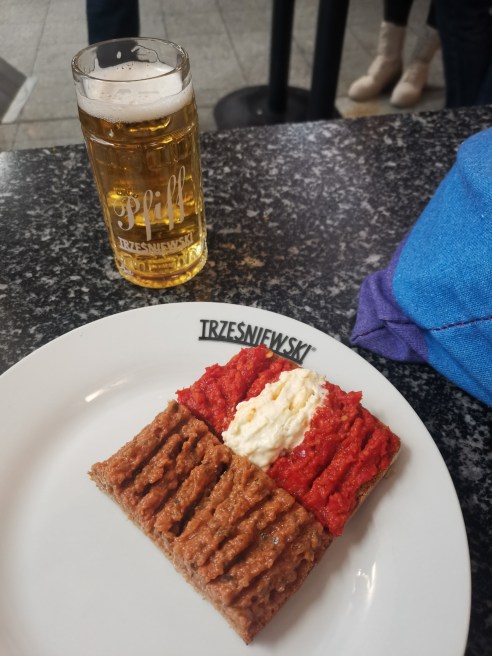
The next stop was Trześniewski 🇦🇹 a famous Vienna institution dating back to 1902. Our first visit here, interest was piqued when hearing about the Pfiff, a tiny beer pour (even smaller than Cologne’s 0.2l Stange glass. As you’ll gather from the name, the founder was Polish, and the format feels somewhat similar, a tastefully retro snack bar with casual tables, the premise is simple. Choose a few finger sandwiches and a Pfiff (In this case Ottakringer Gold Fassl), enjoy a quick chat with your friends and head back. I enjoyed how, similar to a tapas bar, you can be here for a good time not a long time. A truly satisfactory experience here can last no longer than 10 minutes! Something about it is peculiarly addictive. It’s also directly opposite Café Hawelka, so you can stumble out of one and into another (and back again – those sandwiches are good).


Somewhat of a tradition, a trip to Gösser Bierklinik 🇦🇹 followed. A historic restaurant with a Schänke to the right as you enter. The best time to visit here is in the heart of winter, enjoying cosy surroundings in a natural atmosphere, with the occasional sound of horse clops hitting the cobbles outside. A rainy Spring day would have to do. Stiftsbräu Dunkel is the best beer on offer, a delicious rich dark lager.


It was time for a break after all that, and we took it easy in the evening, with food at Gürtelbräu 🇦🇹. This pleasant multitap pub is based in railway arches and a nice modern venue, dimly lit and using the natural ambience of the space, but it was disappointingly not boasting any of its own beers. A reminder to never assume in Austria or Germany a place brews its own beer just because ‘brau’ features in the title. That said, Vienna’s best mainstream beer, Ottakringer Rotes-Zwickl is permanently on tap, so we got over that news pretty quickly. They narrowly missed an inclusion to the guide as it was ridiculously short staffed and the food was pretty mediocre for the price.


The penultimate stop for the evening was a 2nd visit to Mel’s Craft Bar and Diner 🇦🇹. A central beer specialists in a modern, diner style room, we still found the environment oddly sterile despite the warm colours. Stuffy, overly lit, lacking charm and lacking an identity – something a large beer list can never compensate for. The fact we even returned was due to the unexpected closure on the day of Philosopher Bier Bar, an unpretentious little pub that adroitly drums up a comfortable, non-bland social atmosphere which we’d far preferred to have been in.


I thought it best to end the evening somewhere new. Perhaps not the most original choice, but we paid a visit to Delirium Café 🇦🇹 a sort of franchise that has spread across Europe. A curved bar with plenty of space, but lacking atmosphere and perhaps importantly for a Belgian café, short on satisfactory drinks options. The glass of Tremens ordered was also comfortably the worst I’ve had on the continent. Online reviews seem to confirm our suspicions that it was all a bit mediocre. This is an ongoing problem with the very centre of Vienna where a couple of beer bars like the above can prove popular simply due to the absence of competition. Perhaps we learnt something that evening – to not settle for mediocrity on account of convenience.


Day 3 – Final Day in Vienna 🇦🇹

After a dollop of morning culture followed by a dollop of mustard on some Vegan Würst, a 1st visit to Café Sperl 🇦🇹 kicked things off. A city institution, this was always likely to be more of a café than bar, and so it proved. We had hoped there may be a bar like atmosphere with the preserved 1880s interior, and its position as a social fixture, but the ceilings are too high, service is too formal, and the crowd too café like for it to be eligible. That is not to say I disliked it – an Einspänner (espresso with whipped cream) and slice of Sachertorte were delicious and the sense of institution was tangible. But it is a Café, not a bar, somewhere that feels rather like a treat to oneself, a private rather than a socially minded decision.


As we walked back into the city centre a quick search for potential bars uncovered a venue I had missed during cumulative hours of online trawling over the last 8 years. Amazed this slipped the net, Gutruf 🇦🇹 was a wonderful experience! Family-run, a cult Beisl, small informal and preserved venue with a 1970s era appearance. Homely, personalised and distinctive, with a hybrid menu of Chinese and Viennese cooking. The place even hides in plain sight, the street frontage suggesting a barbers or clothes shop that shuttered decades ago. A place you can go for a drink and a chat just as easily, there is an easy informality that belies all preconceptions and lived experience of Vienna’s stuffier pub-restaurants. We recommend.


There must have been 20 minutes to spare in the centre – ah yes, a wait to visit the Cathedral and climb the tower – because our notes confirm we were back in Trześniewski 🇦🇹 munching on sandwiches and sipping on the little Pfiff!


After a very active day out we went back for a rest to recover for the evening.

That evening we paid a 2nd visit of our trip to Känguruh 🇦🇹 . When one of the Top 100 Bars in Europe is on your doorstep, you can’t waste the opportunity!


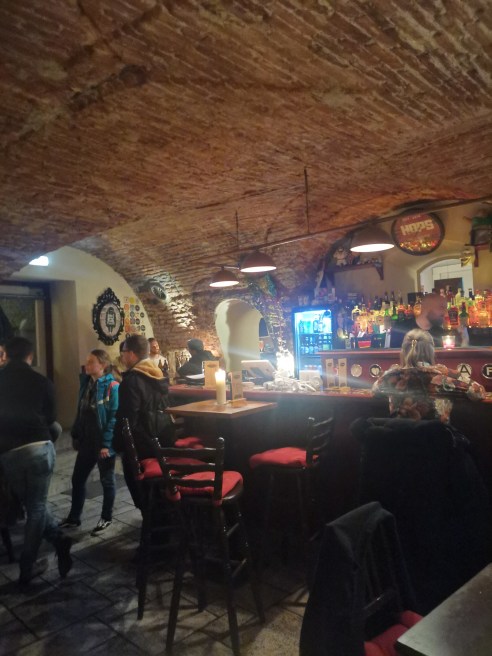
There was time to try one more venue for the first time – and it was a big one – Jazzland 🇦🇹. A long-standing cult Jazz & Blues venue set in the basement of a 500 year old building, everything jumps out at you immediately to suggest this is going to work. And it does. Tucked around a side courtyard, descend stairs to a ticket counter and clothes room, paying the nominal fee (5 euros in our case) to enter a busy little theatre and basement bar in a warren of rooms. Brick vaults decorated with black & white photos of famous (and not so famous) performers that have appeared over the decades. Drinks are decent, all things considered, with Zwicklbier and Dunkel on tap – not the worst outcome for such a venue. The bar room does not allow for much viewing access, so try your luck in one of the niches or wait until a seat in the main room becomes free. An excitable crowd that sense they are part of the best thing going on in Vienna at that moment – a sensation that leaves a lasting impression. Mark this place on your map – we have.


Day 4 – Graz 🇦🇹

Graz in the southern Styria region is a pleasant 2 hour-something train journey from Vienna, passing by some steadily more scenic and hilly areas (still nothing like out West). With the highest peaks still snowcapped, there was plenty to look at on a pleasant sunny day.


Graz 🇦🇹

On arrival, the best way into the centre is via tram. Somewhat similar to Ghent 🇧🇪 in layout, the very centre is just distant enough from the station to warrant a ticket. The central Hauptplatz stop drops you off in the dead centre of town, with its beautiful pastel coloured buildings and the looming Schlossberg and clock tower overlooking the Altstadt.

Unlike Vienna and Linz, Graz’s old town is happy to wear its cracks and peeling plaster, adding to its sense of historic character, and is UNESCO-inscripted. A small centre, once there pretty much everything is walkable providing you’re relatively mobile.

Before our 3pm hotel check-in we started at Bierboutique 🇦🇹, a bottle shop with some space for drinking in. Service was friendly and helpful, the selection offering a decent range of regional beers and plenty of pricier specialist mixed fermentation stuff. A Witbier dedicated to the Bosniaks was an unexpected and rather random find, but also a good one! As for the venue, it isn’t somewhere you’d go for an evening drink really, with it feeling more like a spot for a quick tasting than a social venue.


Up through the old town and through the city park to one of Graz’s Bauzatslokale. Let’s address what that is first. These ‘kit bars’ are owned by the same company and dotted throughout the city. The concept is that your food – be that pizza, salad, burgers, etc is completely customisable, and you fill out your bingo card according to your needs. Reasonably priced and therefore popular with the University population in the city, these breathe life – pub life – into Graz’s cultural scene. Of those concerned, some are better than others, and in our opinion Grammophon 🇦🇹 qualifies as one of the most pubby, with a genuine ‘local’ feel, somewhere you could pop into to say Hi and relax with friends. A wooden interior natural communal seating around a central bar, and ‘worn-in’ feel that tells of many happy nights spent here. As with almost all pubs in Graz, the not-very-nice Puntigamer lager is available on tap, along with a host of other mid-brow options.


With good weather on our side, a walk up through the Schlossberg (yes, direct through the rock) to the clock tower with beautiful cities views followed, before dropping down back to the city centre.

Occasionally we will drop into businesses on a whim if they look good and today was one of them. Maggie’s Leberkas Stadl 🇦🇹 a venue we were hitherto entirely unaware of, was full of locals mid-afternoon and it looked as though they were having a great time. With a meatloaf counter and stools opposite a bar you may begin to wonder if this is some arch hipster venue – far from it. Decorated in a slightly camp – but very Germanic – way, full of friendly – rather drunk – middle aged folk, here is where pretense – and perhaps decorum – goes to die. We both enjoyed the refreshingly no f’s given environment and the fact a pub was actually busy during the typically dead hours of the day, but can’t really justify its inclusion.


The next stop before a break for a rest + dinner was the inverse to the previous place. Thirsty Heart 🇦🇹. Better beers, plenty of artifice and pretense, but no soul, and fewer people – sullen staff weren’t exactly filling the void either. A slate grey room, you look around for something to hold on to other than the glass of beer – and it isn’t there.


After a stomach-lining dinner we took a walk out to Graz’s University district, a pocket of nightlife around Zinzendorfgasse. Here, the best Bausatzlokale, Posaune 🇦🇹 can be found. Another bar with a natural social shape that invites mixing and encounters, producing a dynamic atmosphere. The place is also a worn-in, homely sort of pub that you can hang out in at quieter times. Our 2nd visit here and definitely not our last.


Our next selection, back in the centre was a bar I had mulled over going to in September 2022 until I walked into the middle of a Pub Quiz and a crowded room. This time however, there was ample room in Hops Craft Beer Pub 🇦🇹 which was a pleasant surprise – less of an ex-pat/tourist crowd than expected, and much less ‘crafty’. Instead a healthy mix of people that injected a good sense of social character in historic vaults that are tastefully decorated. It doesn’t hurt that there are several nice beers here – something that should never be taken for granted when you look around Europe.


Tiring but with enough in the tank for a nightcap, a 2nd stop at Brot & Spiele 🇦🇹 an unusual venue. Large, with a pub room and games area, on my first visit I found the environment fell well short, but this was because I was hanging around the games area, having walked past where I should have sat. Walk left into the pub itself which is a pleasant enough place decorated with some classic breweriana and furnished with communal booths. The beer selection is atypically excellent for a games pub. While perhaps not cutting edge, plenty of better traditional options are on offer on draft and tap. Would it feature on our guide – no, that would be a bit of a stretch, but it is good enough to have in your pocket as an option while in Graz.


Day 5 – Graz and Arnold Schwarzenegger 🇦🇹

Arnie’s childhood home is in Thal, a picturesque village that’s a short bus ride and pleasant country ramble from Graz. After morning coffee we took a literally last minute decision to attempt to visit. This was a little reckless given the buses out there are very infrequent. But, as normally happens, everything turned out fine. The museum is small and the entrance fee a little steep, but when were we next going there? (never) And when are we ever going back? (Also never). Underplaying Arnie’s Dad’s far-right leanings with some expert deployment of euphemism, overall it felt more appropriate that the experience emphasises the general cheese and gurning, simple-minded good vibes Schwarzenegger delivers.


Our first visit of the day was an adventurous and novel one. Before now we had only read about Heuriger culture in Austria. These taverns are often family affairs, wine producers with a hospitality focus, often putting on spreads and buffets to accompany their wines. Normally these are based in the hills but occasionally some pop up on the fringes of cities. We were fortunate it wasn’t too difficult to visit Lucky’s Heuriger 🇦🇹, a venue out in the suburbs but just about reachable via tram and bus after a walk. Completely local with a homely, pubby environment inside, full of personal touches that feels like being in someone’s lounge. Wines and the buffet were both simple but distractingly good quality and came in at good value. The cuts of meat were close to par with a meal I had paid over triple for the previous evening. Hospitality was as good as advertised, and the slight adrenalin rush of going somewhere largely untouched by tourists did the rest. An experience we will revisit as soon as we can.


Spring was finally arriving and we enjoyed spectacularly good ice cream from Die Eisperle in Jakobinplatz in the nearby Blumengarten, a little tulip-laden fountain square that begins the run from Herrengasse towards the Hauptplatz. The sugar rush sustained a trip around the Landeszeughaus, the biggest collection of Medieval European armor in the world. Afterwards, we took a walk up to Kaiser Ferdinand II’s mausoleum, a typically extravagant and hubristic affair, but at least such things are entertaining centuries on, better that than some dour alternative!


After a break from these cultural exertions it was time to venture out for the evening beginning with Bier Baron 🇦🇹, our 2nd visit and the 3rd of these Bauzatslokale. This visit really showed off the pub’s charms versus a quieter afternoon last September. While it may be too mainstream for some, a simple versatile format shows why it’s a hit. A DIY pizza and Zwicklbier later, and we were fuelled for the evening ahead.


Our next stop was an intriguing cocktail bar named The Churchill 🇦🇹, which fell somewhere in between student hangout and gentleman’s club (Oi – not that kind). Despite pretensions to exclusivity, the atmosphere was pretty informal and cordial with a mix of people, while the cocktail menu offered classics on top of their house specials. While there is some amusingly dodgy framed art, taking a balanced appraisal of the bar’s appeal overall, it deserves an inclusion to our guide.


Further down the hill in Graz’s attractive moneyed suburbs of Geidorf is Humboldtkeller 🇦🇹, a surviving old family-run Beisl. Longstanding but with very little presence and recent reviews to suggest it was still open. We are glad to confirm it is going strong. Friendly service, Yugoslav pub grub (which is very much not the focus), candlelit tables and attractive curved ceiling is a flavour of what to expect at this quaint, atmospheric little hideaway that has deservedly become a cult hit in Graz over the decades for Jazz & Rock, and cosy atmosphere. We liked it.


Our last stop was back in town, a basement cocktail bar that was locked up on a previous attempt. Caffe Hallo Josephine, 🇦🇹 was a little short on online presence but with plenty of glowing reviews. In the end our experience fell below that hype. Kindly service in a tiny little basement, it was not without charm but lacking a few flourishes in the décor, while the cocktails appeared to be constructed without much assurance.


So there is Graz. Our 2nd visit to the city, this is not a place lacking in decent options for both beers, cocktails, music or community events. It lacks that one killer venue I suppose, though that is no great crime. After a night’s sleep it was time to move on and visit Slovenia for the 1st time since 2014!


Day 6 – Slovenia 🇸🇮 – Maribor & Ptuj

The journey to Slovenia from Graz is about as straightforward an international crossing as you can find, without much delay or bureaucracy, you will land in Maribor train straight around an hour after departure.

Maribor 🇸🇮

Maribor is a nice little town – particularly its unheralded central square and riverside – and will make an acceptable half day/evening for tourists interested. After a look at its modest, vaguely unwelcoming cathedral, we were quickly en route to Pub Gambrinus 🇸🇮, a little place that specialises in Czech 🇨🇿 ales and lagers. Noticing our conversation in English, the owner introduced himself and explained his connection to a roster of beers that are frankly extraordinary to find outside Czechia – and would be pretty damn good to find in Czechia too. Aside of that aspect, it’s a characterful little knajpa, clearly inherited from a previous operation, worn wood, raised seating area and street terrace. While some of the signage veers towards those inane beer sayings and even worse, ‘Live Laugh Love’ type stuff, that is ignorable.


Before moving onto Ptuj there was time to visit Kavarnica Rokaj 🇸🇮, a very down to earth Caffe Bar by the river, currently engulfed in building work. With a surprisingly good beer selection – including local craft, I couldn’t fault the produce, or the soundtrack, but unfortunately the venue is the typical awful Balkans café bar mess.


Following a minor train delay, we even had time in a 3rd Maribor venue, Shakespeare Pub 🇸🇮. A battered old theme pub with wood fittings, it at least vaguely resembled a pub. Staff who appeared to be about 16 years old churned out the typical rubbish lagers, so it was time to get a bottle of Laško, as vile as I remembered.


The journey to Ptuj takes a frustrating L-shape, and a delay backing our of Praguersko ended any prospect of reaching Ptuj castle before closing time. This just left us with a wander around, and it is a very pretty little town.

Ptuj 🇸🇮

A wine producing region, we had hoped to go somewhere to try local wines, but unfortunately none of the cellars were open. We were invited to have some wine at the bar at Hotel Mitra, 🇸🇮 one of the potential wine tasting venues in lieu of their cellar tastings, but it was a drab experience and one of the real wastes of time of the trip.


Ptuj is home to the Kurent, a mystical character who chases away winter to beckon in spring, and it certainly felt like they had paid Slovenia their annual visit on this warm sunny April day. One of Ptuj’s cultural centres is Muzikafe 🇸🇮, a historic building and one that enjoys minor national fame. The interior is a warren of rooms in a café lounge style, warm 1990s type hues with sofas you can sink into and large books to lose yourself in. So far so normal – but the venue is brought into interest with its courtyard area with creative metal art installations and seating niches, which comes alive in the summer months – it is worth mentioning a few superior beer options in the fridge too. Certainly in a small town like Ptuj it shouldn’t be overlooked.


After a meal and a rest we ventured out to a pub we were confident would deliver – we had researched it in advance but it was also mentioned by the bar guy at Gambrinus in Maribor. In the commercial centre of Ptuj you’ll find Kavarna Bodi 🇸🇮 occupying a tall Austrian-era building. This cultural centre, bar and café similarly lays on the amenities for the public, but has more of an edge and relevance. On arrival we were nearly turned away after the limited seating at the main bar was taken. Staff explained a live performance was ongoing in the main room with a 15 euro entry fee, however after some negotiation we were allowed to enter, and enjoyed the last half hour or so. The main room with its tall ceilings and eclectic furniture and installations is cosy, instantly likeable and obviously one of the region’s best social spaces. The experience was accentuated with a very decent beer selection that will keep most tastes satisfied. After the gig and a little exploring of the premises we returned to the bar room to find an available table, and had a 2nd drink in the fairylit surroundings of the bar – a nice place indeed.


A drunken walk home allowed just enough time to visit local’s bar Orfej. While the other venues have their particular charms and audience, this was clearly the pub where the Ptuj residents, those with a stake in proceedings perhaps, hang out. We got the predictable few looks on our entry and were almost caught out by their closing time. Busy and bustling, it had plenty of atmosphere but overall was lacking a little in a distinctive appearance, and perhaps a little in terms of hospitality. We were ushered out pretty promptly at last orders.


Conclusions – and the road ahead!

Visiting Graz and Vienna relatively soon after our last visits in September 2022 was a good opportunity to reaffirm some initial impressions and build on our exploration of their bar scene. Vienna ended up being a success with some excellent bars added to the guide, whereas with Graz we mainly built on breadth rather than depth.

Slovenia is, as always, strikingly beautiful and it is nice to see most venues we visited going beyond the Union and Laško beer options. It feels like we missed out on some of Ptuj’s best bits, which is a source of regret when you may not return for 10 years, but at its bar scene was certainly not neglected.

In the next 6 days we would cross over to Croatia 🇭🇷, visiting Varaždin for a night and the capital Zagreb for 5 nights, both places we had not visited for 10 years. Would they yield the next great inscription on The European Bar Guide? Watch this space!

Le Pot Au Lait, Liège

9.5/10

Le Pot Au Lait: A surrealist masterpiece and rite of passage.

Address: Rue Soeurs-de-Hasque 9, 4000 Liège, Belgium
Nearest Station: Liège-Carré , 10 mins walk
Opening Hours: 11am-4am Monday-Saturday, 2pm-2am Sunday (Due to Coronavirus restrictions this may change, so check with the bar directly for any latest info)

History
Le Pot au Lait is located on Soeurs de Hasque in the heart of Liege. Number 9 is a magnificent house from the 19th century built over an ancient convent which held, from the end of the 15th century, sisters from another convent from Hasselt, a Flemish city, being often called “Haske” in Liege, “The Sisters from Haske” gave their name to the street. Here is how the bar was founded:

“In 1973 a group of students created a place that until then had never existed in Liège where they could organise films, concerts, debates, theme days, free of any official politics. They found what they were looking for at No 9 Soeurs de Hasque Street and it opened as “Trou Perrette”.

In 1979, it became obvious that a second bar was needed next to the “Trou Perrette”. So we needed a name and after a brain storming session came up with “Pot au Lait” in reference to a fable from a french poet, Jean de La Fontaine (1621-1695) called “The Dairywoman and the Pot of milk”.

In 1981, the Trou Perrette closed its doors for the last time. But now you know why the Pot-au-Lait became the Pot-au-Lait


The Pub

These days, Le Pot Au Lait continues its historic function, being the beating heart of nightlife and social affairs in the city. It would be untrue to say that this is a student venue either, more a youthful rite of passage that stays with you afterwards, one of those rare things, a pub you keep returning to over and over long after the early years.

Set off the main street, you will enter through a narrow courtyard, already spying the decorations festooned left and right. Some people will be hanging out on the terrace. The place gives off good vibes straight away.

Then, enter through to what at first appears to be a greenhouse, with uneven flooring. The ethos is akin to Hundertwasserhaus in Vienna, with a commitment to uneven surfaces, and heterodox approach. To call it distinctive is underselling it. Cartoon gorillas, carnival scenes, macabre taxidermy, graffiti, tall plants and more that would take too long to describe. Le Pot Au Lait is the funfair that got lost one day and decided to lay down roots.

Like some of the best bars in Europe: Szimpla Kert, ‘t Brugse Beertje, Zlatna Ribica, to name but a few, the place has an immediate draw that comes from sensing that everyone is having a great time, the excitement of being in the place to be.

It’s pretty cool too that Le Pot Au Lait is located somewhere like Liége. No, not somewhere fashionable for the nightlife like Brussels or Hamberg or Copenhagen, but this down-at-heel working class city in Wallonia.

Anyway, it’s time for a drink, don’t you think? You’re very well served here with several tap options and a suite of bottles covering a reasonably broad range of Belgium’s better beers. Perhaps they could serve a few more specialist options for the sniffier customers, but there is something here for most beer drinkers. Being popular with a younger crowd, there is also a reasonable selection of alternatives. You’d think this might be one of the more expensive venues too, but some choices appear genuinely cheap, and will certainly come across that way after a few days in the much more expensive end of Belgium.

Once served, plonk yourself among the communal niches surrounding the bar, the atrium (good for people watching), the mezzanine level or any little hidey-hole that suits your needs. Go for a wander around, because this is an art gallery as well as a bar.

Le Pot Au Lait has maintained a commitment to culture and the arts, so while we’d be perfectly happy if they just served drinks, it deserves extra commendation for hosting live events and being a communal meeting spot. Long opening hours mean this is a versatile venue that suits a quiet afternoon hangout or raucous late night drinks, each enjoyable in their own right.

We give bars a 10/10 rating when they are reasons in and of themselves to visit a place, and Le Pot Au Lait certainly justifies that.

Au Delft, Liège

There is a certain delight in finding a diamond in the rough, not least when it’s a brown café. Liège’s careworn and ramshackle districts provide plenty of rough – this is not a city that has enjoyed the most tasteful town planning, nor preservation of its heritage. There are quirky features and surprising beauty spots if you are determined to find them. Impasses, a giant staircase, quiet side streets, timber framed buildings sprinkled across the city, and upon arrival a dramatically different (if annoyingly distant) ultra-modern railway station.

This city is certainly not one to write-off, but on a grey weekend, the place seems overburdened with regret about its numerous ill-maintained architectural mistakes, not to mention the inevitable results that come from relatively pauce economic circumstances.

Wallonia is not the well-to-do side of Belgium these days, and hasn’t been for a long time. While it is breathtakingly beautiful in its rural areas and some small towns, a visit to its cities (the likes of Charleroi or Liège) is more than a tad reminiscent of the atmosphere you’ll find visiting dour towns in Northern France, especially in comparison to the well-financed Flemish cities of Ghent and Antwerp.

However, a reliable general rule is: the more hard-nosed a city, the worse its climate, the more likely it will be crammed full of drinking holes. Liège proves this quite adequately, as a cursory search will reveal, you can barely turn a corner in the centre without bumping into some bar or other, while certain streets have a local notoriety.

Some bars, such as Taverne St. Paul, Café Lequet and Le Pot Au Lait are, for their own differing reasons, Liégeois institutions, the bright lights that draw everyone in (those with good taste, anyway). However, today we are going to focus on a more understated city centre venue, Au Delft.

This slideshow requires JavaScript.

Au Delft is a corner bar situated in an art deco influenced grey-brown brick city building with a quarter-circle frontage and circular windows running down each storey. The structure is non-committal and the materials used are unattractive in colour, so the impression lands in an uncanny valley between noticeably funky and downright ugly.

It doesn’t seem as though this would contain anything preserved except perhaps the embryonic ego of a reckless architect, but one look at the Jupiler signage, and the ground floor bar indicates that something interesting may be inside – or at the absolute very least, somewhere to buy a beer.

Step inside under a large dark green awning to discover a well-preserved bar blending stylish décor (appearing to span from the early ’50s to ’70s to my eye), with features and fittings that regularly appear in brown cafés, one of my absolute favourite styles of bar. Their name itself references a medieval town in Western Netherlands, a heartland of the brown café or bruine kroege.

That Au Delft now feels frozen in time is no accident – they knew they were onto a winner with this place and haven’t altered the format. Unlike the thousands of idiots who have vandalised amazing pubs and bars over the years, the owners have chosen to retain what made it special and ignored the nearly irrepressible human instinct to follow trends.

The bar area itself is magnificent. Faded with age but handsomely redeemed by its character. This scene is juxtaposed with a chess board tiled floor, which wouldn’t be my preferred choice usually, but works brilliantly for this place.

Some small details set this place apart, without adding clutter. The newspaper clips, the beautiful painted lettering on the mirrors which are installed in the partitions above crimson leather-backed seats. Indications of present tradition and ritual mixed with a melancholy legacy of days that are long gone, never to return.

Some of this reminded me of Au Daringman, in Brussels, another out-of-time venue,  that exudes confidence and contentment in what it is.

If you are used to paying 4 euros 50 for a quarter litre of beer in Brussels bars then you will scarcely believe your eyes when you discover the prices. Yes, pleasingly these are pitched to attract the custom locals rather than fleece tourists, but when allowing for Au Delft’s city centre location it comfortably beats some of the local competition too.

del8

Au Delft are not competing with those bars that are trying to start their own seed bank of beer for when the human race faces extinction, but they carefully tick off most of the main traditional Belgian beer styles and none of these could be said to be poor value: far from it.

There is actually something relieving about being spared the task of rifling through a Bible to choose between hundreds of beers and dozens of styles each time you desire a drink.

With my limited French I struggled a little to get my point across (there’s nothing more confidence-sapping than delivering a sentence which you are fairly confident is grammatically correct and well-pronounced only to receive a reaction of complete opacity and confusion) but thankfully the service was more than kind enough to offer patience in that regard. Any beer you select will be served to your table along with a small tray of nuts, which is a little token of mutual back-scratching I always like. After all, once the salt gets to work, further liquid is required.

The crowd in Au Delft is a mixture of loyal older regulars who have instant recognition and are well cared for by the staff. You will also find couples wanting a quiet drink and the occasional group of young friends.

IMG_20190302_193325

Au Delft has a nice convivial atmosphere whether quiet or busy, partly down to the carefully preserved décor and sense of refuge. It is both an excellent place for quiet contemplation or jovial conversation.

I was on limited time and so could only stay for a couple of beers, but I could have easily remained in Au Delft all evening. The impossible prospect of turning a place into my local, to get to know the other staff and become part of the fixtures of the bar are often one of the melancholy aspects of travelling. Often I am happy just to have found the venue and spent a night there, but Au Delft is one of those places I suspect you can only truly ‘find’ when you have visited for many years.

While Au Delft may not be the first name on everyone’s lips when it comes to nightlife in Liège, their quietly confident style, preserved features, genuine local life, friendly service and great value mean that it can’t be missed out and it comfortably earns a place on our guide as being one of the best pubs in Europe.

Our Rating:  8/10

Quality and/or choice of drinks8/10

Style and Decor8/10

Character, Atmosphere and/or Local Life8/10

Amenities, Events & Community – 7/10

Value for Money8/10

The Pub-Going Factor8/10

Location
https://goo.gl/maps/vYzrgmhtpQ8cixuw7
Address
Place Cockerill 22, 4000 Liège, Belgium
Website
N/A
Telephone
+32 4 221 45 70

…back to Belgium


Domkeller, Aachen

back to Germany

  • Quality and/or choice of drinks – 8/10
  • Style and Decor – 8/10
  • Character, Atmosphere and/or Local Life – 10/10
  • Amenities & Events – 7/10
  • Value for Money – 7/10
  • The Pub-Going Factor –  9/10
Hof 1, 52062 Aachen, Germany

Although it shouldn’t, it comes as a surprise to me, as much as a relief to have located a cosy, non-corporate pub slap-bang in the middle of a European city centre.

However, Belgium and Netherlands make a habit of it, and these nations just so happen to be Aachen’s closest neighbours.

This German border city and the Low Countries (either of which can be reached in an hour walk from Aachen centre) share a host of cultural cues, with the city itself having initial importance as a Roman spa town before the cult of Imperial Rome spawned Charlemagne and the crowning of 31 Holy Roman Emperors in the subsequent centuries. Aachen also enjoyed a position as a major trading point between nations, goods and wares shipped from the North Sea ports, which may help explain the cultural overlap.

Don’t be under the impression Aachen is any less German for it – believe me, Aachen is a firm fixture of Nord-Rhein Westphalia, and this mixture today results in interesting blends of buildings as you walk around town. Its town hall and surrounding Gothic buildings in the Altstadt could as easily appear as far away as Ghent or Nijmegen without raising any suspicion, but similarly, the remnants of the city wall and the post-war reconstruction are as German as it comes. The cultural centre of Aachen isn’t a large ensemble of buildings when compared to some places, but they are nonetheless impressive and occupy a bigger portion of the city than Cologne or Dusseldorf’s old towns, for example. Aachen is easy to get to from virtually anywhere nearby, and its attractions justify you spending a night here.

Domkeller is situated in the heart of town in an attractive brick townhouse on the small Hof square (you know you’re somewhere central when Hof appears). The scene is made all the more picturesque by a ruined arch halfway along and the distinctive houses that line the square, all fitted with huge grid windows of the kind you normally expect to see on Burgher houses.

This slideshow requires JavaScript.

The risk is that Domkeller could so easily be one of those common tourist traps and a let-down given its advantageous situation. Instead, you will find the opposite is true.

Domkeller is neither based at the cathedral, or in fact a cellar venue (that ceased to be true in the 1980s, apparently, due to safety regulations), however its proximity and age, dating back at least until the 1950s justifies a name of such significance.

This pub enjoys a handsome trade of local people both young and old who are happy to sit and socialise among the odd tourist (such as myself) or group of businessmen that are passing through.

It’s a place that invites interactions with other people; that magic chemistry where strangers who would otherwise be ignoring each other feel they can cross the divide. That alone would be a good reason to include Domkeller on our guide. Aside of that – the antifascist sign near the entrance is proof that many of these elements go hand-in-hand.

Be assured, the appeal doesn’t stop there. As you walk in through a corner door you will find a cosy room with bar area to your right and communal bench seating with fixed small tables. To your left is some chunkier furniture and further benches. Beyond the bar area is the second part of the room, which again is based around bench seating by the walls and has the effect that most of the time you are spent in an enclosed space where you are looking at and interacting with what’s inside rather than what’s outside.

Domkeller accepts orders at the bar but keeps table service operating and prefers that – it is quick, attentive and polite without being too formal. You’ll be needing a drink of course, and here is where Domkeller comes into its own.

The choices of beer are certainly quality over quantity, but even this selection is encyclopaedic when compared to most German venues. Here at Domkeller, several bases are covered. They have various styles of German beer on tap covering Kolsch, Altbier, Landbier, Pils and Hefeweissbier – most of which are from medium-sized, not corporate breweries – and a suite of Belgian bottles which are mostly the familiar Trappist and Abbey ales, but nonetheless hugely welcome in a nation that is not fond of selling beer brewed by anyone except themselves. Believe me, travel east from Domkeller, stop in each pub you find and it will be a long time before you see as many Belgium beers again.

The atmosphere is also quite fitting for drinking whisky, something which the management appear to have recognised a long time ago – take a look at the drinks menu for a few interesting options.

Prices are along the typical level for this part of the world – perhaps cheaper than Maastricht up the road, a little cheaper than Cologne too, though perhaps a little more expensive than Liege and the rest of Wallonia, which is after all a poorer region of Belgium than Flanders. For a city centre venue, it’s fair value.

Domkeller’s website claims their Weinstube (the upper floor, accessed via a central staircase by the end of the bar) is converted into a small concert hall every Monday night, which I can imagine drumming up even more atmosphere in this place. These start at 8PM, and the pub won’t accept new entrants after 7.30PM.

The upper floor is a lighter shade than the downstairs with a surprisingly high ceiling, though still decorated in a simple, traditional style. There is a gently sloping roof at one side of the room which adds a bit of character. I would rather be downstairs, but would certainly accept a seat upstairs if that was what remained.

Domkeller have a relaxed attitude towards bringing food into eat, which is a refreshing change and shows the sort of pragmatism that people who know pubs recognise but accountants do not. Clearly any food is going to make a person thirsty for more of their fine beers – who loses?

Have I mentioned the opening hours yet? Bloody brilliant! How many cities have I been to that practically shut up shop by midnight? A lot. Too many. Expect Domkeller to serve your needs well into the early hours of the morning, in fair weather or foul, throughout the week.  This, along with the friendly company and Belgian ales explained why I found it very difficult to leave and go to bed!

Speaking of weather, the place throws itself open as the weather improves, with outside seating on the square. This is of course a pleasant place to sit back and enjoy the sun, but the true character of the place is indoors in my opinion, a wonderful refuge from the bitter winter weather – the core creation should be at the core of the appeal.

Across Europe, places like Domkeller, based so close to the centre of the city, have ceased to be cult venues long ago and sold out to middle aged tourists to become a generic café.

It’s great to see that the real character of Aachen endures and therefore we say, ‘long live Domkeller’ – and hopefully see you again very soon!


Café Mulder, Amsterdam

back to Netherlands

Weteringschans 163, 1017 XD Amsterdam, Netherlands
  • Quality and/or choice of drinks –7/10
  • Style and Decor – 8/10
  • Character, Atmosphere and/or Local Life – 8/10
  • Amenities, Events & Community – 7/10
  • Value for Money – 6/10
  • The Pub-Going Factor –  8/10

Picture the scene: Amsterdam in winter, one of those dire evenings when gales blow in off the North Sea all the way up De Pijp, whipping sleet in your face. Meanwhile, the going underfoot lurches from ice rink to quagmire with each step. Checking to your right for the cyclist that probably isn’t there (but inevitably will break your arm the one time you don’t bother checking) – and then left to see if any motorists fancy testing how well their airbags work. Each movement of your leg invites a splash of freezing sludge and fresh test of your balance.

Across the roundabout we spot a window glowing like a beacon, heat from the room condensing on the glass, the silhouette of drinkers and the sound of good cheer – it’s a pub – rarely has there been a more fine or  welcome sight.

Shuffling precariously across the ice I spot the sign above the bar confirming the establishment and nothing can stop us now. While there isn’t video evidence to prove otherwise, you may take my word for it, I’ve never homed in on an Amstel sign with such vigour and enthusiasm.

Amsterdam is well-used to this appallingly unpleasant weather and therefore well-prepared in its provision of shelter and booze. In late spring and summer Café Mulder flings open its doors and spreads out into the street front, but on a night like tonight this traditional brasserie turns into a refuge.

Being hugged, wrapped in a fresh towel and ushered inside would be the ideal welcome, but the blast of warmth and prospect of a stiff drink ably substitutes.

The pub was as busy as it looked from the outside, full of folk relieved indeed to be anywhere except outside. Now, ensconced among a mixture of regulars and tourists, a drink and a chat will do the trick very nicely.

Seeing an Amstel sign would normally be a bad omen, but their sickly dross is ubiquitous in the city and it’s genuinely more difficult to find such a place that doesn’t also serve other, better beer. So, here you can choose between a pint of that insipid liquid or a smaller portion of something far nicer for the same price.

Outside of craft beer enthusiasts perhaps, it’s difficult to think that beer drinkers could be too upset by the selections here, especially as the place isn’t wholly beer-focused. The likes of Brugse Zot and De Koninck on tap, and at least 7 or 8 genuinely good bottles provide a stock that, while it could be better in variation and sizes, covers several bases well and isn’t going to let too many people down.

It’s nice to see that the place provides a small selection of food rather than turning itself into a dining room, so if you fancy wolfing down some soup, toasties or bitterballen (I wouldn’t blame you in weather like this) get involved. You can even get a hot boiled egg – very old fashioned and it doesn’t take away from the pub feel.

There’s a bit of extra character too with a pub cat and you’ll note it claims to be the most authentic pub in Amsterdam“. A bold claim (not one it backs up in any way) but this is really for you to explore and see for yourself.

Ronald Pattinson of European Beer Guide fame – a man worth listening to about Dutch brown cafés – commented:

“I’m still regularly pleasantly surprised by Amsterdam’s pub scene. While simple, unpretentious cafés like this survive in such numbers, I’ll pass on the razor blades.”

Mulder fits into the brown café aesthetic beloved of the Low Countries but has a hint of the French brasserie to my eyes, with enormous windows and a more classically corner bar layout.  The pub-like elements come from an impressively ornate bar area and shelf unit, the stylish old décor, rustic furniture and the type of socialising going on within, which certainly on a bitter night swings towards the communal. The sense of history helps too, with a lot of features looking turn of the 20th century.

London is blessed to have a huge number of pubs in the same way Amsterdam does, of a variety as-good-as-duplicated many times over. However, with a few exceptions, many of these London pubs have been made more generic by unimaginative owners or pub-companies, the scourge of character and identity. In London, I suspect this place would have gone the way of Nicholsons or Taylor Walker in the last decade and had its soul expunged, but pleasingly, one of the nicest things to say about Café Mulder is that it is not unique, it is not an oasis surrounded by a desert, but it’s common, frequent to find and that’s what makes Amsterdam still so thoroughly enjoyable. We should celebrate the fact that a place this good is only a notch above the mean average for a brown café in Amsterdam. Is this the inverse of damning with faint praise? I hope so.

Anyway, to boil it down, Mulder is a great place to go for a drink, and you know what? I managed to write all that without a single X-Files joke. Cheers!

For further reading – right hit and click Translate to enjoy this superb article by Josh Wolf, which goes into the rich history of Café Mulder: https://josh-wolf.blogspot.com/2013/11/cafe-mulder-te-amsterdam-weteringschans.html


Insomnia, Cluj-Napoca

back to Romania

Strada Universității 2, Cluj-Napoca 400091, Romania
  • Quality and/or choice of drinks –6/10
  • Style and Decor – 8/10
  • Character, Atmosphere and/or Local Life – 9/10
  • Amenities, Events & Community – 7/10
  • Value for Money – 7/10
  • The Pub-Going Factor –  8/10

Insomnia in the Romanian city of Cluj-Napoca claims the title of the longest continuing pub in town.

22 years (23 in May this year) doesn’t seem to me a long time in the life of a pub, so perhaps this has something to do with the turbulence of the revolution at the turn of the ‘90s, and/or a change in cultural trends? I am from a country where so many pubs have remained open over a hundred years or more, so this strikes me as peculiar.

Cluj-Napoca is a university town and so the nightlife reflects the demands of young people. You’ll struggle to find anywhere (deserving of the label ‘pub’ at least) where young and old people mix as they would in England, or indeed many other countries in Mainland Europe. In fact it was difficult to find the sort of old-man’s drinking hole you’d expect to see everywhere. Another surprise.

https://www.youtube.com/watch?v=9nbSD5lgbqU

Insomnia is very much geared towards a younger crowd – if not young then young at heart – with bright, psychedelic décor, paint thrown up the wall Jackson Pollock style and giant lampshades covered in stretched Insomnia-logo t-shirts. About that logo – a not particularly discreet drawing of two animals humping. That aside, the place is funky and seems to have survived 15 years without looking overly dated.

You will notice from their website a rather esoteric mission statement (some of which might be lost in translation) which is reflected in the bar itself. It is the perigee between taking themselves too seriously and not taking themselves seriously at all. This must come from its early days as an art gallery. While the venue is now predominantly a bar, they still host events of varying flavours – book launches, poetry readings, the odd festival here and there.


The bar, as with most you’ll find in Cluj, is set up for sitting rather than standing, which means dealing with table service – not my favourite thing in the world. In Romania I noticed some people become rather upset when they have to order at the bar. Not sure why – getting drinks that way is quicker, direct and you can settle the bill there and then, saving everyone time and effort.

Insomnia also has a slightly different format in that they expect you to settle the bill upon the drinks being served, which took a little getting used to when most table service involves you settling the bill at the end of the evening. I can only imagine they have had some trouble with people leaving without paying – which again could be solved by switching to bar service!

The other gripe is that, quite alike other central European countries, it is possible to reserve tables in advance. Is this a good thing? In practice this hardly ever works well in a pub, as it deters people who haven’t got a reservation sitting in that spot until the reservation starts, costing the bar money and making the arrangement feel off-putting. Also, when the bar is really busy, save for two or three empty tables, simply because of a couple of reservations that may last for only one round of drinks, where is the logic there?

In Cluj, all beers seem to have arrived on the same lorry, so you can expect the local brew Ursus and its variants (which are okay at best), and other SABMiller-owned brands including some English beers. The choice here is neither great nor terrible – they have covered several bases, but after a couple of days in the city, seeing the identical drinks everywhere becomes a little dull.

Draft beer is also served in 400ml glasses, a cynical way of gaining 20% on every drink, and quite pointless given the bottle sizes are 500ml and often cheaper. It’s difficult to criticise Insomnia over any other Cluj pub for this, as it is unfortunately commonplace. The upshot is that most people order bottles, not draft beer as they are better value for money – given the expense involved in setting up a bar, this seems hideously counter-productive.

Insomnia also offer what they call “long draft”, 2.5l of beer arriving in an enormous trophy-like stand with its own tap which I saw a few people taking ‘advantage’ of.  You know you are in student land when gimmicks like this pop up.

Anyway, moving back to the positives, Insomnia’s atmosphere inside is lively and well-paced, while the surrounding décor certainly helps keep things upbeat.

Insomnia is also based on the first floor of a historic building, which I often like as bars of that sort always feel quite bohemian. Outside the bar you will step out onto the balcony walkway of an inner courtyard, the typical sort of atrium you get in ex-Hapsburg cities (especially those with Hungarian history). This situation is appealling and adds to the experience.

Insomnia can be found just a few seconds walk from the main square, which is also handy as the main squares of European cities are generally host to far more corporate venues than this. Insomnia, more than others, underlines the all-encompassing young feel of the city, not to mention a European city centre that yet hasn’t been ruined by corporatising everything.

Maybe Insomnia will continue for another 23 years to come – and onwards – or perhaps the economic tides will sweep it away. I certainly hope to find it is going strong when I return, and hope it doesn’t take me 23 years to do so!

I strongly recommend Insomnia for your visit to Cluj, primarily as a fun alternative venue, and a strong all-rounder that does a lot of what it takes to be a good bar well, or really well.

Lastly, be aware Insomnia closes at 1AM, so if you are having trouble sleeping, you’ll need to move elsewhere!

Roncsbár, Debrecen

back to Hungary

Csapó u. 27, 4024 Hungary
  • Quality and/or choice of drinks –5/10
  • Style and Decor – 10/10
  • Character, Atmosphere and/or Local Life – 10/10
  • Amenities, Events & Community – 9/10
  • Value for Money – 8/10
  • The Pub-Going Factor –  10/10

While ruin bars may be synonymous with Budapest, other cities in Hungary quickly taken inspiration from the design and ethos – it was inevitable they would create their own version. Gázfröccs in Sopron and Csillag EzPresszó in Győr both prove that the bar has been raised. Roncsbár in Hungary’s 2nd city Debrecen, is the most convincing example yet that it’s worth leaving Hungary’s megacity to explore the nightlife in the provinces.

While I love an old boozer, such as Wichmann’s in Budapest, it must be said the standards of décor, atmosphere and amenities in Hungarian pubs have shot up dramatically since Szimpla et al arrived on the scene. Roncsbár (Roncs, meaning Wreck) immediately showed that its up to the task.

Established 2013, Roncs is both a cosy pub, a concert hall, a garden terrace and a arty streetfood courtyard, delivering the alluring appeal we love about ruin bars – a combination of rooms to explore as well as cosy areas to congregate. Unlike unsuccessful attempts to export these to the West, it doesn’t feel the least bit corporate, even when you add bouncers and plastic cups (we’ll get to that in a minute).

There is no shortage of ways to spend your evening here, whether that be for a quiet drink, for food, for music and partying, or games. What’s better, the bar is designed in such a way that it never feels like those people are clashing with each other.

While not as enormous as the likes of the Fogas Ház ‘party complex’ or the ruined mansion of Szimpla, there is a fair expanse of space, and just like those it’s exciting to walk through it all for the first time.

Entering via the front door of the pub, you could be fooled for thinking that’s all there is. It is very pleasant – nothing negative to report – the area is focused on drinks and socialising rather than food – fine by me. You’ll find exposed brick and slightly ramshackle wooden tables. The ceiling appears to be studded with cymbals from drum kits (or was I wrong?). There’s a lively atmosphere and if that was it, then Roncsbár would probably warrant inclusion on our website as an 8/10 pub.

But after you’ve taken in the indoors, have a wander around and look for a side door – this will take you into the entrance way for the ruin-pub aspect proper. The design suddenly explodes into an eclectic whirlwind of bric-a-brac and, if you pay attention, some finely-crafted artwork. The cherry on top of the cake is, in this case, a wrecked (get it?!) aeroplane which looks like it has been hung, interior contents an all, to the inside of the roof.

What’s better, is this is heated in the icy winter and well-ventilated, keeping the place comfortable at all times.

Carry on past the stalls to find a courtyard seating area which will appeal to anyone wanting to watch some sport (big screen, of course) and a terrace garden area – closed on my visit due to the snowy weather – but definitely a further area to spread out in spring and summer. Barbecue? Yes please.

Drinks are about on standard with most Hungarian bars, however their website boasts they have their own-label beer from Rendelkezik (Reindeer?) which I must admit I didn’t see. It’s still possible to get a standard lager for a fair price and nothing here, be it beer, wine or spirits will offend most local or foreign wallets. If you’re outside you will be made to drink it in a plastic cup – on the upside no-one has to worry about broken glass.

Service can be a bit rushed and impersonal in that way all popular places end up being, but that isn’t a reason to mark this place down.

Unlike Budapest, there really is only one place like this in Debrecen, certainly making it stand out. There will always be one or two people of a contrary or conservative nature who take a dislike to these bars. You can’t please all of the people all of the time, but Roncsbár comes pretty damn close.

I love being able to dip in and out of events that are happening, be able to get some fresh air, or have a sit down, and still be in the same place, and still have something interesting to look at.

Please note that Debrecen has a very lively, albeit dispersed nightlife and there are several pubs of a very different style that are also worth visiting. Please see HERE.

There are only a few bars that have earned our 10/10 score, and so congratulations goes to Roncsbár. Long live the Wreck!


U Zlatého Tygra, Prague

back to Czechia

Husova 228/17, Staré Město, 110 00 Praha 1, Czechia

Nearest Square: Staroměstské náměstí

Nearest Metro Stop: Staroměstská

Hours: 15:00 – 23:00, Monday-Sunday

Reservations: +420 222 221 111

  • Quality and/or choice of drinks – 8/10
  • Style and Décor – 8/10
  • Character, Atmosphere and/or Local Life – 8/10
  • Amenities, Events & Community – 6/10
  • Value for Money – 8/10
  • The Pub-Going Factor –  8/10

Anyone with a mild interest in the European bar scene or the city of Prague will no doubt have heard of U Zlatého Tygra (At The Golden Tiger), the historic Czech pub and city institution based slap-bang in the tourist hub of Prague’s old town.

Reading about the pub’s stories, its literary connections and seeing the photos of Bill Clinton and his ilk tucking into schnitzel and beer sat among locals may generate a degree of excitement alone, but I will be up front with you about the good – and not so good – aspects of U Zlatého Tygra.

 Let’s begin with the good stuff first, of which there is plenty!

The pub signage with its bas-relief tiger and gold lettering is striking and one of Prague’s true icons. The sign indicates not only the business but also the historical identity of the building, which pre-dates its current use. The interior has hosted various previous operations such as a patriotic café and reading room before the second world war, and undergone rebrands such as U černého tygra (The Black Tiger), U kopáčů (The Dice), and U Kraftů (The Craft) in the past. Its literary leanings continued through the 20th Century, not least due to the patronage of writer Bohumil Hrabal, (now made permanent life President) who had a favourite area of the pub in which he would hold forth on the topics of the day, and just as often sit there quietly absorbing the atmosphere and consumed in his own thoughts. Hrabal passed away shortly before the turn of the century, but the pub keeps his memory alive in the best way possible, with tributes that are lovingly well-pitched but don’t turn the place into a shrine.

The entrance is based down an alleyway rather than on the street-front which I generally quite like as this increases a sense of cosiness and clandestine activity, vital for building the atmosphere in traditional venues like this. Heading inside, the design and layout is an archetypal Czech pub with communal tables, bench-seats installed along the walls, wooden panels, cream (going on yellow) walls and those curved arches so typical of the pivnice style. The stained glass windows (with tiger insignia) allow light in but effectively block out activity from the busy street, creating that cocoon-like feel that most of the best Czech pubs offer.

This slideshow requires JavaScript.

Look around and note many framed photographs which present the three key themes of the pub – tigers (of course), famous patrons from sport, art and politics and, as could be predicted: Pilsner Urquell. This lager, while brewed by Plzeňský Prazdroj in Pilsen, not in Prague, is nevertheless synonymous with Prague and  Czechia due to its ubiquity. The Golden Tiger was only the second pub in the city of Prague to secure a contract to service it so there is a long-standing connection not likely to be severed or altered any time soon.

When you consider the old town mean average price for a half-litre of Pilsner Urquell, the prices here are fair-to-middling given the central location, and the first pint of it arrives without your say so (as does a second and a third unless you make a point of putting the mat over your drink). Beware, if you turn up thirsty you could easily find yourself processing several glasses in short order. This is one of those pubs where it’s virtually impossible to leave without at least two.

A slight quirk is an insistence on using 0.45l glasses meaning they gain 10% on each beer. Annoying and cynical, but not worth fussing over too much.

The place sells very little else to drink (see their menu here), and even has a policy of not serving spirits! Highly unusual as nearly every other pub in the country will offer you at least Slivovitz, Becherovka or Fernet Stock.

U Zlateho Tygra was for decades and up until the war a bit of an all-boy’s club, refusing women service and directing them to find the nearest cinema while the menfolk held forth in the pub. However, this culture was broken in fittingly macho fashion by a woman called Lady Helenka, as the tale goes:

“She came here with her fiance Vaclav Prymek, who was an officer and an army pilot. When Lady Helenka was stopped at the door, she promised to keep track. And when the waiter counted the lines on the bill, there were 44 of them. Lady Helenka managed 22 beers that evening, as did her future husband. The waiter laid a white napkin in front of Helenka on the floor, kneeled down and said: Madam, this seat by the counter will always be yours, even if the Egyptian king Faruk comes in.”

22 pints? Sounds crazy but you wouldn’t rule it out.

Now some bad stuff. A famous pub is, as you’d expect, a popular one, with the problem that it cannot accommodate locals and tourists at the same time without losing its appeal pretty quickly. Therefore they have struck some form of compromise.

You may or may not be aware that Czech pubs permit reservations even for the right to perch on a bar stool. This system, so unlike the first-come-first served approach in English pubs can result in disappointment. At U Zlatého Tygra you may as well forget even trying to turn up in the evening unless you have reserved your spot well in advance, though it may be worth enlisting a Czech friend to help secure that.

In the evenings, as there are reservations it feels almost like a private member’s club where you need to stay all evening to get full value for the exclusivity.

Here comes the compromise: there is a way in but it relies on your being prepared to begin drinking mid-afternoon, not always everyone’s favourite starting point. Turn up at 2.50pm, 10 minutes before opening time, join the queue (which at this point may be snaking around the front of the building), and if you’re in the front 30 or so you should be assured of a seat unless you’re in a large group. If you see people pushing in at the front then choose whatever retribution you see fit.

This may not be a concern of yours, but I feel a certain duty, given that I am waxing lyrical about the place, to point out that U Zlatého Tygra is not a museum, and the enduring appeal is because it is not spectacular but authentic and traditional. Even though there is some nice stained glass and a sturdy preserved atmosphere, it’s hardly La Sagrada Familia. Therefore, treat it as the pub it is meant to be – eat, drink and be merry. If you show the staff the respect you would show a host who invited you in, you will not be badly treated.

Inevitably, the authenticity can be occasionally vandalised by some tourists who believe it to be a fairground ride instead of a pub. Their behaviour is offset in amusingly curt fashion by the servers who adopt an uncompromisingly stony-faced approach to anyone who isn’t their mates and anything they regard as bullshit (quite a long list).

This is – depending on your point of view – chauvinistic, deeply cynical in order to maintain their asset, or their absolute right as publicans.

While this can be intimidating, consider it a pushback against the place being overrun with tourists and gentrified, as it surely would be without a little resistance.

While it is easy to have a pop at tourists, in one sense their custom helps keep the philosophy of the place alive –  people from all walks of life sitting around together and enjoying themselves. The pub website explains further through this anecdote:

“There is the story, in which the pre-war French Prime Minister Herriot visited U Zlatého Tygra. He was accompanied by the section chief of the Ministry of Foreign Affairs, a permanent guest U Zlatého Tygra. They bought pork neck with bread and mustard and fitted incognito in the beer hall . While Herriot was drinking, showed to the opposite side and said : “There is sitting the chair of the Chamber of the Deputies of the Parliament Malypetr, but the gentleman sitting next to him I do not know . ” – The section chief said: ” There is sitting a master of painting from Melantriška. ” Herriot greeted again and then whispered : “But there is sitting the president of the Administrative Court , but the gentleman next to him I do not know. ” Also the guide did not know. Then their neighbour to the right said:” This is a manufacturer of funeral lamps from Karlovka. ” – Surprised Herriot turned to that neighbour and asked : ” And who are you ? “That gentleman raised up his glass and answered” I am a caretaker from Skořepka, please . ” – Then the Prime Minister declared : ” Gentlemen, fault! Democracy is not in France but here ! “

Once the crowds are seated, and after their first beers have been extinguished the atmosphere inside quickly gets going. Among them, comfortable and surrounded by the excitable friendly crowd, with dishes of hot food emerging from the kitchen, it really feels like the place to be.

Whilst seated you will note a stout tapster working flat out to replenish glasses, pausing the flow only to greet and converse with the stamgasty whose presence ensures this most Czech of pubs stays that way.

Due to the tourist trade it’s not somewhere I would choose to go every week – there are other places to go in Prague for an authentic traditional pub experience, without the hype and tourist hordes (Hostomicka Nalevarna, for example, which you can read about by following the link), but there’s no doubt the Golden Tiger has a certain sprinkling of magic borne from its history and ultimately its significance. Try it on different dates and times of day in order to work out when to absorb the most local flavour. As hackneyed as it is to say, you can’t really miss out on a pint in U Zlatého Tygra while in Prague. Which, as discussed above, means two.  This really is a pub to be reckoned with.