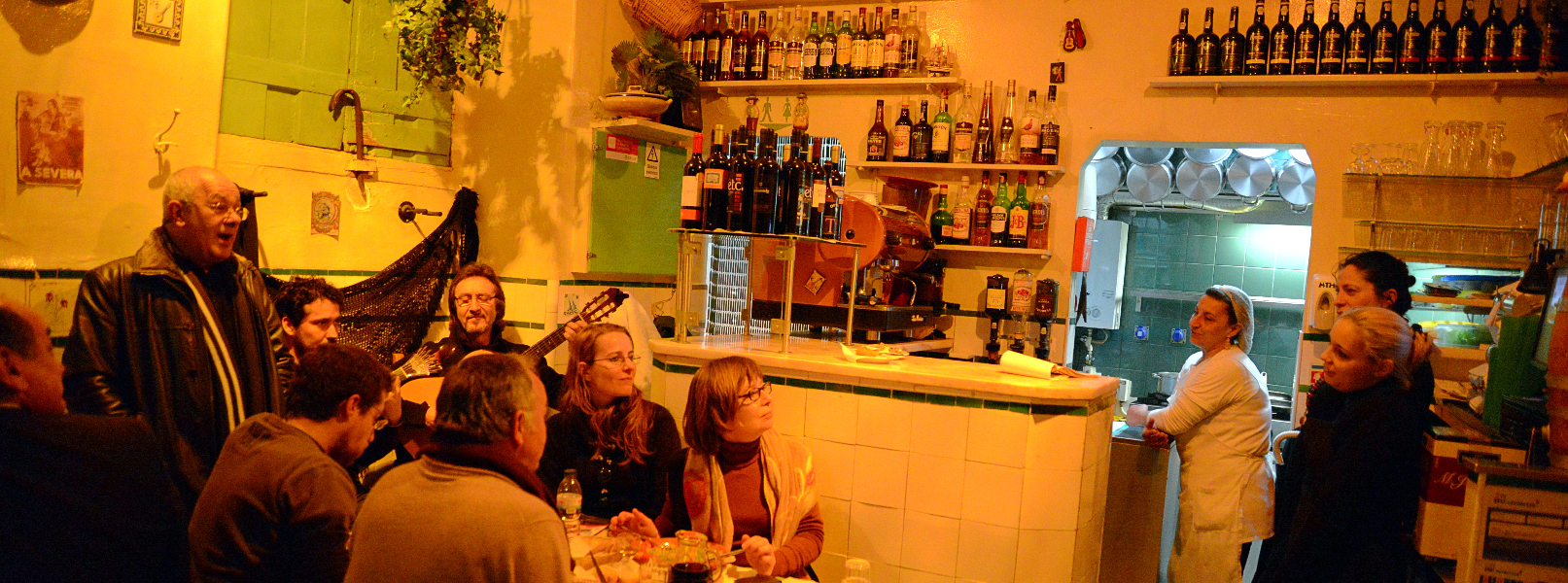
Although you may read reviews referring to A Baiuca as a restaurant, the homely open-kitchen style, late-night drinking and the music-focused atmosphere make this place definitely worthy of the name pub – indeed the doors themselves present A Baiuca as a ‘Taberna’, which is near enough to meet my threshold.
That said, there is an entrance fee which covers the flow of wine and ginjinha and the musical main event, Fado, dramatically mournful Portuguese folk music which translates as ‘destiny or fate’, but symbolising a bohemian, or vagabond lifestyle, signposting what you might expect in the performance.
This may seem off-piste so far considering the beer halls and pubs covered on the blog, but be aware I have offered a degree of latitude to this venue on account of the authenticity and character, and I am seeking to provide a broad range of options.
Lisbon’s traditional working class neighbourhood the Alfama is the perfect setting for a place like this. Wandering up and down the maze of winding streets on the hillside is atmospheric at any time of year.
A Baiuca is not the easiest to spot at night – I remember we ended up locating it by peering through a metal garage door which seemed to correspond to the co-ordinates after wandering around in a circle. The front door itself was shut, but after a couple of knocks the owner met us at the door and arranged our seating, only after payment was made.
At the time of the visit our fee was 10 euros which at the time seemed very reasonable considering the wine and music were both very good.
We gathered on a communal table in a small room, most places taken already, and were made to feel welcome with a couple of glasses of red wine. There is no stage, and the musicians simply perform in the corner of the room. Each song is dramatic and passionate and the performers looked extremely well practiced at the style. An overkill of maudlin music doesn’t seem like the basis for a night out, but the songs are short, melodic, often intense and were received enthusiastically by the room.
There are a great many corporate joints in the city centre offering Fado performances in a large restaurant with a full sit-down meal, and while there is always a place for that, this is where to go for the real McCoy, stripped back, homely and raw, following an unbroken folk tradition.
After considering the experience overall, I think aside of the entrance fee, it occupied a very similar social space as going to a pub, both in terms of the homely working class surroundings and manner of drinking.
Our visit extended long into the early hours of the morning leading to a very uncomfortable wake-up call the following morning to the airport!
There are a few other traditional Fado venues in the Alfama, which I am sure warrant exploration, but I can strongly advocate visiting here if you prefer real and rustic above sheen and pretension. Finding this place on our final night in Lisbon more or less made our holiday.
P.S – I would recommend reserving tables if there are more than two of you, or if it’s the off-season with it being such a small space.
Anyone with a mild interest in the European bar scene or the city of Prague will no doubt have heard of U Zlatého Tygra (At The Golden Tiger), the historic Czech pub and city institution based slap-bang in the tourist hub of Prague’s old town.
Reading about the pub’s stories, its literary connections and seeing the photos of Bill Clinton and his ilk tucking into schnitzel and beer sat among locals may generate a degree of excitement alone, but I will be up front with you about the good – and not so good – aspects of U Zlatého Tygra.
Let’s begin with the good stuff first, of which there is plenty!
The pub signage with its bas-relief tiger and gold lettering is striking and one of Prague’s true icons. The sign indicates not only the business but also the historical identity of the building, which pre-dates its current use. The interior has hosted various previous operations such as a patriotic café and reading room before the second world war, and undergone rebrands such as U černého tygra (The Black Tiger), U kopáčů (The Dice), and U Kraftů (The Craft) in the past. Its literary leanings continued through the 20th Century, not least due to the patronage of writer Bohumil Hrabal, (now made permanent life President) who had a favourite area of the pub in which he would hold forth on the topics of the day, and just as often sit there quietly absorbing the atmosphere and consumed in his own thoughts. Hrabal passed away shortly before the turn of the century, but the pub keeps his memory alive in the best way possible, with tributes that are lovingly well-pitched but don’t turn the place into a shrine.
The entrance is based down an alleyway rather than on the street-front which I generally quite like as this increases a sense of cosiness and clandestine activity, vital for building the atmosphere in traditional venues like this. Heading inside, the design and layout is an archetypal Czech pub with communal tables, bench-seats installed along the walls, wooden panels, cream (going on yellow) walls and those curved arches so typical of the pivnice style. The stained glass windows (with tiger insignia) allow light in but effectively block out activity from the busy street, creating that cocoon-like feel that most of the best Czech pubs offer.
This slideshow requires JavaScript.
Look around and note many framed photographs which present the three key themes of the pub – tigers (of course), famous patrons from sport, art and politics and, as could be predicted: Pilsner Urquell. This lager, while brewed by Plzeňský Prazdroj in Pilsen, not in Prague, is nevertheless synonymous with Prague and Czechia due to its ubiquity. The Golden Tiger was only the second pub in the city of Prague to secure a contract to service it so there is a long-standing connection not likely to be severed or altered any time soon.
When you consider the old town mean average price for a half-litre of Pilsner Urquell, the prices here are fair-to-middling given the central location, and the first pint of it arrives without your say so (as does a second and a third unless you make a point of putting the mat over your drink). Beware, if you turn up thirsty you could easily find yourself processing several glasses in short order. This is one of those pubs where it’s virtually impossible to leave without at least two.
A slight quirk is an insistence on using 0.45l glasses meaning they gain 10% on each beer. Annoying and cynical, but not worth fussing over too much.
The place sells very little else to drink (see their menu here), and even has a policy of not serving spirits! Highly unusual as nearly every other pub in the country will offer you at least Slivovitz, Becherovka or Fernet Stock.
U Zlateho Tygra was for decades and up until the war a bit of an all-boy’s club, refusing women service and directing them to find the nearest cinema while the menfolk held forth in the pub. However, this culture was broken in fittingly macho fashion by a woman called Lady Helenka, as the tale goes:
“She came here with her fiance Vaclav Prymek, who was an officer and an army pilot. When Lady Helenka was stopped at the door, she promised to keep track. And when the waiter counted the lines on the bill, there were 44 of them. Lady Helenka managed 22 beers that evening, as did her future husband. The waiter laid a white napkin in front of Helenka on the floor, kneeled down and said: Madam, this seat by the counter will always be yours, even if the Egyptian king Faruk comes in.”
22 pints? Sounds crazy but you wouldn’t rule it out.
Now some bad stuff. A famous pub is, as you’d expect, a popular one, with the problem that it cannot accommodate locals and tourists at the same time without losing its appeal pretty quickly. Therefore they have struck some form of compromise.
You may or may not be aware that Czech pubs permit reservations even for the right to perch on a bar stool. This system, so unlike the first-come-first served approach in English pubs can result in disappointment. At U Zlatého Tygra you may as well forget even trying to turn up in the evening unless you have reserved your spot well in advance, though it may be worth enlisting a Czech friend to help secure that.
In the evenings, as there are reservations it feels almost like a private member’s club where you need to stay all evening to get full value for the exclusivity.
Here comes the compromise: there is a way in but it relies on your being prepared to begin drinking mid-afternoon, not always everyone’s favourite starting point. Turn up at 2.50pm, 10 minutes before opening time, join the queue (which at this point may be snaking around the front of the building), and if you’re in the front 30 or so you should be assured of a seat unless you’re in a large group. If you see people pushing in at the front then choose whatever retribution you see fit.
This may not be a concern of yours, but I feel a certain duty, given that I am waxing lyrical about the place, to point out that U Zlatého Tygra is not a museum, and the enduring appeal is because it is not spectacular but authentic and traditional. Even though there is some nice stained glass and a sturdy preserved atmosphere, it’s hardly La Sagrada Familia. Therefore, treat it as the pub it is meant to be – eat, drink and be merry. If you show the staff the respect you would show a host who invited you in, you will not be badly treated.
Inevitably, the authenticity can be occasionally vandalised by some tourists who believe it to be a fairground ride instead of a pub. Their behaviour is offset in amusingly curt fashion by the servers who adopt an uncompromisingly stony-faced approach to anyone who isn’t their mates and anything they regard as bullshit (quite a long list).
This is – depending on your point of view – chauvinistic, deeply cynical in order to maintain their asset, or their absolute right as publicans.
While this can be intimidating, consider it a pushback against the place being overrun with tourists and gentrified, as it surely would be without a little resistance.
While it is easy to have a pop at tourists, in one sense their custom helps keep the philosophy of the place alive – people from all walks of life sitting around together and enjoying themselves. The pub website explains further through this anecdote:
“There is the story, in which the pre-war French Prime Minister Herriot visited U Zlatého Tygra. He was accompanied by the section chief of the Ministry of Foreign Affairs, a permanent guest U Zlatého Tygra. They bought pork neck with bread and mustard and fitted incognito in the beer hall . While Herriot was drinking, showed to the opposite side and said : “There is sitting the chair of the Chamber of the Deputies of the Parliament Malypetr, but the gentleman sitting next to him I do not know . ” – The section chief said: ” There is sitting a master of painting from Melantriška. ” Herriot greeted again and then whispered : “But there is sitting the president of the Administrative Court , but the gentleman next to him I do not know. ” Also the guide did not know. Then their neighbour to the right said:” This is a manufacturer of funeral lamps from Karlovka. ” – Surprised Herriot turned to that neighbour and asked : ” And who are you ? “That gentleman raised up his glass and answered” I am a caretaker from Skořepka, please . ” – Then the Prime Minister declared : ” Gentlemen, fault! Democracy is not in France but here ! “
Once the crowds are seated, and after their first beers have been extinguished the atmosphere inside quickly gets going. Among them, comfortable and surrounded by the excitable friendly crowd, with dishes of hot food emerging from the kitchen, it really feels like the place to be.
Whilst seated you will note a stout tapster working flat out to replenish glasses, pausing the flow only to greet and converse with the stamgasty whose presence ensures this most Czech of pubs stays that way.
Due to the tourist trade it’s not somewhere I would choose to go every week – there are other places to go in Prague for an authentic traditional pub experience, without the hype and tourist hordes (Hostomicka Nalevarna, for example, which you can read about by following the link), but there’s no doubt the Golden Tiger has a certain sprinkling of magic borne from its history and ultimately its significance. Try it on different dates and times of day in order to work out when to absorb the most local flavour. As hackneyed as it is to say, you can’t really miss out on a pint in U Zlatého Tygra while in Prague. Which, as discussed above, means two. This really is a pub to be reckoned with.
Rue Des Flandres, in St. Catherine quarter is a great road for a bar crawl, host of several venues varying between good and great. In my view Au Daringman belongs to the great category, not only for the street but for Brussels more widely – I know, high praise in a city jam-packed with great bars.
The primary reason I reach this view is that despite the bar scene across Europe turning increasingly corporate, this brown café still feels like a personal venture. Despite being surrounded by crowds of people, passing trade of tourists and the daily grind, Au Daringman supplies an oasis of calm, moody contemplation during the day and an alternative-feeling cosy haunt at night.
Upon arrival you’ll note an attractive red exterior with old Stella hoarding, partly obscured by the greenery cascading down the front of the entrance, a look which is typical for a street with plenty of side-alleys and greenery.
This slideshow requires JavaScript.
In the afternoon the bar is managed by the charismatic Martine (the pub known locally as Martine’s or Chez Martine), the managing in the quiet hours extending no further than being propped up on a stool reading a newspaper or a book, filing her nails, peering over the rim of her specs and drinking coffee.
On first appearances there doesn’t appear to be all that much maintenance required of Au Daringman other than a morning clean, watering of the plants and the odd keg change/clean of the lines, but it is clear the enterprise is a labour of love.
This café is so named because the original owner was a boxer and member of the Daring Club de Bruxelles in the 1950s and 1960s, a Molenbeek-based football club whose players were referring to as the Daringmen. Read further here.
Au Daringman also proves what a solid basis the ‘brown café’ is as a concept to work outwards from. Let’s compare other Brussels venues: Le Coq is the archetypal Belgian boozer, Monk is an elegant historical recreation, and Au Daringman is the off-beat jazz era cousin, with artistic leanings. Yet all of these still belong to the same pub family.
There are lots of interesting touches to the decor, from the cubist textured wood paneling, to a board with what appear to be scores from a local table football league. Apparently the bar has been going since 1942 – it looks like most of the bar hasn’t been significantly altered since the 1970s.
The simplicity extends to the beer choices on tap – it’s very standard stuff. Stella, Leffe, or Hoegaarden. In Belgium at least, all three of these are a reasonable standard.
While it may not be apparent – at least not during my visits – they also boast a host of bottled drinks, some of the well-known Trappist, Abbey and lambic Belgian ales along with some lesser-seen ones such as Gageleer.
On my last visit I spent two hours here quietly, with no book and no telephone function (imagine that in this day an age). The beautiful simplicity of sitting among the wood paneling and minimalist jazz memorabilia, enjoying a beer and alone your thoughts sums up what Au Daringman is about during the day. Au Daringman wants to make you feel at home, but also quietly oozes cool.
While the bar becomes a lively place in the evening, almost transformed in doing so, some essence of the place goes missing when it is crowded. However, that goes with my impression, which may not be yours. As with Monk, I recommend visiting in the early evening when it begins calm then slowly starts to bubble up.
Despite Instagram cataloguing the world, you won’t find much online presence for Au Daringman, as presumably its location on Rue De Flandres makes advertising superfluous.
Yet another brilliant Brussels bar and an essential visit on the ‘brown café’ circuit in the city.
P.S – Sadly Martina does not own the building itself, so this is a bar that may be on borrowed time. All the more reason to visit while you still can!
Evenings in Olomouc are a tough time to get seated. Wherever you turn, each hostinec, hospoda, pajzl, minipivovar or výčep seems to be full. It is no exception when it comes to U Kuděje. Yet, frustrating though that is, there is all justification to persevere as you are searching for a drink in one of the best pubs in the city, if not in the whole country.
At first appearances Hospůdka U Kuděje may seem unremarkable. A Czech pub in a half-step basement of a very Czech city building? – seen plenty of those before. Wooden furniture from the Austria-Hungary era, with traditional ruralist décor? A well-trodden choice, too but the true quality of U Kuděje is the combination of a number of smaller things contributing to a greater whole, known as genius loci, or spirit of a place. Which we will now come to.
U Kuděje is not based slap bang in the centre (it could potentially lose a fraction of its charm if it were) but a short walk west on the fringes between Olomouc’s old town and a residential neighbourhood west of Čechovy sady.
U Kuděje is named after the writer Zdenek Kuděj, the closest and perhaps long-suffering friend of Jaroslav Hašek, who were both part of an anarchist/bohemian literary scene in the early 20th century, so is a fitting tribute to someone who spent huge amounts of time in pubs. You will find theirs and others’ works available to read (in Czech, of course) within the pub. Here is a short explanation of the pub and connection to the writer: http://www.memorialmatejekudeje.cz/?cat=14
Drop down a short set of stairs outside to the basement level and enter, where the bar area greets you immediately, with a list of beers attached above the bar. The place feels warm and bunker-like and you will almost certainly find people sat at stools around the bar, and a cast of regulars sat on tables to your right. To your left is a small lounge area with people deep in conversation and set into the ritual of the place itself.
This slideshow requires JavaScript.
The pub has the atmosphere you’d expect from a neighbourhood dive and you’ll quickly notice from the interactions there are folk sat around who know each other well. This in my opinion is the core of the pub’s appeal, the warmth and simplicity of a social scene that people invariably seek out when given the choice.
A busy pub full of locals can be intimidating at first, and if you can’t see anywhere to sit you may be forced to hang at the bar (also awkward if there is no leaning room). Take a full look into the pub and if there is a spare seat ask “je tu volny”, and hopefully someone will yield. If you arrive as a group in the evening without a reservation, then all I can say is: Good luck. Yep, unfortunately Czechia does not do first-come-first served in pubs and will reserve tables for loyal locals at the expense of fly-by-night tourists and turf you out of your seat when the time comes.
U Kuděje’s big thing – atmosphere aside – is a focus on regional Czech beer, which is very good news for any fans of unfiltered and/or unpasteurised lagers (me). Offering 5 or so on tap at any one time, this is a sensible number that helps ensure freshness, and a little rotation for new and recurring brands. The beers are also served on porcelain plates built with recesses to collect spillage – this is very old fashioned but seems to be making a comeback of late.
They may try to suggest that these beers are good for your health but quite frankly, who cares? If it makes you feel better then yes, yeast can in theory help repopulate your stomach with good bacteria. However if you need it repopulating because of an excess of beer the previous night then that rather negates the point, doesn’t it? Prices are reasonable, perhaps on the high side for Olomouc, which isn’t a problem given Olomouc is an extremely affordable city.
The pub snacks at U Kuděje are typical for Czech pubs – expect the usual cheese, ham, pickles but keep a look out for Moravian cheese if that’s your thing, as that’s quite the regional speciality.
Lastly, take a look at the opening hours – few places open later on a Saturday than they do during the week, but U Kuděje is one of them This place is does a short 5 hours service on weekends, and opens at 3 during the week. This makes it doubly difficult to try and get into.
Although U Kuděje may be a tough nut to crack as an outsider, I personally couldn’t think of too many pubs on my travels I’d prefer to make the effort to ingratiate myself in. You’ll find the true atmosphere and camaraderie of a mixed crowd partaking in a time-honoured tradition, rate authenticity, not to mention enjoying some of the freshest, well-kept and well-poured lager available.
Have you been? Any comments or suggestions? We’d love to hear from you. Please get in touch, particularly if any of the above requires amending.
Claiming to originate in 1602, the building itself containing The Seven Stars has survived The Great Fire of London, and – just as impressively in my view – the next 400 years of change unscathed, all the while serving as a public house. It’s a remarkable feat that places it as one of London’s core heritage pubs.
Many pubs trade on their history, (and that of The Seven Stars is an interesting read) , without backing that up by being an enjoyable place to drink in the here and now. Thankfully, The Seven Stars is not one of those places: it’s a little cracker.
Carey Street has a row of townhouses that are overshadowed by the enormous London County Court, Royal Courts of Justice and LSE library, so it is quite easy to wander halfway past The Seven Stars before realising. It’s a very quiet street and doesn’t seem the most likely place for a pub to be situated these days, though that makes it a perfect venue for those in-the-know. The frontage of The Seven Stars is squat and compact with the predictable (but entirely appropriate) gothic signage. It looks like a small place and it is – there’s no TARDIS effect once you walk inside.
This slideshow requires JavaScript.
Although micro-pubs may now be reversing the trend for enormous, open plan pubs, none of them are made quite like this old thing. You’ll walk through the entrance to find a low-beamed venerable establishment with a bar directly opposite the entrance, and a narrow space set over two rooms. There are stools to sit at the bar and drink, and tables decorated with checked tablecloths and candles (a little dressy for my tastes, but it did make me think fondly of Den Turk in Ghent, which is not dissimilar).
For the last decade or so, The Seven Stars has been the domain of a ruff-sporting and locally famous pub cat who sadly passed away not so long back. Nevertheless, I have been informed a new cat has entered the premises! If you venture into conversation at the bar with the owner Roxy, she may expand on the and possibly get into the tale of one punter who mistook the cat bowl for bar snacks. Don’t be shocked – anything can happen in London.
The décor and ‘lived-in’ nature of the pub is where most of its character comes from, a pleasingly ungentrified and carefully preserved sense of welcome that tends to strike an immediately positive impression with people regardless of any preconceived ideas. This impression is important to cling onto for when you order a beer (or food), because those London prices hit hard and hit deep. This isn’t worth singling The Seven Stars out for, however, that’s just how things are. It is worth bearing in mind a lot of lawyers drink here.
Nevertheless, you’ll find a set of well kept cask ales from regional breweries served via hand pump – it’s a decent if unspectacular range which will keep you satisfied for at least a few.
In a similar way to Whitelock’s in Leeds, the toilets are located above the pub itself via a satisfyingly creaky staircase, where you will also pass by the kitchens and a room crammed full of odds and ends. By any standards these days (particularly London’s), this is a characterful and individual place that isn’t interesting in the Farrow & Ball school of interior design or repainting itself to remain ‘on-trend’ every ten years.
As mentioned above, the pub is popular with local lawyers and court staff, and due to the small size you may find yourself unable to grab a seat. However, trade is brisk in the evenings so be patient and things will move along – grab your chance when you see it. There’s nothing like being seated to enjoy the atmosphere of a tangle at the bar in a traditional pub such as this.
As the lights from the outside dim, and those from the inside take over, there can be no question of whether this is a pub of outstanding merit.
Although The Seven Stars may have lasted 400 years, the obnoxious pace of gentrification in the last 30 years means that pubs like these perpetually under threat from people who simply want to run poor facsimiles of bars they’ve seen elsewhere. This is a pub that demonstrates the importance of being your own thing. That’s worth something.
I’ll leave you with this anecdote from their website:
“While enjoying a few Friday afternoon wind-down drinks, a group of 15 or so lawyers (young ones) entered the Seven Stars awkwardly and decamped nearby. There then began a cacophonous symphony of table and chair scraping, until they had blocked all passage in or out of the bar. Regaling of a most competitive flavour followed, ever louder, underwritten by a desperate, pleading “notice me” subtext. Its volume only matched by the ethereal transparency of its content. We drank up and moved on – our seats snatched hungrily into their possession before we got to the door. Congratulations, you’ve emptied the pub! Not all lawyers are like this, true, but this was selfish and shameful behaviour. Hopefully, few noticed.”
Have you visited The Seven Stars? Any comments, feedback or suggestions for our write-up? Please get in touch!
Soviet-themed bars have quickly become a staple part of the Eastern European bar scene. It must be due to the tonnes of old communist bric-a-brac that has been purloined from flea markets over the years. It’s remarkable how quickly this ephemera has been regurgitated, often in an apolitical way. Now, shorn of the memory of state repression, paranoia and hardship much of the era’s junk has been re-purposed and exhibited, capturing people’s nostalgic fondness for the idealism, optimism as well as the iconography of the era. Ideal for adorning a moody Polish bar such as this one in Poznań.
Proletaryat isn’t exactly lined with volumes of DasKapital; instead you’ll note a large bust of Lenin staring at you out on the street. Enter to find a display of fairly impressive social realist paintings, disproportionately large portraits of Lenin and Marx, hung in front of rich crimson paint, with emblems and military insignia thrown in. The central bar area also expands further into an interesting looking terrace-style back room where the cool kids hang out, that seems a little separated from the central premise.
There may be a vague leftist feel to the crowd here (perhaps its just the students) but in the main it does seem to be led by decoration rather than a hotbed of any political grouping.
This slideshow requires JavaScript.
That said, the decoration is impressive nonetheless, it’s a very stylish place to go for a drink, without being particularly pretentious. The crimson and lamplight works well for a shady atmospheric slow sup, while at night it gets more raucous and one of those truly buzzing city centre bars where the lack of space and abundance of booze creates its own head of steam. This is a great example of decoration that allows a venue to work well in different ways at different times.
The location down one of the main city centre streets means it feels in the middle of the action – which in Poznan is pretty bloody active. You can expect to witness the type of revelry usually preserved for English city centres on an evening. It was quite an eye-opener, but I had previously been warned about it by some Poznanites (Poznanians?) during a separate trip to Wroclaw (another excellent city). The levity doesn’t emerge from English stag parties or boys-on-tour either – in Poznan it’s mainly locals doing their homespun thing. Wodka i piwo can be a dangerous combo.
Aside of the tongue-in-cheek atmosphere, Proletaryat offers its ‘own’ beer as well (from what I can gathered, this is brewed elsewhere at Browar Czarnków and labelled accordingly), which is cheap even by Polish standards nowadays. The jasne (light) and ciemne (dark) beers are both fresh and well balanced. Not the finest ever brewed but tasty certainly and designed to knock back in volume. Apparently the vodka is served with a pickle here if you are interested in going native.
Any pub crawl around Poznań would be improved by a stop off at Proletaryat, as despite the increasingly familiar concept of the Soviet-themed bar, a good concept doesn’t stop being good just on account of its familiarity. Besides, they do a decent job of and it feels like its own thing rather than a cookie-cutter version or a clone-bar. If you haven’t been to one of these type of places before, then go at least once for the novelty value. If you already have and enjoyed it, then this bar is not to be missed!
‘Vycep Soukenicka’ in a previous life, it seems this spot has served as an in-the-know local’s pub for quite a while before this recent rebrand.
The new name springs from a village south west of Prague, Hostomice, which isn’t much further along than Karlstejn and its enormous castle. You could decide on a trip out if the weather’s nice, but when they’ve set up what is ostensibly their Prague tap house in one of the nicest old pubs in the city centre, there’s a convenient excuse to stay put.
I urge you to mark this pub on your map of Prague as this area of the city between Josefov district and Florenc metro is a little short on pubs worth a damn. I often find myself having to head through it, and invariably choose this place as the pub of choice.
The difficulty is, once you move east from the old town (let’s say, from U Parlamentu/U Pivnrce) area and through Josefov, the traditional Czech pubs disappear and are replaced by cocktail bars and glamorous-looking (but probably seedy) ‘gentlemen’s’ clubs. Josefov is a fascinating district for many reasons but purely on pub terms, I wouldn’t get your hopes up. This malaise extends past the Powder Tower and the Štefánikův bridge to be honest, all the way into Karlin. With one notable exception.
For traditional Czech drinking (the kind where you’ll be rubbing shoulders with normal Prague folk while chugging pivo) the newly christened Hostomická Nalévárna is the best option in that half-mile radius. If you’re planning a pub crawl, particularly if you’re staying near Náměstí Republiky this place will be a godsend to help join the dots together. In fairness, it isn’t a long walk from the old town anyway.
Pivovar Hostomicehas a great reputation for their beer, which is handy given there aren’t any beers from other breweries available at this pub. From the several visits I made they offered an unfiltered 10° světlé výčepní (light lager), 12° světlý ležák (premium lager) and a 13° tmavy, (or dark) lager on tap as a general rule. They may have specials on rotation but if they do, they weren’t exactly advertising the fact. I’m just glad when I visited in March, no-one was drinking green beer, (brewed every Easter and bafflingly popular, even among locals).
This slideshow requires JavaScript.
Their prices are a steal considering it’s Prague city centre, with their 10 degrees light lager as good as being £1 for a half litre, and the others barely a few crowns more. This good value extends to the other options available, such as the wine (which my partner found almost as cheap as beer elsewhere around the city).
One of the more intimidating things for a tourist, leaving the traditionally large pivnices in Prague city centre behind and heading to a local drop-in pub is the more direct interaction with locals, and this is something you’ll need to factor in during your visit. Knowing your p’s and q’s goes a fair way in Czechia. The tapster here is a polite enough young man who will speak in Czech if he thinks he can get away with it but is hospitable to outlanders who play by the house rules. He serves as both tapster and server given the small size of the place. At the very bare minimum, muttering ‘dvyeh piva prosim’ will procure two of their light beers. Fresh, unfiltered and delicious, I may say. The unfussy branding and lack of a corporate feel reminded me of the often brandless, but out of this world fresh Kellerbier and Vollbier you can find in Franconia and Bavaria.
Moving onto the pub itself, it’s a small cosy sort of place with a small bar on your left as you walk in, and a compact seating area in behind. Click here for a quick slideshow from the brewery’s facebook account. I managed to be seated on each occasion I visited which seemed unlikely given the place seats perhaps 25 people at most, and is never empty. The amount of wood you’re surrounded with is typical of these kind of places, and a look I enjoy very much, even if I do wish they offered cushioned, upholstered seats like most English pubs.
The folk around you vary from quiet couples in their 30s, jovial groups of youngsters and old folk playing cards and setting the world to rights. A classic cross section of people who appreciate the virtues of a traditional pub. There’s a big TV hanging at the back of the room for if the going gets dull, which will be playing whatever sport is going. There are those desperate moments in life where Japanese basketball or youth curling competitions suddenly become diverting.
I enjoyed the fact that they hadn’t been bothered to remove or paint over the old sign, which is entirely appropriate as they haven’t done anything to the interior either. That may have changed (and some evidence suggests it has) but the interior remains pleasingly old school. All the Hostomice stuff seems merely transient, which gives me the hope that even if for whatever reason they cease as an ongoing concern, another group will come along to keep the fires burning.
You can see from the scores at the top that the place is a decent all-rounder, the only shortcoming being a relative lack of amenities, but this comes with the territory. Each pub deserves a license to be what it wants to be. Not all pubs need or desire to serve cooked food, or host events. Sometimes a cosy seat, a good cheap pint and a load of old wood is all that’s required. Hostomická Nalévárna is there for you when those times arrive.
This place typifies that often impossible urge to drop in to one more pub on the way home, that is so beautifully brought to life in Czech literature.
Pub goers everywhere, rejoice in the fact places such as this exist! Use it or lose it….
Have you visited? Any comments or corrections? Please get in touch via the comments or our Facebook page!
For all the blabbering on we could indulge in about such things as décor, history, live events, and so on, it is occasionally easy to lose sight of the more humble qualities of a good pub, those of simplicity and authenticity.
A bar’s interesting décor can sometimes divert from the expense or low quality of the drinks, occasionally the unpleasant atmosphere as well. All too often a pub’s history is used as a fig leaf to disguise the fact the interior has since been vandalised and transformed into a chain-operated place devoid of character. A lot of pubs run a pub quiz, food nights, karaoke, live music but are thoroughly unappealing nonetheless. That’s no magic bullet.
It takes a degree of resolve these days to run a pub that doesn’t bother with half of that, isn’t trying to be anything it’s not, doesn’t care about mythologising, widening demographics, or trying to get each customer to pay the absolute limit of what they’re prepared to.
It would be tempting to call such a place ‘quaint’ but there is a patronising element to that word, bordering on ignorant, which I dislike, and which Briody’s doesn’t deserve. I didn’t think Briody’s the least bit ‘quaint’ on my visit. It is however a simple honest boozer that has thought about what to improve,what to keep and what to maintain very carefully.
This slideshow requires JavaScript.
I like the small size – you have a small lounge area on your left, in front of a bar stretching along the room, with comfortable upholstered bench seats lining the wall. It is as big as it ever needs to be, and has a degree of cosiness without ladling it on too thick. It’s a nice lounge, your living room with a bar and a few other folk in it, essentially. Perfect for quiet contemplation, reading, good conversation and so on. There’s an upstairs which I understand is for hire for students cramming for exams, meetings and so forth.
One thing you can never tell from the outside of an Irish pub is how good it’s going to be once you walk in. Nearly all of their exteriors have a rather studied look, with the ubiquitous Gaelic script, or at least a typeface aged enough to suggest a traditional interior. However, this often has little to do with what you’re presented with when you walk in, and it takes a keen eye to distinguish your plastic paddy pub from the genuine places frequented by locals.
One commonality in Dublin, is the sight of a ruddy-cheeked, broad-chested man of borderline retirement age doing the serving, usually dressed very smartly in a plain Daz-white shirt, black trousers and shiny shoes and belt. There’s a certain formality to this which conveys command. Maybe not wholly consciously, but I believe that’s intentional.
These fellows are usually quick-witted and not short of a few comments to make, especially if they haven’t seen your face around their pub before. It’s usually jovial jesting at most, and you’ll notice the standard of welcome in Dublin a notch higher than most European cities, apart from perhaps the most tourist-ridden places where the demand on the service and the churn of staff makes that difficult.
No such worries at Briody’s – taking a seat there feels like you are being added to a painting. Here’s where you find your more raw Dubliner accent, blue language aimed at the Gaelic footy on TV, and most thankfully, an excellent pint of Guinness. You know you’re in for a good pint of the stuff when the cream on top forms an almost-film like layer when it settles. It’s not cheap in Ireland these days, but a pint is cheaper in Briody’s than many places elsewhere in the city centre. Anything like that is welcome on the wallet.
This explains why locals head down here (many of whom the bar staff know by name) but there are other factors. Despite being 5 minutes walk from the Spire on O’Connell Street, most locals don’t venture down Marlborough Street running parallel, instead sticking to and clogging up the main arteries of the city. Given other areas of the city are studded with pubs – mediocre ones – all of which are crammed full, it’s a strange feeling that somewhere like Briody’s could plough its own calm furrow, almost hiding in plain sight.
“Setting foot in the pub, you immediately feel like you are on familiar territory. Just like wandering into your grannies, you know you’re in good hands. The interior is typical of a good local boozer; tiled flooring greets feet upon entrance before a pristine carpet overtakes the rest of the floor space. Lighter wooden tones are well complimented with beige embossed wallpaper. The seating proved to be tremendously cosy in its simplicity while classic drink brands and sport are the themes exhibited in frames upon the wall. We took a particular shine to a bittersweet portrait of Paul McGrath seen in his heyday sitting at an unidentified bar holding a creamy pint aloft.”
It is one of those pubs that you wouldn’t see what the fuss was about until you’d spent a good while visiting the so great many mediocre ones first.
Comfortable, authentic, friendly, and simple. That’s the way it is, and the way it wants to stay. Perhaps deep down they may not welcome me saying this, as this is their refuge rather than a tourist hub, but here we are. I can’t ignore you.
Have you been to Briody’s? Any views, or corrections? Please get in touch on the comments below or via our Facebook page!
As Lviv brought the kerosene fuelled gas lamp to the world in 1853, it is only fitting that this is expressed in the city on some level. You’d expect a museum to be the best place to exhibit this but slightly surprisingly it takes the form of a bar – Gas Lamp.
Although aspects of the display are museum-like, to all intents and purposes the gas lamps are for decorative purposes, with little information on their design or origin. I have visited some pubs and bars which featured information labels on their antique without making the venue too stuffy-feeling (U Veverky in Prague, for example), but in Gas Lamp, providing you are here for a drink over and above a history lesson, you don’t feel like you’re losing out for the lack of information too much. Besides, the venue holds one of the biggest collections of gas lamps in Europe, so there is a lot to look at.
On busy evenings, an old man in a top hat, holding his gas lamp will guide you past the ‘fathers of the lamp’; two bronze statues, one of Jan Zeh sitting at his table (by the front door) and another, if you look up, of Ignacy Lukasiewicz poking out of a third-storey window. Read about their place in history here.
You are then led downstairs into a cellar. Counter-intuitively you have to crouch under what appears to be blackened rock, only to ascend a spiral staircase into the ‘bottom’ floor, which is on the first storey of the building. When you reach it you will notice a traffic light system, which appears to be there to stop customers bumping into each other halfway down the stairs.
Gas Lamp is set across several small floors, which reminded me of De Garre in Bruges (in layout rather than design), one of which is dominated by a bar, and another which appears to be a penthouse apartment that has been converted into a covered roof terrace. There is a coherent theme but each floor has a slightly different feel so don’t leave without being nosy and having a look around.
This slideshow requires JavaScript.
On the top floor you emerge level with what appears to be a sea of slanted rooftops which may well be impressive during the day as much as at night, but night time is a great opportunity to look at the Armenian and Russian churches lit up strikingly. There is a naturally rather rarified air to being on the top floor so it may appear a little more towny and flash in comparison to the cosier downstairs rooms. Regardless of this, it is well worth rubber-necking.
Outside of the eponymous gas lamps, décor is an interesting blend of chunky chalet-type wood, with rafters, beams, bannisters and communal tables, but the lighting is more modern, with yellows, pinks and purples spotlit and backlit among shelves with other assorted valves and measuring equipment. I would rather they lit the gas lamps to be honest, but it’s not a bad effect overall and is more impressive than the images you’ll find online.
Drinks wise, Gas Lamp offers shots in a row of test tubes as a gimmick (make of that what you will), and a well stocked bar for cocktails and the like, but I opted for Pravdaand Lvivske’s beer offerings which are still reasonably priced for such a central location. That’s not difficult however, as from a Western perspective nearly everywhere apart from the airport is reasonably priced.
Gas Lamp serve food, although I found the location to be far too dark to contemplate getting anything there other than emergency snacks to soak up the beer. I don’t really see the appeal of arriving here any sooner than sunset to be honest. Night time is the right time.
Staff are well used to tourists and speak decent English, however there were issues getting their attention. Sadly unless you go direct to the bar, you’re stuck with table service, an always retrograde format that slows everything down unnecessarily. That isn’t isolated to Gas Lamp however, but pretty much everywhere that also serves food.
The city of Lviv offers a night life replete with themes and gimmicks, and yet another rears its head when you pay the bill. A ‘bomb’ with a short fuse is lit when your bill is presented, and you can enjoy a puff of flame, cracker-type pop, then a mix of smoke and incense fills the room. Unnecessary of course, but characterful. European Bar Guide is after all very keen on places which don’t settle for mediocrity. Some places would never get away with this but it felt amusingly dorky.
Exciting, ever that little bit different, popular enough to have atmosphere but also spacious enough to give corners for quieter evenings, Gas Lamp is a very successful execution of its concept, and with one or two tweaks could really push towards being a 10/10 venue.
It comes highly recommended but as much as we bang on about it, we’d love to hear your stories from Gas Lamp and Lviv – please get in touch!
There’s a certain appeal to a corner drop-in pub that’s not much except a load of wood. Wooden floor, wooden ceiling, ledges, barrels, seats, bar front, and so on. In that respect King Grizzly is like the spit n’ sawdust saloon bars of old, just with a hell of a lot of good beer added and a stricter policy on spitting.
Being small and located slap-bang in the centre of Florence doesn’t yet appear to have rendered King Grizzly overcrowded, or over-subscribed.
The comfortable rather than crowded feel may be something to do with the purposefully growly and unprepossessing fuzzy bear exterior which cuts against its surroundings, the stately middle-aged grandeur central Florence lined with cocktail bars and ice cream parlours. The upturned barrels and snarly logo probably put the Aperol Spritz brigade off spending any time here than strictly necessary, while the exterior building has a certain anonymity that you could walk past a dozen times before noticing there was a bar there.
Don’t confuse any of that with a criticism – it really isn’t. What this means in reality is that anyone in the vicinity who is after a real pub experience and a good beer can enjoy both of those in comfort without struggling for seating room or access to the bar. It also allows something very central and liable to be swamped with passing trade to maintain its identity.
The personification of King Grizzly seems to be the chap behind the bar, one of those younger bearded sorts where the beard makes him look wise beyond his years. Affable, helpful, and – unlike nearly all Italian bars and restaurants – he will give you a glass of tap water rather than charging you for mineral water. Mr Grizzly can guide you to a beer that you’ll like, which was particularly useful during my visit as my partner was still struggling to get into beer. An Italian double-wit beer and a salty Germanic Gose later, and progress was being made!
Yes, this is a craft beer place, in that most of the offerings are from the ‘craft scene’ as it were, rather than traditional breweries, and are priced accordingly. However, none of the prices should scare off any English tourists who these days are used to spending £5+ upwards on terrible lager elsewhere, and when you put it into context, the prices are perfectly reasonable considering the excellent quality. If you ever needed persuading that Italian beer is getting its act together, you will leave this pub converted.
They are available in piccolo, media and grande size as well (wot, no Gigante?), which is a blessed relief given some English pubs unwillingness to pour strong beer in anything lager than a half-pint. Don’t look angrily at me if you’re asked to pay many euros for a pint of 8% beer though.
The general idea is that all the beers cost the same unless stated otherwise, so there’s a skill to determining which one is best value for that price. Or if you’re not a Scrooge like me you can just pick whatever takes your fancy.
Expect a really wide selection of styles as Grizzly thankfully has time for German and Belgian styles as well as the usual US craft offerings. Being super-critical, putting on a good Czech pale lager wouldn’t hurt. These places often define themselves as anti-lager which is a shame as there are so many wonderful ones. However, other than that, most bases are covered.
Music selection is eclectic without being irritating, and does a decent job of keeping enough people entertained, and despite central Florence being a sleepy place during the evening, (even in the height of summer), Grizzly remains open until 2am.
It’s one of those places where it’s easy to meet and talk to other people to, where you can say you met as strangers and left as friends. I think this has something to do with the half-seating, half-standing format as you are only ever a swivel or glance from becoming part of a conversation. It’s a fun place to hang out and an example of how a good pub and a good beer brings people together without the need for vacuous ‘glamour’.
It’s great that a place like this can be directly in the old town of Florence, a mere stone’s throw from Piazza della Signoria.
Anyone seriously interested in pub going and spending some time in Florence cannot look past this place on a crawl.
Have you been? Agree with the above comments, or perhaps know some things about the place I don’t? Please do let me know! Comment below or go and join the discussion on Facebook!