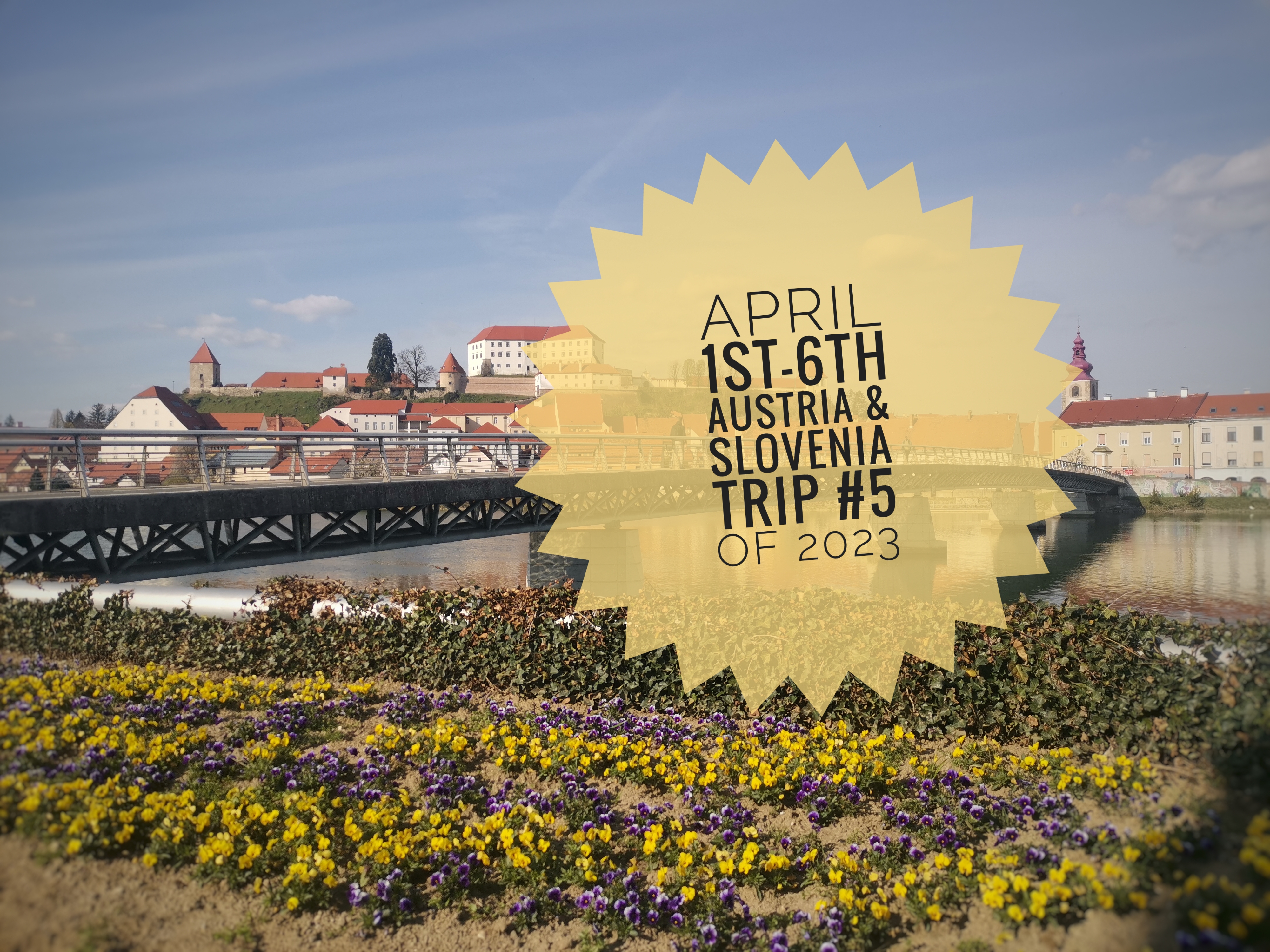

You are reading Part 1 of our Big Trip of 2023! 24 days, 7 countries. In just over 3 weeks we visited 80+ bars and discovered 50+ new venues worthy of The European Bar Guide!
The plan for the first 6 days was as follows:
Fly to Bratislava, Slovakia 🇸🇰 travel to Austria 🇦🇹: Vienna for 3 nights, Graz for 2, then cross the border by rail to explore Maribor and Ptuj in Slovenia 🇸🇮.
Day 1 – Bratislava 🇸🇰 to Vienna 🇦🇹
With only 50km between them, flying into Bratislava can be a cheap and convenient way to get to Vienna, with a simple direct train to Wien HBF (central station). Before that we had only a small time in Bratislava, getting a cheap lunch at U Sedliaka 🇸🇰, a historic venue that churns out retro charms like Zlatý Bažant ’73 on tap and hearty home cooking such as the national dishes Strapačky and Bryndzové halušky. They even offer a couple of vegan dishes, quite a surprise. While the venue does have heritage, they haven’t really made the best design choices and it lacks a layout that produces a pubby enough social atmosphere.

That was soon due to change as we visited Bernard pri lýceu 🇸🇰, somewhat of a pilgrimage site for us in Bratislava. Tiny, cheap and completely shorn of pretence, this is a holdout boozer that has perhaps a minor cult reputation around the city. We found an article recently where it features on a list of ‘Pubs in Bratislava you need a lot of courage to enter‘. Part of that is to do with the service which, it would seem, is equally unfriendly to locals as it is to the very few tourists who wander in. This is self-service, not table service though, so if you come armed with basic phrases, you’ll be fine. Select the beer of your choice from a generous selection (including seasonal specials, this time a strong red/amber lager, the Easter Velikonoční Speciál on tap, and find a seat. The locals are not hostile and the atmosphere feels tolerant. After a short while of being sussed as English, we had a friendly chat about football with a few of them.


The train then beckoned and this concentrated hit of Slovakia had to suffice. Off we went to the station and to Vienna.
Vienna 🇦🇹
Travelling with my partner, Vienna was a first time visit for her, something like 6th or 7th for myself. I had found the city a tough nut to crack for bars, most of the best venues spread out geographically, some hidden behind opaque terminology and formats. Plenty are too foody, some leaning overly towards café culture to qualify. This is not like Prague where in some districts you have a genuine chance of finding a nice pub on any street corner. Gradually though, Vienna’s top quality options reveal themselves.
After visiting the excellent Third Man Film museum, checking in and a bit of a rest, we ventured out for the evening and to our first pub, the best in the city – Känguruh 🇦🇹. One of those pubs that maintains low lighting throughout the day, once inside time appears to stand still. It could be 7pm, it could be 3am. A true refuge. It was also very busy, slightly taking us by surprise (though it was Saturday night, it tends to get going after 10pm) meaning the first 30 minutes were propped at the bar until a table became free. A compact space with muted lamp lighting, there’s a special atmosphere in the main and back rooms. A duo of servers go back and forth, the elder of which I remember from my first visit in 2015. There have been some changes though, with the Belgian beer bible cut back (although still extensive) allowing for a much bigger range of Austrian beers than previously. Tap options remain simple and straightforward, but the bottle range is among the best in the city. Accompanying this is topped toasties they cook themselves, and an Italian food connection which they ring in. After 20 minutes or so a delivery guy from the next door restaurant appears with your meal. It is a quietly quirky venue with bags of personality.


The plan was to work our way East towards the city centre and back to the apartment. A linear plan sometimes means you end up at bars at the wrong time. I thought our 1st visit to Tanzcafé Jenseits 🇦🇹 may have come too early in the evening, but it was reasonably busy when we appeared. This former brothel has deliberately maintained a tacky boudoir type operation – most successfully in its decor and atmosphere, but the drinks choices and prices could do with an adjustment. Still, as a cult Vienna late bar and one-off experience it was well worth a visit, and no doubt we’ll be back.


3rd venue of the evening, Stehbeisl 🇦🇹 was already busy when we arrived. Our 2nd visit, and we weren’t surprised as it is a small and intimate bar. The Viennese Beisl is a curious term and can mean anything from the most down-at-heel venue, to a family run pokey eatery to a silver-service restaurant. This bar is a long, narrow but social space designed for evening meetups and socialising at a reasonable tempo. The drinks offering is decent with plenty more draft beers than you’d expect for a small space, and a backbar that ably covers cocktails, mixers, and shots. It’s up there as one of the best in the city.


The final stop, Café Bendl 🇦🇹 was the big find of our trip to Vienna last September 2022. Merely yards from Vienna’s finest buildings, this bar has long since given up maintaining any sort of pretense of belonging to such high society, instead luxuriating and diving deep into becoming something else, a venue rich in nostalgia, characterful and peeling, the customers enamoured with the place not because of its sophistication but because of its survival, maintaining its operation in a welcoming, affordable way, weathering every challenge and hardship it faces. Perhaps people can see the truth of this reflected in their own lives. The kind of venue that some people will never understand but is immediately appealing to us. And that was that – away to bed!


Day 2 – All Day In Vienna 🇦🇹
“We shall strike a balance between culture and fun”
Ken, In Bruges
On top of the endless bar going, there is of course the sightseeing, the museums, churches and palaces, the parks, the wacky one-offs, the ice-creams and the meals that lay you low. In Vienna, this means the Hofburg, the Imperial Crypt, Stephan’s Cathedral, Schönbrunn Palace, the Museum Quarter – to mention just a few.
After the trawl around the remnants of the dead empire, a 2nd ever trip to Café Hawelka 🇦🇹 felt appropriate. This almost deliberately dingy café remains largely unaltered since opening in 1939, attracting a literary and artistic scene in the 60s and 70s due to the bohemian atmosphere. These days it is firmly on the tourist circuit but its shape and rhythms are such that the Viennese still know when to pay a visit too. Service is jocular with some very well-dressed comedians popping back and forth. While it is clearly a Café, the atmosphere overall feels pub-like and social enough to qualify.


Combining bar and lunch at Kaffee Alt Wien 🇦🇹 came next, also our 2nd visit. Another historic Viennese café, this is hewn into a bar with appealing features such as the many cultural event posters plastered on the wall, the pool table, the racy oil painting (you’ll see it) and the rows of bench seating that make it feel casual enough to drop by for socialising. While they could go further, particularly in respect of drinks, it’s still pretty good.


The weather was pretty changeable to say the least, so after looking at some dead Hapsburgs for an hour, we dived into one of Vienna’s most famous – perhaps notorious too – venues, Loos American Bar. 🇦🇹 Unprepared for just how small it is, the design of this bar provides a false impression of space online. In fact, most of the space is above you with its high ceilings. The notoriety comes in two very different guises – the architect Herr Loos was later outed as a pederast, while the second is its dress code. Quite reasonably, they don’t allow customers wearing shorts/sandals and there is clear signage outside saying so. This doesn’t stop the hordes of entitled tourists moaning online that they were turned away. Their online score takes a hit as a result. A true one-off as a venue though, its modernist design decades ahead of time, well-preserved and never anything less than eye-catching and distinctive. Backlit tables contrast their cocktails in a quietly understated way, while a deliberately stripped back menu focusing on core components (for good reason, the bar literally does not have any space for more bottles) is creative in its sleight of hand. Expensive of course, possibly among the more expensive in the centre, but entirely worth it for what isn’t just a bar but a museum and experience.


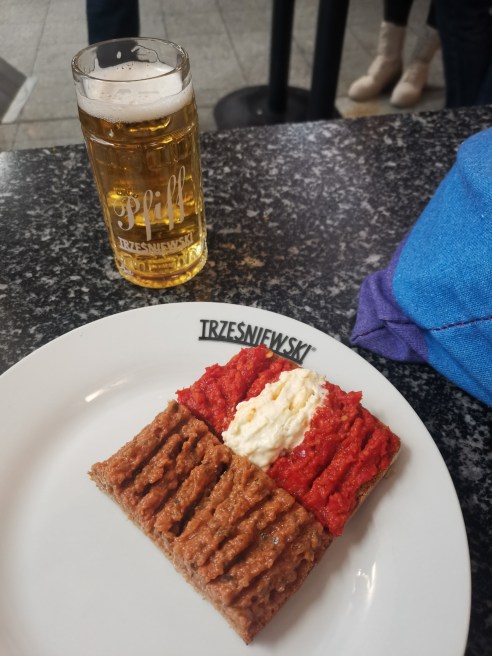
The next stop was Trześniewski 🇦🇹 a famous Vienna institution dating back to 1902. Our first visit here, interest was piqued when hearing about the Pfiff, a tiny beer pour (even smaller than Cologne’s 0.2l Stange glass. As you’ll gather from the name, the founder was Polish, and the format feels somewhat similar, a tastefully retro snack bar with casual tables, the premise is simple. Choose a few finger sandwiches and a Pfiff (In this case Ottakringer Gold Fassl), enjoy a quick chat with your friends and head back. I enjoyed how, similar to a tapas bar, you can be here for a good time not a long time. A truly satisfactory experience here can last no longer than 10 minutes! Something about it is peculiarly addictive. It’s also directly opposite Café Hawelka, so you can stumble out of one and into another (and back again – those sandwiches are good).

Somewhat of a tradition, a trip to Gösser Bierklinik 🇦🇹 followed. A historic restaurant with a Schänke to the right as you enter. The best time to visit here is in the heart of winter, enjoying cosy surroundings in a natural atmosphere, with the occasional sound of horse clops hitting the cobbles outside. A rainy Spring day would have to do. Stiftsbräu Dunkel is the best beer on offer, a delicious rich dark lager.


It was time for a break after all that, and we took it easy in the evening, with food at Gürtelbräu 🇦🇹. This pleasant multitap pub is based in railway arches and a nice modern venue, dimly lit and using the natural ambience of the space, but it was disappointingly not boasting any of its own beers. A reminder to never assume in Austria or Germany a place brews its own beer just because ‘brau’ features in the title. That said, Vienna’s best mainstream beer, Ottakringer Rotes-Zwickl is permanently on tap, so we got over that news pretty quickly. They narrowly missed an inclusion to the guide as it was ridiculously short staffed and the food was pretty mediocre for the price.


The penultimate stop for the evening was a 2nd visit to Mel’s Craft Bar and Diner 🇦🇹. A central beer specialists in a modern, diner style room, we still found the environment oddly sterile despite the warm colours. Stuffy, overly lit, lacking charm and lacking an identity – something a large beer list can never compensate for. The fact we even returned was due to the unexpected closure on the day of Philosopher Bier Bar, an unpretentious little pub that adroitly drums up a comfortable, non-bland social atmosphere which we’d far preferred to have been in.

I thought it best to end the evening somewhere new. Perhaps not the most original choice, but we paid a visit to Delirium Café 🇦🇹 a sort of franchise that has spread across Europe. A curved bar with plenty of space, but lacking atmosphere and perhaps importantly for a Belgian café, short on satisfactory drinks options. The glass of Tremens ordered was also comfortably the worst I’ve had on the continent. Online reviews seem to confirm our suspicions that it was all a bit mediocre. This is an ongoing problem with the very centre of Vienna where a couple of beer bars like the above can prove popular simply due to the absence of competition. Perhaps we learnt something that evening – to not settle for mediocrity on account of convenience.

Day 3 – Final Day in Vienna 🇦🇹
After a dollop of morning culture followed by a dollop of mustard on some Vegan Würst, a 1st visit to Café Sperl 🇦🇹 kicked things off. A city institution, this was always likely to be more of a café than bar, and so it proved. We had hoped there may be a bar like atmosphere with the preserved 1880s interior, and its position as a social fixture, but the ceilings are too high, service is too formal, and the crowd too café like for it to be eligible. That is not to say I disliked it – an Einspänner (espresso with whipped cream) and slice of Sachertorte were delicious and the sense of institution was tangible. But it is a Café, not a bar, somewhere that feels rather like a treat to oneself, a private rather than a socially minded decision.


As we walked back into the city centre a quick search for potential bars uncovered a venue I had missed during cumulative hours of online trawling over the last 8 years. Amazed this slipped the net, Gutruf 🇦🇹 was a wonderful experience! Family-run, a cult Beisl, small informal and preserved venue with a 1970s era appearance. Homely, personalised and distinctive, with a hybrid menu of Chinese and Viennese cooking. The place even hides in plain sight, the street frontage suggesting a barbers or clothes shop that shuttered decades ago. A place you can go for a drink and a chat just as easily, there is an easy informality that belies all preconceptions and lived experience of Vienna’s stuffier pub-restaurants. We recommend.


There must have been 20 minutes to spare in the centre – ah yes, a wait to visit the Cathedral and climb the tower – because our notes confirm we were back in Trześniewski 🇦🇹 munching on sandwiches and sipping on the little Pfiff!
After a very active day out we went back for a rest to recover for the evening.
That evening we paid a 2nd visit of our trip to Känguruh 🇦🇹 . When one of the Top 100 Bars in Europe is on your doorstep, you can’t waste the opportunity!


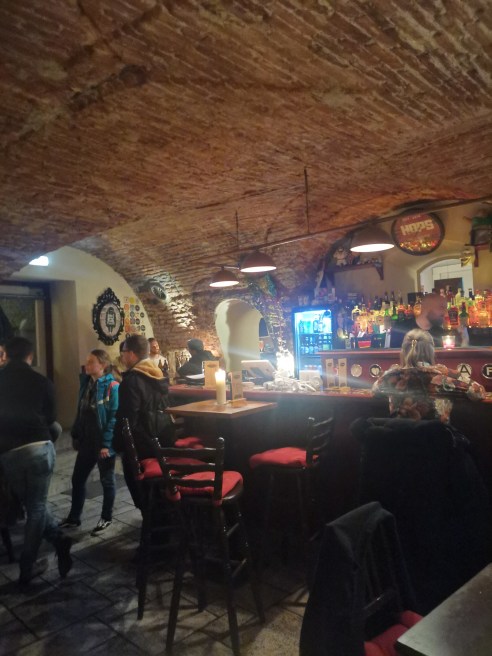
There was time to try one more venue for the first time – and it was a big one – Jazzland 🇦🇹. A long-standing cult Jazz & Blues venue set in the basement of a 500 year old building, everything jumps out at you immediately to suggest this is going to work. And it does. Tucked around a side courtyard, descend stairs to a ticket counter and clothes room, paying the nominal fee (5 euros in our case) to enter a busy little theatre and basement bar in a warren of rooms. Brick vaults decorated with black & white photos of famous (and not so famous) performers that have appeared over the decades. Drinks are decent, all things considered, with Zwicklbier and Dunkel on tap – not the worst outcome for such a venue. The bar room does not allow for much viewing access, so try your luck in one of the niches or wait until a seat in the main room becomes free. An excitable crowd that sense they are part of the best thing going on in Vienna at that moment – a sensation that leaves a lasting impression. Mark this place on your map – we have.


Day 4 – Graz 🇦🇹
Graz in the southern Styria region is a pleasant 2 hour-something train journey from Vienna, passing by some steadily more scenic and hilly areas (still nothing like out West). With the highest peaks still snowcapped, there was plenty to look at on a pleasant sunny day.
Graz 🇦🇹
On arrival, the best way into the centre is via tram. Somewhat similar to Ghent 🇧🇪 in layout, the very centre is just distant enough from the station to warrant a ticket. The central Hauptplatz stop drops you off in the dead centre of town, with its beautiful pastel coloured buildings and the looming Schlossberg and clock tower overlooking the Altstadt.
Unlike Vienna and Linz, Graz’s old town is happy to wear its cracks and peeling plaster, adding to its sense of historic character, and is UNESCO-inscripted. A small centre, once there pretty much everything is walkable providing you’re relatively mobile.
Before our 3pm hotel check-in we started at Bierboutique 🇦🇹, a bottle shop with some space for drinking in. Service was friendly and helpful, the selection offering a decent range of regional beers and plenty of pricier specialist mixed fermentation stuff. A Witbier dedicated to the Bosniaks was an unexpected and rather random find, but also a good one! As for the venue, it isn’t somewhere you’d go for an evening drink really, with it feeling more like a spot for a quick tasting than a social venue.


Up through the old town and through the city park to one of Graz’s Bauzatslokale. Let’s address what that is first. These ‘kit bars’ are owned by the same company and dotted throughout the city. The concept is that your food – be that pizza, salad, burgers, etc is completely customisable, and you fill out your bingo card according to your needs. Reasonably priced and therefore popular with the University population in the city, these breathe life – pub life – into Graz’s cultural scene. Of those concerned, some are better than others, and in our opinion Grammophon 🇦🇹 qualifies as one of the most pubby, with a genuine ‘local’ feel, somewhere you could pop into to say Hi and relax with friends. A wooden interior natural communal seating around a central bar, and ‘worn-in’ feel that tells of many happy nights spent here. As with almost all pubs in Graz, the not-very-nice Puntigamer lager is available on tap, along with a host of other mid-brow options.


With good weather on our side, a walk up through the Schlossberg (yes, direct through the rock) to the clock tower with beautiful cities views followed, before dropping down back to the city centre.
Occasionally we will drop into businesses on a whim if they look good and today was one of them. Maggie’s Leberkas Stadl 🇦🇹 a venue we were hitherto entirely unaware of, was full of locals mid-afternoon and it looked as though they were having a great time. With a meatloaf counter and stools opposite a bar you may begin to wonder if this is some arch hipster venue – far from it. Decorated in a slightly camp – but very Germanic – way, full of friendly – rather drunk – middle aged folk, here is where pretense – and perhaps decorum – goes to die. We both enjoyed the refreshingly no f’s given environment and the fact a pub was actually busy during the typically dead hours of the day, but can’t really justify its inclusion.


The next stop before a break for a rest + dinner was the inverse to the previous place. Thirsty Heart 🇦🇹. Better beers, plenty of artifice and pretense, but no soul, and fewer people – sullen staff weren’t exactly filling the void either. A slate grey room, you look around for something to hold on to other than the glass of beer – and it isn’t there.


After a stomach-lining dinner we took a walk out to Graz’s University district, a pocket of nightlife around Zinzendorfgasse. Here, the best Bausatzlokale, Posaune 🇦🇹 can be found. Another bar with a natural social shape that invites mixing and encounters, producing a dynamic atmosphere. The place is also a worn-in, homely sort of pub that you can hang out in at quieter times. Our 2nd visit here and definitely not our last.


Our next selection, back in the centre was a bar I had mulled over going to in September 2022 until I walked into the middle of a Pub Quiz and a crowded room. This time however, there was ample room in Hops Craft Beer Pub 🇦🇹 which was a pleasant surprise – less of an ex-pat/tourist crowd than expected, and much less ‘crafty’. Instead a healthy mix of people that injected a good sense of social character in historic vaults that are tastefully decorated. It doesn’t hurt that there are several nice beers here – something that should never be taken for granted when you look around Europe.

Tiring but with enough in the tank for a nightcap, a 2nd stop at Brot & Spiele 🇦🇹 an unusual venue. Large, with a pub room and games area, on my first visit I found the environment fell well short, but this was because I was hanging around the games area, having walked past where I should have sat. Walk left into the pub itself which is a pleasant enough place decorated with some classic breweriana and furnished with communal booths. The beer selection is atypically excellent for a games pub. While perhaps not cutting edge, plenty of better traditional options are on offer on draft and tap. Would it feature on our guide – no, that would be a bit of a stretch, but it is good enough to have in your pocket as an option while in Graz.

Day 5 – Graz and Arnold Schwarzenegger 🇦🇹
Arnie’s childhood home is in Thal, a picturesque village that’s a short bus ride and pleasant country ramble from Graz. After morning coffee we took a literally last minute decision to attempt to visit. This was a little reckless given the buses out there are very infrequent. But, as normally happens, everything turned out fine. The museum is small and the entrance fee a little steep, but when were we next going there? (never) And when are we ever going back? (Also never). Underplaying Arnie’s Dad’s far-right leanings with some expert deployment of euphemism, overall it felt more appropriate that the experience emphasises the general cheese and gurning, simple-minded good vibes Schwarzenegger delivers.

Our first visit of the day was an adventurous and novel one. Before now we had only read about Heuriger culture in Austria. These taverns are often family affairs, wine producers with a hospitality focus, often putting on spreads and buffets to accompany their wines. Normally these are based in the hills but occasionally some pop up on the fringes of cities. We were fortunate it wasn’t too difficult to visit Lucky’s Heuriger 🇦🇹, a venue out in the suburbs but just about reachable via tram and bus after a walk. Completely local with a homely, pubby environment inside, full of personal touches that feels like being in someone’s lounge. Wines and the buffet were both simple but distractingly good quality and came in at good value. The cuts of meat were close to par with a meal I had paid over triple for the previous evening. Hospitality was as good as advertised, and the slight adrenalin rush of going somewhere largely untouched by tourists did the rest. An experience we will revisit as soon as we can.


Spring was finally arriving and we enjoyed spectacularly good ice cream from Die Eisperle in Jakobinplatz in the nearby Blumengarten, a little tulip-laden fountain square that begins the run from Herrengasse towards the Hauptplatz. The sugar rush sustained a trip around the Landeszeughaus, the biggest collection of Medieval European armor in the world. Afterwards, we took a walk up to Kaiser Ferdinand II’s mausoleum, a typically extravagant and hubristic affair, but at least such things are entertaining centuries on, better that than some dour alternative!

After a break from these cultural exertions it was time to venture out for the evening beginning with Bier Baron 🇦🇹, our 2nd visit and the 3rd of these Bauzatslokale. This visit really showed off the pub’s charms versus a quieter afternoon last September. While it may be too mainstream for some, a simple versatile format shows why it’s a hit. A DIY pizza and Zwicklbier later, and we were fuelled for the evening ahead.


Our next stop was an intriguing cocktail bar named The Churchill 🇦🇹, which fell somewhere in between student hangout and gentleman’s club (Oi – not that kind). Despite pretensions to exclusivity, the atmosphere was pretty informal and cordial with a mix of people, while the cocktail menu offered classics on top of their house specials. While there is some amusingly dodgy framed art, taking a balanced appraisal of the bar’s appeal overall, it deserves an inclusion to our guide.


Further down the hill in Graz’s attractive moneyed suburbs of Geidorf is Humboldtkeller 🇦🇹, a surviving old family-run Beisl. Longstanding but with very little presence and recent reviews to suggest it was still open. We are glad to confirm it is going strong. Friendly service, Yugoslav pub grub (which is very much not the focus), candlelit tables and attractive curved ceiling is a flavour of what to expect at this quaint, atmospheric little hideaway that has deservedly become a cult hit in Graz over the decades for Jazz & Rock, and cosy atmosphere. We liked it.


Our last stop was back in town, a basement cocktail bar that was locked up on a previous attempt. Caffe Hallo Josephine, 🇦🇹 was a little short on online presence but with plenty of glowing reviews. In the end our experience fell below that hype. Kindly service in a tiny little basement, it was not without charm but lacking a few flourishes in the décor, while the cocktails appeared to be constructed without much assurance.

So there is Graz. Our 2nd visit to the city, this is not a place lacking in decent options for both beers, cocktails, music or community events. It lacks that one killer venue I suppose, though that is no great crime. After a night’s sleep it was time to move on and visit Slovenia for the 1st time since 2014!
Day 6 – Slovenia 🇸🇮 – Maribor & Ptuj
The journey to Slovenia from Graz is about as straightforward an international crossing as you can find, without much delay or bureaucracy, you will land in Maribor train straight around an hour after departure.
Maribor 🇸🇮
Maribor is a nice little town – particularly its unheralded central square and riverside – and will make an acceptable half day/evening for tourists interested. After a look at its modest, vaguely unwelcoming cathedral, we were quickly en route to Pub Gambrinus 🇸🇮, a little place that specialises in Czech 🇨🇿 ales and lagers. Noticing our conversation in English, the owner introduced himself and explained his connection to a roster of beers that are frankly extraordinary to find outside Czechia – and would be pretty damn good to find in Czechia too. Aside of that aspect, it’s a characterful little knajpa, clearly inherited from a previous operation, worn wood, raised seating area and street terrace. While some of the signage veers towards those inane beer sayings and even worse, ‘Live Laugh Love’ type stuff, that is ignorable.


Before moving onto Ptuj there was time to visit Kavarnica Rokaj 🇸🇮, a very down to earth Caffe Bar by the river, currently engulfed in building work. With a surprisingly good beer selection – including local craft, I couldn’t fault the produce, or the soundtrack, but unfortunately the venue is the typical awful Balkans café bar mess.

Following a minor train delay, we even had time in a 3rd Maribor venue, Shakespeare Pub 🇸🇮. A battered old theme pub with wood fittings, it at least vaguely resembled a pub. Staff who appeared to be about 16 years old churned out the typical rubbish lagers, so it was time to get a bottle of Laško, as vile as I remembered.


The journey to Ptuj takes a frustrating L-shape, and a delay backing our of Praguersko ended any prospect of reaching Ptuj castle before closing time. This just left us with a wander around, and it is a very pretty little town.

Ptuj 🇸🇮
A wine producing region, we had hoped to go somewhere to try local wines, but unfortunately none of the cellars were open. We were invited to have some wine at the bar at Hotel Mitra, 🇸🇮 one of the potential wine tasting venues in lieu of their cellar tastings, but it was a drab experience and one of the real wastes of time of the trip.
Ptuj is home to the Kurent, a mystical character who chases away winter to beckon in spring, and it certainly felt like they had paid Slovenia their annual visit on this warm sunny April day. One of Ptuj’s cultural centres is Muzikafe 🇸🇮, a historic building and one that enjoys minor national fame. The interior is a warren of rooms in a café lounge style, warm 1990s type hues with sofas you can sink into and large books to lose yourself in. So far so normal – but the venue is brought into interest with its courtyard area with creative metal art installations and seating niches, which comes alive in the summer months – it is worth mentioning a few superior beer options in the fridge too. Certainly in a small town like Ptuj it shouldn’t be overlooked.


After a meal and a rest we ventured out to a pub we were confident would deliver – we had researched it in advance but it was also mentioned by the bar guy at Gambrinus in Maribor. In the commercial centre of Ptuj you’ll find Kavarna Bodi 🇸🇮 occupying a tall Austrian-era building. This cultural centre, bar and café similarly lays on the amenities for the public, but has more of an edge and relevance. On arrival we were nearly turned away after the limited seating at the main bar was taken. Staff explained a live performance was ongoing in the main room with a 15 euro entry fee, however after some negotiation we were allowed to enter, and enjoyed the last half hour or so. The main room with its tall ceilings and eclectic furniture and installations is cosy, instantly likeable and obviously one of the region’s best social spaces. The experience was accentuated with a very decent beer selection that will keep most tastes satisfied. After the gig and a little exploring of the premises we returned to the bar room to find an available table, and had a 2nd drink in the fairylit surroundings of the bar – a nice place indeed.


A drunken walk home allowed just enough time to visit local’s bar Orfej. While the other venues have their particular charms and audience, this was clearly the pub where the Ptuj residents, those with a stake in proceedings perhaps, hang out. We got the predictable few looks on our entry and were almost caught out by their closing time. Busy and bustling, it had plenty of atmosphere but overall was lacking a little in a distinctive appearance, and perhaps a little in terms of hospitality. We were ushered out pretty promptly at last orders.


Conclusions – and the road ahead!
Visiting Graz and Vienna relatively soon after our last visits in September 2022 was a good opportunity to reaffirm some initial impressions and build on our exploration of their bar scene. Vienna ended up being a success with some excellent bars added to the guide, whereas with Graz we mainly built on breadth rather than depth.
Slovenia is, as always, strikingly beautiful and it is nice to see most venues we visited going beyond the Union and Laško beer options. It feels like we missed out on some of Ptuj’s best bits, which is a source of regret when you may not return for 10 years, but at its bar scene was certainly not neglected.
In the next 6 days we would cross over to Croatia 🇭🇷, visiting Varaždin for a night and the capital Zagreb for 5 nights, both places we had not visited for 10 years. Would they yield the next great inscription on The European Bar Guide? Watch this space!