A Weekend in Brittany – Trip #1 of 2023


Day 1 – Paris to Rennes

What better to blow away the January blues than a Eurostar trip to Brittany? Well, I’m sure some of you could point to a nice tropical island or two. However, pastures new are pastures new. Despite many trips to France growing up there was a big gap until our trip to Lille back in March and as you can see from our map, lots of uncharted terrain in terms of bar going.

Brittany looked promising on the bar front, with its Celtic culture and vaguely secessionist vibes. Rennes itself is a university city which normally means busy nightlife, even in January.

Leg 1 of the journey involved a few hours layover in Paris where we visited Au Sauvignon for lunch, a typical Parisien café bar bistro. Extremely compact with an angular design personalised with Fin de siècle artwork and ephemera. The service was a Tasmanian devil whirlwind of half a dozen pirouetting waiting staff sashaying between the cramped seats. While foodie on our visit, there is all suggestion it slides into being a drinks focused evening wine bar, indeed a glance at the menu confirmed many of the dishes are little more than tapas bites. As a primer for the classic bistro experience however, it was a good start.

Rennes isn’t far on the TGV so we arrived and checked in reasonably quickly, heading out to the old town across the river, linked memorably by the shopping street Rue le Bastard. Grand civic and religious buildings transition into an ensemble of painted timberframe houses which culminates at Place Sainte Anne. On arrival a carousel was operating, the church lit up, and a series of cafés were serving customers outdoors despite the temperatures already plummeting to minus 1 degrees.

Our delve into Rennes’ nightlife began with a trip to L’atelier de l’artiste, a bar which manages to straddle the difficult balance between its artsier, bohemian intentions and the fact it is located in possibly the best place in the entire city to have a bar, so attracting all that comes with that prominence, positive and negative. While the bar doesn’t get rave write-ups online, we really liked it and returned later in the holiday. An outdoor fish tank, piano by the entrance, and the feel of a place enhanced by its own creations that has become more than the sum of its parts. 6 beers on tap took centre stage – none all that great – but were a hint of the emphasis on beer we would come to find in Brittany.


From the very well known to the obscure, our next stop was Cour des Miracles, a small, far more local feeling place with a younger crowd encompassing the alternative to the cosier end of bougie. Upstairs an eclectic but memorable arrangement of décor included cross stitch erotica in the toilets and local artwork that on arrival hadn’t yet been hung on the wall. After a while the place filled up, and we can say this is a good option for later night drinking or earlier musical hangouts. The small bar was staffed by some no-nonsense but friendly guys and drinks choices were very decent.


After dinner we ventured over the river into the very opposite of timber frame world, concrete blocks and arcades to the craft beer bar Amrok. This craft beer bar and bottleshop was an appropriate 1st spot to test Brittany’s approach to such a style of venue. On entry, a familiar industrial chic approach, but being in a retail unit in an arcade still felt down to earth and friendly, rather than the more angular city places you can find. Communal tables, a games machine and striking Amrok mural set the tone. Their beer selection cannily mixed local Brittanique craft with Belgian classics. It all went well.


It was time for a nightcap, so back to the centre of the action via Rue Saint-Michel. This street is the centre of the most raucous nightlife in Rennes. Happy hour pint offers, takeaways, booming music and absolutely sans f**ks given. We did try our best to find the likeliest decent bar among that row but they all appear different shades of the same thing. The right balance was struck though by Ty Anna Tavern. This Breton bar in a timber frame building manages to work in a shade of the energy of Rue Saint-Michel with its live music and drinking on the lean rather than sat down, but wasn’t anywhere near as tacky (admittedly, we did see a bowl of punch though) In fact, bonus points go to it for stocking Brittany products from the beers to spirits.


Day 2- St. Malo and more Rennes

Less than an hour by train up to the coast, it seemed inexcusable not to visit St. Malo. Not your average bucket and spade town, this former military town is ringed by a fortress wall, and its beach has a huge tidal range meaning at low tide you can walk across causeways to various forts and islands. The interior of the old town has a distinctive and intact ensemble of tall grey/brown buildings and side-streets you can briefly get lost in.


Day-tripping is nice in its own right, but for bar going during the day it can be tricky, with so many venues opening later on. L’Aviso was one such place which will have to wait until another year – we can probably recommend that without needing to personally visit. Over the years we’ve graduated towards spending a night rather than going to and from somewhere in a day, but it wasn’t possible this time.

St. Malo hosts possibly one of the oddest and most striking café bars in Europe, which we must tell you about. It’s official name, Le Café du Coin d’en Bas de la Rue du Bout de la Ville d’en Face du Port – La Java (Maison Samoy-Coulon-Goupil) can be shortened to La Java Café if it pleases you.

A veritable institution, this place exudes charm and character, a reminder of the great lengths and labours of love that make great bars. 3000+ dolls line the walls alongside jaunty carnival ephemera, added to by a mechanical accordion, chain swing seats and a confession box acting as the door to the toilets.


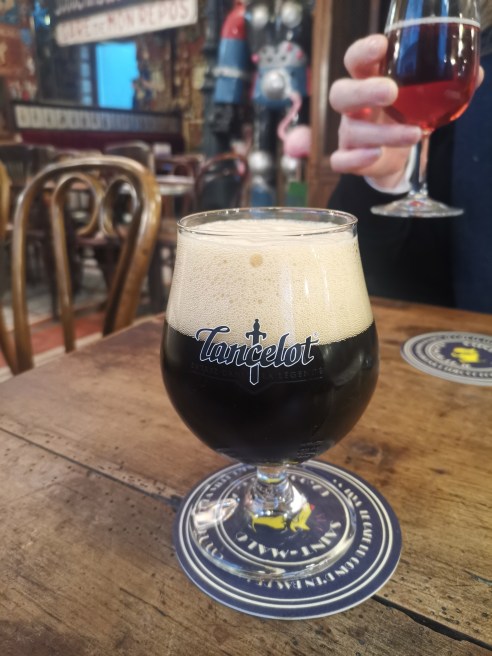
The man of the house, Jean-Jacques Samoy, is a notorious ‘character’ who will not stand for rude photographers or disrespect, but will be no trouble to any civil or polite customers. The wares have plenty of Breton flair too with local beers and twists to popular cold and hot drinks referencing the local agriculture and Celtic customs. While I was there I enjoyed a dark beer Telenn Du brewed with Blé, Brittany black wheat. This was from Lancelot Brewery and superb. A Gruit beer of theirs (brewed with herbs and spices, without hops) was less successful but nonetheless interest.

Truly above the norm, and a must visit when in Brittany. It will feature in our Top 100 for 2023.

On return to Rennes, I visited an attractive looking bar Cité d’Ys which was on the corner from our hotel. This had always looked busy and the clientele gave off a strong indication it would be a friendly and cool place to go. This was where we found our first Breton cask beer, Coreff Ambrée, served from the handpump. As luck would have it, it was also Happy Hour so a pint cost only 4.50 euros (which we can confirm is about as low as you’ll find for a half litre of beer in central Rennes). This was only 1 of several good quality Brittany beers, the emphasis not too subtly accentuated by a large regional flag hanging next to the menu. As for the place, it had a faux-mythology theme with fake ruins , a staircase leading to nowhere and Knights of the Round table insignia upstairs. That makes it sound awful. Trust me, it was really very understated and somehow rather effective, with its warm hues of gold, brown and reds.


The evening was spent in the north end of the centre at La Maison, Origines Micro-Brewery and The Black Bear respectively. The focus of all three was beer, and this meant a deeper dive into Breton brewing and local beer culture.

The former wasn’t a venue my sister enjoyed greatly, though I believe it will have some mileage for beer fans. Despite flash black and gold décor on promotional literature, the venue is quite ‘lived-in’ shall we say? It is definitely a mildly alternative beer monster, craft beer fan hangout with its casual backrooms. Without a stock of customers the atmosphere is somewhat lacking. The beer selection was possibly the widest in Rennes however with over 12 taps and a good proportion offering local wares. I didn’t strike gold with La Ouache, a tripel from La Dilettente but that was simply bad luck.


The next venue was far more interesting overall, a former Hotel Dieu which has been converted on a budget into a vaguely countercultural hangout with a large front yard for spring and summer terrace drinking, games and hangouts, live event space inside and a brewery. Origines’ beers have a Franco-Belgian emphasis but not entirely, and it was enjoyable as well as reasonably priced. The overall space again feels like it comes alive in warmer months, but the central taproom still had a good atmosphere and entirely local crowd.


The last spot, The Black Bear was a friendly spot where the staff and customers were happy engaging us in conversation. The venue itself has some nice aspects such as a bowing timber ceiling and cargo netting, but the furniture and cabinets facing the bar weren’t comfortable or really producing much in the way of overall atmosphere. The beer options were again strong and the evening reinforced what a standout area this in in France for beer above wine and aperitives.


Day 3- Vitré & Cesson-Sévigné in Rennes’ suburbs

Vitré, one of those formerly important medieval towns that suddenly went to sleep, ‘found’ centuries later to be an open air museum. Its impressive chateau and churches speak to its former power and are well worth the 30 minutes train ride there and back from Rennes which goes reasonably regularly. Wandering the cobbled streets past timber-framed houses, finding little nooks and alleyways and pleasing vantage points is the whole point of a visit here. There isn’t anything notable in terms of its bar offerings though. Let’s admire, and move on…


After lunch and a ride back to Rennes we headed out to a peculiar trio of venues, each industrial units in the suburb of Cesson-Sévigné. Brasserie Skumenn, Rennes’ foremost craft beer brewery was unfortunately not open that day, however the other two, Cave à Flo, and Chope et Compagnie were.

Cave à Flo is reachable on the 67 bus which sets off in the centre of Rennes by the river. A simple 15-20 minute journey, the nearest stop is only 3 or 4 minutes walk away. You are dumped in a row of large out of town retail units in something approaching liminal space. The warehouse has exterior signage but it is all unprepossessing. This was worrying, however I reassured myself the images that had drawn me here would be realised on entry. This was, satisfyingly, correct.

This bar has turned a huge, difficult to harness space into a distinctive, personalised venue. Not unlike some US roadside taprooms in layout, but with a dollop of European flavour. Brewing signage and flags decorate the walls and ceiling and large communal tables are set out in rows, drawing you to a taproom at the far end of the room. Rows of beer bottles line the wall with a modest selection of wines and spirits. It is a takeaway bottle shop as well as a bar and pub. Service was friendly and they also had cask beer, Coreff Ambrée again available via handpump. This one was better overall, in excellent shape and really producing a lingering head. Were they to raise the temperature by a couple of degrees, it would have been even better.


Despite the odd location we found a core of regulars, possibly friends of the staff as well as a pizza hatch (which, from the aroma, was clearly in use) which showed this is a known about venue. Reviews on line stretch back years and are overwhelmingly positive. As well as the main room a large terrace and games area shows this is a place that will get seriously busy in summer.

The next stop, Chope et Compagnie was a modern, craft-leaning version of the same thing, with much more generic decor and wider exposure of its warehouse space. They appear to be a chain. It wasn’t all from a template, with some arcade machines and a hang glider fixed to the ceiling catching the eye, and a decent range of beers from the tap. While it wouldn’t be somewhere we’d singularly rush off to, it is only around the corner from Cave a Flo, so it makes sense to visit both.


Later on, being our final night in Rennes we returned to L’atelier de l’artiste and Cite d’Yes, those being the most enjoyable, and attempted to return to Ty Anna Tavern for Breton shots to finish off. Damn! It had closed for a staff party at 7.30. We made do with a final stop at Penny Lane. Despite the name, there was mercifully few signs of tacky ex-pat themes on show. This was set in the vaults under the opera house. Tasteful lighting brought out the brickwork, and a balance of cocktails, beer and whiskies showed that drinks were its strong suit. The venue is a little more ‘see and be seen’ but not so much as to be off-putting. Service was prompt and friendly, and despite being almost sniffy by default about such places, it was genuinely difficult to find much to fault it.


Day 4 – Paris then Home

The trip was marred by both my sister and I having our debit cards munched by two separate ATMs on different days. This left us with only a small handful of cash left on the final for Paris which had to be used judiciously – ie – not as much boozing. With a few hours to kill, I was shown some of the central sights before we headed to a couple of bars, L’imprevu and L’Art Brut.

The former was a colourful friendly spot but unfortunately rather cold, not allowing us to really feel comfortable while there. It is also extremely expensive with the happy hour deals only bringing prices down to barely scraping acceptable.


L’Art Brut was much more like what we had hoped to find. A slight steampunk feel to the exterior, with the interior managing to blend old wood with a sort of rusting patina to good effect alongside macabre/sinister artwork distorting human bodies.


A tiny bar, it was easy to imagine how thronged this must get in an area not exactly studded with such places. It offered a surprisingly decent beer range considering it could easily survive without one, and I had the first ever Belgian Tripel from a pint glass. It soothed the anxiety over whether we’d get home safe with a few euros left in our wallets – glad to report we did, aside some of the usual delays at Kings Cross.

Kings Cross generally gets people recommending The Scottish Stores. While not a bad bar – particularly for its literary history, we’d recommend a 2 minute walk up the road to King Charles I, which is like an Amsterdam brown café has landed in London. At the minute it is still popular for those in the know, perhaps it ought to stay that way. From Kings Cross you can get there in 5 minutes and back, making it super convenient as a time killer, with plenty of real ales available.


Final reflections….

If you can find cheap tickets from the Eurostar, then this is a doable weekend break even as far away as Leeds without needing to fly. Of course, should you decide to fly there are nearby airports to Rennes such as Dinard which will work as a connection. Rennes itself is, without any embellishment nor intent to insult, a middling French city with middling sights. The timber frame architecture is a highlight and will stand out, particularly for the uninitiated, and the central monuments are diverting. Rennes nightlife is pretty buzzing with a clearly marked studenty area, some alternative venues dotted around (several of which we didn’t get to) and a strong beer culture with most places offering not only a good selection of beer but some local beers too (including on cask, which is incredible), which speaks very positively to its lack of any overarching corporate/globalised feel. Many reading will get a lot out of that. Rennes is also nearby many towns of interest such as St. Malo and Vitré above, but also Dinan, Dinard and a host of towns and cities further West in Brittany. The regional influence is about as strong as Cornish, including some attempts at bilingualism on signage. This further creates a distinctive and memorable trip.

Scârț, Timișoara

Scârț
Timișoara
9.2/10

In Timișoara, a venue has appeared in the last 5 years which is entirely unlike anything you would expect to find in the West.

Strada Arhitect Laszlo Szekely 1
Timișoara
Romania

In Timișoara, a venue has appeared in the last 5 years which is entirely unlike anything you would expect to find in the West.

While Western Romania is hardly a hotbed of distinctive individual bars setting Europe alight, in a strange way, the cheaper rents, creative freedom and lack of corporate control make it much more likely that such a place may come into existence versus an expensive, tightly corporate trend-following city centre (eg. Leeds).

There is a twisted irony that Timișoara, birthplace of the Romanian revolution against communism would now host as one of its most popular attractions, Scârț, a bar and museum nostalgically smothered in its relics and ephemera and making money from them.

The name itself, “Scârț” translates to ‘Squeak’. Apparently there are extra layers of meaning to that (I haven’t managed to find out just what. Other suggestions seem to think it means Creaky door). Loc Lejer is more direct: ‘A chill place’. It was opened by a group of actors who were looking for a way to sustain themselves and their work.

The bar itself is located in a large old house in a quiet neighbourhood south of the city centre. It is not all that far away on foot, perhaps 15 minutes, also only a hundred metres away from a locally famous restaurant Casa Bunicii.

While the walk to Scârț may feel unsettling, entering the bar, even for the first time, feels almost like going to see an old friend.

Despite a Museum attraction on the premises, you won’t find too many huge signs nearby advertising its location.  However, as long as you stick to the address and follow your nose, you’ll be OK.

Like a lot of cities in the region, backstreet Timișoara during the evenings is dark. I mean really, really dark. With little signage or street lights to guide you, the strongest indicator of the bar is the rumbling of conversation around the back of the building. Enter through the front gate and you will see a number of large artworks fixed to the fence in the driveway. Carry on through and you’ll find a small garden terrace, and a set of steps leading up to the bar itself.

On entering, you will find the bar directly to your right. You will have quickly noticed the place is very nicely decorated, with an array of communist-era nostalgia among one or two new artworks, with a few tables directly opposite the bar top to sit around.

There is a wide choice of drinks – alcohol certainly does not dominate, although there is plenty of that should you wish. The cheapest (though certainly not nicest) beer, Ciuc, will set you back 7 lei, reasonably good value in a city which generally fluctuates between 8-13 lei for a basic half litre bottle. If you are simply looking for tea, that can be served in pints and I read that they make their own elderberry drinks. We also read that you can buy certain old time snacks like Pufuleti, Eugenia and Danut, which is thoughtful.

Once served, you can explore two backrooms, where the décor hits you from all angles, with any number of interesting and varied pieces of communist kitsch to cast your eyes on. The furnishing is eclectic, but thoughtful, with some chunky tables to sit around, some bench seats and some soft furnishings to laze around on.

They have also provided board games, books and musical instruments, great touches from a bar which has dedicated itself to becoming a social hub.

We visited Scârț several times during our visit, at different times of day too, and there always seemed to be people milling about and treating the place as a second home (in a positive way). The garden in particular seems to be an area for convalescence, almost.

Remember we mentioned a museum? Well here is where the experience becomes even more colourful. If you have already been identified as a tourist the staff at the bar will likely invite you to go down and see the museum at a time of your choosing.

You will experience more intense version of what can be found in the bar. The name is “The Communist Consumers’ Museum”, effectively a collection of childhood items, relative luxuries and day-to-day objects which inspire nostalgia for the era set out in the style of a small apartment.

I must admit, its basement location makes it feel more nuclear bunker-like than was probably intended, but they have put a lot of care into arranging the items in a homely way. The exhibition is also interactive to a point. You are free to play with stamps, blackboards, musical instruments, old radios and really get hands on with the items in front of you (providing you show respect, of course!)

At the end point you will find some piggy banks – the museum is free but donations are welcome (and well deserved).

Once you have exhausted yourself in their historical air raid shelter of nik-naks and nostalgia, it’s back up to the bar to take a seat and socialise.

The crowd hanging out at Scârț are down-to-earth. This isn’t a pretentious see-and-be-seen destination. There are no bouncers, no under-dressed teenagers and no one is trying to be someone they aren’t. It’s a place to be yourself, at ease with others.  Which is why we like it – a lot. This is also the recurring reason why thousands of people have rated it so highly on Google and TripAdvisor.

As if this wasn’t enough, the bar also has a theatrical connection, founded by members of the local Auăleu theatre group, who you can find more about during your visit.

Scârț does what nearly all the best bars in Europe achieve: it pits itself at the heart of a community, gives people multiple reasons to visit and exudes an identity that inspires loyalty.

What other bars find so difficult, this one seems to find easy. Where other venues have settled for less, this one has gone expressively explosive. As the website itself states – nothing has been left to chance. (Also, they haven’t removed the bath from the restroom, even more underlining that this really was someone’s house back in the day!)

Their sign-off is bold and confident: “you have got to be new, surprising, magical, young, warm, precise, inviting and everything else that Scârţ proves to be every single time.” We couldn’t agree more.

This mission statement is what all should have in mind when they create a bar. Sadly very few do, but at least we have places like this one to remind us what things could be like, and a website like ours to tell you where they exist! 🙂

Is it really that difficult?

Opus Pistorium, Bari

…back to Italy

Opus Pistorium, Bari

8.7/10

Where is Opus Pistorium?

The best bar in Bari is located in the tight twisty environs of Bari old town! Here you can enjoy an atmosphere which – at the time of writing – has survived the effects of major tourism that has so drastically affected the likes of Dubrovnik and Venice, destroying the local life in the centre of its city.

Such local life, in all unfettered glory can be found in the heart of Bari, what many other hollowed-out cities would simply call their ‘cultural centre’ (with the tacit acknowledgement that the city’s residents are surplus to requirements), but what in Bari constitutes a genuine living city.

The air is heavy with fresh laundry as residents drape their newly washed bed linens over the balcony to dry, families gather in dining room cum kitchens to dine and converse, their loud exclamations echoing along the alleys and passageways. Children play football and bar owners trundle the latest batch of beer on trolleys around the uneven flagstones with careworn expressions. Traffic noise appears distant, with only the occasional revving of a Piaggio piercing the background echoes of human life cleanly bouncing off the flat surfaces and crooked streets.

Don’t be fooled, Bari is no backwater, indeed the old town is simply 1 of several distinct constituent parts of what is a busy and vibrant place. The city simply features a little further down most travellers to-do lists. Yet, what Bari may lack in self-opportunities, quirky features and bucket-list icons, it compensates for through its authenticity. Outside of the summer in particular, the lack of tourism will feel like a breath of fresh air. This experience is now absent from the places which have welcomed cruises, AirBnB and backpackers all year round.

Bari old town’s nightlight is crowned by 2 very atmospheric brooding bars situated within 30 seconds of each other just off the old town square Piazza Mercantile, the first being Chat Noir (also featuring on our guide), and this one, Opus Pistorium.

The name, which sounds uncannily like a disgraced amputee, is actually a reference to a Henry Miller novel. OP (as we will refer to it from now on) is the best bar we have found in any district of Bari. What made the discovery even more fun was finding it on a whim, not after any studious research, and it being the last bar we visited in Bari on our stay!

What’s it like?

On arrival from the exterior, the contents within will not appear screamingly obvious, with a small discreet entrance, but venture in, and you will be greeted with a spectacularly stylish bar.

OP is based in a tall long room with a curved brick ceiling nearly 15 metres up. I would not be surprised if the room had a specific different use in the past (a water tank perhaps, like Azimut in Sibenik?) but the effect on the bar is endowing it with acres of wall space.

Most bars would not attempt to rise to the challenge, but instead OP carefully accepts it, with a tall long bar area decorated with plants, rather than simply bottles, and artwork of an exotic, occasionally oriental leaning. The colour scheme is crimson – combined with fairylights and candles, this creates a brooding effect that lends itself wonderfully to an intimate late night drink.

Casting your eyes around the room will also reveal a careful decoration of antique furnishings and ephemera, although this isn’t an out-and-out antique bar like the half dozen we have documented in our Days Out feature at Kazimierz, Krakow. The end effect at OP is somewhere in between. Modern artwork and lighting but with a strong nod to the past in other aspects. It is effective and impresses as being tasteful and distinctive – extremely important for becoming eligible for the European Bar Guide.

…come on, tell me about the drinks!

Of course be interested to know what drinks are on offer. Wine strongly features on any menu in a non-specialist Italian bar, and OP is no different, but the beer and cocktail choices are similarly very strong, the emphasis being on quality, not quantity in terms of options. The cocktails we tried were carefully but promptly made, beautifully mixed and presented at a fair price, certainly one which makes you raise an eyebrow in comparison to the cost of beer (which after all, takes rather less effort for bar staff to prepare and serve). Local ingredients make up a strong feature. Normally a sprig in a cocktail in any old bar would be largely presentational, but the rosemary was so fresh and full of scent it added to the flavour and sensation of drinking (what in my case was a Penicillin).

OP is a late bar, so don’t attempt to visit before 7pm, indeed you may be advised to pop by later on if you are seeking a faster-pace. While it was sedate on our visit, many other reviews reference how busy it can get, so it may be advisable to reserve a table, which is possible between 7 and 9.30pm.

Combining a drink here with one in the longer standing and slightly more bohemian Chat Noir will delight anyone who enjoys drinking in those deep red boudoir aesthetics.

One of the risks of a bar of this kind is drowning in its own pretentiousness, risking a lack of openness and a stuffy feel, producing a crowd of customers that behave accordingly. Neither of these bars fall into that category, as while they may not be down to earth either, the decoration, atmosphere and staff will put you at ease.

Both are worth visiting, indeed both belong among the best bars in Europe but Opus Pistorium stands out even further, offering better drinks and value for money, with a style that is original in places. We highly recommend taking time to drink at this superb moody bar on your visit to Bari!

…back to Italy

Domkeller, Aachen

…back to Germany

  • Quality and/or choice of drinks – 8/10
  • Style and Decor – 8/10
  • Character, Atmosphere and/or Local Life – 10/10
  • Amenities & Events – 7/10
  • Value for Money – 7/10
  • The Pub-Going Factor –  9/10
Hof 1, 52062 Aachen, Germany

Although it shouldn’t, it comes as a surprise to me, as much as a relief to have located a cosy, non-corporate pub slap-bang in the middle of a European city centre.

However, Belgium and Netherlands make a habit of it, and these nations just so happen to be Aachen’s closest neighbours.

This German border city and the Low Countries (either of which can be reached in an hour walk from Aachen centre) share a host of cultural cues, with the city itself having initial importance as a Roman spa town before the cult of Imperial Rome spawned Charlemagne and the crowning of 31 Holy Roman Emperors in the subsequent centuries. Aachen also enjoyed a position as a major trading point between nations, goods and wares shipped from the North Sea ports, which may help explain the cultural overlap.

Don’t be under the impression Aachen is any less German for it – believe me, Aachen is a firm fixture of Nord-Rhein Westphalia, and this mixture today results in interesting blends of buildings as you walk around town. Its town hall and surrounding Gothic buildings in the Altstadt could as easily appear as far away as Ghent or Nijmegen without raising any suspicion, but similarly, the remnants of the city wall and the post-war reconstruction are as German as it comes. The cultural centre of Aachen isn’t a large ensemble of buildings when compared to some places, but they are nonetheless impressive and occupy a bigger portion of the city than Cologne or Dusseldorf’s old towns, for example. Aachen is easy to get to from virtually anywhere nearby, and its attractions justify you spending a night here.

Domkeller is situated in the heart of town in an attractive brick townhouse on the small Hof square (you know you’re somewhere central when Hof appears). The scene is made all the more picturesque by a ruined arch halfway along and the distinctive houses that line the square, all fitted with huge grid windows of the kind you normally expect to see on Burgher houses.

This slideshow requires JavaScript.

The risk is that Domkeller could so easily be one of those common tourist traps and a let-down given its advantageous situation. Instead, you will find the opposite is true.

Domkeller is neither based at the cathedral, or in fact a cellar venue (that ceased to be true in the 1980s, apparently, due to safety regulations), however its proximity and age, dating back at least until the 1950s justifies a name of such significance.

This pub enjoys a handsome trade of local people both young and old who are happy to sit and socialise among the odd tourist (such as myself) or group of businessmen that are passing through.

It’s a place that invites interactions with other people; that magic chemistry where strangers who would otherwise be ignoring each other feel they can cross the divide. That alone would be a good reason to include Domkeller on our guide. Aside of that – the antifascist sign near the entrance is proof that many of these elements go hand-in-hand.

Be assured, the appeal doesn’t stop there. As you walk in through a corner door you will find a cosy room with bar area to your right and communal bench seating with fixed small tables. To your left is some chunkier furniture and further benches. Beyond the bar area is the second part of the room, which again is based around bench seating by the walls and has the effect that most of the time you are spent in an enclosed space where you are looking at and interacting with what’s inside rather than what’s outside.

Domkeller accepts orders at the bar but keeps table service operating and prefers that – it is quick, attentive and polite without being too formal. You’ll be needing a drink of course, and here is where Domkeller comes into its own.

The choices of beer are certainly quality over quantity, but even this selection is encyclopaedic when compared to most German venues. Here at Domkeller, several bases are covered. They have various styles of German beer on tap covering Kolsch, Altbier, Landbier, Pils and Hefeweissbier – most of which are from medium-sized, not corporate breweries – and a suite of Belgian bottles which are mostly the familiar Trappist and Abbey ales, but nonetheless hugely welcome in a nation that is not fond of selling beer brewed by anyone except themselves. Believe me, travel east from Domkeller, stop in each pub you find and it will be a long time before you see as many Belgium beers again.

The atmosphere is also quite fitting for drinking whisky, something which the management appear to have recognised a long time ago – take a look at the drinks menu for a few interesting options.

Prices are along the typical level for this part of the world – perhaps cheaper than Maastricht up the road, a little cheaper than Cologne too, though perhaps a little more expensive than Liege and the rest of Wallonia, which is after all a poorer region of Belgium than Flanders. For a city centre venue, it’s fair value.

Domkeller’s website claims their Weinstube (the upper floor, accessed via a central staircase by the end of the bar) is converted into a small concert hall every Monday night, which I can imagine drumming up even more atmosphere in this place. These start at 8PM, and the pub won’t accept new entrants after 7.30PM.

The upper floor is a lighter shade than the downstairs with a surprisingly high ceiling, though still decorated in a simple, traditional style. There is a gently sloping roof at one side of the room which adds a bit of character. I would rather be downstairs, but would certainly accept a seat upstairs if that was what remained.

Domkeller have a relaxed attitude towards bringing food into eat, which is a refreshing change and shows the sort of pragmatism that people who know pubs recognise but accountants do not. Clearly any food is going to make a person thirsty for more of their fine beers – who loses?

Have I mentioned the opening hours yet? Bloody brilliant! How many cities have I been to that practically shut up shop by midnight? A lot. Too many. Expect Domkeller to serve your needs well into the early hours of the morning, in fair weather or foul, throughout the week.  This, along with the friendly company and Belgian ales explained why I found it very difficult to leave and go to bed!

Speaking of weather, the place throws itself open as the weather improves, with outside seating on the square. This is of course a pleasant place to sit back and enjoy the sun, but the true character of the place is indoors in my opinion, a wonderful refuge from the bitter winter weather – the core creation should be at the core of the appeal.

Across Europe, places like Domkeller, based so close to the centre of the city, have ceased to be cult venues long ago and sold out to middle aged tourists to become a generic café.

It’s great to see that the real character of Aachen endures and therefore we say, ‘long live Domkeller’ – and hopefully see you again very soon!


B.O Baras, Kaunas

back to Lithuania

Muitinės g. 9, Kaunas 44280, Lithuania

Website: www.blueorange.lt

  • Quality and/or choice of drinks – 7/10
  • Style and Decor – 7/10
  • Character, Atmosphere and/or Local Life – 9/10
  • Amenities & Events – 8/10
  • Value for Money – 9/10
  • The Pub-Going Factor –  8/10

Blue Orange, or B.O for short (…lol!) is undoubtedly Kaunas’ foremost long-standing social drinking institution for students and young folk, taking on an unofficial Student Union bar feel, with a few bells and whistles that entice a post-Uni crowd  as well.

The name was inspired by the poem The World Is Blue As An Orange by the French Surrealist poet Paul Éluard, yet this little pretentious flourish couldn’t be further apart from the uncomplicated down-to-earth and friendly bar you’re about to visit.

Unusually for a student bar, Blue Orange is a family operation, opened by the current manager’s father and uncle, now run by mother and son. This is a nice fact in an increasingly corporate world.

Enter off a quiet side street in Kaunas’ pretty, though low-key old town and you’ll see a long room tunneling off to your left, and the bar straight in front of you. Décor is down to a earth, a little offbeat but generally plain, going on ramshackle, but in that cosy lived-in way that gives places like these some charm.

B.O (yep, this is still funny) offers a range of the usual pub amenities in addition to the beer: board games, beer pong, foosball, rudimentary pub food, events nights etc, and is without doubt focused on gathering and maintaining a community around it as best as it can. It succeeds. Football championships, “Guitar Hero” nights etc., you name it.

At the minute the second floor is being renovated so don’t count on any DJing or dancing up there for now. We shall keep a close watch on what they do with the space.

Everyone likes a late bar (What, you don’t? See me after class!) and Blue Orange provides a stalwart service in that regard, opening way past midnight into the early hours, all nights of the week. Be aware though that the place doesn’t actually open until 5pm, so don’t rely on it for an afternoon pint.

The furnishings and the bar concept may be growing a little dog-eared, but among a friendly crowd, that doesn’t seem to matter. And it’s an easy place to make friends, with space being at a premium you may find a group or individuals offer you a friendly – if drunken – introduction.

As far as the beers go, you can fill your glass for a very decent price, and there are 6-7 decent taps with Lithuanian beer on offer, along with a correspondingly well stocked fridge full of bottles. It is, after reflection, a pretty good range for the type of bar it is, and reasonable quality. Unfortunately you might find as with a lot of small time operations in mainland Europe that the beer comes out of the taps far too lively and it takes three pint glasses of foam before finally enough beer is produced to fill your glass. This can cause holdups but thankfully the drink at the end is worth it.

Staff are surly in the usual Baltic manner (perhaps they are fed up by the bar taps) but at least it’s service at the bar and not having to wait for table service – a dreaded custom across many venues in Eastern Europe.

BO has a central location near a number of good transport connections, but isn’t situated on a main thoroughfare that gets passing trade. This means it is visited by a loyal crowd of those in the know. It remains a really good option if you want to sample what the young but not so preening Kaunasii are up to with their free time or make it your local.

Going from some comments, Blue Orange  isn’t quite as zeitgeisty as it’s heyday, though you can’t help wonder whether these critics are just resentful thirty somethings trying and failing to relive their glory days. It must have been some heyday if they’re correct, as during my visit the bar was rammed full of young people who all looked like they were having a great time, also with the feel that it was their regular hangout spot. I’ll be back next time I’m in Kaunas, that’s for sure.

If Blue Orange doesn’t suit your mature post-grad mentality, then check out their new bar B20 on Gedminas gatve 30, which is similarly well reviewed but has a more modern and generic décor to my eyes. All the same, it breaks up the long, long walk between the train station and the old town quite nicely.

Have you been to Blue Orange? Agree or disagree with this review? Join in the discussion on Facebook or leave a review below!

Insomnia, Cluj-Napoca

back to Romania

Strada Universității 2, Cluj-Napoca 400091, Romania
  • Quality and/or choice of drinks –6/10
  • Style and Decor – 8/10
  • Character, Atmosphere and/or Local Life – 9/10
  • Amenities, Events & Community – 7/10
  • Value for Money – 7/10
  • The Pub-Going Factor –  8/10

Insomnia in the Romanian city of Cluj-Napoca claims the title of the longest continuing pub in town.

22 years (23 in May this year) doesn’t seem to me a long time in the life of a pub, so perhaps this has something to do with the turbulence of the revolution at the turn of the ‘90s, and/or a change in cultural trends? I am from a country where so many pubs have remained open over a hundred years or more, so this strikes me as peculiar.

Cluj-Napoca is a university town and so the nightlife reflects the demands of young people. You’ll struggle to find anywhere (deserving of the label ‘pub’ at least) where young and old people mix as they would in England, or indeed many other countries in Mainland Europe. In fact it was difficult to find the sort of old-man’s drinking hole you’d expect to see everywhere. Another surprise.

Insomnia is very much geared towards a younger crowd – if not young then young at heart – with bright, psychedelic décor, paint thrown up the wall Jackson Pollock style and giant lampshades covered in stretched Insomnia-logo t-shirts. About that logo – a not particularly discreet drawing of two animals humping. That aside, the place is funky and seems to have survived 15 years without looking overly dated.

You will notice from their website a rather esoteric mission statement (some of which might be lost in translation) which is reflected in the bar itself. It is the perigee between taking themselves too seriously and not taking themselves seriously at all. This must come from its early days as an art gallery. While the venue is now predominantly a bar, they still host events of varying flavours – book launches, poetry readings, the odd festival here and there.


The bar, as with most you’ll find in Cluj, is set up for sitting rather than standing, which means dealing with table service – not my favourite thing in the world. In Romania I noticed some people become rather upset when they have to order at the bar. Not sure why – getting drinks that way is quicker, direct and you can settle the bill there and then, saving everyone time and effort.

Insomnia also has a slightly different format in that they expect you to settle the bill upon the drinks being served, which took a little getting used to when most table service involves you settling the bill at the end of the evening. I can only imagine they have had some trouble with people leaving without paying – which again could be solved by switching to bar service!

The other gripe is that, quite alike other central European countries, it is possible to reserve tables in advance. Is this a good thing? In practice this hardly ever works well in a pub, as it deters people who haven’t got a reservation sitting in that spot until the reservation starts, costing the bar money and making the arrangement feel off-putting. Also, when the bar is really busy, save for two or three empty tables, simply because of a couple of reservations that may last for only one round of drinks, where is the logic there?

In Cluj, all beers seem to have arrived on the same lorry, so you can expect the local brew Ursus and its variants (which are okay at best), and other SABMiller-owned brands including some English beers. The choice here is neither great nor terrible – they have covered several bases, but after a couple of days in the city, seeing the identical drinks everywhere becomes a little dull.

Draft beer is also served in 400ml glasses, a cynical way of gaining 20% on every drink, and quite pointless given the bottle sizes are 500ml and often cheaper. It’s difficult to criticise Insomnia over any other Cluj pub for this, as it is unfortunately commonplace. The upshot is that most people order bottles, not draft beer as they are better value for money – given the expense involved in setting up a bar, this seems hideously counter-productive.

Insomnia also offer what they call “long draft”, 2.5l of beer arriving in an enormous trophy-like stand with its own tap which I saw a few people taking ‘advantage’ of.  You know you are in student land when gimmicks like this pop up.

Anyway, moving back to the positives, Insomnia’s atmosphere inside is lively and well-paced, while the surrounding décor certainly helps keep things upbeat.

Insomnia is also based on the first floor of a historic building, which I often like as bars of that sort always feel quite bohemian. Outside the bar you will step out onto the balcony walkway of an inner courtyard, the typical sort of atrium you get in ex-Hapsburg cities (especially those with Hungarian history). This situation is appealling and adds to the experience.

Insomnia can be found just a few seconds walk from the main square, which is also handy as the main squares of European cities are generally host to far more corporate venues than this. Insomnia, more than others, underlines the all-encompassing young feel of the city, not to mention a European city centre that yet hasn’t been ruined by corporatising everything.

Maybe Insomnia will continue for another 23 years to come – and onwards – or perhaps the economic tides will sweep it away. I certainly hope to find it is going strong when I return, and hope it doesn’t take me 23 years to do so!

I strongly recommend Insomnia for your visit to Cluj, primarily as a fun alternative venue, and a strong all-rounder that does a lot of what it takes to be a good bar well, or really well.

Lastly, be aware Insomnia closes at 1AM, so if you are having trouble sleeping, you’ll need to move elsewhere!

A Baiuca – Fado Vadio, Lisbon

back to Portugal

Rua de S.Miguel nr.20, Alfama, 1100-544 Lisboa, Portugal

  • Quality and/or choice of drinks –6/10
  • Style and Decor – 8/10
  • Character, Atmosphere and/or Local Life – 10/10
  • Amenities, Events & Community – 7/10
  • Value for Money – 7/10
  • The Pub-Going Factor –  8/10

Although you may read reviews referring to A Baiuca as a restaurant, the homely open-kitchen style, late-night drinking and the music-focused atmosphere make this place definitely worthy of the name pub – indeed the doors themselves present A Baiuca as a ‘Taberna’, which is near enough to meet my threshold.

That said, there is an entrance fee which covers the flow of wine and ginjinha and the musical main event, Fado, dramatically mournful Portuguese folk music which translates as ‘destiny or fate’, but symbolising a bohemian, or vagabond lifestyle, signposting what you might expect in the performance.


This may seem off-piste so far considering the beer halls and pubs covered on the blog, but be aware I have offered a degree of latitude to this venue on account of the authenticity and character, and I am seeking to provide a broad range of options.

Lisbon’s traditional working class neighbourhood the Alfama is the perfect setting for a place like this. Wandering up and down the maze of winding streets on the hillside is atmospheric at any time of year.


A Baiuca is not the easiest to spot at night – I remember we ended up locating it by peering through a metal garage door which seemed to correspond to the co-ordinates after wandering around in a circle. The front door itself was shut, but after a couple of knocks the owner met us at the door and arranged our seating, only after payment was made.

At the time of the visit our fee was 10 euros which at the time seemed very reasonable considering the wine and music were both very good.

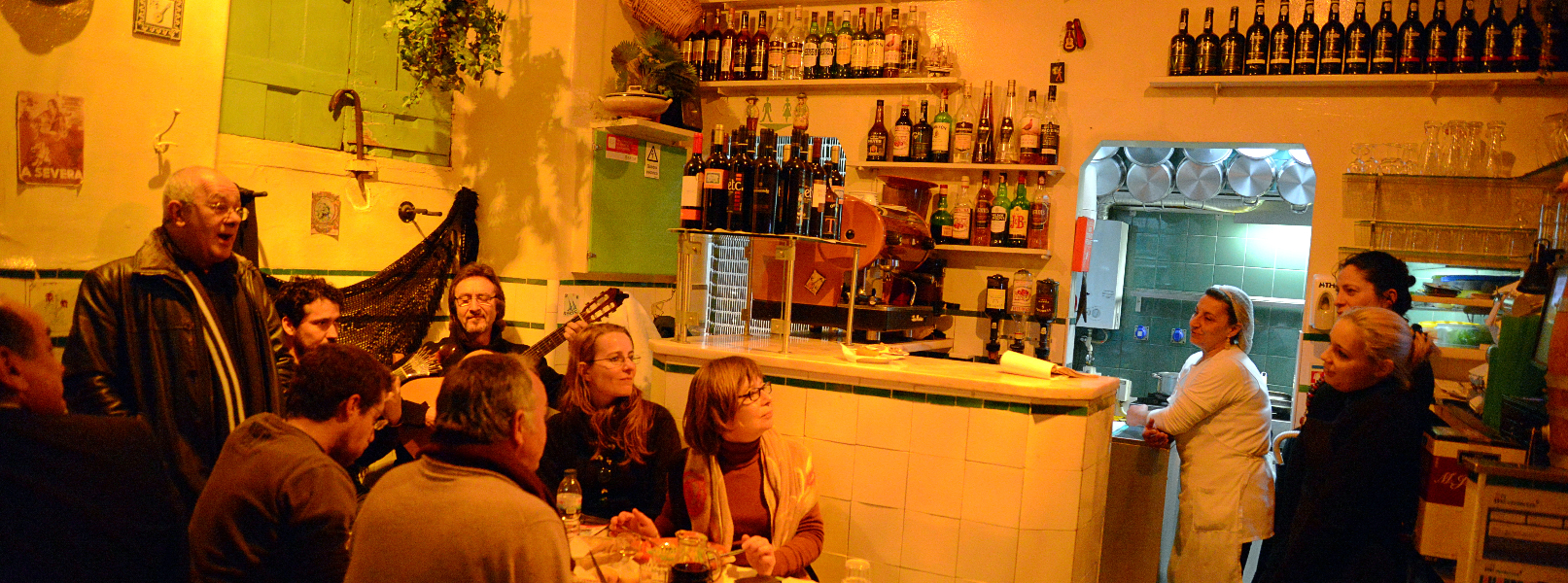
We gathered on a communal table in a small room, most places taken already, and were made to feel welcome with a couple of glasses of red wine. There is no stage, and the musicians simply perform in the corner of the room. Each song is dramatic and passionate and the performers looked extremely well practiced at the style. An overkill of maudlin music doesn’t seem like the basis for a night out, but the songs are short, melodic, often intense and were received enthusiastically by the room.

There are a great many corporate joints in the city centre offering Fado performances in a large restaurant with a full sit-down meal, and while there is always a place for that, this is where to go for the real McCoy, stripped back, homely and raw, following an unbroken folk tradition.

After considering the experience overall, I think aside of the entrance fee, it occupied a very similar social space as going to a pub, both in terms of the homely working class surroundings and manner of drinking.

Our visit extended long into the early hours of the morning leading to a very uncomfortable wake-up call the following morning to the airport!

There are a few other traditional Fado venues in the Alfama, which I am sure warrant exploration, but I can strongly advocate visiting here if you prefer real and rustic above sheen and pretension. Finding this place on our final night in Lisbon more or less made our holiday.

P.S – I would recommend reserving tables if there are more than two of you, or if it’s the off-season with it being such a small space.

Have you visited A Baiuca? Please let us know!

U Kuděje, Olomouc

back to Czechia

Krapkova 236/20, Nová Ulice, 779 00 Olomouc, Czechia
  • Quality and/or choice of drinks – 10/10
  • Style and Décor – 8/10
  • Character, Atmosphere and/or Local Life – 10/10
  • Amenities, Events & Community – 7/10
  • Value for Money – 9/10
  • The Pub-Going Factor –  10/10

Evenings in Olomouc are a tough time to get seated. Wherever you turn, each hostinec, hospoda, pajzl, minipivovar or  výčep seems to be full. It is no exception when it comes to U Kuděje. Yet, frustrating though that is, there is all justification to persevere as you are searching for a drink in one of the best pubs in the city, if not in the whole country.

At first appearances Hospůdka U Kuděje may seem unremarkable. A Czech pub in a half-step basement of a very Czech city building? – seen plenty of those before. Wooden furniture from the Austria-Hungary era, with traditional ruralist décor? A well-trodden choice, too but the true quality of U Kuděje is the combination of a number of smaller things contributing to a greater whole, known as genius loci, or spirit of a place. Which we will now come to.

U Kuděje is not based slap bang in the centre (it could potentially lose a fraction of its charm if it were) but a short walk west on the fringes between Olomouc’s old town and a residential neighbourhood west of Čechovy sady.

U Kuděje is named after the writer Zdenek Kuděj, the closest and perhaps long-suffering friend of Jaroslav Hašek, who were both part of an anarchist/bohemian literary scene in the early 20th century, so is a fitting tribute to someone who spent huge amounts of time in pubs. You will find theirs and others’ works available to read (in Czech, of course) within the pub. Here is a short explanation of the pub and connection to the writer: http://www.memorialmatejekudeje.cz/?cat=14

Drop down a short set of stairs outside to the basement level and enter, where the bar area greets you immediately, with a list of beers attached above the bar. The place feels warm and bunker-like and you will almost certainly find people sat at stools around the bar, and a cast of regulars sat on tables to your right. To your left is a small lounge area with people deep in conversation and set into the ritual of the place itself.

This slideshow requires JavaScript.

The pub has the atmosphere you’d expect from a neighbourhood dive and you’ll quickly notice from the interactions there are folk sat around who know each other well. This in my opinion is the core of the pub’s appeal, the warmth and simplicity of a social scene that people invariably seek out when given the choice.

A busy pub full of locals can be intimidating at first, and if you can’t see anywhere to sit you may be forced to hang at the bar (also awkward if there is no leaning room). Take a full look into the pub and if there is a spare seat ask “je tu volny”, and hopefully someone will yield. If you arrive as a group in the evening without a reservation, then all I can say is: Good luck. Yep, unfortunately Czechia does not do first-come-first served in pubs and will reserve tables for loyal locals at the expense of fly-by-night tourists and turf you out of your seat when the time comes.

U Kuděje’s big thing – atmosphere aside – is a focus on regional Czech beer, which is very good news for any fans of unfiltered and/or unpasteurised lagers (me). Offering 5 or so on tap at any one time, this is a sensible number that helps ensure freshness, and a little rotation for new and recurring brands. The beers are also served on porcelain plates built with recesses to collect spillage – this is very old fashioned but seems to be making a comeback of late.

They may try to suggest that these beers are good for your health but quite frankly, who cares? If it makes you feel better then yes, yeast can in theory help repopulate your stomach with good bacteria. However if you need it repopulating because of an excess of beer the previous night then that rather negates the point, doesn’t it? Prices are reasonable, perhaps on the high side for Olomouc, which isn’t a problem given Olomouc is an extremely affordable city.

The pub snacks at U Kuděje are typical for Czech pubs – expect the usual cheese, ham, pickles but keep a look out for Moravian cheese if that’s your thing, as that’s quite the regional speciality.

Lastly, take a look at the opening hours – few places open later on a Saturday than they do during the week, but U Kuděje is one of them This place is does a short 5 hours service on weekends, and opens at 3 during the week. This makes it doubly difficult to try and get into.

Although U Kuděje may be a tough nut to crack as an outsider, I personally couldn’t think of too many pubs on my travels I’d prefer to make the effort to ingratiate myself in. You’ll find the true atmosphere and camaraderie of a mixed crowd partaking in a time-honoured tradition, rate authenticity, not to mention enjoying some of the freshest, well-kept and well-poured lager available.

Have you been? Any comments or suggestions? We’d love to hear from you. Please get in touch, particularly if any of the above requires amending.

Proletaryat, Poznań

back to Poland

Wrocławska 9, 61-838 Poznań, Poland
  • Quality and/or choice of drinks – 6/10
  • Style and Décor – 9/10
  • Character, Atmosphere and/or Local Life – 8/10
  • Amenities, Events & Community – 6/10
  • Value for Money – 9/10
  • The Pub-Going Factor –  8/10

Soviet-themed bars have quickly become a staple part of the Eastern European bar scene. It must be due to the tonnes of old communist bric-a-brac that has been purloined from flea markets over the years. It’s remarkable how quickly this ephemera has been regurgitated, often in an apolitical way. Now, shorn of the memory of state repression, paranoia and hardship much of the era’s junk has been re-purposed and exhibited, capturing people’s nostalgic fondness for the idealism, optimism as well as the iconography of the era. Ideal for adorning a moody Polish bar such as this one in Poznań.

Proletaryat isn’t exactly lined with volumes of Das Kapital; instead you’ll note a large bust of Lenin staring at you out on the street. Enter to find a display of fairly impressive social realist paintings, disproportionately large portraits of Lenin and Marx, hung in front of rich crimson paint, with emblems and military insignia thrown in. The central bar area also expands further into an interesting looking  terrace-style back room where the cool kids hang out, that seems a little separated from the central premise.

There may be a vague leftist feel to the crowd here (perhaps its just the students) but in the main it does seem to be led by decoration rather than a hotbed of any political grouping.


This slideshow requires JavaScript.

That said, the decoration is impressive nonetheless, it’s a very stylish place to go for a drink, without being particularly pretentious. The crimson and lamplight works well for a shady atmospheric slow sup, while at night it gets more raucous and one of those truly buzzing city centre bars where the lack of space and abundance of booze creates its own head of steam. This is a great example of decoration that allows a venue to work well in different ways at different times.

The location down one of the main city centre streets means it feels in the middle of the action – which in Poznan is pretty bloody active. You can expect to witness the type of revelry usually preserved for English city centres on an evening. It was quite an eye-opener, but I had previously been warned about it by some Poznanites (Poznanians?) during a separate trip to Wroclaw (another excellent city). The levity  doesn’t emerge from English stag parties or boys-on-tour either – in Poznan it’s mainly locals doing their homespun thing. Wodka i piwo can be a dangerous combo.

Aside of the tongue-in-cheek atmosphere, Proletaryat offers its ‘own’ beer as well (from what I can gathered, this is brewed elsewhere at Browar Czarnków and labelled accordingly), which is cheap even by Polish standards nowadays. The jasne (light) and ciemne (dark) beers are both fresh and well balanced. Not the finest ever brewed but tasty certainly and designed to knock back in volume. Apparently the vodka is served with a pickle here if you are interested in going native.

Any pub crawl around Poznań would be improved by a stop off at Proletaryat, as despite the increasingly familiar concept of the Soviet-themed bar, a good concept doesn’t stop being good just on account of its familiarity. Besides, they do a decent job of and it feels like its own thing rather than a cookie-cutter version or a clone-bar. If you haven’t been to one of these type of places before, then go at least once for the novelty value. If you already have and enjoyed it, then this bar is not to be missed!

Here I am:

pro7

Orzo Bruno, Pisa

back to Italy

This slideshow requires JavaScript.

Via delle Case Dipinte, 6/8, 56127 Pisa PI, Italy
  • Quality and/or choice of drinks – 8/10
  • Style and Decor – 8/10
  • Character, Atmosphere and/or Local Life – 9/10
  • Amenities, Events & Community – 7/10
  • Value for Money – 7/10
  • The Pub-Going Factor – 8/10

Opinions of Pisa tend to be mixed, which is a shame as the airport provides an excellent conduit for people to explore Tuscany, but often people venture no further than the Piazza Dei Miracoli before moving on. It’s certainly true the Tuscan idyll of cypress trees, rolling hills and gently worn villas is perhaps not best demonstrated in Pisa, but that’s not to say the town is without charm, far from it.

The city centre is certainly one of those places that feels like it gets taken over by young people at night. Yes, you can sigh at the peeling plaster and graffiti in some of the classical piazzas that have become a bit grungy but there is a certain verve and energy Pisa offers in compensation for that. It’s a good night out.

Beer isn’t Italy’s strong suit, however it has belatedly begun a concerted effort to catch up. When you have a little think about why it’s suddenly taking off, it makes sense. The young seek good beer out in Italy for a few different reasons. Wine is seen as the preserve of the middle-aged and middle class, increasingly more of a drink to enjoy with food or a particular occasion or season, whereas beer is more casual.

Of course there are those looking to be a bit hip and different for which beer offers an opportunity to pose and stand out/completely conform among peers. Boiling all that down, the main appeal as I see it, is that quite honestly beer and aperitifs are a better option in a hot country over the course of a long evening. It is still the case that in Italy good beer is a bit of a novelty, but craft beer has been riding the crest of a rising wave for a few years now.

Pisa’s very best exponent of this is Orzo Bruno (a play on words with Orso meaning Bear and Orzo meaning Barley) not just a place with good beer on tap, but a really, really good pub.  In order to find Orzo Bruno you naturally find yourself wandering into the epicentre of the city’s nightlife. It’s a nice walk in, as you can feel the volume and excitement level gradually rise. You’ll find the pub and its unassuming exterior perched down a side-street, yet in the thick of the action.

Inside, it’s an informal affair with pinewood type seating falling somewhere inbetween modern and ramshackle. In the summer heat the windows and thrown open and there are tables and chairs outside. As with all great pubs, everyone looks like they’re having a good time. The best of all, it looks and feels predominantly like somewhere Pisans go themselves, with a ring of authenticity you just can’t fake.

On tap you’ll find local Italian brews for a decent price – their predilections for strong beers and German styles ensures you can purchase some strong, tasty stuff for quite a lot less than you’d expect. Wit beer, red beer, doppio malto, it’s nice to go to the heart of interesting Italian brewing styles and have a genuine isolated and authentic ‘Italian beer experience’ in what is a nice pub.

These are brewed at a co-operative brewery Il Birrificio Artigiano, an excellent idea still common in Germany where provincial beer enthusiasts have occasional use of shared premises of a scale capable of delivering decent volume. These beers are usually unpasteurised and unfiltered, which is fine because they aren’t designed to last, but to be drunk straight away! You may even find oddities such as attempts at cask conditioned bitter served by Angram hand-pumps.

There’s a little something extra on offer too, that a lot of English people won’t be used to. It’s difficult to find complimentary anything with a drink in England these days, yet in Orzo Bruno dig into a veritable platter of snacks laid out on plates in front of the bar to enjoy with you beer from 7pm onwards.

Spain and Italy are insistent that food must in nearly all cases accompany drink, which is not my view, but offers a change of speed. You may want to consider leaving some room after your evening meal to enjoy the range of snacky bites on offer. It’s a quick way of adding on further poundage on top of the calories in your beer, so don’t go over the top!

Orzo Bruno works well whether at day or night, which is typical of places of its kind that stay low key and informal. You could pop in mid-afternoon and read a book with a pint of head here at 11 in the evening with a group. It’s just an all-round good place, reinforced by the enthusiastic patronage of locals. They also do discounts between 7-8.30pm, which is much later (and therefore better) than most happy hours in England.