Senk Na Parkanu, Plzeň

back to Czechia

Veleslavínova 59/4, 301 00 Plzeň, Czechia
  • Quality and/or choice of drinks –10/10
  • Style and Decor – 7/10
  • Character, Atmosphere and/or Local Life – 7/10
  • Amenities, Events & Community – 6/10
  • Value for Money – 7/10
  • The Pub-Going Factor –  8/10

Drink unfiltered unpasteurised Pilsner Urquell delivered in barrels via horse and cart from Plzensky Prazdroj brewery up the road.

It doesn’t get much better than that for beer drinking, and despite the relative expense (cost being £1.70 rather than £1 which is the usual price for a beer in Czechia) it still represents extraordinary good value by nearly all other Western measures for supping what still is, pound for pound, the nicest beer going.

The horse and cart service also goes around a few other Pilsner Urquell pubs in Plzen on a largely ceremonial journey (though a good quantity of beer is delivered), such as U Senku and U Mansfelda,which are also worth checking out, but Na Parkanu is really the cultural epicentre, located in the bailey in the city walls and features an adjoining brewing museum which is brief, and poorly signposted but comes with a pint thrown in.

Na Parkanu itself is a shiny new pub, albeit in a traditional cookie-cutter Pivnice style, with some nice traditional features and a few little quirky concessions to the local hockey and football teams, along with reliable, absolutely conventional Czech food. You can sit down and just have a beer anywhere, much in the way you can at a chain pub in England, but there is a dedicated bar area too if you want to sit away from diners.

This slideshow requires JavaScript.

In the main, Na Parkanu is a fairly by-the-by venue and in local terms a tad expensive by virtue of self-awareness of its own importance.

Why the fuss then?

The place serves a special beer that is very difficult to obtain in both unfiltered + unpasteurised form in Czechia let alone anywhere else, so there is always a tinge of excitement at the prospect of drinking at the ‘place to be’, which, outside of the Plzensky Prazdroj tap itself, this pub pretty much is, and everyone knows it, and is excited by the fact, which alone elevates the experience of drinking there.

The 12° Pilsner Urquell Nefiltrovany has that classically thicker texture and sharper flavour you get with a lager pre-filtration, but that makes it no more difficult to drink. The reviews speak for themselves. The beer slips down with alarming alacrity, while the keen-eyed servers have their eyes trained on any near-empty glass, and are only a quick nod of the head away from providing you with a replacement.

That’s enough in itself on this occasion. The venue is otherwise ‘steady’, it doesn’t really have any weak points (other than failing to fulfil my desire for it to be wonderfully old, preserved and traditional), which is hardly its fault. If they keep the layout for the next 80 years they may achieve that. It’s a solid pub you’ll find around in many a place, just one that’s blessed with something nearly every other pub doesn’t have.

If you’re feeling brave, try some of the intimidatingly greasy ‘food to go with beer’ options on the menu, and wash it down with the gorgeous beer – you’ll soon be transported into a fatty, gristly, and delicious world of true Czech pub going – halitosis central but that’s just your body trying to communicate how satisfied you are!

A trip to Plzen that doesn’t include a pint of unfiltered ‘PU’ at Na Parkanu would feel strangely hollow and lacking. This is something that I and the other Google reviewers seem to agree on. Join the throng and drink the tastiest damn beer you’re ever going to have, right from the source.

 

U Poutníka, Brno

back to Czechia

Vstup branou č.p. 14, Starobrněnská 16/18, 602 00 Brno-střed, Czechia
  • Quality and/or choice of drinks –9/10
  • Style and Decor – 8/10
  • Character, Atmosphere and/or Local Life – 9/10
  • Amenities, Events & Community – 6/10
  • Value for Money – 10/10
  • The Pub-Going Factor –  9/10

Czechia excels in very unpretentious pubs devoted to swilling high quality beers of its own making. These pubs are the very definition of down-to-earth (particularly the ones located in cellars), welcoming all comers so long as they wish to experience and uphold this noble mission.

U Poutnika is Brno’s best example, possessing attributes common to those rare standout pubs that tie everything they do and everything they are together to produce ‘genius loci‘, a phrase which refers to that most indefinable and frustratingly hard to pin down thing – a place’s ‘spirit’ – (no, not Becherovka or Slivovitz ) – an accumulated sense of place and purpose that produces that atmosphere most people are seeking when they go out and socialise: vitality and character, usually so elusive to the majority of bars and pubs. The phrase ‘you had one job’ springs to mind whenever I think of some the hapless, and occasionally pretentious soulless holes I’ve stepped into.

Genius loci is a very well-used phrase by Czechs on reviews of their pubs, so it seems appropriate to mention it in reference to U Poutnika, which is as good a pick as any to demonstrate how an otherwise simple place with a look you could barely pick out at an identity parade can be elevated by virtue of its operation and customers, who every day contribute in their own way to the maintenance of a tradition, and who knows, perhaps even one day a legend. Some people may scoff at this, but even cursory research indicates that this place, much as several others has had its very existence threatened by bureaucrats, and therefore anyone who in their own way has patronised a pub, become an advocate, or a regular can fairly be argued to be participating in a peaceful revolt against such nonsense.

U Poutnika enjoys a central location in Brno’s ‘old town’ (largely a bustling and business-like provincial city but with some very pretty areas and buildings too), meaning no special trip-out to the suburbs is required in order to join the young, old and everything in-between who drop by on their nightly ritual. Although the pub may be central, its unassuming position nestled in a side-street arcade seems to provide at least some shelter from passing trade. However, upon your arrival you may notice a throng of people outside (all smoking). It will be quite busy, as Brno itself has very lively nightlife of a kind anyone from a northern city in the UK might be quite familiar with.

From a simple look around at the exterior, with its shopping arcade frontage and rather straggly-looking signs you may be adjusting your expectations downwards by the second, and I wouldn’t blame you if you were a touch tremulous arriving solo. Sod it – you’ve come this far, so why baulk at the last minute? Dive inside!

This slideshow requires JavaScript.

The taproom is located right at the front, so if you want a quick beer ‘on the stand’ as they say, find a leaning post and have at it. U Poutnika is lucky enough to boast a “tapster” – invariably a rotund, middle-aged man whose sole job is to attend to the cleaning of glasses, pouring of beers and maintenance of the taps and kegs. Separately the server’s job is to go around tables doing the ordering and delivering of said drinks, but if you’re alone it may be easier and quicker (given how busy U Poutnika is) to approach the tapster directly when you first walk in – not always the most pleasant experience. These chaps can be quite growly and monosyllabic, even in their own language, let alone trying to converse with them in yours, so approach with caution, know your ‘dobry den‘ from your ‘ahoj‘ (the latter reserved for friends and regular acquaintances only) and be clear in your demands.

Jedno Pivo, prosim‘ will result in being presented with the house light lager, which is the excellent, criminally under-distributed Poutnik Pehlrimov, (translating to Pehlrimov Pilgrim) a Moravian beer difficult to find in Prague and Brno, let alone anywhere else (forget about tracking it down in the UK). As always in Czechia, light lager is so much more than the thin, gloopy and over-crisp offerings Brits are used to. This beer is poured with a smooth thick head, giving you a correspondingly thicker, smoother drink, and one which is so easy to knock back it becomes virtually irresistible. They do the 12 degrees and the unfiltered equivalent. That’s all – and that’s all that’s required. Try escaping from a pub having had just one half-litre of Poutnik – I haven’t seen it happen yet.

And ‘Czech‘ out the prices (sorry, I had to do that once and I promise never to do so again) – unbelievable! 29 crowns for a half-litre, ie. a pound a pint in a city centre pub, without having to enter into a slum with a tap, or one of Czechia’s notoriously rough and occasionally dodgy ‘Nonstop’ Herna pubs that stay open 24 hours for gambling, chain smoking and putting back of gallons worth of budget lager in a haze of depression. This great value has not escaped the attention of everyone – the pub is name-checked in a 2010 article in The Guardian.

Fuck, we haven’t even sat down yet! Have a glance around the taproom first – there are usually some pub emblems, mascots and ornaments that give a place individuality, and U Poutnika is no different in that respect, but head into the backroom for the sit-down and a chat amongst Brno’s finest.

You’ll find a curved ceiling in the archetypal Czech pivnice style, bench seating around the perimeter and plenty of communal tables, with a yellow ceiling telling tales of the millions of cigarettes smoked in the room and a palpable sense of history reverberating through the echoes and murmurations of friendly conversation going on around you.

Once seated, the server will be round to hand out a slip, and mark your slip for every beer you consume. He works pretty hard considering the almost constant demand for fresh beers – it is no cushy job, and you can tell that by the thickness of forearm and glistening forehead. The drinking goes on between 2pm and midnight – a relatively late closing time in a country with a more conservative attitude in that regard.

As with a lot of the best pubs, the come-one-come-all inclusivity here is what makes it – you can rub shoulders with students, architects, petty philosophers, borderline-vagrants, politicians, quiet pensioners, who may sit there silent for an hour before a conversation topic sparks them into life. Idle chit chat, card games, passionate political discussions, bitter feuds over sporting rivalries, it’s all to be had in places like this where everyone no matter how low or lofty is allowed to express themselves and be at one with each other.

It’s the kind of pub you would make your local minutes after moving into town.

Café Den Turk, Ghent

back to Belgium

Botermarkt 3, 9000 Gent, Belgium
  • Quality and/or choice of drinks – 8/10
  • Style and Decor – 9/10
  • Character, Atmosphere and/or Local Life – 9/10
  • Amenities, Events & Community – 5/10
  • Value for Money – 7/10
  • The Pub-Going Factor –  9/10

Any pub described as a ‘city institution’ carries its reputation before it. A heightened expectation level can and has resulted in occasional disappointment for me in the past, however a visit to Café Den Turk was not among such occasions, indeed, the place cemented its reputation, as I’ll explain below.

Café Den Turk is located in the very centre of Ghent, among an unparalleled, stunning display of Gothic and medieval buildings, which at points achieves a grandeur not even neighbouring Brugge can quite match. That alone has a tendency to draw you towards the place, which acts as a natural start or end to a sightseeing circuit of the city centre.

The longevity of Den Turk (reputedly the oldest continuous drinking hole in the city) appears to partly be down to officials from the town hall nipping across the road for lunchtime and post-work drinks. It really does feel like the kind of place where you come to shoot the shit about the latest political shenanigans or strike a clandestine deal over lunch and a beer – a proper pub.

Den Turk has striking signage and is located in a classic stepped-gable Flemish house, transmitting all sorts of positive signals before you’ve even walked through the door.

Although the interior of the bar area is typically Belgian, there is a more universally recognisable sense, that you get with those classic pubs that have so clearly and resolutely refused to change with the times. Furnishings and bar area are similar to a brown café, which are better known as being characteristic of Amsterdam, and Netherlands but are just as prevalent in Flanders too. However, the layout of Den Turk is more like a country English pub with ‘plotting’ rooms and corners, along with some pub-style corner seating, all proudly old fashioned with that doorstep sandwich thickness to the unvarnished tables that gives off a rustic feel.

This slideshow requires JavaScript.

The choice on tap is a pointedly sensible working class array of typical AB InBev products, Leffe, Hoegaarden, Stella, yadda yadda at decent prices about you’d expect to pay in a well-to-do Belgian city centre, but check their menu! They stock a small but choice selection of bottles that will keep any Belgian beer fans well interested, not least a few Ghent beers that don’t crop up very often. Ghent Tripel is nice (but not a Ghent beer strictly – it is brewed to order elsewhere and relabelled) but Gentse Gruut is brewed only walking distance away, and their blonde ale makes for a sensible choice for a first drink in Ghent. Gruut style beer is brewed with spices in substitution for (or sometimes in addition to) hops, leading to a different flavour balance. The spices are also slightly botanical and bitter which balances well against the sweet, yeasty Belgian blonde you’ll be familiar with.

The pub regulars look dyed-in-the-wool and give off that vaguely reassurring feel of permanence; that while they remain in attendance everything in the world is ticking over nicely, or at least doesn’t matter a great deal for the time you are there. Better still, the place , like Ghent in general, is tourist-free. Expect a few stares to greet you on your entrance, as they clock an unfamiliar face, but the servers expect one or two new comers and are welcoming, if a bit upright. The city website itself tells of “typical Ghent arrogance” which may be overplaying it slightly, but then even their own website seems to take pride in the same reputation. Yes, the service gives off an air of fellows who are masters of their domain – they won’t be fawning over you or pretending to be your mate, but it isn’t really obnoxious.

One quirk is the red and white patchwork tablecloth spread on many of the tables which don’t seem to fit the brown café style or the jazz bar intentions (that it wears quite casually), being more akin to a Hungarian Etkezde or trattoria than what you or I may think of for a pub. That’s a slight distraction, however.

An afternoon drink in Den Turk is quiet, surprisingly so for such a central location but the place acts as an oasis of calm and normality, of a sort that normally lends a place a permanent appeal.  However, while an afternoon drink in here is far from unpleasant I most recommend visiting in the core of the evening where everything takes on an atmospheric and shady glow, and the murmur of conversation starts to bubble up.

In the evening there is an understated jazz and blues soundtrack which are naturally complimentary and the whole effect coalesces to become a brilliant pub.

Den Turk is deservedly an institution, and a visit to Ghent without popping down for at least one would be to deny you one of the city’s finest and most authentic offerings. It seems almost impossible if I worked in Ghent I would not join their venerable councillors for a drink in Den Turk every lunchtime.

Categories: Uncategorized Tags:

Bar Pastis, Barcelona

Carrer de Santa Mònica, 4, 08001 Barcelona, Spain
  • Quality and/or choice of drinks –6/10
  • Style and Decor – 10/10
  • Character, Atmosphere and/or Local Life – 9/10
  • Amenities, Events & Community – 8/10
  • Value for Money – 7/10
  • The Pub-Going Factor –  9/10

Any cursory research into Barcelona’s bar scene will lead you to the venerable and incredibly dinky-sized Bar Pastis, a staple venue of the Raval district for decades – with very good reason.

You may be concerned the place is over-exposed and  overly touristy – that’s understandable given how often it happens – well don’t worry. Bar Pastis can’t physically contain very many people for a start – secondly, the format of the place acts as an effective filter repelling faint-hearted rubberneckers, mainstream middle class folks and gormless teens almost as soon as they walk in (if they even get that far).

The outside of the bar really looks like nothing special, so much so that you might do a double-take before even trying the door. A late 80s/early 90s era sign in black and white ‘futuristic’ lettering hardly signposts the atmospheric speakeasy inside – just look at it! – but be brave, intrepid traveller, and dive in.

Once entering, and on the – not guaranteed – proviso you’ve managed to secure a comfortable standing or leaning spot, do take a moment to glance around at people entering the bar for the first time; enjoy the shocked and intimidated looks on people’s faces as though they’ve opened the wrong door into something truly disturbing and smily wryly as they reverse back out.

The old geezer running the bar wouldn’t want it any other way – indeed you’ll notice many stickers behind the bar area pointedly directing Erasmus students to an eff marked off.

So what’s this all about then?

Well, despite its diminutive size Bar Pastis could mostly call itself something of a music venue. It seems silly, even then, considering the place most likely fits 25 people in at a push (including any performers) but as true as day, there’s a small stage at the back of the bar that might allow 3 musicians at most, a table by the door that seems to become ever more useless and in the way as the night progresses (you can’t see the stage properly from there) and a few bar stools. If you’re desperate to sit down then prepare to be patient or prepare to leave – it took us around half an hour last time.

This slideshow requires JavaScript.

The musical offerings vary between folk and jazz, and my last visit involved a maudlin French folk duo which despite being in Spain seemed perfectly appropriate for the location. Rather than recoiling in disappointment by what we found, the sound of live music was just the ticket as we thrust ourselves inside, and leaned over a few bodies to order some drinks.

Although it is a pastis/absinthe bar, strictly speaking, you’ll find a beer/wine easily enough. These are perfunctory efforts, really, slight concessions to what the bar would really rather sell, and merely passable. In addition to the drinks expect to pay a little surcharge for when there’s music on, though this doesn’t run to much more than a few euro. It’s all done informally by way of your first drinks order, which providing you’re not scared yet and wanting to flee, will prove very good value when the music starts.

The owner Angél has a typical René type look, slick back balding hair, roman nose and paunch, and is very much master of his domain.

While the music is playing you’ll find yourself drifting off into the surroundings which are some of the most crusty, ramshackle and amazing I’ve ever visited. The crimson painted walls of this tiny drinking den ran out of space some time ago, taken up with an unmistakably gothic and ever darkening set of paintings, yellowing newspaper clippings and various cultural ephemera from decades past. There is a slight bordello theme with some vaguely erotic stockings gestures and the centre piece on the ceiling, almost certainly a remnant from a Mardi Gras type festival is a suitably macabre mascot for a bar of rich, unflinching, uncompromising character. None of these items appear counterfeit, but inherited, and as a consequence you feel smothered in its history and the gradual accumulation of its importance.

No matter how many tourists attempt a pilgrimage to Bar Pastis, there is always a core fanbase who could be clearly identified from the tourists, while the transient custom of couples and folk music aficionados is only fitting for a bar of its kind.

Although I could suggest a few changes to the drinks roster and seating situation, it seems almost rude in the circumstances to do so, when so much of the place lavishes you with new things to look at, new music and revelry to enjoy, or that bleary eyed soulful haze at the end of a night. The place has a tendency to stay open into the small hours. Rejoining the street and heading down the relative normalcy of La Rambla (2017 terror attack excepted) feels like you just stepped back from a window into another universe, both real and yet unreal. How many bars come close to this?

It is for this reason Bar Pastis gets such a thumbs up from me. One of those places where an average score on Google fails to tell the true story. It’s brilliant – even if you go there once just to say I was there, good on you. You were there.

Strefa Piwa, Kraków

Józefa 6, 31-056 Kraków, Poland
  • Quality and/or choice of drinks –10/10
  • Style and Decor – 7/10
  • Character, Atmosphere and/or Local Life – 8/10
  • Amenities, Events & Community – 6/10
  • Value for Money – 7/10
  • The Pub-Going Factor –  9/10

Any new bar venture in Kraków’s old Jewish quarter Kazimierz (unarguably the coolest district for nightlife in Poland) needs to work hard to wrench people away from the dozen other exceptional bar options in the vicinity. My first visit to Strefa Piwa in 2015 was enjoyable, but the venue was young looking with that fresh wood-shavings smell still lingering in the air, yet to develop character either as a place or with its own crowd. In just a short space of time, that has now changed.

Strefa Piwa translates to ‘Beer Zone’, a rather generic name if there ever was one, so I stick with the lingua franca when referring to it. The pub itself is quite small – a narrow room with a curved ceiling in the style of a Czech pivnice decorated with a rather striking chart painted across the expanse of the walls, linking a hundred beer styles with their parent families. This decoration gives a clear indication about their raison d’etre -it’s heavily beer orientated, which is of course a good start with any bar. I quite like the fact the interior is a nice cross between a simple cosy drinking den with some of the architectural features of a beer hall. It’s not a specific reason to visit, but adds to the genius loci. The mirror to the left hand side of the bar always suggests there’s a second room, but trust me, there isn’t.

Two years ago a visit to Strefa Piwa would have been largely one to seek out a quality beer, what with the venue being in its infancy and  atmosphere still being a little quiet. I’m pleased to say since that visit Strefa Piwa has developed a core audience of locals who share the space with clutches of young travellers and backpackers. It’s a friendly, hustle and bustle type place in the evening that isn’t overly bothered about competing with the faded antiquey style bars down the road in terms of décor, isn’t going to drown out conversation with pumping music either and does well in providing a slightly different offering for the area.

This slideshow requires JavaScript.

Because the décor is simple, it is the kind of pub that needs a throng of people to lend it vitality, but now it has that, Strefa Piwa serves up a great combination of incredibly high quality beer and a chatty, vibrant venue, that is also down-to-earth enough to avoid the pitfalls of some pretentious multi-tap beard-stroking craft venues out there (we’ve all been to them).

To compliment the nod towards Czech pubs in the design, there are a few high quality Czech ales (such as Kout na Sumavy) along with rotating craft Polish beer. The range is wide enough that you can find something great along a range of styles, with 7/8 tap options and a large bottle selection. As per usual the pricing, while a tad expensive by Polish standards is among the cheapest for craft ale you are likely to find around Europe. They have also opened a beer shop next door, which qualifies as one of the least surprising business moves going. Fine, of course, avail yourself of that if you feel the need, but we are more interested in the pub, right?

Strefa Piwa succeeds by offering something different to the majority of Kazimierz bars (although Omerta is quite similar). The pointedly different style to the ruined antique chic typifying the style in other Kazimierz bars seems to appeal to a local crowd who are more interested in drinking good stuff and socialising than ‘being seen’. You can pop in, sit down, calm down, and find a corner your mates and you can have a chat – that’s a key appeal of a pub, after all. The reviews online don’t lie – 4.6 stars on Google after 250 reviews is a phenomenal mean average considering it’s a simple pub, and that speaks of a widely friendly and likeable place, not just a hipster venue, and it’s not the first time the pub has caught the affectionate praise of a bar blogger , nor I suspect will it be the last.

Strefa works well as a stop off in between the bars around Plac Nowy in the centre of Kazimierz and the old town in Krakow, or just to drop by in and of itself for a casual pint. It’s a strong option that’s improving every year.

Like many pubs courting a young crowd they must be careful to make plans for when the place is no longer flavour of the month. For now they’re safe, but it wouldn’t hurt them to introduce a few community events, or consider a small extension to create more space.

If you lived anywhere near Kazimierz, Strefa would be right up the list for a stop-off, very much your home away from home public house, as it were. It’s just a pity only Cracovians get to enjoy the pleasure more regularly, the jammy bastards. Even though Strefa is up against stiff competition, jot this one down in your notebook! You won’t regret it.


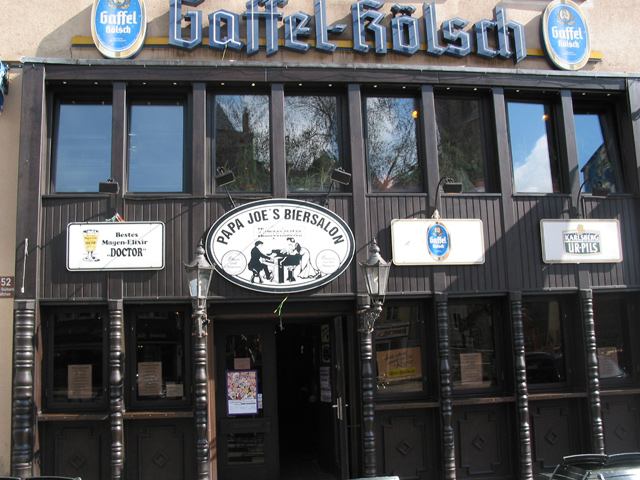
Papa Joe’s Biersalon, Cologne.

back to Germany

Alter Markt 50-52, 50667 Köln, Germany

**Important: PLEASE NOTE THAT PAPA JOE’S BIERSALON & PAPA JOE’S JAZZLOKAL ARE 2 DIFFERENT PLACES IN COLOGNE**

  • Quality and/or choice of drinks – 8/10
  • Style and Decor – 10/10
  • Character, Atmosphere and/or Local Life – 10/10
  • Amenities, Events & Community – 8/10
  • Value for Money – 6/10
  • The Pub-Going Factor –  9/10

Some forms of pub going occur entirely outside of the confines of English culture, and one of these is to be found in Cologne, where Papa Joe’s Biersalon has become a local favourite.

The traditional of socialising and even group singing alongside strangers is much more common in Germany, and during the height of the evening, the singalongs in Papa Joe’s constitute a proto-form of kareoke, except instead of one person singing, most of the pub joins in.

To make matters weirder, the songs are ‘performed’ hourly by a mechanical marionette by the bar, the range of tunes being a remorseless cast list of traditional German favourites with the typical organ, harpsichord and accordion ensemble. You’ll be gawping at first, through the sheer  eccentricity of a setup that by now locals know like the back of their hand.

Sitting among the crowd, even if you aren’t joining in the singing (there is no obligation to) is to take in a heady experience of local life, a sample of German national expression even, if you want to take it further. The venue itself adds to all of this; is traditional in style but theatrical in shape with raised seating around the perimeter of the ‘pit’ area in front of the bar, and a corner stage to boot. With the bar’s history, it isn’t surprising the place is adorned with jazz instruments hanging from the beams and snippets of musical ephemera plastered to the walls. There’s plenty to look at.

This slideshow requires JavaScript.

Drinks are best procured from the bar area as table service can be a little slow at peak times. The local beer Gaffel Kolsch is on tap and delicious, at a standard price for the city centre, and while that ought to do you just fine, there are some decent other options these days too (if you fancy a hefeweizen for example).

The traditional seating and cosy interior is about the only aspect of the experience I can think of that was akin to English pub going. Everything else was rather quaint, quirky and shameless in its kitsch ‘old-time’ quality. Expect to see a huddle of young folk bombastically belting out the standards by the bar, while the middle aged folk sit further back, rocking their heads and crooning along.

If it’s not the mechanical instruments it’s live jazz music, bawdy poetry recitals and all other sorts of 1920s-era throwbacks to keep everyone entertained. Concerts are free and it’s always busy. Unsurprisingly, given its location in the heart of Cologne (you could run there from the front door of the Dom in a minute flat) Papa Joe’s has become an institution, creating an atmosphere you can’t just bottle or duplicate at will.

If you’re a little anxious about forced jollity I can certainly understand a degree of reticence, but you have to be there to understand. Even if you’re still wary, you’ll be pleased to note there is some respite in-between the shows, and you can hang out perfectly as you would elsewhere, just in a lovely and lively pub.

After visiting in 2007 I kept a grainy video on my phone of our time there, and over the next few years, generally spent penniless and occasionally depressed, I would occasionally pop that video on and remind myself of the good times spent in here to cheer me up. That phone and video has now gone, but the memory lives on strongly.

Since then I returned in 2018 and 2019 to find that, thankfully, hardly anything had changed.

It’s an essential place to drop by in Cologne, particularly as some of the brauhauses can tend to melt into one after a while. Papa Joe’s it offers something utterly different, strange, and yet pitted in the local tradition. Throw down a far jars of Gaffel Kolsch, gawp at the spectacle in front of you, and hey, even join in if you dare. After the festivities head around the corner to a kebab shop for a Turkisch pizza (making care to consume it before the alcohol wears off). Welcome to Cologne! In fact – welcome to Germany! This is the kind of pub you can justify a plane ticket for all on its own.

Bernard pri Lýceu, Bratislava

back to Slovakia

  • Quality and/or choice of drinks – 9/10
  • Style and Decor – 6/10
  • Character, Atmosphere and/or Local Life – 8/10
  • Amenities, Events & Community – 6/10
  • Value for Money – 10/10
  • The Pub-Going Factor –  8/10

The appeal of pure, unfettered going out to the pub, without extra bullshit or pretensions is something that grows on you the longer you spend time in Czechia or Slovakia, both countries that are strong on substance over style. Backing this philosophy up is their retinue of absolutely excellent world class beer kept to strict and exacting standards that is so singularly enjoyable you can find yourself in many scuzzy and otherwise unappealing dive bars still with something worth clinging onto (literally) . Not only that, but the sheer simplicity of the arrangement. A warm homely room with comfortable seating and good beer for a chat and a good time among your peers. Whatever gimmicks bars with throw at you, a million beers on tap, a sheet urinal with slices of orange in it, or drinks priced according to the stock exchange, it all eventually comes down to a room, a drink, and a good time. If you haven’t got that, you may as well be running a hardware store for all I care.

This Bernard Pivo insignia pub typifies working class drinking, set with only a car park between it and the dual carriageway out of town. It’s easy to reach if you’re near Bratislava old town, 15 minutes walk, so close you can still hear the trams exiting the tunnel under the castle (well worth a closer look in the dusky hours). The discount supermarket and sex shop next door certainly hammers home the gritty location, yet in spite of its grim view of the motorway and dubious neighbours the pub offers a surprisingly pleasant terrace area outside with covered bench seating that compliments the pub itself quite well.

This slideshow requires JavaScript.

Don’t expect a warm welcome at the door, for this place is not about such fripperies. Czechoslovakian (in this sense I believe the defunct term still is applicable) service is almost routinely noted for being gruff and workmanlike at best and openly hostile at worst. The real welcome hug, if you were searching for one, is written on the blackboard stand by the pub, boasting nearly the full Bernard range, from the simple 10 degrees light lager or  ‘desitka‘, at barely a euro for a glass right up to the stronger special beers. Walk inside and find a very simple cosy room decorated like it hasn’t seen the fall of the Berlin wall, with a dinky bar area in the corner. There is a TV adjacent and some ice hockey memorabilia dotted around the place.

Don’t expect anything fancy – though I hardly telegraphed that it would be, did I? – it’s a classic local drinking hole with a vaguely nostalgic sporty theme. The staff won’t speak English (unless really, really pressed to) but neither do they utter any objection when you order a beer – they know why you are here and behind the stoic expressions they are pleased to serve, in that solemn Slavic way. The other patrons inside barely even turn around to acknowledge you, clouded in their haze of cigarette smoke and drunkenness, something which might give you peace of mind if you find the prospect of entering pajzls like this place intimidating.

There isn’t really space at the bar to have a beer na stojaka so if you’re going for a good time not a long time, your arse will need to make contact with some furniture. Not to worry, expect plenty of seats inside to go at. Hey, why not surprise them by choosing in Slovakian – desitka, jedenactka or dvanactka (3.8%, 4.5% or 5.0% Bernard lager) prosim – you might cause a flicker of an eyelid, which would be something of a successful extraction from a Slovakian tapster in my experience. Or they’ll just be annoyed you spoke Czech to them.

The terrace is a bit more communal, so even if you aren’t involved in any socialising directly and have arrived on your own there is a friendly feel to sit amongst the hubbub, and comes recommended over sitting indoors if the weather is fair. If you’re there in January dive inside the Dive! The pub crowd is an odd split between young couples and students who sit outside and typically grizzled old boozehounds who wander in and out between cigs and beer, but this crankily functional dynamic works in its favour and I quite like places like this that throw different groups of people together. That’s what a true pub should do.

The Bernard is excellent, disappearing down the hatch with alarming ease. Quite often you’ll arrive with the noble intention of staying for one, then ten minutes later, having found yourself dispatching a whole large beer, well and truly snared into staying for another, partly because you don’t want to move on so soon, partly because the beer is so fucking good. On both occasions I found myself dispatching several in short order, the price and quality proving irresistible. If you google the pub most of the photographs are simply pictures of glasses filled to varying levels, testifying to how well they keep their beer in this pub that anyone thinks someone would want to look at that.

While there are many humdrum aspects to Bernard pri Lyceu you could probably find in dozens of other hospodas in the city, I couldn’t think of a better example of a comfortable, strongly-supported working class venue, and the beer and value just tops it off.

When compared to the central brewery and pub Mestiansky Pivovar with its glass, chrome and corporate feel, Bernard pri Lyceu provides a stark contrast but equally, a welcome reminder of the more homely and simple values of pub going. I would include it on any night out in Bratislava. If you don’t believe me, check out what other people are saying.

Since first exploring this pub in 2015 I have been lucky enough to return many times since.

Happy to report that little has changed (except perhaps the price of a beer, which isn’t as good value, though still about the cheapest in the city). In particular, I was able to visit at different times of day. The evening atmosphere turns into a little clubhouse with its own special atmosphere. As before, so now. Excellent pub.

À la Mort Subite, Bruxelles

back to Belgium

alamortsubite
Rue Montagne aux Herbes Potagères 7, 1000 Bruxelles, Belgium

There is sometimes a premium to be paid on a special occasion, so on my annual visit to A La Mort Subite I breathe in deeply and dive more deeply still into my wallet, on account of the luxurious overall experience of visiting this splendid Bruxelles bar.

Distinctly Parisien in format, this opulent faded-grandeur art nouveau venue (translation: At The Sudden Death) is one of Brussels and Belgiums most famous bars, so no surprises or left-field picks from me this time. A la Mort Subite might count as a brown café for the bench seating up the sides of the long room, if it wasn’t for the lack of brown elsewhere. Cream walls and pillars, the elegant ornamental décor stacked with studded crenullations, mirror panels and a stately, out of time design. You have a venue somewhere in between a café and a salon, originally built as a place for socialites to be seen in, yet, being Belgian, still focused predominantly on beer. The décor has such an authentic and preserved quality (no change since 1928, save for the occasional running repair) so it’s difficult to think of too many other places that are alike.

Mort Subite supplies the draft beer, and this brewery serves fruit beers and lambic effect rather than the real wild yeast sour lambics McCoy. They are still rich in flavour and sweetness, and a tad sour, but lacking any sort of dryness and depth that might indicate the traditional lambic brewing process. A small serving of their kriek for example, which would be a good choice, will set you back five euros on its own. Some of the other options are fairly astronomical considering the price one can drink for elsewhere in excellent surroundings. Mort Subite beer may as well be drunk here as much as anywhere on the globe. With this being Brussels you can expect a small food menu with cheese, charcuterie options and the usual pub food like croque monsieur to help your beer go down (as if anyone should need help finishing a Belgian beer!)


This slideshow requires JavaScript.

The bar clearly feel they are unique to set such a high price, and annoyingly, they are right. An afternoon drink in A la Mort Subite can feel rather like a drink in a grand café, nice enough in itself, but the bar character starts to come alive in the early evening time as the crowd changes, and you can suddenly start to absorb some of the atmosphere and understand the underlying reasons for the endurance of this place. A special bleary eyed feel starts to develop, the sharp lines and corners blurring into the cream colours, like dropping into a dreamworld. That’ll also be the strong beer…

The grandeur and glamour of socialising in the inter-war era is yet to be recreated around Europe on any identifiable level, save for the odd outstanding example, partly because of the lack of venues who have committed to investing the kind of money to pull it off well, and also because the eventual crowd it attracts tend to have little to no appreciation of their surroundings anyway.

Service is almost classically continental, with wide stomached balding René type characters smoothly dissecting the venue with assurance and steady hands under the drinks trays. They are immaculately professional and patient considering conveyor belt of foreign tourists and the format of table service requiring more work than is strictly necessary. These characters add further to the sense of intransigent and reliability that lend a place a certain charm, that A la Mort Subite certainly possesses.

Although the evening and night crowd appeals to a few nostalgic locals who insist bars like these used to be abundant, a large volume tourists of venture in during the daytime, and because of the heritage of the place, often an aged crowd at that. The only sudden death that occurs in this bar is from pneumonia and cardiac arrest, I suspect.

Changing the venue in anyway seems to be verboten, and I wouldn’t approve major adjustments either ,however it seems to me there is nothing to stop the place rejigging the drinks choices and doing some marketing from the outside, as this venue is not designed for middle aged obese American sat in Burghaus jackets, it is designed for the young, the stylish and the vibrant. The way to really bring back the good old days isn’t just to leave the décor and service meticulously unchanged and hope for the best. The good old days were good because they were vital, vibrant and inhabited a nascent social scene. The place could do more in that regard by hosting more events, perhaps some understated live music, and so on.

In order for A La Mort Subite to take the next step, they need to be brave enough to recapture the zeitgeist in a way that doesn’t upset the period features, rather than settling for being a museum.

A La Mort Subite is a preserved remnant of a particular era and a great opportunity for anyone with a real passion in the rich and diverse history of socialising, beer drinking and recreational culture to step out of the every day experience and soak in the special character of the place. There are scarcely grander or more historical venues to recline and get merry with some astoundingly good beer. It may be so well known as to be passé, and it isn’t the pinnacle itself of pub going, but that doesn’t stop it being one of the best bars in Europe.

  • Quality and/or choice of drinks – 7/10
  • Style and Decor – 9/10
  • Character, Atmosphere and/or Local Life – 8/10
  • Amenities, Events & Community – 5/10
  • Value for Money – 4/10
  • The Pub-Going Factor –  8/10

Gostilna Pri Planincu, Bled

back to Slovenia

gostilnapriplanincu

Grajska cesta 8, 4260 Bled, Slovenia

The offerings and special experience of the Slovenian ‘Gostilna’ have in recent years become the subject of sentimental revival in the country, partly due to a period of national reflection, but also in acknowledgement of their slow and gradual disappearance as international restaurants took their place and globalisation promoted chains over independent character. As a response the Slovenian government, with the aid of the EU have now trademarked the ‘Gostilna Slovenija’ in their ongoing attempt to promote and rationalise what is an important and distinct offering in an otherwise dinky and Slavic-influenced country.

The Gostilna is the nearest place you can think of to an English country inn, a large but very homely venue, predominantly serving food but also offering rustic pub-like elements that invite a longer stay or an evening visit purely for a pint or two. Originally these began through landlords inviting guests around to taste their local food and wine. In the countryside these venues offer a home away from home, roaring fires, hearty food and shelter from harsh weather. In addition to that Slovenia takes a break from the usual sullen Slavic service and in a Gostilna you can expect to be treated like a host treats a guest at their house.

As a small town in the foothills of the Julian Alps, Bled is well placed to offer a good Gostilna, and there are a few worthy venues in town. The greatest of all is Gostilna Pri Planincu, both a cracking country restaurant of true history (continually serving since 1903)  authenticity, and a to all intents a characterful local pub.

The service was efficient, ruthlessly polite and cheerful, and the food arrived in suitably mountainous portions, after a reassuringly lengthy wait. Our whole table were in approval at the flavour of the food and the way it seemed to tower over us at our seats. The dining occurs in evocative country surroundings that feel real, aged with time and use rather than kitsch and plastic. Little oddities such as the stuffed witch character hanging from the ceiling are precisely the sort of oddity you wouldn’t find in a chain or modern bar (perhaps a very affectatious one).

This slideshow requires JavaScript.

Slovenia’s own beer options are still limited at the time of writing but Lasko Zlatorog is a bearable lager for the first pint, so long as you get it on tap, and you may find some Austrian and German offerings if that doesn’t float your boat. There are Primator parasols in the beer garden of late, so if they’ve brought along Primator for the ride, that will increase the rating above it’s current level.

The pub area is saloon bar style, typically countrified and has an obsession with car registration plates and bike ephemera that cover more of the walls and ceilings than you’d first expect. There is also a showpiece ceramic heater giving central heating of the kind you usually see in high medieval mansions which takes up a quarter of the room itself.

On a trip out into the countryside it would be difficult to create a venue more desirable to visit than this excellent Gostilna. A hike in the beautiful surroundings of Bled followed by a portion of hearty home cooking in a wonderful welcoming pub. The only improvements I can think of would be longer opening hours for the bar area and a physical extension to it, which would elevate the place to a 10/10. As it is, the place is well worth your while.

  • Quality and/or choice of drinks – 6/10
  • Style and Decor – 9/10
  • Character, Atmosphere and/or Local Life – 9/10
  • Amenities, Events & Community – 7/10
  • Value for Money – 6/10
  • The Pub-Going Factor –  8/10


Jazz Kocsma, Szeged

back to Hungary

jazzkocsma

Kálmány Lajos u. 14, 6721 Hungary

One of the pleasures of travelling is the sense of inevitability of unearthing a gem, something even more rewarding when it has involved some level of adventure. That was certainly the case when discovering Jazz Kocsma in Szeged, a fascinating and typically Hungarian university town bordering Serbia, which I wrote about recently in my sister blog Undiscovered Europe. Being in Szeged was alone, rather off the touristic beaten path, and even for a well-seasoned traveller there was a certain sense of the mystic about it with its enormous twin spires brick cathedral with volleys of bats swooping around it, a similarly enormous synagogue and the whole Vojvodina region being largely unknown to me.

There are bars in Szeged city centre, as you’d well expect, although we found fairly few for a city of its size. Unfortunately due to being out of term time, it was also sheepishly quiet at times. The central pub scene seems to divide itself between student drinking and old man drinking, without too many crossover places (which were tacky and/or corporate in any event). It was quite difficult to find any drinking holes that looked like they’d made any efforts to be homely, characterful or different. After a couple of hours of mediocre boozing we decided to call it a night, with the option of a venue called Jazz Kocsma, which we would drop by on the off-chance it was still open in the early hours.

On an unlit back street 20 minutes out of the centre, in a spookily quiet backstreet (to the point of feeling abandoned), Jazz Kocsma hoved into view. When we approached the bar, its old wooden doors were shut, the ancient lettering above the door frame several decades old at least – from there it seemed impossible to think the place had opened to anyone for years. Remarkably its inception was in 1992, so one can only assume they were going for a 1930s speakeasy vibe from the word go.

However, desperate to find somewhere before heading back to our awful hotel (the Tisza Sport, if you’re interested, though please don’t stay there) we tried the doors and to our surprise and relief found light downstairs, the place alive and accepting guests. There was a short break of silence as we walked in (the entrance of four Englishmen at a late hour most likely unexpected), and while surveying the scene we discovered this very ramshackle ancient jazz club, with a corner bar area on the right and small stage on the left, with resident piano and giant old rug lending the place a somewhat homely feel – that is, if the home had been left vacant and squat in periodically for a decade – however that isn’t intended to be a criticism in this case.

This slideshow requires JavaScript.

The beer options are perfunctory Hungarian stuff, unspectacular, with the risible Borsodi at least being cheap, and a dark lager option that will almost certainly prove a better bet. The bar staff were neutral and as impassive as ever for Hungary (it remains to be seen what actually surprises Hungarian middle aged men) and the bar area was a very typical example with lots of pinewood giving it an almost cabin type quality versus the look of the place as a whole.

However, while we were in search of a good beer in a good pub the primary quality of Jazz Kocsma is not beer but atmosphere. Being very late at night, events were slowing in pace, with groups huddling quietly around ramshackle tables and vintage furniture and paintings in the candlelight. The mood lighting and gentle murmur of the groups in each area of the room set the tone nicely, as does the homely, yet dilapidated décor.

Yes, the Jazz part of their title does actually mean something, and although there was no music playing at our late time of arrival, their events calendar shows their live music performances remain in full swing with 5/6 official events a month, and more if you count the open mic stuff. It was easy to see from the interior how a Jazz band would elevate the experience. Make sure to check before you go as you may find that your woozy late evening pint is interrupted by some energetic live music performances (or alternatively visit in search of those performances to find one man and his dog at the bar trying to dissolve into the scenery).

This venue is a historical slice of local life that seems determined never to redecorate or change. Impossible to tell whether it was always this ad hoc, old and crusty or it has been happy to become so worn down. Regardless, the end effect is a powerful and distinct experience that will elevate your evening out in Szeged and prove that sometimes the best pub experiences aren’t always going on in the centre of town. It’s telling that the place is still going strong despite the lack of marketing and obscure location, largely from word of mouth. Such institutions are rarely bad places to visit. This is one of those encounters that rewards curiosity and comes highly recommended.

  • Quality and/or choice of drinks – 4/10
  • Style and Decor – 7/10
  • Character, Atmosphere and/or Local Life – 10/10
  • Amenities, Events & Community – 7/10
  • Value for Money – 8/10
  • F: The Pub-Going Factor –  9/10