
I’ll start by throwing a few terms at you:
- Pintxos 🇪🇸
- Cicchetti 🇮🇹
- Jednohubky 🇨🇿
Heard of 1, 2….all 3? Either way, what you need to know is that these cultural practices influence, to differing degrees, the bar scenes where they are popular. In this article we attempt to explain what, how and why.
Pinxtos
Pintxos is a reasonably well-known term across Europe these days. Hailing from the Basque country, pintxos are mini-dishes, finger food ordered to accompany a drink. These are displayed on a counter at the front for you to inspect. They are often unmarked and you will have to inspect them carefully or enquire. The old notion of pintxos where each plate would be pierced with different coloured flags which you collected and paid for at the end is long gone, and we saw this system nowhere in Bilbao, San Sebastian or Vitoria-Gasteiz.
A common drinks order is a glass of red or white wine, or a beer (for a small beer order a zurito (200-250ml) as opposed to a caña which in Bilbao is more like a copa doble serving elsewhere in Spain (300-400ml). Large beer servings (0.5l) are possible, but uncommon. As usual, Vermouth is popular too at specific times of the day and week and bars are known for their differing house preparations. Jerez sherries and other fortified wines feature prominently, which shouldn’t surprise either. Don’t overlook Sidra, which is a common Basque drink poured in elaborate style.
Pintxos culture makes bar surfing quite common, so like the bars of Andalusia it is customary to hop from place to place rather than getting a reservation and remaining somewhere for the evening. Prices remain fair. If we put a price here it would go out of date quickly, but generally speaking you’ll pay similar for a drink as for the pintxo. On Plaza Nueva in Bilbao you have a self-contained bar crawl on the square if you’re feeling particularly unadventurous. If you want to explore the centre little more widely, Bars like Fermín, Basaras and the famous Café Iruña offer a selection from the most humble to the bourgeois and flashy.
Activity at the bar is busy, sometimes frenzied as orders and serving plates are exchanged, and there is a ‘here for a good time, not a long time’ sense of informal social get-together that cuts through class divides too. Spain has a particular knack for bonding people through ritual.


Cicchetti
Popular in the Veneto, Italy, Cicchetti bars do not dominate in the same way as Pintxos in the Basque country (where almost every bar of any kind feels obliged to provide some). They are also popular at more specific times, namely pre-lunch and at “Aperitivo time”, the ritual daily after work get together.
There are certainly similarities in the nature of the offering though and the presentation. Expect croquettes, crostini, meatballs, fried fish usually perched (get it?) on a slice of baguette, or fresh porchetta in a bread bun. Cicchetti incorporates another term, Tramezzini, which are mini-sandwiches normally offered and sold under this wider umbrella.
These can be found in typical bars, but also Osterias. The Osteria inhabits an especially grey area between bar, tavern and restaurant depending on the sensibilities and each business’ target market. They can be casual though, and there, Cicchetti is not uncommon. There are specific Cicchetti bars too where it is the focus, such as La Mandorla and Monte Baldo in Verona and Corte Sconta in Padova. At these places expect a similar informal approach to Basque pintxos bars, however there is often a distinctive refinement in Italy versus the more working class or at least open-ended, democratic Basque locals (give or take a few flashy San Sebastian examples).


Jednohubky
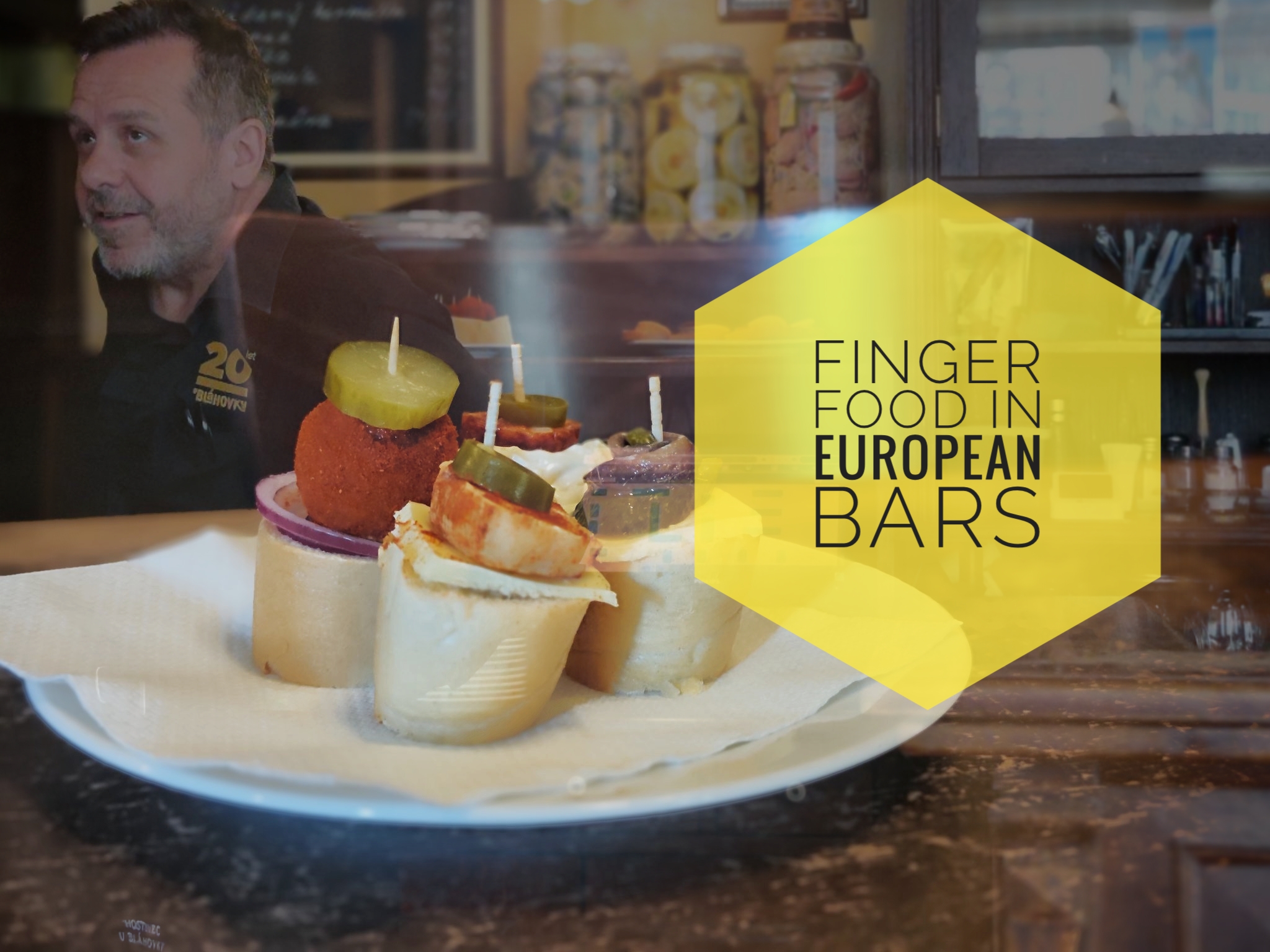
Perhaps the more emerging scene of these three. Outside certain one-offs in Prague and some other cities, Jednohubky is a developing sensation in Brno, Moravia. Popularised by the cult pub U Bláhovky, and now found in many bars elsewhere such as Pivnice U Míče, Pivo & Syn and na dobré cestě.
I find this a particularly interesting development because the Czech hospoda is normally big enough to incorporate a kitchen and with that the usual Czech classics are offered – Goulash, roast pork, Svíčková and so on. However, the smaller Czech pub, the Knajpa may not either have space or wish to turn the venue into a diner. Yet food is a very important aspect of Czech drinking culture and so they do need to offer something interesting to eat.
Over the decades the offering in smaller pubs was provided by the Něco k pivu (something for a beer) menu, with dishes like Hermelin, Utopenec, Tlačenku, Klobasa and occasionally Topinky designed to help the medicine go down and maybe induce another order of beer. No matter how small the pub, you will usually still find this.
Jednohubky is like a further diminutive of this, with little pintxo-like skewers or topped baguette slices (canapé-style), usually dressed with meat & cheese, but commonly also pickles, sometimes herring. The Czechs like a bit of pikantni flavour, acid sharpness and creamy spread. The most popular I have noticed are Ninové koule, blue cheese balls dusted in Hungarian paprika. These fly off the shelves! The ever-popular chlebíček, mini open-faced sandwiches are generally included in the offer too, but you have to be lucky in certain pubs as those will disappear in the space of minutes after being released on sale. Roast beef and horseradish is a popular and delicious combo.
This format works well, particularly in a country where alcohol is drunk in a high liquid volume in comparison with Spain and Italy, while the cost is always kept sensible too.
Unlike the first two, the format does not at all dominate the pub experience, meaning that some excellent pubs and their social scene can be enjoyed without the food element overrunning them.


These aren’t the only three countries with a snack culture but they are three of the most distinctive to twin that with bar going.
English pubs often have pies, rolls and pasties but these are always a little more substantial. Ireland’s toasties, likewise.
French hors d’oeuvres / canapés are possibly the origin of this food format, but in France you won’t generally find those offered in bars as standard.
It’s fair to say German daytime pub culture is very much about hot dinners with little evidence of finger food at bars. Later on, it’s kebabs/falafel after evening drinks rather than finger food grazing. The nearest similar example I can think of is some of the appetiser options like Halve Hahn at Düsseldorf beer halls.
Smørrebrød in Denmark is similar but far less tied to pub culture than any of these.
A footnote for Netherlands where Bitterballen almost singlehandedly constitutes the finger food offering in their brown cafés.
Did you enjoy this article? Please consider making a Donation (this URL directs you to my Paypal donation page) to help support our ongoing work in exploring and exhibiting European pub culture and its best bars!