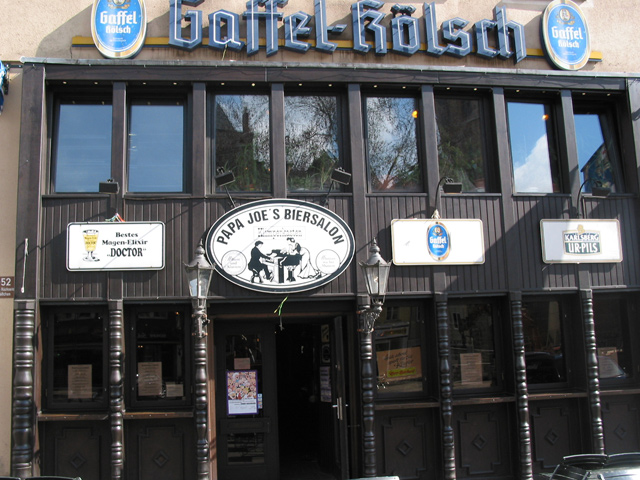
Papa Joe’s Biersalon, Cologne.

back to Germany

Alter Markt 50-52, 50667 Köln, Germany

**Important: PLEASE NOTE THAT PAPA JOE’S BIERSALON & PAPA JOE’S JAZZLOKAL ARE 2 DIFFERENT PLACES IN COLOGNE**

  • Quality and/or choice of drinks – 8/10
  • Style and Decor – 10/10
  • Character, Atmosphere and/or Local Life – 10/10
  • Amenities, Events & Community – 8/10
  • Value for Money – 6/10
  • The Pub-Going Factor –  9/10

Some forms of pub going occur entirely outside of the confines of English culture, and one of these is to be found in Cologne, where Papa Joe’s Biersalon has become a local favourite.

The traditional of socialising and even group singing alongside strangers is much more common in Germany, and during the height of the evening, the singalongs in Papa Joe’s constitute a proto-form of kareoke, except instead of one person singing, most of the pub joins in.

To make matters weirder, the songs are ‘performed’ hourly by a mechanical marionette by the bar, the range of tunes being a remorseless cast list of traditional German favourites with the typical organ, harpsichord and accordion ensemble. You’ll be gawping at first, through the sheer  eccentricity of a setup that by now locals know like the back of their hand.

Sitting among the crowd, even if you aren’t joining in the singing (there is no obligation to) is to take in a heady experience of local life, a sample of German national expression even, if you want to take it further. The venue itself adds to all of this; is traditional in style but theatrical in shape with raised seating around the perimeter of the ‘pit’ area in front of the bar, and a corner stage to boot. With the bar’s history, it isn’t surprising the place is adorned with jazz instruments hanging from the beams and snippets of musical ephemera plastered to the walls. There’s plenty to look at.

This slideshow requires JavaScript.

Drinks are best procured from the bar area as table service can be a little slow at peak times. The local beer Gaffel Kolsch is on tap and delicious, at a standard price for the city centre, and while that ought to do you just fine, there are some decent other options these days too (if you fancy a hefeweizen for example).

The traditional seating and cosy interior is about the only aspect of the experience I can think of that was akin to English pub going. Everything else was rather quaint, quirky and shameless in its kitsch ‘old-time’ quality. Expect to see a huddle of young folk bombastically belting out the standards by the bar, while the middle aged folk sit further back, rocking their heads and crooning along.

If it’s not the mechanical instruments it’s live jazz music, bawdy poetry recitals and all other sorts of 1920s-era throwbacks to keep everyone entertained. Concerts are free and it’s always busy. Unsurprisingly, given its location in the heart of Cologne (you could run there from the front door of the Dom in a minute flat) Papa Joe’s has become an institution, creating an atmosphere you can’t just bottle or duplicate at will.

If you’re a little anxious about forced jollity I can certainly understand a degree of reticence, but you have to be there to understand. Even if you’re still wary, you’ll be pleased to note there is some respite in-between the shows, and you can hang out perfectly as you would elsewhere, just in a lovely and lively pub.

After visiting in 2007 I kept a grainy video on my phone of our time there, and over the next few years, generally spent penniless and occasionally depressed, I would occasionally pop that video on and remind myself of the good times spent in here to cheer me up. That phone and video has now gone, but the memory lives on strongly.

Since then I returned in 2018 and 2019 to find that, thankfully, hardly anything had changed.

It’s an essential place to drop by in Cologne, particularly as some of the brauhauses can tend to melt into one after a while. Papa Joe’s it offers something utterly different, strange, and yet pitted in the local tradition. Throw down a far jars of Gaffel Kolsch, gawp at the spectacle in front of you, and hey, even join in if you dare. After the festivities head around the corner to a kebab shop for a Turkisch pizza (making care to consume it before the alcohol wears off). Welcome to Cologne! In fact – welcome to Germany! This is the kind of pub you can justify a plane ticket for all on its own.

À la Mort Subite, Bruxelles

back to Belgium

alamortsubite
Rue Montagne aux Herbes Potagères 7, 1000 Bruxelles, Belgium

There is sometimes a premium to be paid on a special occasion, so on my annual visit to A La Mort Subite I breathe in deeply and dive more deeply still into my wallet, on account of the luxurious overall experience of visiting this splendid Bruxelles bar.

Distinctly Parisien in format, this opulent faded-grandeur art nouveau venue (translation: At The Sudden Death) is one of Brussels and Belgiums most famous bars, so no surprises or left-field picks from me this time. A la Mort Subite might count as a brown café for the bench seating up the sides of the long room, if it wasn’t for the lack of brown elsewhere. Cream walls and pillars, the elegant ornamental décor stacked with studded crenullations, mirror panels and a stately, out of time design. You have a venue somewhere in between a café and a salon, originally built as a place for socialites to be seen in, yet, being Belgian, still focused predominantly on beer. The décor has such an authentic and preserved quality (no change since 1928, save for the occasional running repair) so it’s difficult to think of too many other places that are alike.

Mort Subite supplies the draft beer, and this brewery serves fruit beers and lambic effect rather than the real wild yeast sour lambics McCoy. They are still rich in flavour and sweetness, and a tad sour, but lacking any sort of dryness and depth that might indicate the traditional lambic brewing process. A small serving of their kriek for example, which would be a good choice, will set you back five euros on its own. Some of the other options are fairly astronomical considering the price one can drink for elsewhere in excellent surroundings. Mort Subite beer may as well be drunk here as much as anywhere on the globe. With this being Brussels you can expect a small food menu with cheese, charcuterie options and the usual pub food like croque monsieur to help your beer go down (as if anyone should need help finishing a Belgian beer!)


This slideshow requires JavaScript.

The bar clearly feel they are unique to set such a high price, and annoyingly, they are right. An afternoon drink in A la Mort Subite can feel rather like a drink in a grand café, nice enough in itself, but the bar character starts to come alive in the early evening time as the crowd changes, and you can suddenly start to absorb some of the atmosphere and understand the underlying reasons for the endurance of this place. A special bleary eyed feel starts to develop, the sharp lines and corners blurring into the cream colours, like dropping into a dreamworld. That’ll also be the strong beer…

The grandeur and glamour of socialising in the inter-war era is yet to be recreated around Europe on any identifiable level, save for the odd outstanding example, partly because of the lack of venues who have committed to investing the kind of money to pull it off well, and also because the eventual crowd it attracts tend to have little to no appreciation of their surroundings anyway.

Service is almost classically continental, with wide stomached balding René type characters smoothly dissecting the venue with assurance and steady hands under the drinks trays. They are immaculately professional and patient considering conveyor belt of foreign tourists and the format of table service requiring more work than is strictly necessary. These characters add further to the sense of intransigent and reliability that lend a place a certain charm, that A la Mort Subite certainly possesses.

Although the evening and night crowd appeals to a few nostalgic locals who insist bars like these used to be abundant, a large volume tourists of venture in during the daytime, and because of the heritage of the place, often an aged crowd at that. The only sudden death that occurs in this bar is from pneumonia and cardiac arrest, I suspect.

Changing the venue in anyway seems to be verboten, and I wouldn’t approve major adjustments either ,however it seems to me there is nothing to stop the place rejigging the drinks choices and doing some marketing from the outside, as this venue is not designed for middle aged obese American sat in Burghaus jackets, it is designed for the young, the stylish and the vibrant. The way to really bring back the good old days isn’t just to leave the décor and service meticulously unchanged and hope for the best. The good old days were good because they were vital, vibrant and inhabited a nascent social scene. The place could do more in that regard by hosting more events, perhaps some understated live music, and so on.

In order for A La Mort Subite to take the next step, they need to be brave enough to recapture the zeitgeist in a way that doesn’t upset the period features, rather than settling for being a museum.

A La Mort Subite is a preserved remnant of a particular era and a great opportunity for anyone with a real passion in the rich and diverse history of socialising, beer drinking and recreational culture to step out of the every day experience and soak in the special character of the place. There are scarcely grander or more historical venues to recline and get merry with some astoundingly good beer. It may be so well known as to be passé, and it isn’t the pinnacle itself of pub going, but that doesn’t stop it being one of the best bars in Europe.

  • Quality and/or choice of drinks – 7/10
  • Style and Decor – 9/10
  • Character, Atmosphere and/or Local Life – 8/10
  • Amenities, Events & Community – 5/10
  • Value for Money – 4/10
  • The Pub-Going Factor –  8/10

Lórien, Palma di Mallorca

…back to Spain
lorien
Carrer de les Caputxines, 5A, 07003 Palma, Illes Balears, Spain
In a city geared up for café culture, tapas, pintxos and wine, the pastime of drinking beer and pub-going currently plays a definite bit-part role in Palma. Going for a night out here generally revolves around visiting various tapas bars on an evening, which are often lively and buzzing but lacking any standout décor and character to distinguish themselves. Indeed, the crowds in those places, the endless snacking and paucity of good beer options become a drawback after a time.
Thankfully Lorien has stepped into the breach, a superb genuine beer pub with a Lord of The Rings theme. This whole notion hangs loosely around the frame of the pub though, think tasteful artwork, motifs and patterns rather than role play and costumes! It isn’t like The Prancing Pony either, although few places are.
The pub tailors itself for an audience who have been starved of choice and quality of beer, stocking a range of Spanish and Mallorcan craft ales on tap along with a healthy supply of beers from more traditional parts of the world. This will come as a refreshing change of speed from the relentlessly uniform options of Estrella or Mahou everywhere else in the city. You’ll be surprised at the length and breadth of the beer menu.
There is a corresponding uptick in price which is hardly surprising given the sheer lack of competition, but given the alternative option is standing around food-munching Mallorcans in corporate tapas bars, or drinking wine in inappropriately intimate cellar bars, it’s worth it.
Furthermore, Lorien succeeds by being a real pub. You will find corner bench seating arranged in a communal, inwardly facing main room – a pub, in essence – and unsurprisingly a rather different crowd of young people than the dress-to-impress crowd in the tapas bars, going for a drink and a chat in a cosy and informal setting.

This slideshow requires JavaScript.

The bar staff are almost textbook beer monsters: bald, big beards and big beer guts, and are more than happy to chew over your drinking options. You’ll find English is commonly spoken, as is often a big plus of craft beer places abroad when you’re trying to decipher what to drink, or just to have a friendly conversation.
However, this is more than just a venue for craft beer, there is a real effort made to engender a local drinking spot and community. Thankfully Lorien strikes the balance right between the studious beer contemplation and a friendly community.
Anyone frustrated by the other options and angling for a good beer and a communal pub in Palma must start by making a pilgrimage to Lorien, perhaps meeting your own Lady Galadriel along the way!
There are no two ways about it – if I lived in Palma, Lorien would be my local of choice.
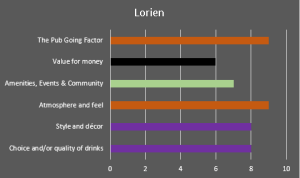
  • Quality and/or choice of drinks – 8/10
  • Style and Decor – 8/10
  • Character, Atmosphere and/or Local Life – 9/10
  • Amenities, Events & Community – 7/10
  • Value for Money – 6/10
  • F: The Pub-Going Factor –  9/10

Spiż, Wrocław

back to Poland

Spiz

Ratusz 2, 50-106 Wrocław, Poland

The history of the ‘Ratskeller’ in central Europe is rich and fascinating, not least because the concept of the main social meeting place being in the epicentre of the town was the signature of medieval towns. Yet for various reasons this has become lost, even countries famed for such traditions, not least Germany. The cities expanded, the places became victims of their own success? Who knows.

Wroclaw has a great deal of crossover culture with Germany, being known as ‘Breslau’ by their neighbours, and along with that, the drinking culture centred in traditional fashion on the city’s extremely large and impressive Rynek. Today, the Ratskeller ‘Spiz’ delivers to modern Poland such an correct feeling representation of the style, it acts as traditional cultural anchor in the city’s otherwise modern and often alternative-edged social scene. Despite having only existed since 1992, it has basically revived a periodically forgotten historical purpose and in a short space of time picked up quite a bit of character to boot.

Upon entering the Spiz cellar, you will discover a Germanic, Gothic and stately subterranean beer hall with its impressive mash tuns, giant barrels, cloistered ceiling and interesting display cabinets, acting as a mini-museum. You can order these straight from the bar which makes a nice change from having to wait for table service. The bar area is a fairly amusingly disorganised affair with servers handling money slightly grouchily and seemingly not fully comfortable with the concept of direct interaction with the general public. Alternatively you can wait for the waiting staff to make an appearance, and these matronly sorts are not to be messed around with. Apparently carrying heavy beers around all day gives you muscles!

Importantly too, Spiz brews what it sells, and yet freakishly it competes with two other breweries also on the square itself – talk about keeping a tradition alive! All Spiz beers are unfiltered and unpasteurised giving them a hard-to-match freshness, and their whole range from the light lagers, yeast beer and honey mead fall somewhere between okay, good and very good.

They are geared towards either hearty winter drinking or refreshing high volume summer drinking and although you may quibble here and there about not hitting a certain level of finesse, their drinks hit a good mark consistently. None of their beers will come close to breaking the bank, even by Polish standards although with it being central it’s not the cheapest place either.


This slideshow requires JavaScript.

Conversely, there is a huge seating area outside, including an outside bar which on a sunny day becomes the ultimate drinking spot in the city, as one can recline with a beverage and enjoy the sights and sounds of a buzzing and vibrant Rynek. On my last visit the weather was gloriously sunny and although I’m not hugely taken by terrace drinking usually (as often you may as well be anywhere), it hardly gets any better than this. To your left, glance upward to the clock tower of the Ratusz, then straight ahead a line of magnificently restored and individually painted burgher houses, then to your right the join onto the Maly Rynek, which, through depth of field provides a fleeting illusion that this beauty and artistry stretches throughout the city. If you just keep sat there chugging away at the lovely beer, you can convince yourself it does.

A passion for preserved historical features isn’t just borne of an interest and preference in historical architecture, also a yearning for the atmosphere and simplicity of the time. Sat outside spectating on the various forms of life passing by does on a temporal level transport you to a previous era. The Rynek in Wroclaw is terrific and Spiz has the number one location for enjoying it.

If there wasn’t anything else to do in Wroclaw it would be enjoyable in itself to spend your entire time at Spiz. As can be seen by the various reviews, the positive experiences are well founded. However, Wroclaw is a terrific city as I highlighted here on my sister site Undiscovered Europe.

Yes, it’s entirely obvious as a destination and about as alternative as the use of the letter E in the word sentence. The service may not be all that, and it can be very busy at peak hours. Similarly, the TV screens downstairs in the beer hall garishly advertising info about its horrendous looking disco nights do detract from the experience. It needs to be very very good to overcome these – and it is.

Very few pubs will ever take such a short time to embed themselves in the landscape and cultural of such a big city, and they’ve done, by heavens they’ve done it.

  • Quality and/or choice of drinks – 8/10
  • Style and Decor – 8/10
  • Character, Atmosphere and/or Local Life – 9/10
  • Amenities, Events & Community – 8/10
  • Value for Money – 7/10
  • The Pub-Going Factor –  9/10

Update: Since my initial visit in 2016, I returned to Spiz again in 2018 and 2019 to find, thankfully, little had changed except for the addition of a craft beer to their roster, the APA.

Schlenkerla, Bamberg

…back to Germany

schlenkerla

Dominikanerstraße 6, 96049 Bamberg, Germany

The number one purveyor of ‘rauchbier‘ in the universe, Schlenkerla are a big international brand and export their strange smokey ale across the world. Bamberg’s tradition for beer brewing is well known about in Germany with nine active breweries in the centre itself, all of which existed long before this decade’s revival of small scale brewing. You might expect Schlenkerla’s brewery tap to be along the lines of many other German breweries, a vast beer hall serving high volumes to the masses, as the place certainly fulfils one of Bamberg’s central tourist functions.

It comes as a very pleasant surprise then to visit Schlenkerla and find  a small-to-medium sized pub, connected to a cloistered medieval banqueting hall, which while rather impressive to look at isn’t enormous either.

This certainly isn’t a criticism, quite the opposite. In comparison to many other breweries who go in for a far more corporate business-like approach to style and service, hard to hate but at the same time difficult to love, at Schlenkerla the preservation of the tradition, and a determined low-key approach seems to be the modus operandi. For whatever reason, outside of the peak weeks of summer, maintaining this normal scale pub seems to meet demand and work just fine.

There is a luxury to be had bathing in stereotypes from time to time, and you will find the unabashed gothic agricultural charms of Schlenkerla’s tap house so distinct and powerful, encompassing a stereotype of the traditional Germanic identity, (the Middle Ages in particular), as to make a lasting impression.

The exterior of the pub is a beautiful traditional fachwerk house (as could be expected) with the classic Schlenkerla motif on the lantern outside, the name loosely translating to ‘limping man’ (though I believe the direct translation is slightly less politically correct). The location of the pub could hardly be more central, almost at the epicentre of operations in Bamberg’s Altstadt and just a short walk from the absurd and brilliant Altes Rathaus perched halfway across a bridge over a fast-flowing river. You can read more about that in my general review of this modest yet spectacular city here.

Turn left as you walk in to enter the pub room, and notice the Schlenkerla beer served gravity pulled direct from the barrel at the bar. The interior is black beamed, previously having been washed in ox blood, presumably for some superstitious reasons. Bamberg was one of the centres of witch trials in the middle ages and like a few corners of Germany, does enjoy trading on a rather gruesome history. The room itself feels like it could have existed hundreds of years ago, and save perhaps for certain added sounds and smells that would take you there it is remarkably transporting all the same.

This slideshow requires JavaScript.

The pub offers communal seating, and was so appealing to dive into on a winter’s day none of my inherently reserved Britishness about sharing communal space came into play. Find any space going and place yourself there – perhaps be polite to ask first, but it’s unlikely anyone will decline – it is the done thing. The serving wench (I do use that term advisedly) is stodgy and middle aged, which suits the place perfectly, being after all, a stout and venerable operation. With her level of dour scrutiny over proceedings, your beer will arrive in short order and be replaced just as swiftly when you’ve finished drinking. Keep the bar mat handy as she will be keeping tabs via pencil marks and you’ll settle up at the end.

Schlenkerla’s rauchbier overwhelms your mouth at first with smoke and bacon flavour, but once it has laid the flavour there, that recedes to the background, or at least becomes the ‘medium’ if you like. From there, drinking the rauchbier becomes milder, with their Marzen being similar to a sweetish nut brown ale, with that background smoke and a refreshing hoppy finish to boot. Similar to trying your first pint of Guinness or other stout, once you overcome the initially strange flavour there is a fantastic drink to be had and one you can put away volumes of in one sitting. The guy I sat next to assured me it takes three full pints before you appreciate the virtues of a rauchbier.  And check out the value as well! Germany has generally offered a large beer for 3 euros 50 cents for a while now, but in Schlenkerla it’s well under that for a glass, meaning you can have a whole session in here without worrying about rapidly draining your funds. Good value is hardly a common feature of any sizeable brewery tap I’ve been to, so here’s another feather to its bow.

The pub room is really cosy and friendly, with many traditional pub staples, including even a serving hatch with a stained glass window, and a door leading to a courtyard of high medieval design where one can get fresh air and nosy around at the general environment at this terrific venue. At the time of my visit it was even snowing in the courtyard heightening the atmosphere further. Diving back inside I spent a good few hours alongside a Brazilian family who were being introduced to Bamberg by their daughter’s husband. Even though I was suffering from a bad sore throat at this point it still counted as one of the highlights of the stay. You know there will be little stories and vignettes shared every day by people who bumped into some stranger or other in Schlenkerla and for a brief moment in their lives because well-acquainted. Such socialising cuts to the heart of a pub’s function.

Although they serve food in the pub area, the best place to be for that sort of thing is their banqueting hall through the other side of the building. The styling inches even further towards medievalism without going over the top as with some themed-restaurants. Schlenkerla serve food built to withstand the power of a smoked beer, and the offerings are intensely flavoured, stodgy and agricultural. The Bamberger sausage is charred black, comes on a spartan metal plate and will make your breath stink for weeks. It’s delicious. The Bamberg Zwiebel is a giant onion stuffed with mince. You’re probably getting the idea. You can even push the boat out and order Schlenkerla’s doppelbock beer. The combination of a complex strong beer and smoked effect on top pushes the boundaries of what a tongue can cope with, and it’s a specialist kind of brew.

All venues that see a high volume of traffic such as this one can suffer from the service being a little jaded and that also applies to Schlenkerla if you’re doing any more than drinking. I got the impression the majority are well meaning but they certainly seem to tire as the day goes along. Most of the negative comments online also pertain to this, and I think they have little patience for the more ignorant tourists, finding their other tasks quite challenging enough as it is. However, that’s a rather mild criticism in what otherwise is a richly enjoyable experience.

As a pub I would recommend this all day long – it is one of the finest drinking spots I’ve ever been to and I wince with regret that we haven’t developed matter transporters so I can press a button and visit every week with impunity. In many ways Schlenkerla sums up what pub going is all about and takes several of those aspects to the very highest level of enjoyment. Stunning.

  • A: Quality and/or choice of drinks – 9/10
  • B: Style and Decor – 10/10
  • C: Character, Atmosphere and/or Local Life – 10/10
  • D: Amenities, Events & Community – 8/10
  • E: Value for Money – 9/10
  • F: The Pub-Going Factor –  10/10

Update: Since my first visit in 2017, I’ve returned twice in 2018 and 2019 and the operation is going strong much as before. Interestingly, all three visits have been in totally different weather conditions, hot sun, pouring rain, and snow. Schlenkerla was just as attractive a prospect in all 3 and is surprisingly cool and pleasant inside when it’s hot outside.

t’Brugs Beertje, Brugge

…back to Belgium

tbrugsebeertje

t’Brug Beertje, Kemelstraat 5, 8000 Brugge, Belgium

The alchemy of what constitutes a good pub is worthy of considerable study, and partly why this site was created.  The Little Bruges Bear is an excellent place to begin.

While there are so very many hundreds of bars and pubs across Europe missing essential ingredients, scrambling in the dark in their search to attract patrons, despite having a reliable formula almost laid out for them, this pub serves to illustrate how simple the task is.

t’Brugs Beertje is a cosy communal venue with the dimensions and confines of a snug brown café/pub decorated with wood panelled walls and adorned well selected and stylish bar ephemera. There is a choice of simple wooden seating or slightly more comfortable bench seating if you’re lucky enough to swoop in and claim it. Ask to peruse their enormous menu of Belgian beer, presented in the form of an almanac that takes a good 20 minutes to look through properly and consider a selection of typical Belgian snack options (gouda, biscuits, meat platters, croque monsieur etc) to go with. Just thinking about this while writing is salivating.

Hanging above the bar is a gleaming selection of the various beer glasses each tailored to their specific beer, every single flavour journey mapped out by their brewers right down to the way the beer sits in a glass, tempered to the point of maximising every single potential for an improvement of the experience, telling of a country utterly obsessed with the art of brewing and the pleasure of drinking. There will be a beer for you in this pub, or I’m afraid there is no beer for you.

Service is efficient and attentive, while the prices are 20-30 cents higher than other nearby places, but not punishingly so. This can be offset by choosing a rare beer you’re unlikely to get anywhere else (my suggestion would be to try an Oud Bruin/Flemish Red style, which apart from Rodenbach are less commonly exported to the UK, while curiously, the style hasn’t yet caught on as a craft brewing style despite the proliferation of red ales and sours).

BrugsBeertje_tcm13-9835

The enormous popularity of the place has unfortunately driven locals away apart from a few quiet months in the New Year before Easter. Normally it would earn a mark down for that, as it’s important for a pub to have an original community element, but the place must be given a free pass. The ideal would be for it to contain a healthy mixture of both locals and a few tourists, but the world has taken over Bruges in the last 10 years. In lieu of local life, the shining qualities of the pub, that seem to epitomise everything good about traditional beer drinking in Belgium, compensate adequately.

The pub opens at 5pm and by 5.30 nearly every seat is taken. After that it’s a case of waiting politely at the door and taking your chance to swoop to a seat. Once seated, it’s unlikely you’ll see a reason to leave any time soon. It’s a rare example of a place where I would actually wait for 10-15 minutes to be seated.

The main room has a terrific atmosphere, watching folk come and go, but if that’s not available, the backroom has a lovely down-to-earth feel, like a rambler’s pub full of strangers thrown together in the tangle of a boozy evening. This compensates well for the lack of local characters. Only the matter of being on holiday, in Bruges of all places could distract a visitor from staying there all night, returning at opening time the next day and doing the same. It is the best pub in Bruges and there’s no doubt that this is pub going at its very best.

  • A: Quality and/or choice of drinks – 10/10
  • B: Style and Decor – 10/10
  • C: Character, Atmosphere and/or Local Life – 9/10
  • D: Amenities, Events & Community – 5/10
  • E: Value for Money – 6/10
  • F: The Pub-Going Factor –  10/10