De Pilsener Club (De Engelse Reet), Amsterdam

back to Netherlands

Begijnensteeg 4, 1012 PN Amsterdam, Netherlands
  • Quality and/or choice of drinks –9/10
  • Style and Decor – 9/10
  • Character, Atmosphere and/or Local Life – 9/10
  • Amenities, Events & Community – 5/10
  • Value for Money – 6/10
  • The Pub-Going Factor –  9/10

Brown cafés warrant the name because of their shared characteristics, but the term is best served as a general guide to indicate a few of their recurring themes rather prescribing a precise template. Exploration of these pubs across Belgium and Netherlands will reveal a surprising diversity in décor and atmosphere.

Some emerged from a jazz/blues tradition and are decorated accordingly, even hosting live acts as a revival or preservation of that. There are some upscale brown cafes which take their cues from the roaring twenties: high society, art nouveau and all that. There are English/French style taverns which blend vaulted beams and thick wood with the bric-a-brac décor and beer ephemera you’d expect in a brown café. There there are working class venues with a simple format: rickety furniture, dusty floors, yellowed walls and good booze.

It seems though, whichever angle the owner deigns to take, the fundamental basics of what constitute a great pub are inherent in the DNA of a brown café which put them at a distinct advantage. Whether it’s the fantastic Belgian beer, their aforementioned styling choices, their character and atmosphere that evolves over the course of a day and remains as appealing whether you’re sat there on your own or among a tangle of people, you have to go pretty far to mess this concept up.

The rather crappily-named De Pilsener Club goes by another far better name ‘De Engelse Reet’, or ‘English Arse’. This place is one of Amsterdam’s core historic brown cafes dating back to 1893, and this place is content to be down-to-earth and working class.

There is a no-bullshit attitude to the entire arrangement: it’s brown alright, from the walls to the tables and chairs, and the floor has that aged spit-and-sawdust type look to it that probably has been cleaned daily but has been around so long it has received stains and wear that won’t rub out. Characterful, basically. A notable quirk is that there is no bar at all, all drinks are prepared in a backroom and then brought out.

Drinking is done across a set of communal tables along a small rectangular room with a fairly high ceiling, so you get a cosy surrounding but a woozy sense of space if you look up. The lighting and ambience gives that sense that it could be virtually any time of day and feel the same.

This slideshow requires JavaScript.

Drinking pilsener isn’t even half of the point of being here. The purpose of your visit is to drink some high quality, and invariably strong Belgian and specialist Dutch ale in these surroundings. Trappiste, abbey, lambics, micro-brewery stuff. These are proudly displayed above the head of the bar. Alternatively (or potentially in addition to) you can try their decent enough range of jenevers or order a cocktail (I’m not sure why you would feel the need to do the latter in a place such as this, but alcohol is a strange master at times).

There is a nice range of clientele in the place that give it a nice community feel. Old men sipping their beer over a newspaper, groups of youngster sharing conversation, couples diving in from the bad weather (in our case), business folk holding-forth over the worn-through tables. It is the kind of place which manages to be inclusive without turning itself into a safety first bland chain pub, and maintains what it wants to be without discriminating in the ageist and stylist fashion many craft beer pubs do. Of course, being in central Amsterdam will help, but natural advantages still count.

Beer isn’t cheap in Western Europe these days, and it’s no exception in here. Expect to pay 5 euros and upwards for a 0.25l pouring or a 0.33l bottle, although keep content in the knowledge the quality is among the best you’re likely to get. Given the savings to be made elsewhere in the city centre are 20 cents here and there at most, and that a pint of Heineken regularly clocks in at 5.50+ these days, it seems churlish to complain about paying 5 euros for a Rochefort 8. You certainly pay more in England.

As the evening progresses and the alcohol takes effect, the browns and off-whites of the room form a rather comforting hue, and the hubbub of conversation adds to that great calming melange where you really wouldn’t rather be anywhere else. And that’s great because it stays open until 2am.

In most towns and cities this place would be the best pub by a country mile. Up against seriously stiff competition in Amsterdam, De Pilsener Club eschews all gimmickery, sell-out concessions, and, if you excuse the waiter’s rather formal attire, modernisation of any kind, and does a good trade being what it is, a thoroughly likable, characterful place for a drink and a good time. Google reviews are almost uniformly positive about the place and after a visit it’s easy to see why. Mark my words, their words and place it firmly on your hitlist.


U Rotundy, Prague

back to Czechia

Karoliny Světlé 1035/17, 110 00 Staré Město, Czechia
  • Quality and/or choice of drinks –7/10
  • Style and Decor – 7/10
  • Character, Atmosphere and/or Local Life – 9/10
  • Amenities, Events & Community – 7/10
  • Value for Money – 10/10
  • The Pub-Going Factor –  8/10

If you read travel blogs or even mainstream travel journalism, then you may have read about why the time of paying ‘a pound a pint’ abroad is dead, this referring to an era from the mid-90’s to around 2009 when the enormous disparity in earnings and currencies between West and East meant that Western Tourists could turn up in Prague and Budapest and feel like they were taking the piss even when, by the standards of the local economy, they were actually being ripped off.

The travel writers are true in identifying that the general trend over this last decade has been a paring back of those obscene financial advantages due to a steady increase in wealth, prosperity, earning power and the touristification (if that is a word) of Eastern European capitals, which has had a considerably restricting effect on the bargains to be had abroad, albeit in very specific conditions. Spend a day in Dubrovnik or Riga old town and tell me if you feel like you’re surfing on a wave of great value!

Prague too, has its tourist traps, and while there is far too much competition across what is a large and well-connected city for a rot to have set in like those honeypots I’ve listed above (as is also the case in large cities like Kraków and Budapest), it is certainly true that a normal beer, Kozel 11, for example, is sold in Prague old town and across the river Mala Strana for a price 40-50% more expensive than the going rate in most of the rest of the country. At the start of 2018, with Pound Sterling (£) in a slump, that puts you well over £1 for a half litre. For a Czech person visiting Prague from a small town, this would be a mild concern, but not, I doubt, much of a concern for you. Drinking great lager for so little, even if it is above the average for the nation isn’t exactly the kind of issue a British tourist spends much time worrying about. However, I am quite determined to demonstrate there are still breathtaking bargains to be found in Europe for beer.

Of course, I could drag you to a revolting dive bar in the middle of nowhere to prove my point (and in the process, kind of disprove it at the same time and make me seem like a petty idiot). However, the real satisfaction is finding the cheap beer in a good pub. I think the best approach to the old ‘pound a pint’ question is to find out: can you visit a good pub in the old town of Prague (Prague 1, Stare Mesto, whatever you want to call it) and get a half litre of beer outside of happy-hour for less than a pound?

Yes, of course you can!

During the socialist era, businesses such as cafés, diners and pubs were graded, the cheapest generally being ‘Fourth Grade’ or čtvrtý, the grading allowing goods and services to be distributed and tailored according to their central planning. This term has survived in Czech parlance to this day, as serves partly a useful metric if you are interested in finding some of the best value places for a drink (though be aware it can be used disparagingly about some rough and ready places too).

These ‘Fours’ have nearly died out in Prague old town, partly because there is little need for them in an affluent touristic, commercial district, but also due to capitalism’s inevitable march of progress in claiming the land from underneath people and its hostility towards partly-socialised enterprise (just witness the lamentable decline of the Milk Bar in Poland since their government stopped subsidizing virtually any seasoning that would help their food taste of something. What private enterprise is so pathetic and helpless that they need to winnow the offerings in a Milk Bar?).

Hostinec U Rotundy is not the last place standing in the old town where you can get a pint for considerably less than the usual going rate, but it is the most venerable, best quality, and I must confess, slightly alien and fascinating. It is by all reputable accounts, a ‘Four’ in form and function, and as I’ve been multiple times and had fun time and on one occasion surprisingly good food, it deserves a spot on European Bar Guide.

This slideshow requires JavaScript.

U Rotundy gets its name from the rotunda a 100 metres up the road (which is an interesting little oddity that kind of blends into the background among the jawdropping other sights) and is so close to some of the main streets and sights in Prague old town that you can tack it on to any of the usual pub crawls without it feeling like a special detour. Yes, U Rotundy is on a less quiet street but it’s a spit from the river, Charles Bridge and an idle wander from the tourist crush on Karlova to remarkably peaceful old streets like Betlemska and Konviktska.

In some of the classic Pilsner Urquell pubs, such as U Pinkasu or Jelinkova Plzenska Pivnice you can experience what Prague was, or may have been like before the war, but U Rotundy is where to go if you want to experience an unvarnished socialist-era drinking hole, something which now, I think, is becoming a curiosity.

One ardent Czech pub tradition which has bitten the dust for good, whatever your personal view on it, is smoking, so although U Rotundy looks like the kind of place where after 11pm you’d be lucky if you could make out the people from the other side of the room, that particular atmosphere (I was always dubious about as to whether smoke added as much atmosphere as people though) is gone, and won’t be returning, and that goes for the country as a whole.

One threat to banning smoking indoors, as happened in the UK, is that old men will simply retire from pub-going and fill their apartments with stale fog instead. However, unlike the UK, Czechia benefits from ludicrously cheap beer which isn’t going up by the same rate beer prices were in the mid-00s. For now at least, the cast of regulars at U Rotundy remains firmly in place, which is all for the good, as they are the ones keeping the place in business.

As with all cheap pubs, you find a coalition of old men and students enjoying the good value and occasionally having a ‘forthright exchange of cultural values’. One of the more pleasant aspects to Czechia is a healthy down-to-earth attitude and understanding of a communal pub-going mentality where people are less reserved than England. I wouldn’t say U Rotundy was full of women, exactly, as it’s not but neither is it so much of a man-pit that Czech women are afraid to venture in.

U Rotundy typifies the simplicity of those olden days. Don’t worry about deciding what beer you’re going to have. It’s Staropramen and you’re having it. Right? That’s settled then.

I posted a good article from Beer Advocate about this on our Facebook page (which I recommend you join for extra goodies and comments) where an American so used to multi-tap places got choice fatigue between his DIPA’s, barrel-aged sours and hibiscus goses and loved the culture in Prague where the stress of each decision was alleviated by the glasses being continually refreshed with the same beer, freeing your mind to concentrate on the important things about going out, like being with your mates and having a good time!

I must admit privately smirking at the thought of a few people I know or have met on my travels venturing into U Rotundy and being prescribed their drink. It’s not what I would want life to always be like but I have some serious admiration for the mentality behind it, in a world where choice must always equal better. Surely the fact stuff like this even exists is evidence of diversity in itself, right?

Anyway, the Staropramen 10 is as good as it’s ever going to get (ie. alright) and you can switch between light or dark if you really want to go crazy. At the time of writing 27czk weighs in snugly under a pound a pint, even at the lowest rate for sterling in years. Back in 2015 when it was 38czk to £1, this pint of beer would have been just over 80 pence a pint.

Even in Prague, these prices turn heads, and U Rotundy is busy most evenings as a result. The pub itself is relatively spacious, with a communal main room, and some dining tables up the corridor and anteroom to the back. One enjoyable aspect is that the tap faces you as you walk through the entrance, leaving you with a beer virtually before you’ve had a chance to wipe your feet!

There isn’t much going on musically other than the sound of geriatric grumbling and twenty-something conviviality, but they have a new TV (beginning of the end for this place, mate) and tend to throw on ice hockey and football. I wouldn’t call it a sport pub, but it’s got a casual interest, and that’s an amenity you won’t find in many of the more traditional pubs in the city.

Food-wise, U Rotundy does something of a surprising turn. If I was visiting a pub that looked like this in England I’d go hungry rather than attempt to eat anything emerging from the kitchen, and yet, after reading the largely positive reviews I gave it a go, and what do you know? Big portions of no-nonsense, fresh Czech cuisine at fair prices – not quite as fair as the beer price but at a corresponding standard to match what you’re paying for, and food you would pay over double for down the road without that home-cooked feel. That aspect of the place really counts in its favour, and although I wouldn’t usually bang on about food too much, it’s a nice feather in its cap.

Lastly, for flavour, I refer you to Max Bahnson of Pivni Filosof-fame, who said of U Rotundy in his funny and ever-useful book Prague: A Pisshead’s Pub Guide,

It’s dingy, dirt cheap and I doubt much has changed in the last 25 years, if not more. It’s like a bulldog, so ugly it’s beautiful. Proof that what really makes a pub special is not the stuff that comes out of the taps”.

Amen to that.


Café Vlissinghe, Brugge

back to Belgium

Blekersstraat 2, 8000 Brugge, Belgium
  • Quality and/or choice of drinks –8/10
  • Style and Decor – 10/10
  • Character, Atmosphere and/or Local Life – 10/10
  • Amenities, Events & Community – 8/10
  • Value for Money – 6/10
  • The Pub-Going Factor –  10/10

Every town deserves at least one historic place in which nothing ever seems to change. Being able to link aspects of our own lives to the past (as futile as that endeavour may seem at times) helps to provide our own existence with a sense of place and purpose, in the knowledge that we have retained and respected at least some things of value along the way, and by frequenting these places we contribute to their survival.

Café Vlissinghe takes this idea and extends it beyond all usual historical parameters, and the news gets better still – it’s a pub! Even in Brugge, a place not short of preserved architecture and institutions, it can reasonably claim to be one of the most evocative links to their past, the business traceable for centuries and thankfully keen to preserve the format for centuries to come. Once you have a good thing you don’t easily let that go.

The earliest record of the pub dates back to 1515, extraordinary in and of itself and it claims to have been running continuously from then until the present. This earns Vlissinghe a place on the list of oldest companies in the world. The look of the place may be redolent of a late Medieval inn, however it appears some of the appearance was lovingly and coherently retrofitted in the mid-1800s (an era steeped in fascination and nostalgia for all things Medieval), with the installation of contemporaneous artworks and paintings and furniture that are consistent with the period. It’s all very brown, black, tarred, burnt caramel and crusty textures. Precisely the sort of thing you want with an old pub.

Vlissinghe is located mercifully outside of the main tourist drag, down a typical Brugge alley: cobbled street, whitewashed walls, ancient brickwork, and a bicycle propped up outside that’s so old you wonder whether it’s become an ornament (until a man in a flat cap emerges from the door, tucks his newspaper under his coat and rides off on it). It must be no more than 50 metres long, but the amble down the lane, with the pub entrance coming closer with your every stride has become somewhat of a ritual for me, just long enough to build a sense of anticipation for what’s to come…

Vlissinghe’s gothic lettering is painted above the entrance, so dive straight in and turn left and head down a long corridor entrance with a series of side rooms. This may lead you to believe it is a large venue, but the pub itself is really just a central room, up a couple of steps at the end. You will note it is appointed with large, sturdy, venerable furniture, cushioned with studded leather upholstery, warped floorboards that creak underfoot, faded oil paintings hung on the wall which you have to swivel to and fro between the sheen of the lighting to properly discern, and an impressive and unusual centrepiece: a cast iron steam heater kicking out warmth into the room, most welcome on those days when the cold is piercing and the wind is rushing down the North Sea through the canals and arteries off Zeebrugge.

This slideshow requires JavaScript.

There is a pub dog, for good measure who is unobtrusive and content with its existence, pottering around, sniffing and having naps.

The main room overlooks a garden and terrace area used as a bowling green in the summer and has outhouse toilets, which gives the place a friendly and ad hoc feel. These toilets are modern, which I will concede is the one part of a pub which should keep up with the times (though, rather incongruously, they also ‘have’ an APP!)

The kitchen is in an adjoining building and focuses on winter fuel – soups, toasties, meat and cheese platters, miscellaneous bar snacks, which are all done Belgian-style, reliably homespun, the purpose being to warm you up and soak up the drinking. Service is friendly (occasionally disorganised and a little slow, which comes with the territory) and the prices are par for the course, with a few cheaper options.

Nevertheless, there are other things going on here than a pocket sized ethnographic museum, Café Vlissinghe stocks a local beer, the delicious tripel Fort Lapin brewed in a garage five minutes up the road by a new brewer. As this is part-fermented in the bottle and unfiltered, as you pour in the last part of the bottle you will note the colour change from bright amber to a cloudy, yeasty colour! Even with this beer choice, you get the sense of sentimentality and heritage at wanting to promote a city project, even with the hundreds of other Belgian beers they could have chosen to sell. The total range of beers available is modest (most Belgian cafés feel obliged to offer at least 60 bottles and 8-10 taps these days, which does showcase their extraordinary brewing very well, but is often unnecessary) but it is well chosen, with at least one of each main style, and with local options.

The main appeal of frequenting Vlissinghe is the sheer sense of relaxation. Whether it is 11.30 in the morning or last thing at night, I doubt anything about the feel of the pub changes hugely. Hunker down for an afternoon of supremely enjoyable beer drinking, hearty soups and toast, or head down in the evening and sit amongst the throng, frozen- in-time but warmed through with merriment and the satisfaction of your own quiet contribution to keeping the whole thing going. Cheers!

Libertina, Dubrovnik

back to Croatia

Zlatarska ul. 3, 20000, Dubrovnik, Croatia
  • Quality and/or choice of drinks – 6/10
  • Style and Decor – 9/10
  • Character, Atmosphere and/or Local Life – 8/10
  • Amenities, Events & Community – 6/10
  • Value for Money – 7/10
  • The Pub-Going Factor –  8/10

Dubrovnik has done a pretty good job of evicting all traces of local life from its historic old town to make way for a touristic theme park. Apartments once owned and lived in by locals are now rented out to Western travellers gorging themselves on the feast of Instagram-worthy shots of the city walls and fulfilling such enthralling bucket-list items as the Game Of Thrones tour, as though the place itself only ever existed so it would eventually serve as the set of a TV show, then after, a museum dedicated to it.

The locals long since packed up and headed for the suburbs, set in sprawling hills outside of town where an entirely different economy operates. During my research, I didn’t find any diamonds in the rough bar-wise out there either, leaving the treacherous prospect of being stuck trying to find a decent down to earth pub in an old town where fairness and modesty are an endangered species. This was a challenge undertaken in 2015 by Guardian writer David Farley, and now, armed with his findings, I was to take on the challenge in 2017.

As you may expect, going for a night out slap bang within the city walls can be an expensive business and not a particularly enthralling one, with characterless generic bars (many of which are focused on wine) and an early call for bed time, leaving a sleepy, slovenly and fairly unexciting atmosphere to it in general – with the usual blight of being shrouded in cigarette smoke for good measure. You won’t find many local haunts anywhere within the old town proper and finding even a simple crap lager for less than £3 is close to impossible.

You may read blogs telling you how Dubrovnik being expensive is a myth, but rest assured – it isn’t – their rather clueless middle class claims are redundant.  The old town is far smaller than the likes of Venice and every square inch of it has been ruthlessly priced in the knowledge of a baying, wealthy and pliant audience. Following any recommendations on these blogs, particularly in terms of restaurants will lead you to places that sink in quality dramatically in the search for what are ultimately meagre savings. If you’re in an expensive place, you may as well enjoy yourself.

Libertina is hardly a shining example of good value or good beer either (you may be wondering at this point where the good stuff is going to start) but fortunately it executes the main thing our page exists to champion – it’s a really good, honest and atmospheric pub.

This slideshow requires JavaScript.

You’ll find Libertina stuck at the end of the uphill stretch of alleys at the north end of the old town, a slightly less visited corner, and one you might miss out on altogether unless you were determined to eat your way through every single street in Dubrovnik’s grid-pattern old town like a demented Pacman.

There’s an arched doorway and upon entry you’ll encounter a pleasant and homely semi-circular bar area patrolled by a kindly simple chap by the name ‘Luci’, who is also the owner. Luci has quite the story to tell – he was a member of the apparently renowned Troubadours of Dubrovnik, the Yugoslavian entry to the 1968 Eurovision song contest where they took 7th place. The group toured Europe and Great Britain and Luci claims their medieval style outfits where the inspiration for the movie “Robin Hood – Men in Tights”. So there you go.

The shape of the pub invites communal drinking and you’ll quietly sing Hallelujah to yourself in relief as you can escape the corporate drudgery and enjoy the environment of a true pub, something not just Dubrovnik, but Croatia in general sorely lacks.

It appears Libertina has further nostalgic reason for its continued existence, being a popular meeting place during the war when the city was under siege. When you look at its location it really does have the kind of snug close-knit feel you can imagine banding people together – that’s something special.

The place is decorated with an appropriately nautical theme, not overstated but enough to give it a traditional and faintly rustic style. Libertina certainly isn’t interested in attracting the seen and be-seen crowd, and outside of the height of summer you’ll find the place largely filled with locals, which is a delight as a trip to Dubrovnik usually involves only interacting in a service capacity – predominantly them standing at the front of restaurants trying to get your attention and you telling them to get lost.

Please note that inside Libertina there is a prime spot to sit, on a raised seating area at the back of the room. It’s cushioned, cosy and snug, and has a great view of the pub proceedings without ever feeling detached from the action. If you grab that seat, you’re all set for the evening.

Paying western prices for 0.5l of the decidedly ropey beer Ozujsko will burn your wallet, and in a more subtle way, your soul, but it’s difficult, nay impossible to do any better elsewhere in the city centre –  so you may as well pay it somewhere that’s good.

It’s one of the few places in the hollowed out city that has a real hubbub and character. Glam Café is also recommended, but for independent Croatian beer rather than for any particular atmosphere. However, you’ll want to spend the wealth of your time in the evening in Dubrovnik’s best pub, among the locals, as the last bastion of character clings like a limpet by the city walls to the corporatised husk left behind. Get down there and get the beers in while you still can!


Café Jubilee, Valletta

back to Malta

Konvoj Ta’ Sta Marija, Malta
  • Quality and/or choice of drinks –6/10
  • Style and Decor – 9/10
  • Character, Atmosphere and/or Local Life – 8/10
  • Amenities, Events & Community – 6/10
  • Value for Money – 7/10
  • The Pub-Going Factor –  8/10

Sometimes quiet towns and cities can churn up such desperation for a drink that you’re prepared to lower your standards with alarming ease, as you wander past boarded up shops and sleeping houses in search of nightlife, or in lieu of that human adults that aren’t already in bed at 10pm.

Malta’s capital Valletta certainly knows how to make a beer drinking pub-goer concerned, as although it may be pretty and characterful, on an average evening out of season you may find its large old town to be packed away and fast-asleep in the manner of an English market town on a Sunday circa 1950. As with many countries with a warm climate, a bulk of the usual pub characters you’d see propping up the bar in an English pub or holding forth at the stamgast table in Germany or Czechia (craggy old men, let’s be honest) instead start the day with a pint and a cig at a drop-in bar, and are safely home for tea, bed and chronic farting by the time most of Northern Europe are venturing out.

It’s vital to do some digging if you want to hang around all evening in Valletta, as turning up on spec could lead to a good hour of traipsing around fruitlessly for drinking options, something which can become more confusing on account of the inconsistent labeling of streets on printed maps flitting from Maltese to English whenever it feels like it.

Café Jubilee is a shining star in this void, a bar I’d be eager to frequent were it in my town. Tasteful, sometimes striking art nouveau frames fill each inch of wall space making it a very stylish and atmospheric place for a drink, regardless of how many people are there, yet it is a popular place, predominantly with young people, and tables fill up during the evening. Grab any table you get the chance to. I’d say it goes past simply being tasteful and really crams in the art pieces to build a memorably busy-looking atmosphere.

This slideshow requires JavaScript.

There is an unavoidable café element to the place, with that being the daytime purpose, and the furniture style being more in that direction, but I felt it transformed sufficiently on an evening to be a typical evening bar, a meeting place with a communal vibe developing that makes it feel more homely as the evening progresses, bubbling up to that pleasant background hubbub that combined with the elegant surroundings could be transporting you to Paris or Brussels.

It’s also a place to find Farson’s Blue Label on tap, reasonably rare as most other places tapping from Malta’s big brewery, one of many true oddities on the island serve only Cisk, a decent if not outstanding lager. The combination of cask bitter and the cosy, ornate surroundings are just the tonic to a city pub scene lacking on a number of levels. Service and price are not notable for the area, but neither are they offensive, and the service is likewise understated rather than fantastic, but those are minor issues. The bar is open until 1-am (wahey!).

The good news is Café Jubilee are stationed in Gzira and Gozo too, providing further pleasant places of refuge as you navigate options that fall between tacky ex-pat pubs and generic Mediterranean café bars. Along with the strip of stylish night bars that open on weekend evenings down the centre artery of town Café Jubilee is an essential port of call during your stay in Valletta, as the exemplary reviews elsewhere attest to.


Bar Pastis, Barcelona

Carrer de Santa Mònica, 4, 08001 Barcelona, Spain
  • Quality and/or choice of drinks –6/10
  • Style and Decor – 10/10
  • Character, Atmosphere and/or Local Life – 9/10
  • Amenities, Events & Community – 8/10
  • Value for Money – 7/10
  • The Pub-Going Factor –  9/10

Any cursory research into Barcelona’s bar scene will lead you to the venerable and incredibly dinky-sized Bar Pastis, a staple venue of the Raval district for decades – with very good reason.

You may be concerned the place is over-exposed and  overly touristy – that’s understandable given how often it happens – well don’t worry. Bar Pastis can’t physically contain very many people for a start – secondly, the format of the place acts as an effective filter repelling faint-hearted rubberneckers, mainstream middle class folks and gormless teens almost as soon as they walk in (if they even get that far).

The outside of the bar really looks like nothing special, so much so that you might do a double-take before even trying the door. A late 80s/early 90s era sign in black and white ‘futuristic’ lettering hardly signposts the atmospheric speakeasy inside – just look at it! – but be brave, intrepid traveller, and dive in.

Once entering, and on the – not guaranteed – proviso you’ve managed to secure a comfortable standing or leaning spot, do take a moment to glance around at people entering the bar for the first time; enjoy the shocked and intimidated looks on people’s faces as though they’ve opened the wrong door into something truly disturbing and smily wryly as they reverse back out.

The old geezer running the bar wouldn’t want it any other way – indeed you’ll notice many stickers behind the bar area pointedly directing Erasmus students to an eff marked off.

So what’s this all about then?

Well, despite its diminutive size Bar Pastis could mostly call itself something of a music venue. It seems silly, even then, considering the place most likely fits 25 people in at a push (including any performers) but as true as day, there’s a small stage at the back of the bar that might allow 3 musicians at most, a table by the door that seems to become ever more useless and in the way as the night progresses (you can’t see the stage properly from there) and a few bar stools. If you’re desperate to sit down then prepare to be patient or prepare to leave – it took us around half an hour last time.

This slideshow requires JavaScript.

The musical offerings vary between folk and jazz, and my last visit involved a maudlin French folk duo which despite being in Spain seemed perfectly appropriate for the location. Rather than recoiling in disappointment by what we found, the sound of live music was just the ticket as we thrust ourselves inside, and leaned over a few bodies to order some drinks.

Although it is a pastis/absinthe bar, strictly speaking, you’ll find a beer/wine easily enough. These are perfunctory efforts, really, slight concessions to what the bar would really rather sell, and merely passable. In addition to the drinks expect to pay a little surcharge for when there’s music on, though this doesn’t run to much more than a few euro. It’s all done informally by way of your first drinks order, which providing you’re not scared yet and wanting to flee, will prove very good value when the music starts.

The owner Angél has a typical René type look, slick back balding hair, roman nose and paunch, and is very much master of his domain.

While the music is playing you’ll find yourself drifting off into the surroundings which are some of the most crusty, ramshackle and amazing I’ve ever visited. The crimson painted walls of this tiny drinking den ran out of space some time ago, taken up with an unmistakably gothic and ever darkening set of paintings, yellowing newspaper clippings and various cultural ephemera from decades past. There is a slight bordello theme with some vaguely erotic stockings gestures and the centre piece on the ceiling, almost certainly a remnant from a Mardi Gras type festival is a suitably macabre mascot for a bar of rich, unflinching, uncompromising character. None of these items appear counterfeit, but inherited, and as a consequence you feel smothered in its history and the gradual accumulation of its importance.

No matter how many tourists attempt a pilgrimage to Bar Pastis, there is always a core fanbase who could be clearly identified from the tourists, while the transient custom of couples and folk music aficionados is only fitting for a bar of its kind.

Although I could suggest a few changes to the drinks roster and seating situation, it seems almost rude in the circumstances to do so, when so much of the place lavishes you with new things to look at, new music and revelry to enjoy, or that bleary eyed soulful haze at the end of a night. The place has a tendency to stay open into the small hours. Rejoining the street and heading down the relative normalcy of La Rambla (2017 terror attack excepted) feels like you just stepped back from a window into another universe, both real and yet unreal. How many bars come close to this?

It is for this reason Bar Pastis gets such a thumbs up from me. One of those places where an average score on Google fails to tell the true story. It’s brilliant – even if you go there once just to say I was there, good on you. You were there.

Strefa Piwa, Kraków

Józefa 6, 31-056 Kraków, Poland
  • Quality and/or choice of drinks –10/10
  • Style and Decor – 7/10
  • Character, Atmosphere and/or Local Life – 8/10
  • Amenities, Events & Community – 6/10
  • Value for Money – 7/10
  • The Pub-Going Factor –  9/10

Any new bar venture in Kraków’s old Jewish quarter Kazimierz (unarguably the coolest district for nightlife in Poland) needs to work hard to wrench people away from the dozen other exceptional bar options in the vicinity. My first visit to Strefa Piwa in 2015 was enjoyable, but the venue was young looking with that fresh wood-shavings smell still lingering in the air, yet to develop character either as a place or with its own crowd. In just a short space of time, that has now changed.

Strefa Piwa translates to ‘Beer Zone’, a rather generic name if there ever was one, so I stick with the lingua franca when referring to it. The pub itself is quite small – a narrow room with a curved ceiling in the style of a Czech pivnice decorated with a rather striking chart painted across the expanse of the walls, linking a hundred beer styles with their parent families. This decoration gives a clear indication about their raison d’etre -it’s heavily beer orientated, which is of course a good start with any bar. I quite like the fact the interior is a nice cross between a simple cosy drinking den with some of the architectural features of a beer hall. It’s not a specific reason to visit, but adds to the genius loci. The mirror to the left hand side of the bar always suggests there’s a second room, but trust me, there isn’t.

Two years ago a visit to Strefa Piwa would have been largely one to seek out a quality beer, what with the venue being in its infancy and  atmosphere still being a little quiet. I’m pleased to say since that visit Strefa Piwa has developed a core audience of locals who share the space with clutches of young travellers and backpackers. It’s a friendly, hustle and bustle type place in the evening that isn’t overly bothered about competing with the faded antiquey style bars down the road in terms of décor, isn’t going to drown out conversation with pumping music either and does well in providing a slightly different offering for the area.

This slideshow requires JavaScript.

Because the décor is simple, it is the kind of pub that needs a throng of people to lend it vitality, but now it has that, Strefa Piwa serves up a great combination of incredibly high quality beer and a chatty, vibrant venue, that is also down-to-earth enough to avoid the pitfalls of some pretentious multi-tap beard-stroking craft venues out there (we’ve all been to them).

To compliment the nod towards Czech pubs in the design, there are a few high quality Czech ales (such as Kout na Sumavy) along with rotating craft Polish beer. The range is wide enough that you can find something great along a range of styles, with 7/8 tap options and a large bottle selection. As per usual the pricing, while a tad expensive by Polish standards is among the cheapest for craft ale you are likely to find around Europe. They have also opened a beer shop next door, which qualifies as one of the least surprising business moves going. Fine, of course, avail yourself of that if you feel the need, but we are more interested in the pub, right?

Strefa Piwa succeeds by offering something different to the majority of Kazimierz bars (although Omerta is quite similar). The pointedly different style to the ruined antique chic typifying the style in other Kazimierz bars seems to appeal to a local crowd who are more interested in drinking good stuff and socialising than ‘being seen’. You can pop in, sit down, calm down, and find a corner your mates and you can have a chat – that’s a key appeal of a pub, after all. The reviews online don’t lie – 4.6 stars on Google after 250 reviews is a phenomenal mean average considering it’s a simple pub, and that speaks of a widely friendly and likeable place, not just a hipster venue, and it’s not the first time the pub has caught the affectionate praise of a bar blogger , nor I suspect will it be the last.

Strefa works well as a stop off in between the bars around Plac Nowy in the centre of Kazimierz and the old town in Krakow, or just to drop by in and of itself for a casual pint. It’s a strong option that’s improving every year.

Like many pubs courting a young crowd they must be careful to make plans for when the place is no longer flavour of the month. For now they’re safe, but it wouldn’t hurt them to introduce a few community events, or consider a small extension to create more space.

If you lived anywhere near Kazimierz, Strefa would be right up the list for a stop-off, very much your home away from home public house, as it were. It’s just a pity only Cracovians get to enjoy the pleasure more regularly, the jammy bastards. Even though Strefa is up against stiff competition, jot this one down in your notebook! You won’t regret it.


Papa Joe’s Biersalon, Cologne.

back to Germany

Alter Markt 50-52, 50667 Köln, Germany

**Important: PLEASE NOTE THAT PAPA JOE’S BIERSALON & PAPA JOE’S JAZZLOKAL ARE 2 DIFFERENT PLACES IN COLOGNE**

  • Quality and/or choice of drinks – 8/10
  • Style and Decor – 10/10
  • Character, Atmosphere and/or Local Life – 10/10
  • Amenities, Events & Community – 8/10
  • Value for Money – 6/10
  • The Pub-Going Factor –  9/10

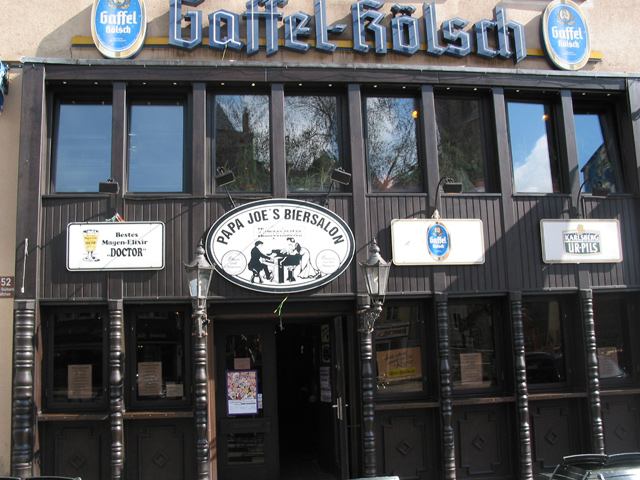
Some forms of pub going occur entirely outside of the confines of English culture, and one of these is to be found in Cologne, where Papa Joe’s Biersalon has become a local favourite.

The traditional of socialising and even group singing alongside strangers is much more common in Germany, and during the height of the evening, the singalongs in Papa Joe’s constitute a proto-form of kareoke, except instead of one person singing, most of the pub joins in.

To make matters weirder, the songs are ‘performed’ hourly by a mechanical marionette by the bar, the range of tunes being a remorseless cast list of traditional German favourites with the typical organ, harpsichord and accordion ensemble. You’ll be gawping at first, through the sheer  eccentricity of a setup that by now locals know like the back of their hand.

Sitting among the crowd, even if you aren’t joining in the singing (there is no obligation to) is to take in a heady experience of local life, a sample of German national expression even, if you want to take it further. The venue itself adds to all of this; is traditional in style but theatrical in shape with raised seating around the perimeter of the ‘pit’ area in front of the bar, and a corner stage to boot. With the bar’s history, it isn’t surprising the place is adorned with jazz instruments hanging from the beams and snippets of musical ephemera plastered to the walls. There’s plenty to look at.

This slideshow requires JavaScript.

Drinks are best procured from the bar area as table service can be a little slow at peak times. The local beer Gaffel Kolsch is on tap and delicious, at a standard price for the city centre, and while that ought to do you just fine, there are some decent other options these days too (if you fancy a hefeweizen for example).

The traditional seating and cosy interior is about the only aspect of the experience I can think of that was akin to English pub going. Everything else was rather quaint, quirky and shameless in its kitsch ‘old-time’ quality. Expect to see a huddle of young folk bombastically belting out the standards by the bar, while the middle aged folk sit further back, rocking their heads and crooning along.

If it’s not the mechanical instruments it’s live jazz music, bawdy poetry recitals and all other sorts of 1920s-era throwbacks to keep everyone entertained. Concerts are free and it’s always busy. Unsurprisingly, given its location in the heart of Cologne (you could run there from the front door of the Dom in a minute flat) Papa Joe’s has become an institution, creating an atmosphere you can’t just bottle or duplicate at will.

If you’re a little anxious about forced jollity I can certainly understand a degree of reticence, but you have to be there to understand. Even if you’re still wary, you’ll be pleased to note there is some respite in-between the shows, and you can hang out perfectly as you would elsewhere, just in a lovely and lively pub.

After visiting in 2007 I kept a grainy video on my phone of our time there, and over the next few years, generally spent penniless and occasionally depressed, I would occasionally pop that video on and remind myself of the good times spent in here to cheer me up. That phone and video has now gone, but the memory lives on strongly.

Since then I returned in 2018 and 2019 to find that, thankfully, hardly anything had changed.

It’s an essential place to drop by in Cologne, particularly as some of the brauhauses can tend to melt into one after a while. Papa Joe’s it offers something utterly different, strange, and yet pitted in the local tradition. Throw down a far jars of Gaffel Kolsch, gawp at the spectacle in front of you, and hey, even join in if you dare. After the festivities head around the corner to a kebab shop for a Turkisch pizza (making care to consume it before the alcohol wears off). Welcome to Cologne! In fact – welcome to Germany! This is the kind of pub you can justify a plane ticket for all on its own.

À la Mort Subite, Bruxelles

back to Belgium

alamortsubite
Rue Montagne aux Herbes Potagères 7, 1000 Bruxelles, Belgium

There is sometimes a premium to be paid on a special occasion, so on my annual visit to A La Mort Subite I breathe in deeply and dive more deeply still into my wallet, on account of the luxurious overall experience of visiting this splendid Bruxelles bar.

Distinctly Parisien in format, this opulent faded-grandeur art nouveau venue (translation: At The Sudden Death) is one of Brussels and Belgiums most famous bars, so no surprises or left-field picks from me this time. A la Mort Subite might count as a brown café for the bench seating up the sides of the long room, if it wasn’t for the lack of brown elsewhere. Cream walls and pillars, the elegant ornamental décor stacked with studded crenullations, mirror panels and a stately, out of time design. You have a venue somewhere in between a café and a salon, originally built as a place for socialites to be seen in, yet, being Belgian, still focused predominantly on beer. The décor has such an authentic and preserved quality (no change since 1928, save for the occasional running repair) so it’s difficult to think of too many other places that are alike.

Mort Subite supplies the draft beer, and this brewery serves fruit beers and lambic effect rather than the real wild yeast sour lambics McCoy. They are still rich in flavour and sweetness, and a tad sour, but lacking any sort of dryness and depth that might indicate the traditional lambic brewing process. A small serving of their kriek for example, which would be a good choice, will set you back five euros on its own. Some of the other options are fairly astronomical considering the price one can drink for elsewhere in excellent surroundings. Mort Subite beer may as well be drunk here as much as anywhere on the globe. With this being Brussels you can expect a small food menu with cheese, charcuterie options and the usual pub food like croque monsieur to help your beer go down (as if anyone should need help finishing a Belgian beer!)


This slideshow requires JavaScript.

The bar clearly feel they are unique to set such a high price, and annoyingly, they are right. An afternoon drink in A la Mort Subite can feel rather like a drink in a grand café, nice enough in itself, but the bar character starts to come alive in the early evening time as the crowd changes, and you can suddenly start to absorb some of the atmosphere and understand the underlying reasons for the endurance of this place. A special bleary eyed feel starts to develop, the sharp lines and corners blurring into the cream colours, like dropping into a dreamworld. That’ll also be the strong beer…

The grandeur and glamour of socialising in the inter-war era is yet to be recreated around Europe on any identifiable level, save for the odd outstanding example, partly because of the lack of venues who have committed to investing the kind of money to pull it off well, and also because the eventual crowd it attracts tend to have little to no appreciation of their surroundings anyway.

Service is almost classically continental, with wide stomached balding René type characters smoothly dissecting the venue with assurance and steady hands under the drinks trays. They are immaculately professional and patient considering conveyor belt of foreign tourists and the format of table service requiring more work than is strictly necessary. These characters add further to the sense of intransigent and reliability that lend a place a certain charm, that A la Mort Subite certainly possesses.

Although the evening and night crowd appeals to a few nostalgic locals who insist bars like these used to be abundant, a large volume tourists of venture in during the daytime, and because of the heritage of the place, often an aged crowd at that. The only sudden death that occurs in this bar is from pneumonia and cardiac arrest, I suspect.

Changing the venue in anyway seems to be verboten, and I wouldn’t approve major adjustments either ,however it seems to me there is nothing to stop the place rejigging the drinks choices and doing some marketing from the outside, as this venue is not designed for middle aged obese American sat in Burghaus jackets, it is designed for the young, the stylish and the vibrant. The way to really bring back the good old days isn’t just to leave the décor and service meticulously unchanged and hope for the best. The good old days were good because they were vital, vibrant and inhabited a nascent social scene. The place could do more in that regard by hosting more events, perhaps some understated live music, and so on.

In order for A La Mort Subite to take the next step, they need to be brave enough to recapture the zeitgeist in a way that doesn’t upset the period features, rather than settling for being a museum.

A La Mort Subite is a preserved remnant of a particular era and a great opportunity for anyone with a real passion in the rich and diverse history of socialising, beer drinking and recreational culture to step out of the every day experience and soak in the special character of the place. There are scarcely grander or more historical venues to recline and get merry with some astoundingly good beer. It may be so well known as to be passé, and it isn’t the pinnacle itself of pub going, but that doesn’t stop it being one of the best bars in Europe.

  • Quality and/or choice of drinks – 7/10
  • Style and Decor – 9/10
  • Character, Atmosphere and/or Local Life – 8/10
  • Amenities, Events & Community – 5/10
  • Value for Money – 4/10
  • The Pub-Going Factor –  8/10

Lórien, Palma di Mallorca

back to Spain
lorien
Carrer de les Caputxines, 5A, 07003 Palma, Illes Balears, Spain
In a city geared up for café culture, tapas, pintxos and wine, the pastime of drinking beer and pub-going currently plays a definite bit-part role in Palma. Going for a night out here generally revolves around visiting various tapas bars on an evening, which are often lively and buzzing but lacking any standout décor and character to distinguish themselves. Indeed, the crowds in those places, the endless snacking and paucity of good beer options become a drawback after a time.
Thankfully Lorien has stepped into the breach, a superb genuine beer pub with a Lord of The Rings theme. This whole notion hangs loosely around the frame of the pub though, think tasteful artwork, motifs and patterns rather than role play and costumes! It isn’t like The Prancing Pony either, although few places are.
The pub tailors itself for an audience who have been starved of choice and quality of beer, stocking a range of Spanish and Mallorcan craft ales on tap along with a healthy supply of beers from more traditional parts of the world. This will come as a refreshing change of speed from the relentlessly uniform options of Estrella or Mahou everywhere else in the city. You’ll be surprised at the length and breadth of the beer menu.
There is a corresponding uptick in price which is hardly surprising given the sheer lack of competition, but given the alternative option is standing around food-munching Mallorcans in corporate tapas bars, or drinking wine in inappropriately intimate cellar bars, it’s worth it.
Furthermore, Lorien succeeds by being a real pub. You will find corner bench seating arranged in a communal, inwardly facing main room – a pub, in essence – and unsurprisingly a rather different crowd of young people than the dress-to-impress crowd in the tapas bars, going for a drink and a chat in a cosy and informal setting.

This slideshow requires JavaScript.

The bar staff are almost textbook beer monsters: bald, big beards and big beer guts, and are more than happy to chew over your drinking options. You’ll find English is commonly spoken, as is often a big plus of craft beer places abroad when you’re trying to decipher what to drink, or just to have a friendly conversation.
However, this is more than just a venue for craft beer, there is a real effort made to engender a local drinking spot and community. Thankfully Lorien strikes the balance right between the studious beer contemplation and a friendly community.
Anyone frustrated by the other options and angling for a good beer and a communal pub in Palma must start by making a pilgrimage to Lorien, perhaps meeting your own Lady Galadriel along the way!
There are no two ways about it – if I lived in Palma, Lorien would be my local of choice.
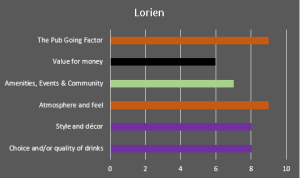
  • Quality and/or choice of drinks – 8/10
  • Style and Decor – 8/10
  • Character, Atmosphere and/or Local Life – 9/10
  • Amenities, Events & Community – 7/10
  • Value for Money – 6/10
  • F: The Pub-Going Factor –  9/10